
 Ishan Crawford
 The Scottish National Party’s national council passed a motion last Sunday to freeze all new data centres in Scotland and sent it to the Scottish government for consideration, according to a report by The Guardian. The move puts a key plank of the UK’s AI strategy on a collision course with devolved planning, energy constraints and a community campaign that has reached Holyrood.
At stake is whether Scotland becomes the UK’s hyperscale AI hub or the first part of Britain to slam the door on it. Twenty-four proposals for major new sites, if all approved, would consume up to 6,000MW of power, more than 1.5 times Scotland’s total peak power use now, according to the Scottish Greens. The Scottish government is now weighing whether to back a national pause, introduce planning guidance, or leave the 40 or so existing facilities and a small number of approved projects to keep building.
What the SNP Actually Voted For
The motion, passed at the SNP’s national council on Sunday and reported first by The Guardian, calls for a halt to new data centres and has been forwarded to ministers for consideration. The Scottish government has not committed to a moratorium. A party spokesperson told the Herald Scotland it is “currently reviewing what action can be taken to help balance the rapid expansion of such centres with our national energy and climate goals, including a potential pause on applications.”
First Minister John Swinney told MSPs in June that he was “giving active consideration” to introducing national planning guidance, and indicated that decisions on hyperscale sites could be taken at a national rather than local level. Two councils, Edinburgh and East Ayrshire, had already called for a moratorium before the SNP vote. The Scottish Parliament Information Centre (SPICe) concluded in a briefing last month that the pace of hyperscale data centre proposals had “outpaced national and local planning policy development in Scotland.”
A freeze, if imposed, would most likely apply to data centre projects that have not yet received planning permission, though the exact scope is for ministers to decide. The vote does not bind the government, and the wording leaves room for either a national pause or new national planning guidance that allows projects through on a case-by-case basis.
The Energy Math That Forced the Question
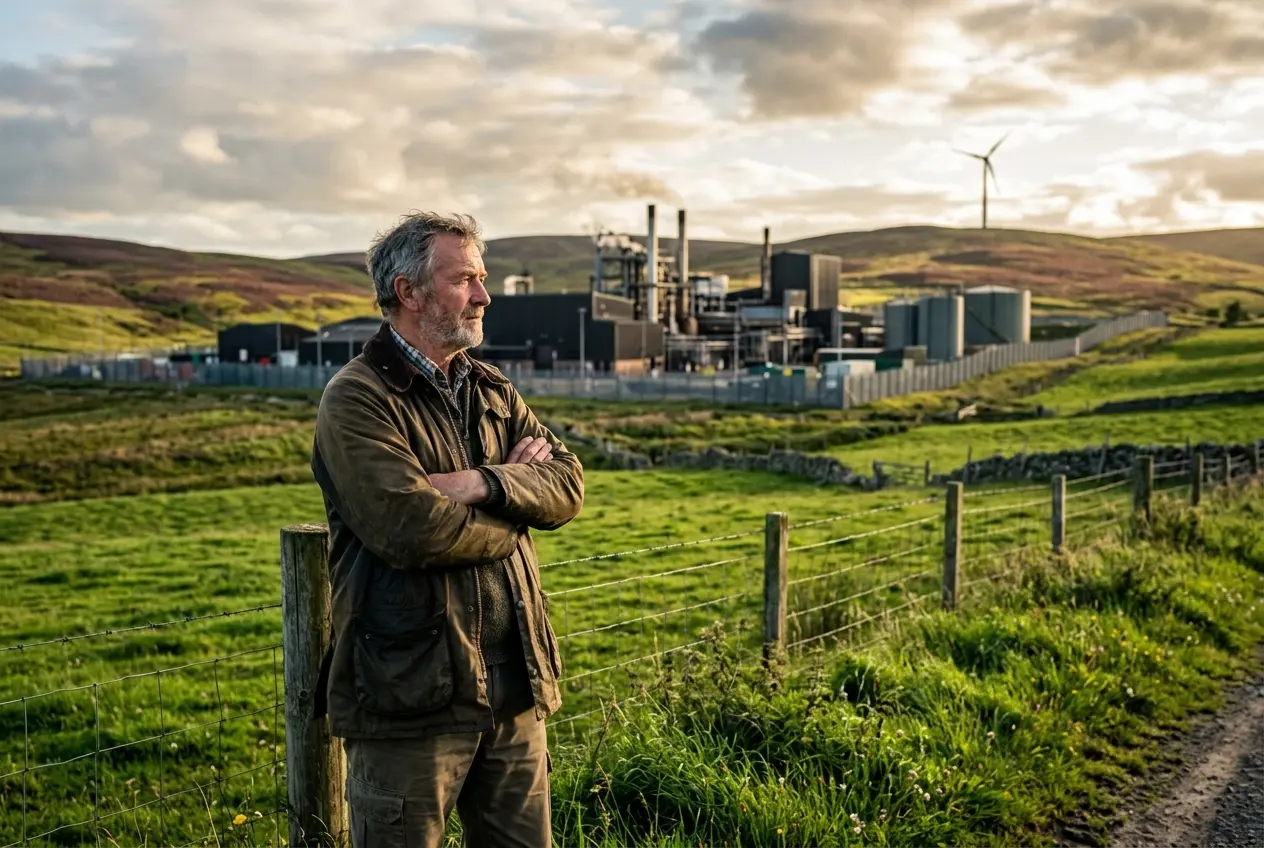
The 6,000MW figure is the wedge. Scotland generated 51.8TWh of electricity in 2024, of which 91.5% came from renewables, according to SPICe. The proposed Cato data centre at Auchtertool in Fife alone, covering 280,000 square metres and rising to 35 metres, would consume 7.7% of that total at full capacity, the same annual electricity as 1.6 million typical households. The Scottish Greens say six of the 24 hyperscale proposals currently in the pipeline have not undergone any environmental impact assessment at all, a position Ross Greer, the party’s co-leader, pressed on John Swinney at First Minister’s Questions in June.
Three London boroughs have already frozen house-building because of the strain data centres put on local grid connections, a precedent the Scottish Greens have pointed to directly. Oxford Economics, cited in the same SPICe briefing, forecasts that UK data centre electricity demand will grow more than fivefold by 2030 to 26.2TWh, or 8.8% of total UK electricity demand. The National Energy System Operator’s Strategic Spatial Energy Plan, which will set out where new grid capacity can and cannot go, is due in draft for consultation in early 2027 and in final form by the end of that year.
For the rural communities staring down the largest of these projects, the 6,000MW number is the entire argument. For the industry’s backers, it is the entire problem.
| Proposed site | Footprint | Energy demand | Scale reference |
|---|---|---|---|
| Cato, Auchtertool, Fife | 280,000 sq m | Up to 600MW | Almost 40 football pitches; up to 35m high (12-storey block) |
| Larbert campus, Forth Valley | 128,863 sq m plus 11,500 sq m substation | Not stated in SPICe briefing | Two data centre buildings, 25m high (28m with flues) |
| Rufus, Hurlford near Kilmarnock | Not stated in SPICe briefing | 540MW | Capped at maximum power draw of 540MW |
| Aggregate of 24 proposals in planning | Scotland-wide | Up to 6,000MW | More than 1.5x Scotland’s current peak power demand |
London’s Push Meets Edinburgh’s Planning Power
The freeze vote lands on top of a year of Westminster pressure to build faster. The UK classified data centres as critical national infrastructure last year, a change Chancellor of the Exchequer Rachel Reeves highlighted, and the Treasury has moved to relax planning and infrastructure rules to speed up approvals. From January 2026, large-scale data centre facilities became eligible to be treated as nationally significant infrastructure projects (NSIPs), a category that lets ministers bypass local councils.
The clearest example of that approach sits outside Scotland. Epping Forest district council was urged by Lord Stockwood, the UK’s Minister for Investment, to back a Microsoft and Nscale supercomputer site in a letter to the council’s chief executive described as highly unusual, according to The Telegraph and reported by Capacity. Nscale, valued at around $15 billion, is co-developing the Loughton site as part of a US$30 billion (£22 billion) Microsoft plan announced by Sir Keir Starmer during President Trump’s state visit in September 2025. The site, originally expected to be operational this year, has been delayed until 2027. A separate site in Kent was approved last week with local councillors bypassed. Prime Minister Sir Keir Starmer is now stepping down, and his successor will inherit the question of how aggressive that centralising instinct can be without provoking a devolved revolt.
The £44 Billion Counter-Argument
Business groups argue the cost of a freeze is measured in the largest sums of the debate. Sandy Begbie CBE, chief executive of Scottish Financial Enterprise, said a moratorium would “undermine economic growth and negatively impact investor sentiment towards Scotland,” and called it “an early test of whether ministers stand behind the government’s economic growth ambitions.” His warning was echoed by techUK, whose November 2024 report Foundations for the Future estimated data centres have the potential to contribute an additional £44 billion to the UK economy by 2035 and over 58,000 jobs between 2025 and 2035.
Whether that figure, drawn up before the SNP won this term, will still hold up if Scotland’s grid is locked out of hyperscale development is the live political question. The Local Government Association has tried to stake out a middle ground, saying in a statement that “data centres and AI infrastructure cannot be planned in isolation from wider digital connectivity, energy, water, land use and climate systems,” and that “councils must be treated as key partners in the design and delivery of national digital strategies.”
For now, the business argument has not stopped the political momentum behind a pause.
The adoption of a moratorium is a policy that would undermine economic growth and negatively impact investor sentiment towards Scotland. Data centres are a critical part of the national infrastructure of any high-performing economy.
Sandy Begbie CBE, chief executive of Scottish Financial Enterprise, responding to the SNP’s national council motion.
How the Community Fight Reached Holyrood
The Greens’ six-EIA finding is the line Scottish Green MSP Patrick Harvie has been pressing since the spring. “It is time to pause hyperscale data centre applications until councils have clear guidance, communities have certainty, and Scotland has a coherent national strategy to deal with them instead of a corporate free-for-all,” he said after the SNP vote. The party’s framing, that the scale of expansion “is mostly about enriching giant AI companies,” is now being echoed by community groups from Fife to East Ayrshire.
The campaign has been built outside Holyrood as much as inside it. Kat Jones, director of Action to Protect Rural Scotland (APRS), said: “It is thanks to the campaigns springing up in communities which have the threat of hyperscale AI data centres hanging over them, that the issue is now so much in the public eye and that MSPs and Councillors are really starting to take notice.” The country’s last national planning update, completed in 2022, predated the launch of ChatGPT, and APRS says there is now over 6,000MW of data centre energy demand currently in the planning system, with an additional 11,000MW in pre-application consultation, an order of magnitude the existing framework was never designed to handle.
What Could Still Change Before the Summer Recess
The next decision points are short and visible.
- The Scottish government is due to respond formally to the national council motion, with a “potential pause on applications” on the table but not yet policy.
- First Minister Swinney has committed to returning to Parliament with a statement on national planning guidance for hyperscale data centres, a debate that was deferred before the summer recess.
- The National Energy System Operator’s draft Strategic Spatial Energy Plan, due in early 2027, will set the grid-side ceiling on what is buildable where.
- Westminster is expected to push more large data centre schemes into the NSIP pipeline, sharpening the devolved-vs-central tension.
- The UK will get a new prime minister after Sir Keir Starmer steps down, with the data centre file landing on an untested desk.
Swinney has framed the choice as one between economic growth and climate commitments, and said Parliament should have a wider debate about where these decisions are made. Begbie, for his part, has said the test is whether ministers back the growth mandate the SNP was elected on two months ago. The £44 billion number and the 6,000MW number are both, in their own terms, correct. The argument is over which one Scotland’s planning system should be built to absorb.
Frequently Asked Questions
How many data centres are already operating in Scotland?
Scotland is currently host to nearly 40 operational colocation and enterprise data centre facilities, with major providers DataVita and Pulsant offering Tier III certified capacity. The new motion targets new sites, not the existing estate.
What would the 6,000MW figure actually power?
Scotland’s current peak power demand is just over 4,000MW in winter, according to NESO data cited by APRS. The 24 proposed hyperscale sites, taken together, would need up to 1.5 times that amount at full draw. The proposed Cato data centre at Auchtertool alone would consume as much electricity as 1.6 million typical households in a year.
What powers does the Scottish government have over data centres?
Planning is devolved, so the Scottish government controls the framework for new data centre applications and can issue national planning guidance. From January 2026, large-scale data centre facilities in England and Wales became eligible to be treated as nationally significant infrastructure projects, a route that lets UK ministers bypass local councils. That NSIP route does not exist in Scotland in the same form.
How does a Scottish freeze fit with the UK’s wider AI plan?
It cuts across it. The UK has classified data centres as critical national infrastructure and is leaning on NSIP consenting to push approvals through, including the Microsoft and Nscale supercomputer site in Essex, part of a US$30 billion (£22 billion) plan announced during President Trump’s state visit in September 2025. A Scottish freeze would not stop those English projects, but it would redirect hyperscale investment south of the border.
When could a decision come?
Ministers are reviewing what action can be taken, with a potential pause on applications one option. First Minister John Swinney has indicated he is “giving active consideration” to national planning guidance and that decisions on hyperscale sites could be taken at a national level, with a statement to Parliament expected before the summer recess.
 moto g77 POWER Launches in India at Rs 23,999 With 7,000mAh Battery
  Beats Power Pink Woven Cables: Specs, Price, and Color Match Play
  Redmi Note 17 Series Confirmed for July 14 China Launch
  Meta’s Glasses Update Guards the Camera, Not the Bystander
  India’s Retail GCC Hub Now Outscales Five Peers Combined
  Dundee to Host First Scotland StreetCar Festival Alongside Eco Rally