
 Ishan Crawford
 Samsung will stand on a stage in London this Wednesday, July 22, and rename a phone it has sold under one badge for seven straight years. Three days out, the more consequential move already happened quietly on a production line in Vietnam, where Samsung Display started building screens for Apple’s rival foldable months ago.
That’s the split at the center of this year’s foldable phone story. Samsung Electronics is publicly reshuffling the Galaxy Z Fold lineup to blunt Apple’s rumored entry into the category. Samsung Display, a separate arm of the same corporate group, is already under contract to build the folding OLED panel inside that Apple phone, whichever name it ends up wearing.
Samsung Splits Its Flagship Into Two Names
For seven generations, ‘Galaxy Z Fold’ meant one shape: a tall, narrow phone that opens into a roughly square tablet. That’s changing on July 22. Leaks and FCC filings now point to Samsung launching three foldables at once, and the naming has scrambled in the process.
The familiar tall design, the one that has carried the Fold name since 2019, is being pushed into a new tier called the Galaxy Z Fold 8 Ultra. Meanwhile the plain Galaxy Z Fold 8 name is going to an entirely new device, the shorter and wider design that leakers had been calling the ‘Wide’ for months. A Galaxy Z Flip 8 rounds out the trio.
Pricing leaks put the Z Fold 8 Ultra’s base 256GB model near $1,999, with the wider Z Fold 8 starting a few hundred dollars lower. A global DRAM shortage is squeezing the top end hardest, and the highest-capacity 1TB configuration has reportedly climbed above $2,700. Samsung hasn’t confirmed a single price. The same event is expected to bring price increases elsewhere in Samsung’s hardware lineup too, following new chips and higher prices across the Watch9 line.
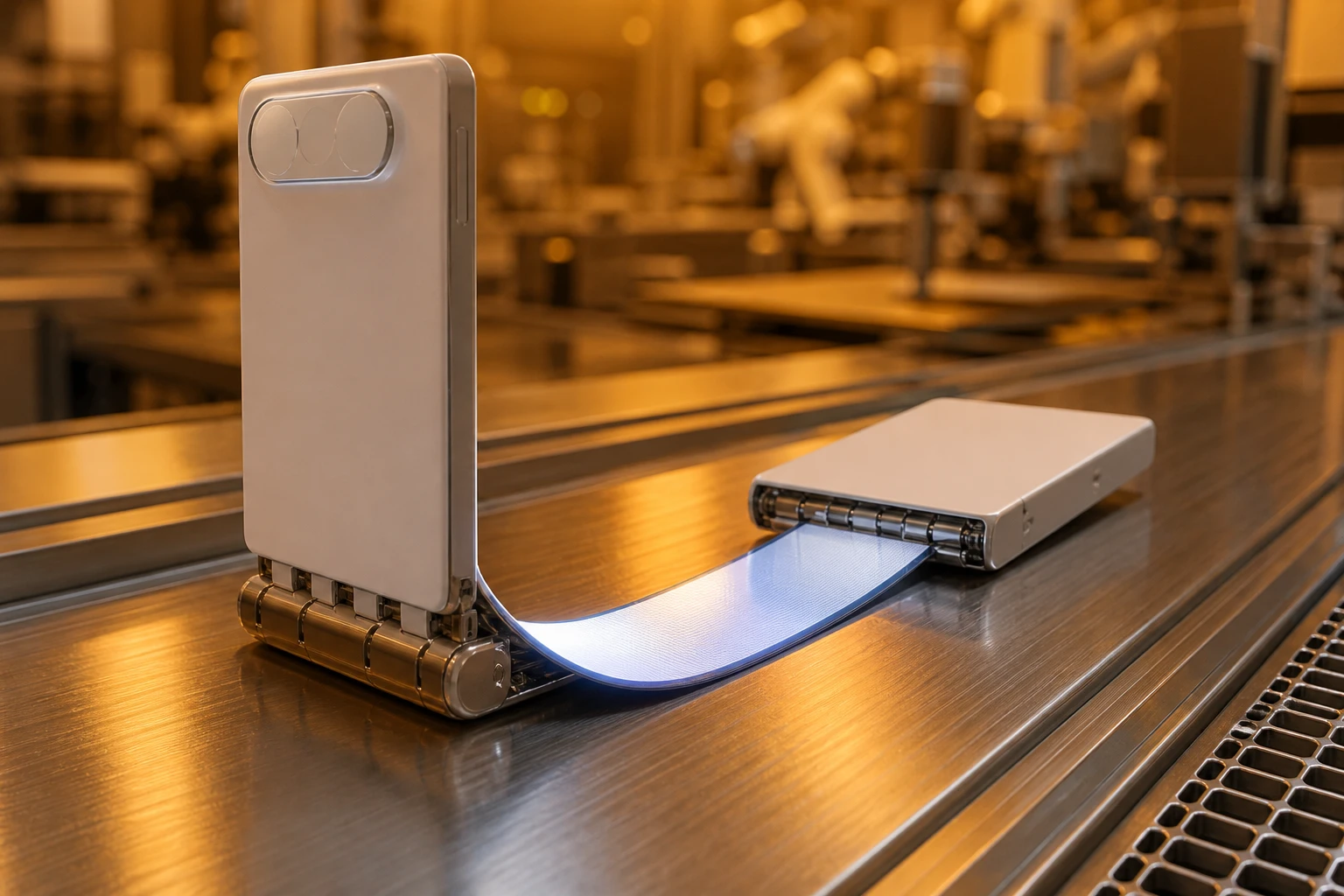
Why Are Foldables Suddenly Getting Wider?
Because the tall, narrow shape that defined book-style foldables for a decade has a video problem. Open one flat and its display is nearly square, which means black bars above and below every widescreen show or game. A shorter, wider panel fixes that by opening into something closer to a 4:3 tablet, the shape Apple is expected to use for its own foldable.
Apple’s rumored device, referred to alternately as the iPhone Fold and the iPhone Ultra, is tipped to carry a 5.5-inch cover screen and a 7.8-inch main display when unfolded, both shorter and wider than any foldable Samsung or Google currently sells. Samsung’s new Z Fold 8 is chasing the same proportions. Google, notably, is not.
Bigger, wider canvases only matter if software catches up. Samsung has already been laying groundwork on that front through smaller updates, including a multi-finger gesture update for jumping between split-screen apps, the kind of feature that only pays off once the display is wide enough to hold two full apps side by side.
| Device | Maker | Body Style | Rumored Starting Price | Expected Launch |
|---|---|---|---|---|
| Galaxy Z Fold 8 Ultra | Samsung | Tall book fold, replaces Fold 7 | ~$1,999 (256GB) | July 22, 2026 |
| Galaxy Z Fold 8 | Samsung | Short, wide fold (formerly ‘Wide’) | ~$1,800 (256GB) | July 22, 2026 |
| iPhone Fold / iPhone Ultra | Apple | Short, wide fold, 5.5in / 7.8in screens | ~$2,400 average price | Expected September 2026 |
| Pixel 11 Pro Fold | Standard tall book fold, unchanged | Not yet disclosed | August 12, 2026 |
Every price in that table is a leak or an analyst estimate. None of the three companies has confirmed a number, and Apple hasn’t confirmed the device exists at all.
The Screen Inside Both Rivals Comes From One Factory
Here is the part that gets lost in all the naming drama. According to a three-year exclusive supply agreement reported by the Korean outlet The Elec, Samsung Display will be the sole manufacturer of the folding OLED panel inside Apple’s foldable iPhone. Apple reportedly accepted exclusivity because neither of its other panel partners could deliver: LG Display has no track record making foldable phone screens, and BOE’s panels, the ones Huawei uses, are considered short of Apple’s durability and yield standards.
The deal locks Samsung out of using any other foldable screen supplier for Apple’s phone for three years, an exclusivity window rivals aren’t expected to crack until around 2029. Samsung Display began operating back-end production lines in Vietnam to fill an initial order of roughly 3 million panels this year, using the same CoE panel technology already found in recent iPhone models.
So Samsung Electronics’ phone division is racing to beat a competitor whose screens are being built by Samsung’s own display division. Win or lose the naming war, Samsung profits from the sale.
Panel Orders Reveal Who Profits Either Way
The scale of that arrangement shows up clearly in the industry’s own numbers.
- 27.5 million foldable display panels are projected to ship worldwide in 2026, according to Counterpoint’s forecast of a 24% rebound in panel shipments this year.
- 31%, 29% and 24% are Samsung’s, Apple’s and Huawei’s respective shares of those 2026 panel orders, per the same research, with Apple stepping straight into second place in its debut year.
- 22% versus 45% was Samsung Display’s manufacturing share of the whole foldable panel market in the first quarter, still trailing China’s BOE, a gap set to close once Apple’s order ramps up in the back half of the year.
- $4.4 billion is the projected 2026 revenue for foldable panel makers, up 48% year over year, with Apple’s entry named as a central driver of that jump.
Separately, IDC forecasts the finished foldable phone market growing 30% this year, up from 20.6 million devices shipped in 2025. IDC expects Apple to capture over 22% of unit sales and 34% of the category’s revenue in its first year, at an average price near $2,400. Add Apple’s panel order to whatever share of Samsung Electronics’ own order Samsung Display fills internally, and the display maker ends up supplying more of the finished foldable market than any other single manufacturer, including the outside rival it’s racing against.
Google Sits Out the Redesign
Not every foldable maker is chasing the new shape. Google’s Pixel 11 Pro Fold, due August 12, is expected to keep its current proportions: a regular-size phone when closed, a squarer tablet screen when open. No wide redesign, no rebrand.
That leaves Google as the control group in this experiment, still betting on the design every foldable maker used until this year. Counterpoint Research expects the shift toward Apple to hit hardest in North America, where brand loyalty runs deep.
As some Android users considering book-type foldables evaluate Apple’s upcoming device as an alternative, Apple’s expected entry is expected to place additional competitive pressure on existing Android OEMs such as Samsung, Motorola and Google in North America.
Gerrit Schneemann, principal analyst at Counterpoint Research, made that call as the firm’s broader 2026 forecast projected Apple capturing 46% of the North American foldable market in its first year, with the category’s average selling price climbing from $1,255 to $1,485 industry-wide.
Apple’s Shipment Math Hints at Caution
Apple’s own ordering pattern tells a more careful story than the hype around it. Early supply-chain expectations had pointed to roughly 10 million foldable iPhone units this year. The actual order Samsung Display is filling covers about 3 million.
A few things could still complicate this shift.
- Apple’s caution echoes its own Vision Pro launch, where a $3,499 price tag met weak demand, a precedent suppliers are watching closely for the foldable.
- The DRAM shortage driving up Samsung’s pricing isn’t going away soon, and it’s expected to affect Apple’s component costs too.
- App developers still have to adapt layouts built for tall screens to a wider, near-square canvas most software was never designed around.
- Samsung’s own rename risks confusing buyers who’ve spent years learning that ‘Ultra’ means the newest and best, not the older shape being phased toward a legacy tier.
Reports on Apple’s timeline still disagree. Nikkei Asia has reported engineering test delays that could push the launch past its original window, while Bloomberg has reported Apple is still targeting a release around September. Neither company has said anything official.
Frequently Asked Questions
Is Apple’s foldable phone called the iPhone Fold or the iPhone Ultra?
Neither name is confirmed. Apple hasn’t announced the device at all, and leaks split roughly evenly between ‘iPhone Fold’ and ‘iPhone Ultra,’ with some outlets using both interchangeably until Apple’s expected September event settles it.
Why is Samsung holding Unpacked in London this year?
Samsung’s Unpacked events have moved yearly, from Seoul in 2023 to Paris in 2024 to Brooklyn in 2025, and London marks the first UK stop, positioning the launch in one of Apple’s strongest European markets ahead of its own foldable debut.
Will the Galaxy Z Fold 8 Ultra come with an S Pen?
Leaks disagree. Some reports describe S Pen support as locked to the Ultra tier, while a widely followed display leaker known as Ice Universe said in May that neither 2026 Fold model would support the stylus at all.
Is Samsung launching a cheaper foldable this year?
No evidence points that way. There’s no sign of a budget Fan Edition Fold in regulatory filings or test servers for 2026, suggesting Samsung is concentrating entirely on its three premium foldables this cycle.
Does either company’s foldable finally get rid of the crease?
Samsung showed a crease-free foldable display at CES in January, though it remains unclear whether that panel is destined for the Z Fold 8 Ultra or held back for a future device, since some industry watchers believe the most advanced version may be reserved for Apple’s screen instead.
 ONGC licence frees Venezuela cash and operatorship talks
  Anthropic Hits $65 Billion Run Rate and Flips the AI Cash Test
  Supreme Court grounds the fare free-for-all with three-week clock
  Gold Nears $4400 as Soft Data Meets Oil Inflation Risk
  Nifty Slips as Zaggle Circuits and Dhoot Debuts Big
  Diesel Crack Tops $100 as Iran Rhetoric Lifts Crude