
 Ishan Crawford
 Paris Saint-Germain defend their Champions League crown against Arsenal at the Puskas Arena in Budapest on Saturday, the first final since 2018 to feature the reigning champions. PSG go in as favourites; Arsenal, runners-up once in 2006, are chasing a first European title in the club’s history. Kickoff is 18:00 local time at the home of Hungarian football’s most famous name.
There is a catch buried in the favourite’s tag. In the 34 years since the European Cup became the Champions League under UEFA (Union of European Football Associations, the sport’s governing body in Europe), only one club has managed to win it two seasons running.
The Holder’s Curse PSG Must Break
That one club is Real Madrid, who took three in a row between 2016 and 2018. Every other holder since 1992 has gone out the following season, often early, sometimes humiliatingly. The competition’s expanded format, the grind of a longer league phase, and the simple fact that everyone raises their game against the champions all conspire against a repeat. PSG know the weight of it, because they are the team carrying the target this time.
Their case for beating the trend is strong. Luis Enrique, the PSG head coach who won the treble at Barcelona, has built a side that humbled Inter Milan 5-0 in last year’s final, the most one-sided finish the showpiece has produced. Domestically they barely broke stride, lifting a 14th Ligue 1 crown and a fifth in succession. On paper this is the deepest, youngest, most balanced squad PSG have ever assembled.
The numbers behind the challenge tell their own story, and they are not kind to holders.
- 1 club has retained the trophy since the 1992 rebrand: Real Madrid, 2016 to 2018.
- 5-0 was PSG’s winning margin over Inter Milan in last season’s final.
- 2006 is the only previous year Arsenal have reached this stage, losing to Barcelona in Paris.
You can read the full 2026 Champions League final line-up and venue details on UEFA’s own pages.
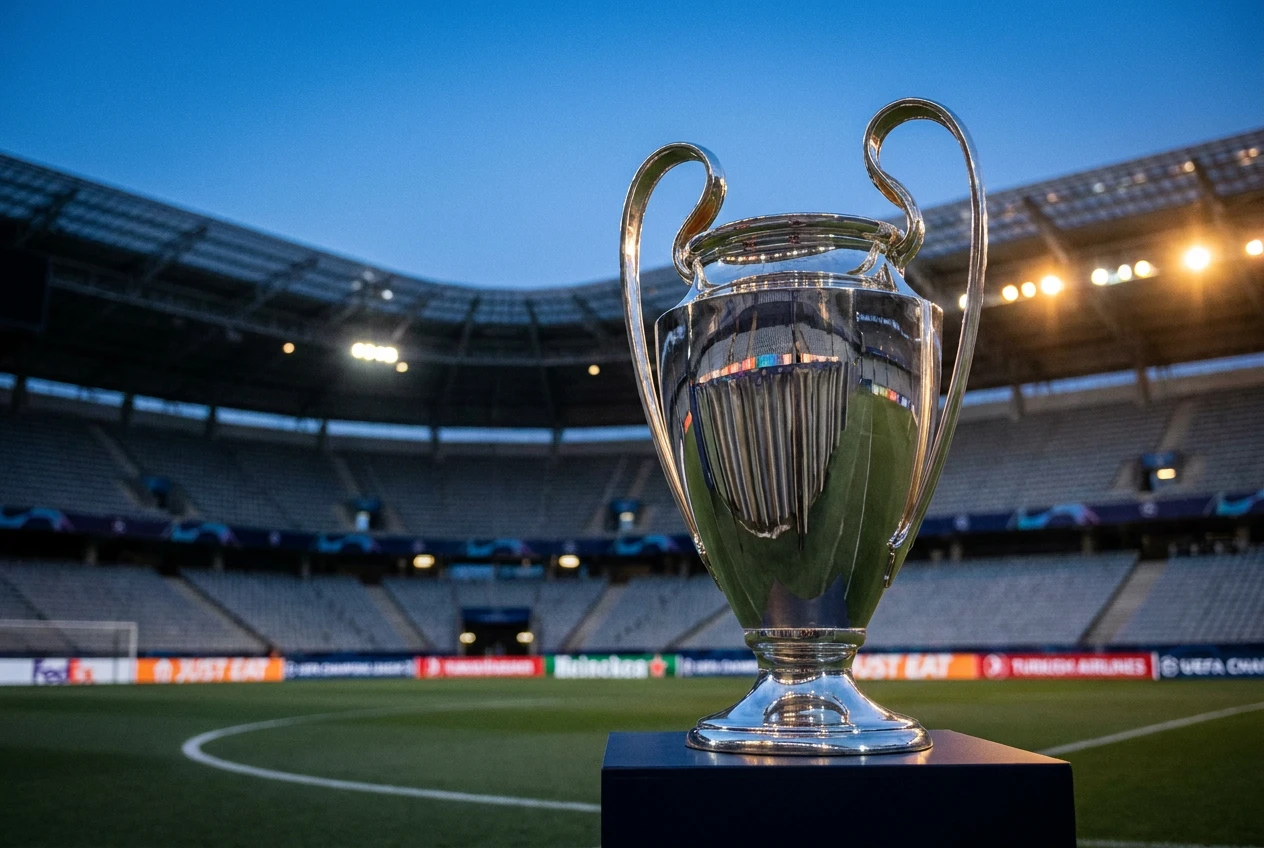
Two Paths to the Puskas Arena
Both finalists arrived in Budapest off the back of standout domestic campaigns and tough European semifinals. PSG saw off Bayern Munich in the last four. Arsenal knocked out Atletico Madrid, with Bukayo Saka the match-winner who finally settled a tight tie.
The contrast in pedigree is the sharpest part of this fixture, and the table below lays it out.
| Measure | Paris Saint-Germain | Arsenal |
|---|---|---|
| Domestic title | 14th Ligue 1 crown, fifth in a row | First English league title since 2004 |
| Semifinal win | Bayern Munich | Atletico Madrid |
| European Cup record | Champions, won 2025 | Runners-up 2006, never won |
| Top scorer this season | Khvicha Kvaratskhelia | Viktor Gyokeres, 19 in all competitions |
For the head-to-head build-up and confirmed details, UEFA’s Paris and Arsenal final fixture page is the primary reference.
The Parisians Lean on Dembele and Doue
PSG’s threat starts with movement and pace rather than a single talisman. Desire Doue, still only 19, scored twice in last year’s final and has carried that form into this campaign with 12 goals. Ousmane Dembele, the France forward and reigning Ballon d’Or winner, has 18 and remains the man defenders fear most when he drifts inside off the right.
The worry for Luis Enrique is fitness. Dembele is an injury doubt for the final, and his availability may shape the entire game plan. Achraf Hakimi, the marauding Morocco right-back who scored in the 2025 final, is the bigger concern, having missed both semifinal legs and the closing stretch of the league season.
Behind them, Bradley Barcola has chipped in 13 goals and Kvaratskhelia tops the internal charts, giving Luis Enrique attacking options even if his stars are short of full sharpness. Marquinhos, the Brazil centre-back, captains a defence that conceded little on the way to Budapest.
If the front line clicks, PSG can blow almost anyone away. If Dembele and Hakimi are missing or muted, the margin between these two teams narrows fast.
Arsenal’s First Shot at the European Crown
Arsenal have waited their whole existence for a night like this. The 2006 defeat to Barcelona is the closest they have come, and the squad Mikel Arteta has assembled looks better equipped than that one ever was.
Gyokeres Leads a Reinvented Front Line
Viktor Gyokeres, the Sweden striker signed to fix Arsenal’s long-running goal problem, has answered with 19 goals in his debut season. He gives Arteta something the club lacked for years: a centre-forward who stretches defences and finishes the chances the team’s creators manufacture.
Around him, Saka and Eberechi Eze provide the spark. Saka has 10 goals and the knack of producing in the biggest matches, while Eze, the England playmaker, has added seven and a layer of unpredictability between the lines.
Rice Anchors the Engine Room
Declan Rice is the heartbeat. The England midfielder controls tempo, breaks up play, and has grown into one of Europe’s most complete number eights. Gabriel Magalhaes, the Brazil defender, leads a back line that has been Arsenal’s foundation all season.
The Gunners reach this final on the back of a first league title since Arsene Wenger’s unbeaten Invincibles of 2004, a 22-year wait that finally ended this spring. The momentum is real, and so is the belief. Arsenal’s pre-final team news from the club’s official channel covers the latest availability.
Where the Budapest Final Tilts
The contest may come down to whether Arsenal’s structure can smother PSG’s pace before it gets going. Arteta’s side defend in tight blocks and counter with directness; PSG want space to run into. Win the midfield battle, where Rice meets PSG’s young runners, and you likely win the night.
Set pieces could prove decisive too. Arsenal have scored a heavy share of their goals from dead balls this season, an area where Gabriel and Gyokeres are genuine aerial threats against a PSG defence that, for all its quality, can be got at in the air.
If PSG’s stars are fit and firing, history will probably bend to their talent and they become only the second club to defend the trophy. If Dembele and Hakimi are anything less than full strength, Arsenal have the platform to write the night they have chased for two decades.
Kickoff Time, Venue and How To Follow
The final is staged at the Puskas Arena, named after Ferenc Puskas and rebuilt as Hungary’s national stadium, with construction finished in 2019. It seats 67,215, and this is the first time Hungary has hosted the men’s final.
Here are the essentials for following the match.
- Date and kickoff: Saturday 30 May, 18:00 CEST (Central European Summer Time), which is 17:00 BST (British Summer Time) in the UK.
- Referee: Daniel Siebert of Germany takes charge.
- Opening ceremony: American rock band The Killers headline the pre-match show, with pianist Adam Gyorgy performing the competition anthem.
- Watching it: the match sits behind a paid subscription package worldwide; it is not free to air.
Supporters heading to Hungary can find ticketing details for the Budapest final through Arsenal’s official site.
Frequently Asked Questions
When is the Champions League final and what time does it kick off?
The final is on Saturday 30 May, with kickoff at 18:00 CEST in Budapest, which translates to 17:00 BST for viewers in the United Kingdom.
Where is the 2026 final being played?
It is at the Puskas Arena in Budapest, capacity 67,215. This is the first time Hungary has hosted the men’s Champions League final.
Are PSG the defending champions?
Yes. Paris Saint-Germain won their first European Cup last season, beating Inter Milan 5-0, the heaviest winning margin in a final.
Has Arsenal ever won the Champions League?
No. Arsenal’s only previous final was in 2006, when they lost to Barcelona. A win in Budapest would be the club’s first European Cup.
Is the final free to watch?
No. UEFA sells broadcast rights as part of subscription packages, so coverage sits behind a paywall in almost every market.
 How Vela Satellites Caught Gamma-Ray Bursts Nobody Hid
  Moon Phase Today: May 29 Climbs to a Shrinking Blue Moon
  Scientists Map the Waves Shaking 16% of Antarctic Sea Ice
  Skip Sunday: The Blue Moon’s Best View Is Saturday at Dusk
  Antarctica’s Ancient Ice Tipping Point Is Misread as Today’s Alarm
  Ocean Census Logs 1,121 New Species, Races a 13.5-Year Lag