
 Ishan Crawford
 Antarctica’s ice sheet crossed a hidden threshold roughly a million years ago, and a new study in the journal Nature Geoscience argues the consequences of that switch still shape how the continent will react to a warming planet. South Korean researchers found that once atmospheric carbon dioxide fell below about 240 parts per million (ppm, a measure of how much CO2 sits in the air), Antarctic ice began responding far more violently to small shifts in ocean and air temperature.
That figure is moving fast through headlines as a fresh alarm bell. Slow down before reading it as one. Today’s atmosphere holds roughly 430 parts per million, almost double the level the study flags, so 240 ppm is not a boundary the planet is about to breach. What should worry readers is something subtler in the research: evidence that Antarctica can flip between a steady mode and a jumpy one, which makes its behaviour harder to forecast than any single number suggests.
What the Pusan Team Measured
The work comes from the IBS Center for Climate Physics (ICCP, a climate research unit run by South Korea’s Institute for Basic Science) at Pusan National University. Lead author Kyung-Sook Yun and her colleagues set out to solve a long-standing puzzle about the Mid-Pleistocene Transition, the period roughly a million years ago when Earth’s ice ages stretched longer, turned colder and grew more intense.
Before that shift, their reconstruction shows, the Antarctic ice sheet changed size slowly and predictably as the climate wobbled. After it, the ice entered a different mode of behaviour. Below the carbon dioxide threshold the team identified, the swings in ice volume suddenly grew much larger for the same nudge in temperature. The researchers describe this as a nonlinear regime shift, meaning the system stopped reacting in proportion to what was done to it.
The headline numbers from the analysis sit close together and tell the core story on their own:
- 240 ppm of CO2 is the level below which Antarctic ice variations sharpened, according to the Nature Geoscience study on Antarctic ice sensitivity.
- 1 million years ago is roughly when the Mid-Pleistocene Transition reorganised the planet’s ice age rhythm.
- Ice ages lengthened from cycles of about 40,000 years to roughly 100,000 years across that transition.
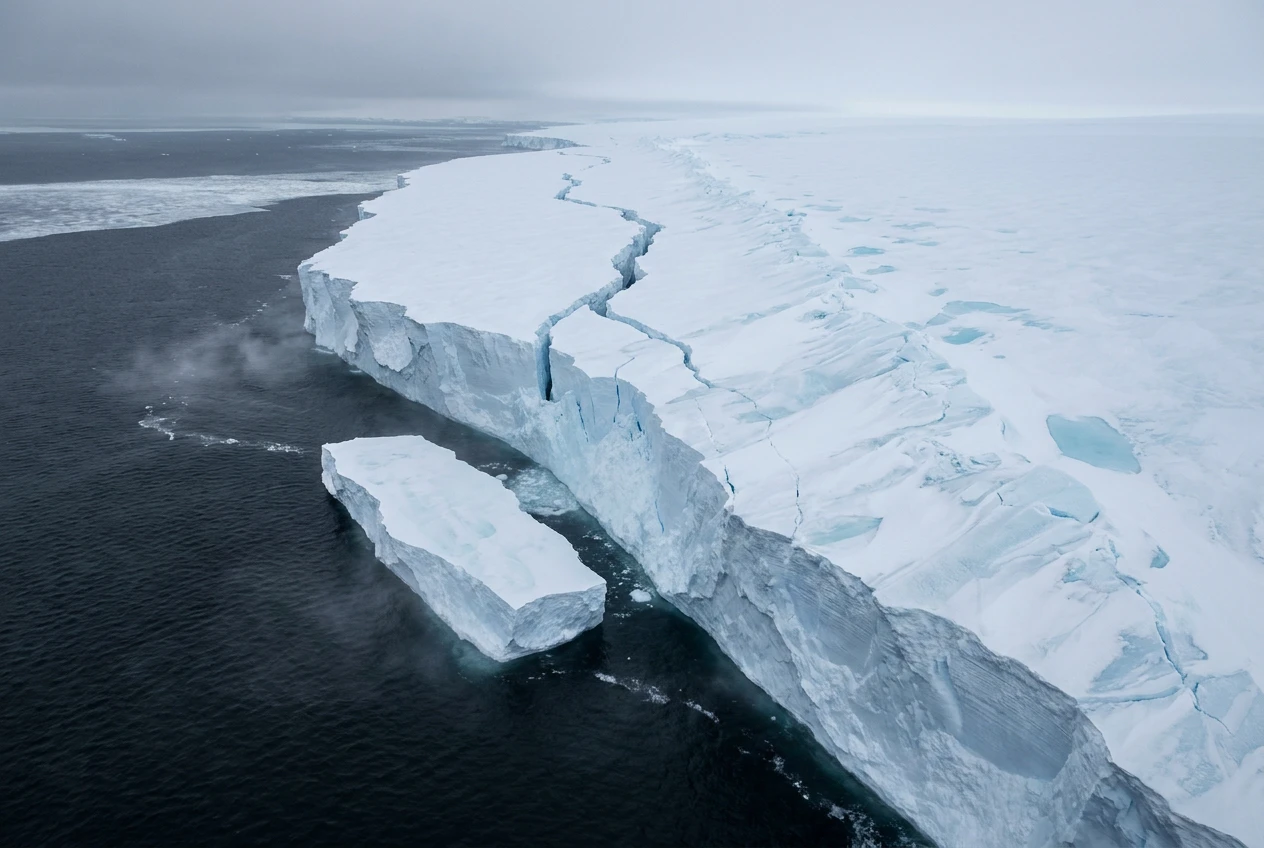
Why 240 Parts per Million Is Not a Countdown Clock
Here is the part the quick rewrites skip. The 240 ppm threshold belongs to a cold, glacial world, and it marks the point at which falling CO2 let ice grow explosively rather than melt. Earth was heading down, toward more ice, when that line mattered. We are heading the other way.
Carbon dioxide today sits at roughly 430 parts per million, far above the ancient threshold and climbing. The seasonal peak first topped 430 ppm in 2025, and the annual average for 2026 is forecast near 429 ppm by NOAA. So the study is not telling us a dangerous switch is a few decades out at 240. It is telling us the ice sheet has shown, in the geological record, that it owns a switch at all.
| Setting | Glacial world (the study) | Today (2026) |
|---|---|---|
| CO2 level | Falling below ~240 ppm | ~430 ppm and rising |
| Direction of change | Cooling, ice building | Warming, ice losing mass |
| What the threshold did | Unlocked rapid ice growth | Not a level we are near |
| Lesson that carries over | Response was nonlinear | Sensitivity can switch states |
The numbers come from NOAA’s atmospheric carbon dioxide record, the federal monitoring effort that has tracked the gas since the late 1950s.
How Antarctica Flips Into a Touchier Mode
The study does not leave the regime shift as a black box. It ties the new sensitivity to three physical processes that reinforced one another once the climate turned colder and the seas dropped.
- Colder oceans starved the melt. Chilly glacial water reduced melting on the underside of floating ice shelves, the seaward tongues that hold back ice on land. Less melt there meant the grounded ice behind could thicken and advance.
- Lower seas eased the load. With global sea levels sitting 50 to 100 metres below today’s, less ocean weight pressed on the continental shelf, letting coastal ice push outward onto newly exposed ground.
- The bedrock beneath rebounded. As pressure eased, the land under the ice lifted, raising the base and helping thick coastal ice anchor itself rather than float free and break away.
Stacked together, these effects let the ice sheet store far more volume during cold spells and shed it faster when warmth returned. That is the mechanical heart of why the swings got bigger after the transition, and why a system that once drifted began to lurch.
The Three-Million-Year Simulation Behind the Claim
This is a modelling result, not a measurement pulled from a single ice core, so how the team built it matters for how much weight it carries. The researchers ran a detailed paleoclimate simulation reconstructing Earth’s climate across the last three million years, then fed it into an advanced ice-sheet model developed at Pennsylvania State University.
That ice model resolves both the Northern Hemisphere sheets and the Antarctic system, including the dynamics of the Ross and Weddell Sea ice shelves. The combined run demanded serious computing muscle and was carried out on one of South Korea’s fastest supercomputers dedicated to climate science, operated through the IBS Center for Climate Physics.
The strength of the approach is its length. Three million years captures many full ice age cycles, so the team could watch the system’s response change rather than infer it from a snapshot. The caution is that paleoclimate forcing arrived slowly, over tens of thousands of years, while the carbon being added today is arriving in roughly two centuries.
That gap matters. The ancient world tells us the switch exists and what flips it, but it cannot tell us exactly how a fast push will land. The mechanism is real; the timing under modern speeds is the open question.
What Nonlinearity Does to Sea-Level Forecasts
Antarctica holds the largest mass of ice on Earth and ranks among the biggest drivers of global sea-level rise, so the way its ice responds is not an academic detail. Most public forecasts still picture a sheet that loses mass at a fairly steady, projectable pace. A regime that can switch into heightened sensitivity widens the range of plausible outcomes, especially at the high end.
That is the genuine warning buried under the million-year framing: the ice sheet has more than one personality, and the calm one is not guaranteed to last as forcing grows. The study’s senior author put the implication plainly.
Our findings suggest that the Antarctic ice sheet was more sensitive to external forcings than previously assumed. This also raises important questions about its future response to global warming.
That was Axel Timmermann, director of the IBS Center for Climate Physics and a co-author of the paper. The point is not that 240 ppm is coming back. It is that a system capable of past regime shifts deserves to be modelled as one that could shift again, against the background of CO2 levels charted by the Keeling Curve measurements at Mauna Loa.
The Limits That Still Frame the Warning
One study does not rewrite sea-level science, and the authors do not claim it does. The result needs to be tested against other ice models and reconciled with field evidence from sediment and rock. Work like this also feeds a wider public conversation about climate research, the kind that projects such as Scotland’s new climate science podcast are built to carry beyond the journals.
What stands, for now, is the shape of the lesson rather than a date. If future models confirm that Antarctica carries a hidden gear it can drop into, the high-end sea-level scenarios that planners treat as unlikely start to look less like outliers. If they do not, the million-year switch stays an artefact of a colder world, and the steadier forecasts hold.
Sources:
 ONGC licence frees Venezuela cash and operatorship talks
  Anthropic Hits $65 Billion Run Rate and Flips the AI Cash Test
  Supreme Court grounds the fare free-for-all with three-week clock
  Gold Nears $4400 as Soft Data Meets Oil Inflation Risk
  Nifty Slips as Zaggle Circuits and Dhoot Debuts Big
  Diesel Crack Tops $100 as Iran Rhetoric Lifts Crude