
 Ishan Crawford
 Researchers from the University of Leicester and the University of Aberdeen have just finished field demonstrations in Portsoy Scotland of handheld spectrometers built for astronauts on the Moon. The PHOENIX instruments let suited explorers identify rocks, minerals and signs of past water on the spot instead of waiting for samples to reach Earth labs.
The work sits inside ESA’s wider push to turn astronauts into working field geologists. It drew little fanfare beyond university channels, yet the quiet coastal tests mark real progress on tools that could reshape how crews scout resources during the next human landings.
The Two Breadboards Astronauts Can Hold
PHOENIX produced two TRL4 breadboard devices under ESA’s ExPeRT and CAVES & PANGAEA programmes. Both are sized and shaped for spacesuit gloves. Partners include INTA in Spain, Mission Control in Canada and the University of Valladolid.
Mission Control adapted its Spacefarer software so the tools can run under astronaut or Earth-based control. The design goal is rapid characterisation of geological features during short surface traverses.
- BB1 pairs Raman spectroscopy with Laser-Induced Breakdown Spectroscopy (LIBS).
- BB2 pairs Raman with X-Ray Fluorescence (XRF) imaging.
- Both add visual context cameras for documentation.
The same teams aim for non-destructive readings that finish fast enough to keep an EVA schedule moving.
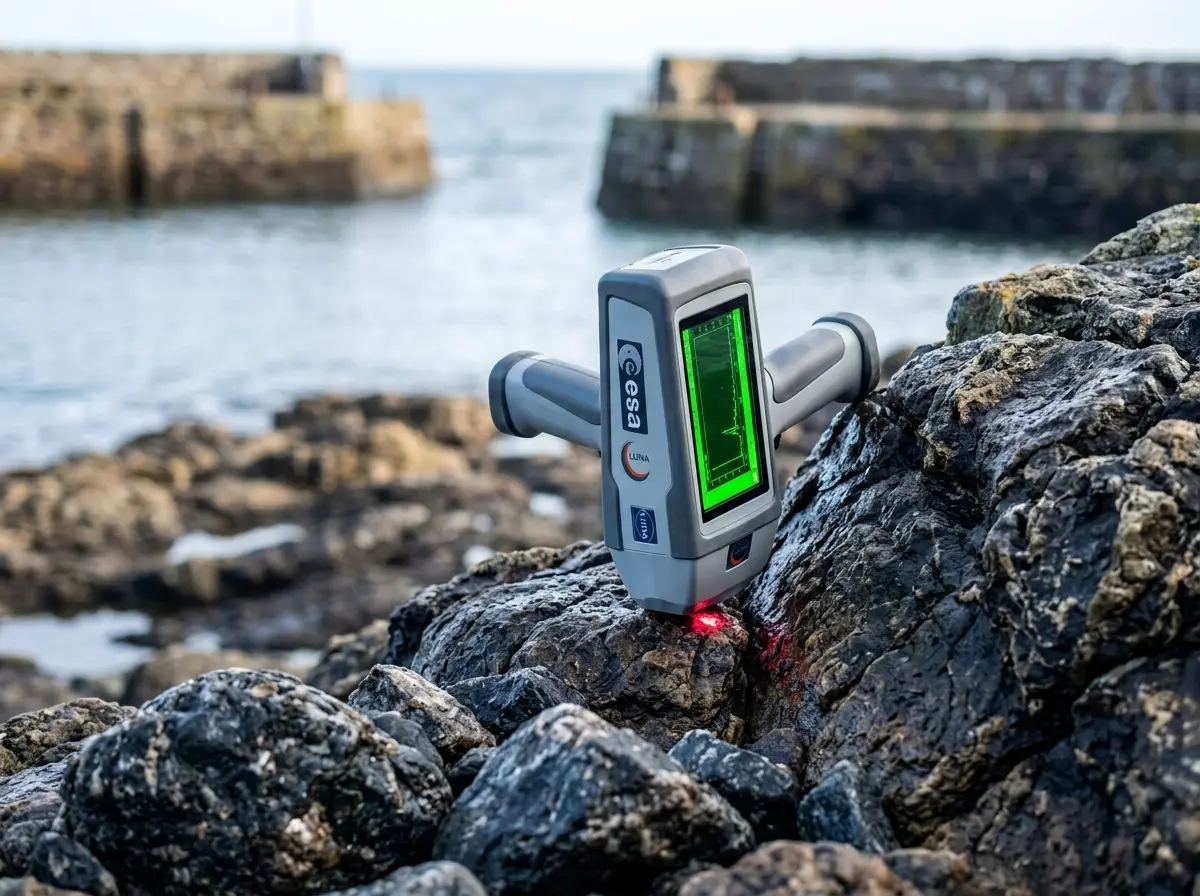
Portsoy’s Harbour Rocks Match the Moon
Portsoy on the Aberdeenshire coast was chosen because it holds a rare natural trio that mirrors lunar surface materials. Professor John Parnell of Aberdeen has long used the site for student training. He calls it the closest replica his team has found.
| Lunar material | Portsoy equivalent | Why it matters |
|---|---|---|
| Anorthosite (highlands) | Anorthosite outcrops | Crustal composition baseline |
| Gabbro / mare basalts | Gabbro with olivine | Volcanic history and nickel potential |
| Pyroxenite (deeper material brought up by impacts) | Pyroxenite nearby | Interior samples at surface |
The gabbro contains olivine. When water alters olivine it forms serpentine-group minerals. Locals know the resulting rock as “Portsoy marble,” long sold as souvenirs. Detecting that conversion gives a direct proxy for past water activity, one of the highest-value science targets for lunar crews.
Parnell noted that the three rocks that characterise the moon surface sit within walking distance of each other in the harbour area. Generations of Aberdeen students learned field skills there. The same outcrops now train instruments headed for space.
How the LUNA Suit Tests Went
The Scotland runs followed a controlled campaign at the ESA-DLR LUNA Analog Facility in Cologne in late February 2026. ESA astronaut Matthias Maurer operated both breadboards while wearing the LUNA analog suit and EVA gloves.
Over two days the team ran four structured scenarios that copy real surface conditions:
- Sunlit operations under the facility’s Sun Simulator
- Deep-shadow work using only the instruments’ built-in LEDs
- A timed traverse between ten measurement stations
- Contamination and recovery, with regolith simulant dusted onto samples then cleaned before re-measurement
Key metrics included “Time-to-Spectrum” (target under three minutes from power-on to valid result), first-attempt success rates with gloved hands, and error recovery inside two minutes. Rock types included Norwegian anorthosites, Etna and Lanzarote basalts, Ries Crater suevite and peridotite nodules.
Maurer supplied direct feedback on ergonomics, display readability in harsh light and cleaning routines. The demonstration test at the LUNA facility moved the hardware from clean-lab validation into full operational lifecycle checks: unpack, assemble, calibrate, deploy, clean and repack.
What the Instruments Measure
Each technique supplies a different piece of the mineral puzzle. Raman identifies molecular structure and mineral phases. LIBS vaporises a tiny spot to reveal elemental composition. XRF maps elements without destroying the surface. Together they let a crew decide in minutes whether a rock is worth bagging or can be left behind.
| Instrument | Core techniques | Primary output |
|---|---|---|
| PHOENIX BB1 | Raman + LIBS | Mineral ID plus elemental snapshot |
| PHOENIX BB2 | Raman + XRF | Mineral ID plus non-destructive elemental maps |
Mission Control’s contribution lets the devices combine LIBS XRF and Raman spectroscopy under one software interface with visual context. Flight versions would give astronauts the same multi-mode view that ground labs now require multiple instruments to achieve.
Water Signs and Resources Without Sample Return
Apollo crews brought rocks home because they had almost no real-time analytical power. Future missions face tighter mass budgets and shorter surface stays. Tools that flag olivine-to-serpentine conversion or nickel-bearing phases on the spot change the economics of every traverse.
We are moving ever closer to astronauts setting foot on the Moon again, and when they get there, they will need the tools to gather as much insight as they can into the type of resources available on the moon.
Dr Hannah Lerman of Leicester’s School of Physics and Astronomy said the Portsoy runs optimise performance, usability and scientific output before lunar deployment. The same logic applies to Mars, though the nearer-term focus remains the Moon.
Resource targets include water-related minerals, metals and any volatiles that could support propellant or life-support production. Identifying them in the field reduces the number of samples that must ride home on a return vehicle.
UK Teams Bridge Training and Flight Payloads
PANGAEA’s core job is teaching astronauts to think like field geologists. The same network now doubles as a technology trial track. Leicester’s planetary group leads the UK side of PHOENIX while Aberdeen supplies deep local knowledge of the analog site and the water-proxy mineralogy.
The work is not isolated. In May 2026 Leicester and ispace signed a payload service agreement to fly a related Raman spectrometer payload for a future ispace lander. That instrument draws on ExoMars heritage and is funded by the UK Space Agency’s bilateral programme. The same partners (INTA, Aberdeen, Valladolid, RAL Space) appear on both projects.
UK Space Minister Liz Lloyd called the ispace deal an example of academic expertise meeting commercial ambition and strengthening cooperation with Japan. The Portsoy and LUNA campaigns supply the operational data that flight hardware will need.
Observers tracking European lunar plans note that these university-led breadboards rarely generate the same headlines as lander contracts. Yet the ability to do rapid, multi-technique geology on the surface is the science backbone that makes later resource utilisation possible. Scotland’s coastal outcrops and Leicester’s labs are quietly filling that gap.
From Breadboard Feedback to Mission-Ready Kits
The combined LUNA and Portsoy data feed the next design loop: better glove interfaces, dust-tolerant optics, clearer displays under lunar lighting and tighter integration with suit systems. Quantitative numbers on success rates and cleaning times will set requirements for higher-TRL units.
Flight-ready versions remain years away, but the path is now mapped. Astronauts will one day step onto the lunar surface carrying instruments whose ergonomics were first hammered out on a Scottish harbour and inside a German regolith hall. The rocks at Portsoy have already done their part.
 The Quiet Architect Behind Akshay Oberoi’s Karjat Home
  Nothing Ear 3A Hits $79 and Repeats the Slide
  Hyderabad Gold Dip Freezes Buying as Duty Talk Hits Wedding Season
  India Pushes Japan CEPA Review After 15 Years of One-Way Gains
  HDFC Bank’s US Class Action Turns Deposit Scheme Into Securities Reckoning
  Gold Holds Above $4600 as Treasury Buybacks Fuel Debasement Bid