
 Ishan Crawford
 A former NHS Scotland strategy director wants to take the writing of health strategy out of ministers’ hands entirely. Peter Williamson taught health policy at Aberdeen Medical School, ran strategy for NHS boards and later led health innovation policy for the Scottish Government. He has now laid out a plan to replace decades of committee-heavy, marginally effective strategy making with a small independent body empowered to write binding service blueprints instead.
His proposal lands as fresh figures show the funding growth that once masked forty years of thin strategy has largely disappeared. Scotland has written health strategy roughly the same way since the 1980s: broad consultation, gradual change, and short-term financial patches instead of structural fixes. Williamson is betting that only a process insulated from politics can break that pattern now that the money to paper over it has run out.
Four Decades of Strategies That Never Quite Land
Williamson’s diagnosis is blunt. Scottish health strategy suffers from thin strategic capacity inside health boards, consultation so extensive it waters down change into marginal tweaks, financial planning built around the next budget rather than the next decade, objectives too numerous and vague to measure, and staffing, estates and technology plans bolted on too late to matter.
That pattern has a paper trail. Auditors have been flagging it for years.
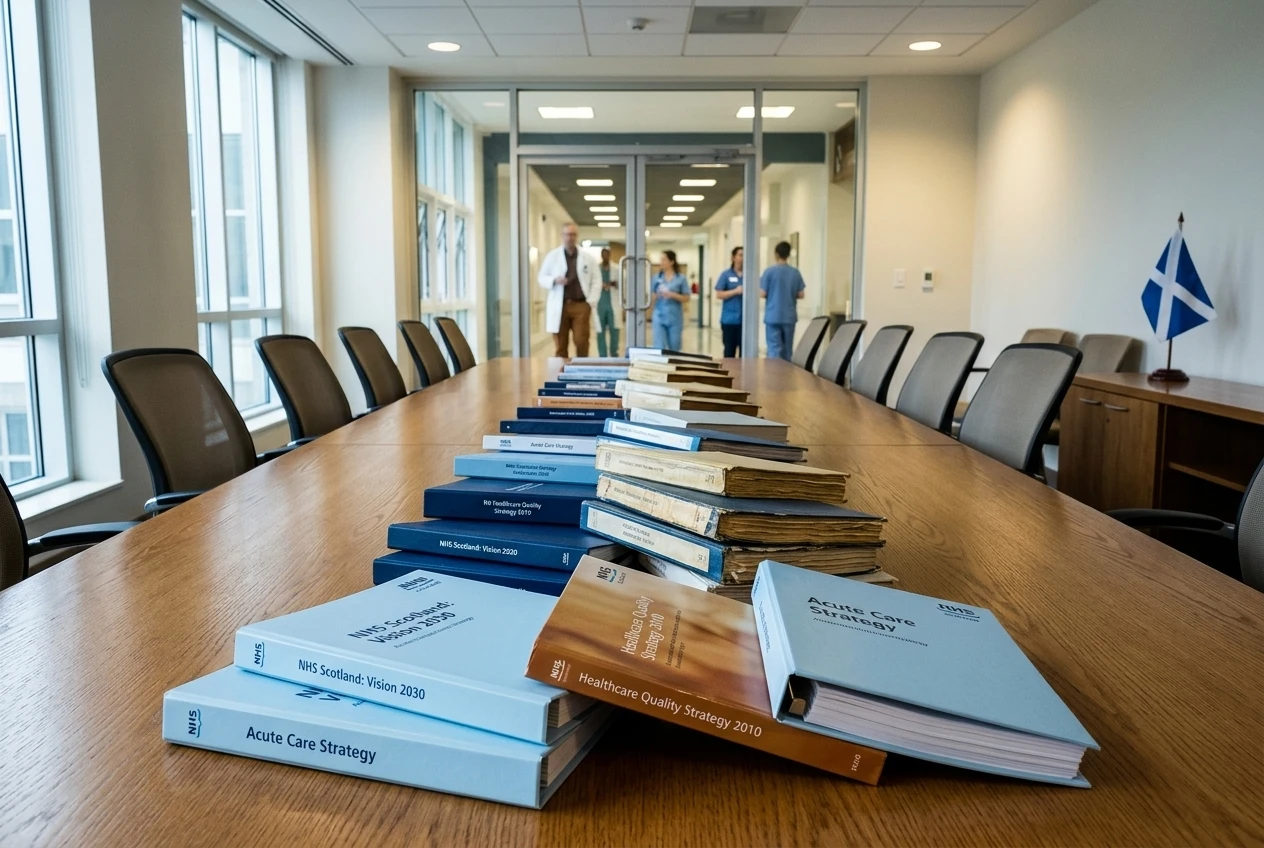
a range of strategies, plans and policies in place for the future delivery of healthcare, but no overall vision
Audit Scotland, the public spending watchdog, made that finding in its 2023 report on NHS Scotland, adding that the lack of a single vision made long-term planning harder for individual health boards. It repeated the same call for a national strategy the following year in its 2024 review.
Williamson is careful not to reduce this to a plea for technology. Politicians, health service staff and commentators have increasingly promoted innovation as the fix for financial sustainability, and his essay treats that idea with caution: some innovations cut costs, others raise them, particularly upfront, and simply chasing novelty is not a strategy in itself.
The Funding Numbers Behind the Diagnosis
The case for urgency sits in the spending record. Real-terms health spending per person in Scotland grew quickly through the 2000s, then nearly stalled through the 2010s, before a partial recovery this decade.
| Financial Year | Real-Terms Spending Per Person | Average Annual Growth |
|---|---|---|
| 1999-2000 | £1,897 | Baseline |
| 2010-11 | £3,089 | About 6% a year since 1999-2000 |
| 2019-20 | £3,223 | 0.4% a year since 2010-11 |
| 2024-25 | £3,644 | About 2% a year since 2019-20 |
Independent research backs up that slowdown. Health now swallows 35% of the Scottish Government’s discretionary budget and 39% of its non-benefit spending, the largest single share of any portfolio, according to the Institute for Fiscal Studies (IFS). Current budget plans imply health and social care spending will fall in real terms in 2026-27 once social care wage costs are stripped out, which would require heroic improvements in efficiency just to hold performance steady.
Additional UK government funding confirmed since the last Scottish Budget could allow in-year top-ups without forcing cuts elsewhere, the IFS notes, though real-terms increases pencilled in for 2027-28 and 2028-29 (2.5% and 2.3%) still sit below what the government itself judges health funding actually needs. The Scottish Fiscal Commission separately calculates that health spending needs to grow roughly 3% a year through the late 2020s and into the 2030s to keep pace with an ageing, less healthy population, well above the 2% pencilled in for government spending as a whole.
Five Service Lines, One New Layer of Oversight
Williamson’s fix is structural, not financial. He proposes a Strategic Support Group (SSG) that would oversee a set of Service Strategy Forums (SSFs), each one producing a strategic statement for a distinct part of the health system.
The SSG would do four things: help pick independent, evidence-literate members for each forum; help each forum set terms of reference and a work plan; design a common template so every strategy reads the same way to the boards that must deliver it; and build the public case for adopting each strategy, including the cost of not doing so.
Five service areas are proposed as the starting list.
- Primary and social care integration – proactive, coordinated care that keeps more people well outside hospital.
- Acute emergency care redesign – faster, safer hospital admissions matched to clinical need.
- Elective care funding and efficiency – funding that matches rising demand alongside a more consistent patient experience.
- Mental health model reset – less reliance on crisis response, more community-based support.
- Population health roles – a clearer division of labour between the NHS, councils and voluntary groups on deprivation-linked ill health.
Williamson insists this should read like a technical specification rather than a mission statement, with hard, unambiguous language rather than aspiration. The strategic layer would stay high-level; the operational detail would still sit with boards and frontline services, which keep freedom to adapt plans to local circumstances.
Why Would Politicians Give Up This Power?
Because three groups currently benefit from the way strategy gets made. Politicians score points on small differences rather than shared direction. Professional bodies defend their own turf. And the Scottish Government, wary of looking like a poor steward of a cherished institution, tends to soften hard choices rather than force them through.
Williamson leans on an academic idea to make the first point: politicians, he argues, often indulge what political scientist James Mitchell called the “Narcissism of Small Differences” in a 2010 paper on Scotland and Westminster politics, magnifying minor disagreements instead of converging on shared, evidence-based direction.
The second group is easy to spot in practice. When Angela Constance took over as health secretary, she inherited the SNP’s manifesto pledge of a million extra GP appointments, a target both the Royal College of General Practitioners in Scotland and the British Medical Association (BMA) have argued would deliver more value if simply invested in the existing general practice network instead, according to health policy reporting on her appointment. That is precisely the kind of organised professional pushback Williamson says strategy has to work around rather than be captured by.
The third obstacle is the government itself. Williamson’s essay notes that ministers place great store in being seen to protect the NHS, which means unpopular but necessary choices get moderated or avoided rather than made.
Reform Is Already Moving, Just Not Through This Process
Scotland already has a new health secretary testing that theory. Angela Constance became Cabinet Secretary for Health and Care on 20 May 2026, swapping briefs with Neil Gray after that month’s Holyrood election.
Gray had described the previous year as a turning point, writing in a government progress report that the health and social care system’s focus has shifted from recovery to reform and renewal, pointing to the Health and Social Care Service Renewal Framework and Scotland’s Population Health Framework, a ten-year plan co-written with the Convention of Scottish Local Authorities (COSLA) that aims to shrink the life expectancy gap between Scotland’s most deprived areas and the national average by 2035.
Not everyone rates that framework’s chances of success. Researchers at the Scottish Health Equity Research Unit said the way the Scottish Government itself is structured, without mechanisms for genuine whole-of-government working, remains a fundamental barrier to the kind of collective approach the evidence says is needed.
Meanwhile, a separate and less visible reorganisation is already under way. The Scottish Daily Express reported this month that health boards are being consolidated into two new sub-national structures, styled Scotland East and Scotland West, alongside single authority models merging health, council and social work services in Argyll and Bute, Orkney and the Western Isles, with critics telling the paper that ministers are “keeping Parliament and the public in the dark” about the scale of the change. That reporting rests on a single source and has not been independently confirmed in detail, but if accurate it shows exactly the kind of top-down, low-visibility restructuring Williamson’s proposal is designed to replace with an open, evidence-tested alternative.
Shorter Waits Mask a Longer-Term Problem
None of this happens in a vacuum of patient experience. An estimated 571,054 people in Scotland were on at least one waiting list for a new outpatient appointment, inpatient stay or day case as of 31 March 2026, equivalent to roughly one in ten people in Scotland, according to Public Health Scotland.
The trend line is genuinely improving. New outpatient waits of more than a year have fallen for eleven consecutive months, down 76.5% since July 2025, while inpatient and day case waits of more than a year have fallen for fifteen months running, down 47.4% over the same period, according to Public Health Scotland figures. The government has also said it exceeded its pledge of 150,000 additional appointments and procedures in the year to March 2026.
Williamson’s essay warns against reading that kind of recovery as proof the system is fixed. Filling gaps left by a decade of underfunding is treated as a problem for short-term fixes, he argues, when the harder question, whether the underlying service models are simply outdated, gets deferred instead of confronted. A shorter waiting list, on his logic, is not the same thing as a resolved strategy.
Frequently Asked Questions
How Does Scotland’s NHS Funding Compare With England’s?
At the start of devolution Scotland spent about 22% more per person on health than England. By 2019-20 that gap had narrowed to just 3%, because spending grew faster in England from a lower starting base, according to Institute for Fiscal Studies research comparing the four UK nations.
Has NHS Scotland Tried This Kind of Strategy Reset Before?
Repeatedly. Scotland has published a string of overarching health plans over the past decade and a half, including the 20:20 Vision in 2011, A National Clinical Strategy in 2016 and the NHS Recovery Plan covering 2021 to 2026, yet Audit Scotland kept finding no single vision tying the pieces together.
Why Not Just Charge Patients for GP Appointments?
Williamson’s essay argues charging would raise comparatively little money, cost a lot to administer, discourage people from seeking care early, and risk changing the NHS’s basic character through a series of small, unplanned steps rather than one deliberate decision.
What Would a Service Strategy Forum Have to Produce?
Each forum would write a strategic statement covering who the service is for, how people access and are discharged from it, the staffing, estates, equipment and technology costs of running it, the main benefits and risks of adopting it, and the strength of the evidence behind it, closer to a technical specification than a mission statement.
Who Is Now Responsible for Delivering NHS Scotland Reform?
Angela Constance, who swapped the justice brief for health and care on 20 May 2026, inherited what the health policy news site healthandcare.scot called the “unfinished business” of NHS reform, including Neil Gray’s existing targets on waiting times and appointment numbers.
 The Quiet Architect Behind Akshay Oberoi’s Karjat Home
  Nothing Ear 3A Hits $79 and Repeats the Slide
  Hyderabad Gold Dip Freezes Buying as Duty Talk Hits Wedding Season
  India Pushes Japan CEPA Review After 15 Years of One-Way Gains
  HDFC Bank’s US Class Action Turns Deposit Scheme Into Securities Reckoning
  Gold Holds Above $4600 as Treasury Buybacks Fuel Debasement Bid