
 Ishan Crawford
 Loch Lomond Distillery runs eleven stills capable of eleven distinct spirit styles. The company paying for that complexity sits roughly 6,000 miles away in Hong Kong, at Hillhouse Capital Group, an Asian private equity firm that has owned the Highland site since June 2019.
It is Loch Lomond Group’s second change of financial ownership since 2014, when UK firm Exponent Private Equity bought the distillery from the Bulloch family that rebuilt it. Consumers rarely hear that part of the story. Loch Lomond runs no public tours, and its marketing leans on production detail rather than ownership.
Who Owns Loch Lomond Distillery?
Hillhouse Capital Group closed its purchase of Loch Lomond Group on June 6, 2019, paying about £400 million (roughly $500 million) for the business, according to the deal announcement Hillhouse issued at the time. Some trade coverage of the sale pegged the enterprise value as high as $550 million.
The purchase folded in three working sites: Loch Lomond itself, Campbeltown’s Glen Scotia, and the mothballed Littlemill distillery, demolished in 2004 but still good for the occasional release of old stock. Hillhouse also picked up High Commissioner blended Scotch, Glen’s Vodka and Ben Lomond Gin along with the deal.
Hillhouse is not a household name among whisky drinkers. The firm manages investments across multiple industries, and it has framed the Loch Lomond purchase as part of a strategy to grow premium spirits brands internationally, particularly across Asia, where Scotch demand has been climbing for years.
From the Bulloch Family to Two Private Equity Sales
Loch Lomond’s ownership churn looks unusual next to Scotch’s big heritage names, but the site has changed hands under pressure more than once. Here is how it moved from a struggling single owner to a private equity relay:
- 1965: The distillery is built in Alexandria, on the site of an old dye factory, by the owners of Littlemill Distillery and Barton Brands, to expand production beyond Littlemill’s capacity.
- 1984: A weak whisky market forces Loch Lomond to close.
- 1985: Sandy Bulloch, head of Glen Catrine Bonded Warehouse Ltd, buys the site and rebuilds it to produce nearly every regional Scotch style under one roof.
- 1994: Bulloch’s group buys Littlemill and Campbeltown’s Glen Scotia, installs continuous stills for grain whisky, and opens Loch Lomond’s on-site cooperage.
- 2014: Exponent Private Equity buys Loch Lomond Group from the Bulloch family.
- 2019: Hillhouse Capital buys the group from Exponent for about £400 million.
Under Exponent’s five years of ownership, international sales grew from under 10% of revenue to about 70%, spread across more than 100 markets. That growth is a big reason Hillhouse paid what it did.
Eleven Stills Turning Out Eleven Different Spirits
Bulloch’s original goal explains why Loch Lomond’s still house looks nothing like a typical Highland distillery. Gary Mills, Loch Lomond Group’s visitor experience manager and brand ambassador, calls the result a “one-stop blended Scotch factory.”
The distillery’s straight neck pot stills get called “Lomond stills” by drinkers, but Mills says that is not accurate; they are a different hybrid design entirely. Rectifying plates inside the neck, one in the wash still and seventeen in the spirit still, give distillers precise control over the spirit and push its ABV higher than a standard pot run would.
| Still Type | Count | What It Produces |
|---|---|---|
| Straight neck pot stills | 6 (three pairs) | Malt spirit styles, peated and unpeated |
| Swan neck pot stills (added 1998) | 2 | Additional malt spirit styles |
| Column still, malt only | 1 | Grainstorm, single grain whisky from 100% malted barley |
| Column stills, grain | 2 | Traditional single grain whisky (90% wheat, 10% malted barley) |
That lineup yields eleven styles of new-make spirit: ten malt-based, one grain. Eight qualify as single malt under UK law. Distillers vary cut points and switch between peated and unpeated malt to keep the styles distinct, and the site is generally reported to produce 3 million to 5 million liters of malt spirit a year, plus around 20 million liters of single grain whisky.
The Single Malt That Legally Cannot Say So
Loch Lomond’s ninth and strangest liquid stream is a copper column malt spirit, distilled from 100% malted barley in peated and unpeated versions. It comes off the still at 80% to 85% ABV, well under the roughly 94% standard for grain whisky columns.
Made from all malted barley at a single distillery, the spirit meets two of the usual tests for single malt Scotch. UK law adds a third test it fails: the Scotch Whisky Regulations 2009 require single malt to be batch distilled in pot stills, and this spirit runs through a column still. So Loch Lomond sells it as single grain whisky under the Grainstorm label instead.
Grainstorm retails for about $30 to $35 and shares more in common with Japan’s Nikka, England’s Copper Rivet and America’s Triple Eight Distillery than with traditional Scotch grain whisky, Mills says. It sells best in South Africa, and he hopes to grow it elsewhere. Inside Loch Lomond’s own blends, the same spirit gets used far more heavily.
The Cooperage Hillhouse’s Money Keeps Running
Loch Lomond is one of just four modern Scottish distilleries with its own working cooperage, a feature that predates Hillhouse’s ownership but depends on continued spending to run. Nine coopers repair between 20,000 and 30,000 casks there every year.
Because the cooperage is on site, our Master Blender, Michael Henry, can ask for six heavily charred casks tomorrow and have them almost immediately.
That is Mills, describing the arrangement to Forbes. Relying on an outside cooperage for the same request, he said, can push delivery out by months, sometimes into the following year.
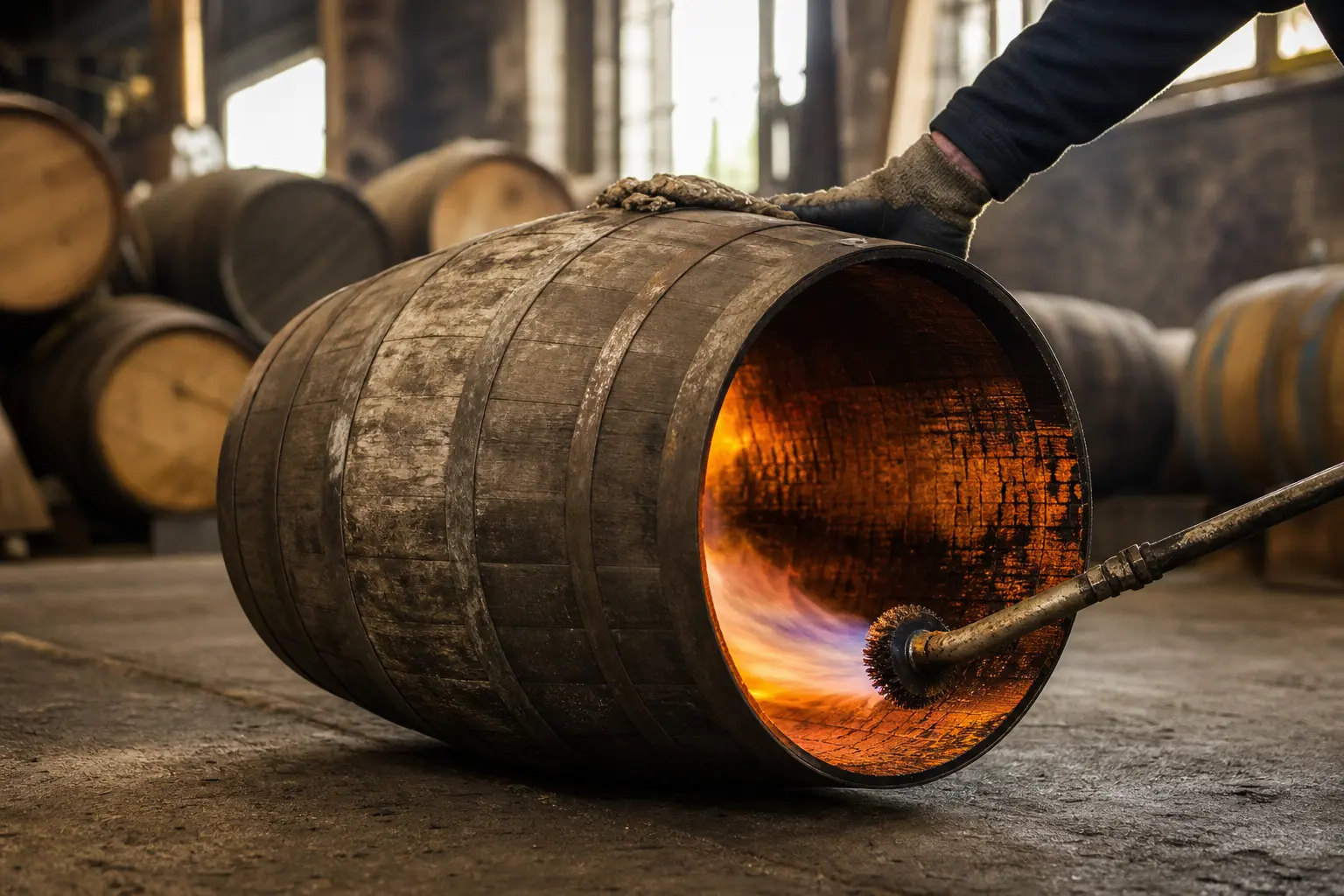
The cooperage also runs a cask rejuvenation process, stripping char with rotating steel brushes and re-charring the inside with propane flame. A few numbers show the scale of it:
- Up to nine fills per cask through rejuvenation, against an industry average Mills puts near three.
- 500,000 casks under management in total.
- 28 warehouses on site, plus additional off-site aging facilities.
- Ex-bourbon barrels sourced from American producers including Heaven Hill, Wild Turkey and Jim Beam.
Nine coopers and a 500,000-cask inventory cost real money to maintain, the kind of recurring spend that depends on whoever holds the group staying committed to it year after year.
Chasing Growth From Alexandria to New York
Hillhouse’s involvement did not stop at buying the group. Loch Lomond Group has kept expanding since 2019, most recently by acquiring New York Distilling Co., an American whiskey and gin producer, according to trade coverage of the deal.
The push into the United States sits alongside a broader relaunch. Loch Lomond Group has refreshed its Original single malt line, and Michael Henry, the group’s master blender, released Open Championship-themed whiskies tied to golf’s oldest tournament this year.
Scotch is not competing only against other Scotch these days. Indian single malts have begun challenging Scotch’s global dominance in export markets, and Scottish producers are testing new ways to hold their edge, including aluminium bottle trials at another Scottish distillery aimed at cutting packaging weight and cost. Loch Lomond’s answer has been production variety and geographic reach rather than packaging changes.
Four Bottles That Show the House Style
Americans hunting for Loch Lomond mostly find two bottles on shelves. “The core expressions available in the United States are our 12 year old and 18 year old, because they really represent the classic Loch Lomond house style: fruit, honeyed sweetness, and soft smoke,” Mills said. “Those two whiskies embody that profile perfectly.”
Travelers who find Loch Lomond outside the US get more range. Mills points newcomers toward four expressions in particular:
- Loch Lomond 12 Year Old, the core US single malt built around fruit, honeyed sweetness and soft smoke, aged entirely in ex-bourbon casks.
- Loch Lomond 18 Year Old, the other US core expression, carrying the same house style with more time in wood.
- Inchmurrin 12 Year Old, a Lowland-inspired style with orchard fruit and fresh grass notes.
- Inchmoan 12 Year Old, peated and blended from three separate peated spirit styles Mills describes as spicy, medicinal and smoky.
All four mature exclusively in ex-bourbon casks, the same barrels the on-site cooperage keeps in rotation. Hillhouse has not announced any plan to sell Loch Lomond Group since 2019, but the casks filling those 28 warehouses today will not be ready to drink for a decade or more, long after most private equity holding periods end.
Frequently Asked Questions
Who owns Loch Lomond Distillery?
Hillhouse Capital Group, an Asian private equity firm, has owned Loch Lomond Distillery since June 2019 through its holding company, Loch Lomond Group, which also owns sister distilleries Glen Scotia and Littlemill. Hillhouse bought the group from Exponent Private Equity, which had bought it from the Bulloch family in 2014.
Can you tour Loch Lomond Distillery?
No. Loch Lomond does not run consumer-facing tours because the site was purpose-built for production rather than visitors. The company does employ a visitor experience manager and brand ambassador, Gary Mills, who represents the distillery at tastings and industry events instead of on-site tours.
Why is Grainstorm not labeled a single malt Scotch?
Grainstorm is made from 100% malted barley at a single distillery, but it runs through a copper column still rather than a pot still. UK law, the Scotch Whisky Regulations 2009, reserves the term single malt for pot-distilled whisky, so Loch Lomond sells this spirit as single grain whisky under the Grainstorm label, priced around $30 to $35 a bottle.
How much whisky does Loch Lomond produce each year?
Loch Lomond’s eleven stills turn out two very different volumes: roughly 3 million to 5 million liters of malt spirit a year, plus about 20 million liters of single grain spirit, making grain whisky the larger share of what the site actually distills.
What is the difference between Loch Lomond’s core range and its Inchmurrin and Inchmoan bottlings?
The 12 and 18 year old single malts sold in the United States carry Loch Lomond’s house style of fruit, honeyed sweetness and soft smoke. Inchmurrin 12 leans into Lowland-style orchard fruit and grass notes, while Inchmoan 12 is peated and blended from three different peated spirit styles.
 ONGC licence frees Venezuela cash and operatorship talks
  Anthropic Hits $65 Billion Run Rate and Flips the AI Cash Test
  Supreme Court grounds the fare free-for-all with three-week clock
  Gold Nears $4400 as Soft Data Meets Oil Inflation Risk
  Nifty Slips as Zaggle Circuits and Dhoot Debuts Big
  Diesel Crack Tops $100 as Iran Rhetoric Lifts Crude