
 Ishan Crawford
 Reliance Jio is selling the new AX3000 universal Wi-Fi 6 router for Rs 3,999, a 60 percent cut from its Rs 9,999 MRP, with claimed coverage of up to 1500 square feet and combined speeds of 3000 Mbps class. The unit works with any ISP over Ethernet and targets homes that have outgrown the free router that arrives with a JioFiber or AirFiber plan.
Most modern phones and laptops in India already support Wi-Fi 6. Jio positions the AX3000 as the simple upgrade for multi-device flats that still run older dual-band gear.
The pitch is straightforward. Keep the JioHome app you already know, gain a stronger radio, and stop fighting the limits of the box that came free with the connection. For households that later change providers, the same hardware stays useful because the WAN side is plain Ethernet rather than a locked Jio-only link.
What the AX3000 ships with
Official specs list the AX3000 at 2400 Mbps on 5 GHz plus 600 Mbps on 2.4 GHz. It uses Wi-Fi 6 (802.11ax) with OFDMA and MU-MIMO so multiple devices share airtime instead of queuing. Jio states support for more than 100 connected devices at once.
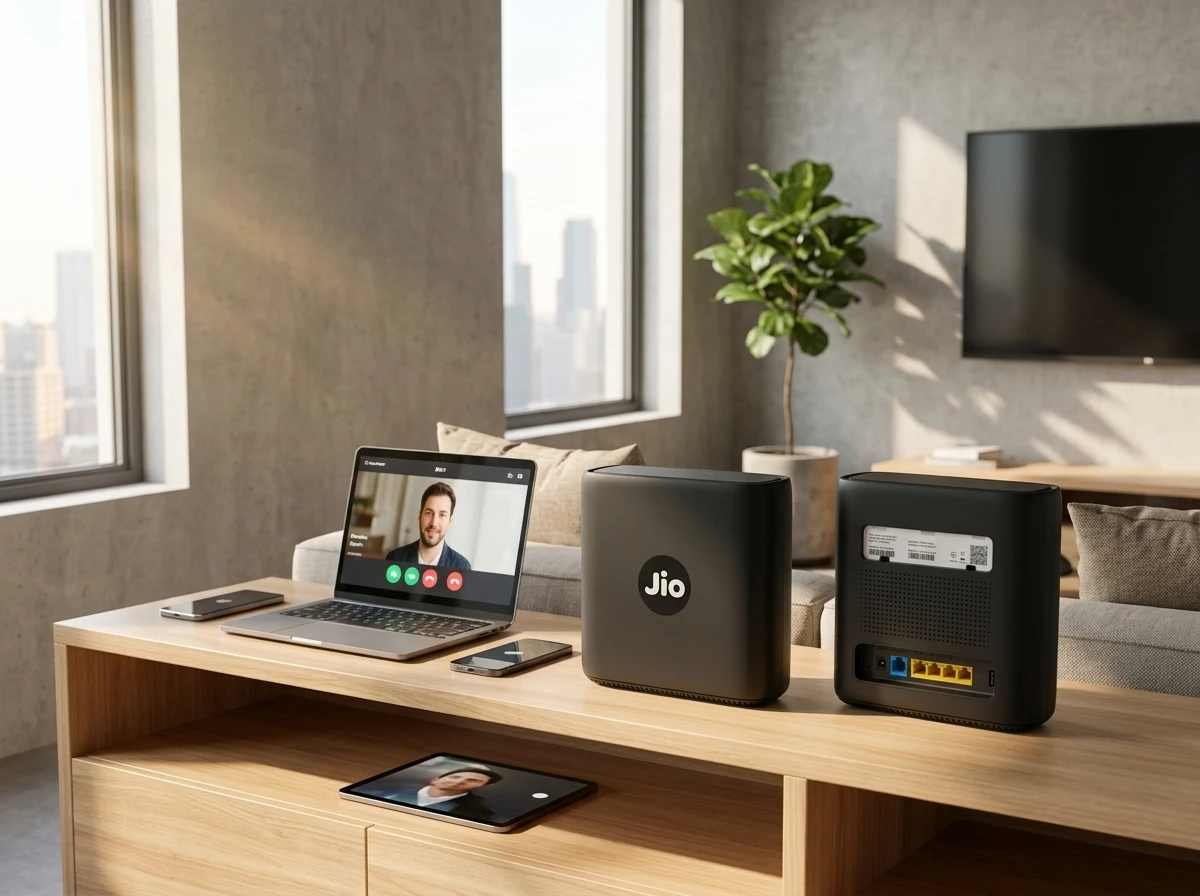
The router is universal: connect it by Ethernet to a fibre ONT, broadband modem or DSL box from any provider. It carries four Gigabit LAN ports, WPA3 security, and a single SSID that steers devices between bands. Setup and controls run through the JioHome app, which adds parental limits, guest networks and site blocking.
- Quad-core chipset for concurrent traffic
- Hidden antennas inside a 197 x 190 x 74 mm chassis
- Jio True AI Mesh ready with compatible extenders
- 1-year device warranty, 6 months on the adapter, made in India
Those four points matter together. The quad-core chipset is meant to keep the radio and the LAN ports busy at the same time. Hidden antennas keep the 197 x 190 x 74 mm body compact enough for a shelf or TV unit. Mesh readiness means the first box is not a dead end if the flat later needs a second node. The made-in-India build and the split warranty (full year on the router, six months on the adapter) set clear expectations on support.
Jio lists the same hardware on its AX3000 speeds and 1500 sq ft coverage page alongside the higher AX6000 model.
1500 square feet matches most Indian apartments
Typical urban flats and small independent houses in India run 800 to 2000 square feet, often with thick concrete walls that kill older 2.4 GHz signals. A single well-placed Wi-Fi 6 unit covering 1500 square feet removes the need for cheap plug-in repeaters that halve speed.
Jio claims the AX3000 handles 4K streams, cloud gaming and video calls across rooms without the drop-outs common on free ISP boxes. Real-world range still depends on placement and wall materials, yet the stated figure lines up with the size of a standard 2BHK or compact 3BHK.
Placement still decides outcomes. A central living-room shelf usually beats a corner cupboard near the ONT. Concrete and water tanks remain the main obstacles; the 1500 square feet claim assumes a sensible install rather than a hidden corner. Homes at the upper end of the 800 to 2000 square feet band may still want a second node later, which is why the True AI Mesh path exists.
- 800 to 1500 sq ft: one well-placed AX3000 is the intended fit
- Compact 2BHK or small 3BHK: coverage claim matches the floor plate
- Larger multi-storey layouts: plan for a mesh extender from day one
Free Jio gear versus the paid universal box
Every new Jio home connection includes a standard Wi-Fi router at no extra charge. Those units are usually adequate for light use and lower-speed plans, but many users report locked settings: no separate band names, limited guest options, and weaker multi-device behaviour once the house fills with phones, TVs and smart plugs.
The AX3000 is sold as an optional upgrade. It keeps the same JioHome app ecosystem while adding full universal mode so the household can switch ISPs later without buying another router. Coverage jumps to the stated 1500 square feet and theoretical throughput triples the older free models that topped out in the AC1200-AC1800 range.
| Feature | Typical free Jio router | Jio AX3000 |
|---|---|---|
| Wi-Fi generation | Often Wi-Fi 5 / basic 6 | Wi-Fi 6 AX3000 |
| Claimed coverage | Lower, plan-dependent | Up to 1500 sq ft |
| Max devices | Limited in practice | 100+ |
| ISP lock | Jio-centric | Universal Ethernet |
| Price | Included | Rs 3,999 |
Users who stay on Jio still gain the stronger radio and open features; those who later port keep the hardware.
The free box is not a failure for light homes. It is simply tuned for the plan it ships with. Once the device count climbs and 5 GHz rooms go dark, the paid unit becomes the cleaner fix than stacking random repeaters on the old radio.
How the price stacks against other Wi-Fi 6 boxes
At Rs 3,999 the AX3000 sits in the crowded sub-Rs 5,000 tier where TP-Link, D-Link and others already sell AX1500 and AX3000 class units. Entry AX1500 models start near Rs 2,600; stronger dual-band options climb past Rs 4,000-5,500.
| Model | Class | Approx price | Notes |
|---|---|---|---|
| TP-Link Archer AX10 | AX1500 | Rs 2,599 | Basic Wi-Fi 6, four antennas |
| D-Link R15 / similar | AX1500 | Rs 2,900-4,300 | Mesh-ready AI features |
| Jio AX3000 | AX3000 | Rs 3,999 | 1500 sq ft claim, 100+ devices, Jio app |
| Jio AX6000 | AX6000 | Rs 5,999 | 2000 sq ft, higher throughput |
The Jio unit’s edge is the deeper app integration for existing Jio households plus the mesh path that uses the same True AI branding. Independent brands often win on raw feature lists or USB ports; Jio wins on one-app management and easy availability through JioMart, Amazon and company stores.
Current pricing and the rest of the JioHome devices lineup and current pricing appear on the official devices page.
Shoppers comparing class labels should note the gap between AX1500 entry boxes and the AX3000 rating. The Jio model lands above the cheapest Wi-Fi 6 options yet below the AX6000 step-up, which is the point of the Rs 3,999 street price after the 60 percent cut from MRP.
Mesh path and the JioHome app layer
The AX3000 is True AI Mesh compatible. Add a matching Jio Wi-Fi 6 extender (JE6801 or similar AX3000-class units) and the system creates a single roaming network without manual band steering. Extenders have appeared on sale near Rs 3,500, so a two-node setup stays under Rs 8,000.
The JioHome app handles the whole stack: SSID, parental schedules, guest access and device priority. Official FAQs confirm dual-band operation under one name and Ethernet compatibility with non-Jio links. Some early buyers have posted that the router can show offline inside the app even while internet works; a reboot or support ticket usually clears it, but the glitch is worth knowing before purchase.
For deeper technical notes see the JioRouter compatibility and dual-band details on Jio’s help site.
A simple cost picture for buyers who already expect a second node:
| Setup | Pieces | Approx outlay |
|---|---|---|
| Single AX3000 | Router only | Rs 3,999 |
| Two-node mesh | AX3000 + extender near Rs 3,500 | Under Rs 8,000 |
| Step-up single unit | AX6000 alone | Rs 5,999 |
That table keeps the decision practical. One strong box covers the stated 1500 square feet. A mesh pair still undercuts many third-party kits while staying inside the same app. The AX6000 is the other single-box path if the floor plate is closer to the 2000 square feet claim on that model.
OFDMA and MU-MIMO Keep Traffic Moving
Wi-Fi 6 on the AX3000 is not only a higher megabit label. OFDMA splits each channel so several devices send small packets in the same time window instead of waiting in a single line. MU-MIMO lets the router talk to more than one client in the downlink direction at once. Together they cut the queue that builds when phones, TVs, cameras and laptops all wake at the same moment.
That design matches the 100-plus device rating. A free older router may list dual-band Wi-Fi yet still stall when many clients poll the network. The AX3000’s 2400 Mbps on 5 GHz plus 600 Mbps on 2.4 GHz gives the scheduler more airtime to allocate. Homes that run 4K streams, cloud gaming and video calls in parallel are exactly the load this scheduling was built for.
WPA3 and the single steered SSID sit on top of that radio layer. Security stays current while clients move between bands without the user renaming networks by hand. The quad-core chipset is there to keep those concurrent flows from choking the control plane while the radios stay busy.
Universal Ethernet Protects a Later ISP Switch
Universal mode is the quiet feature that outlives the first broadband contract. The AX3000 takes a standard Ethernet WAN feed from a fibre ONT, cable modem or DSL box. It is not tied to a Jio-only uplink. Official notes also cover PPPoE, which many Indian broadband lines still use.
That matters for two groups. JioFiber or AirFiber homes can upgrade the Wi-Fi layer today and keep the same box if they port out later. Non-Jio broadband customers can buy the unit as a plain Wi-Fi 6 router and still manage it through the JioHome app for parental limits, guest networks and site blocking.
Four Gigabit LAN ports keep wired devices off the air. A desktop, smart TV or network drive can sit on copper while phones and tablets use the AX3000 radio. The free ISP routers often expose fewer open controls; the paid unit opens guest access and schedules without forcing a second brand’s app onto the household.
- Day one: Ethernet from the existing ONT or modem into the AX3000 WAN port
- App setup: single SSID, parental rules and guest network inside JioHome
- Later change: same router stays when the household switches ISP on the WAN side
The sequence is short on purpose. No new mesh brand, no second learning curve, and no forced router swap when the broadband contract changes.
Who gains most from the switch
Households on 100 Mbps or faster fibre plans with eight or more always-on devices see the clearest lift. Concrete multi-room flats that currently rely on the free ONU plus a cheap repeater gain stable 5 GHz reach without buying a full third-party mesh. Gamers and 4K streamers benefit from lower latency and OFDMA scheduling.
Light users on sub-50 Mbps plans or tiny studio apartments will notice less difference and can stay with the free unit. Non-Jio broadband customers get a clean Wi-Fi 6 box that does not lock them to one provider.
A quick filter helps before checkout:
- Fast fibre, many devices, thick walls: strongest case for the AX3000
- Already on JioHome and want one-app control: stays inside the same ecosystem
- May switch ISP within a year: universal Ethernet avoids a second purchase
- Sub-50 Mbps or a single small room: free router may still be enough
Stats at a glance
- Rs 3,999 street price (60% off MRP)
- 1500 sq ft claimed single-unit coverage
- 3000 Mbps class dual-band total
- 100+ simultaneous devices supported
Availability is listed through jio.com, JioMart, Amazon and Jio retail stores, subject to stock.
Frequently Asked Questions
What is the exact price of the Jio AX3000 router in India?
Jio sells the AX3000 universal Wi-Fi 6 router at Rs 3,999 after a 60 percent discount from the Rs 9,999 MRP; the figure appears on the official JioRouter and JioHome devices pages and major online retailers.
Does the Jio AX3000 work with non-Jio broadband?
Yes. It is a universal router that connects via Ethernet WAN to fibre ONTs, cable modems or DSL from any ISP and supports PPPoE common in Indian broadband setups.
How does the free JioFiber router differ from the AX3000?
The free unit supplied with a new connection is usually a lower-spec dual-band model with more locked settings; the paid AX3000 adds full Wi-Fi 6 AX3000 speeds, 1500 sq ft coverage claim, open guest and parental controls, and universal ISP mode.
Can the AX3000 form a mesh network?
It supports Jio True AI Mesh when paired with compatible Jio Wi-Fi 6 extenders such as the JE6801 series, creating seamless roaming under one SSID.
How many devices can the Jio AX3000 handle at once?
Jio rates the router for more than 100 simultaneous connections using OFDMA and MU-MIMO, suitable for phones, laptops, TVs, cameras and IoT gear in a typical multi-user home.
The AX3000 is available now through Jio’s own channels and major retailers while stocks last.
 ONGC licence frees Venezuela cash and operatorship talks
  Anthropic Hits $65 Billion Run Rate and Flips the AI Cash Test
  Supreme Court grounds the fare free-for-all with three-week clock
  Gold Nears $4400 as Soft Data Meets Oil Inflation Risk
  Nifty Slips as Zaggle Circuits and Dhoot Debuts Big
  Diesel Crack Tops $100 as Iran Rhetoric Lifts Crude