
 Ishan Crawford
 IndiGo, India’s largest airline by domestic market share, reported a consolidated net loss of Rs 2,537 crore (about $300 million at roughly 85 rupees to the dollar) for the quarter ended March 2026, its first quarterly loss in years, against a profit of Rs 3,068 crore a year earlier. The striking part is that close to Rs 4,820 crore of that reversal came from a single foreign exchange charge that never moved through the company’s bank account.
Strip the currency hit out and the operating business looks steadier than the headline screams. That gap is why a stock down 13% so far this year still carries 20 buy calls on the Street, and why the conversation has shifted from the loss itself to how fast the airline can climb back. The catch is that the pressures that produced the quarter, expensive jet fuel and a West Asia network frozen by conflict, are still on the board.
The Loss That Never Left the Bank Account
A net loss usually means cash burned. This one mostly did not. The bulk of the damage was a mark-to-market charge, which is an accounting revaluation of future obligations at quarter-end exchange rates rather than money paid out. When the rupee weakens, the rupee value of IndiGo’s dollar liabilities rises on paper, and that paper increase lands in the profit-and-loss statement even though no payment is due yet.
Underneath it, the core engine kept running. Revenue from operations rose 1.3% year on year to Rs 22,438 crore, the passenger load factor held at 85.8%, and capacity measured in available seat kilometres (ASK, a gauge of how much flying an airline deploys) grew 3.4% to 43.6 billion. Earnings before interest, tax, depreciation, amortisation and aircraft rentals (EBITDAR, the profit measure airlines use to strip out lease costs), excluding the forex impact, came in at Rs 6,435 crore, a margin of 28.7%. That number beat what most analysts had pencilled in.
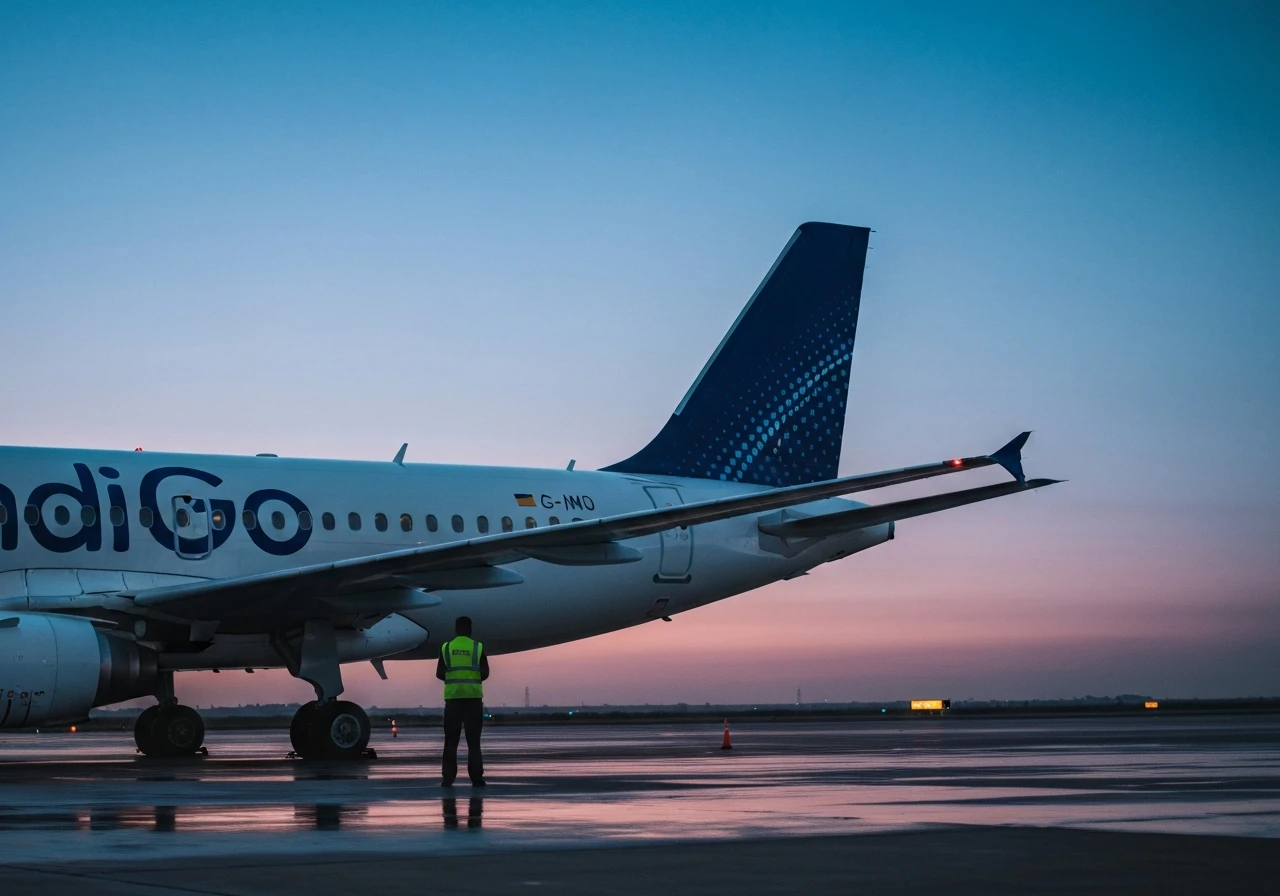
The reported figures sit in IndiGo’s quarterly results disclosures, and the contrast between the headline and the operations is the whole story. Here is the quarter in one frame, and it explains why this counts as the carrier’s first quarterly loss in years despite a working operation.
| Metric (Q4 FY26) | Value | Year-on-year |
|---|---|---|
| Net result | Loss of Rs 2,537 cr | vs Rs 3,068 cr profit |
| Revenue from operations | Rs 22,438 cr | up 1.3% |
| EBITDAR (excluding forex) | Rs 6,435 cr | 28.7% margin |
| Passenger load factor | 85.8% | down 1.7 points |
| Capacity (ASK) | 43.6 billion | up 3.4% |
Why a 5% Rupee Slide Cost Rs 4,820 Crore
Airlines like IndiGo lease most of their aircraft and pay for engine maintenance in US dollars, with obligations that stretch out over years. When the rupee fell roughly 5% against the dollar during the quarter, the rupee value of those long-dated commitments jumped, and the entire revaluation hit the books at once even though the cash falls due far into the future. The airline tracks the move against the rupee’s official reference rate against the dollar published by the central bank.
Chief Financial Officer Gaurav Negi told the earnings call that the losses were largely mark-to-market and tied to aircraft lease and maintenance liabilities payable over eight to ten years. In plain terms, the company has not spent the money; it has simply restated what that money will be worth if the rupee stays where it is.
Management is also trying to put a lid on the swings. IndiGo lifted its foreign exchange hedging target from $1 billion to $3 billion, spreading part of the cover across a two-to-five-year window so a future currency lurch does less damage to a single quarter.
- Rs 4,820 crore: the quarter’s foreign exchange charge, almost entirely non-cash
- 5%: the rupee’s slide against the dollar over the three months
- 8 to 10 years: the horizon over which the marked-down liabilities actually fall due
- $3 billion: the new hedging target, triple the previous $1 billion
Fuel Bills and the West Asia Gap
Currency was the loud problem. Fuel and geopolitics were the persistent ones. Global jet fuel prices climbed more than 50% during the quarter, a jump that lands straight on an airline’s biggest single cost. IndiGo added fuel surcharges and clawed back much of the increase on domestic routes, but it could not fully pass higher prices on to passengers, and the squeeze shows up across the wider market in recent moves in international and domestic aviation fuel pricing and in the global jet fuel price monitor.
The conflict in West Asia made it worse. IndiGo ran close to 160 daily frequencies linking the Middle East and Europe before the disruption, and many of those had to be suspended or rerouted, draining a chunk of higher-yielding international flying out of the schedule. That capacity pullback is part of a broader belt-tightening, with carriers having trimmed roughly 250 daily domestic flights through the summer as costs bit.
What the Street Is Pricing In
For most analysts the quarter changed the optics, not the thesis. The view is that the forex charge is a timing event and the operating beat is the signal worth trusting, so the medium-term growth story stays intact.
The Buy Case
Motilal Oswal kept its buy rating, arguing the airline controlled costs better than expected through a turbulent stretch. The brokerage expects revenue and EBITDAR to grow at compound annual rates (CAGR, the smoothed yearly growth rate) of 13% and 46% respectively between FY26 and FY28, driven by easing Pratt & Whitney engine groundings, a recovering international network and continued fleet expansion.
Despite the volatile quarter impacting air travel and muted capacity growth, IndiGo managed its costs better than expected.
That note, from Motilal Oswal’s research desk, captures why the loss is being read as noise rather than rot. The brokerage added that it remains confident in the growth strategy, anchored by India’s strong domestic demand base and a steadily expanding international map.
The Consensus Shift
The broader tape agrees. Bloomberg consensus data shows the stock now carries 20 buy ratings, four holds and two sells, up from 19 buys, two holds and two sells a year ago. More analysts cover it, and the balance has tilted toward conviction even as the share price slipped.
The Risks the Buy Case Underweights
The bull case rests on several things normalising at once, and not all of them are inside the airline’s control. The same currency mechanics that produced this loss can reverse just as sharply if the rupee weakens again next quarter.
The hard constraints worth watching:
- Engine groundings: aircraft fitted with Pratt & Whitney (P&W, the US maker whose geared turbofan engines power much of the fleet) units have been parked for inspections, capping how much capacity IndiGo can actually fly.
- Fuel pass-through limits: domestic surcharges recovered most of the fuel spike, but international and price-sensitive routes absorb the rest.
- Thin near-term growth: management guided to only 3% to 4% capacity growth in the June quarter as West Asia routes recover slowly.
- Fleet cleanup costs: phasing out expensive damp-leased and older fuel-hungry aircraft improves efficiency later but carries a bill now.
If international flying normalises and the rupee holds near current levels, the FY27 numbers can swing back toward the kind of underlying profit the core business was generating before the markdown. If the rupee slides again or the Middle East routes stay shut, the next quarter prints another paper loss and the recovery story waits another three months.
Frequently Asked Questions
Was IndiGo’s Q4 FY26 loss a real cash loss?
Mostly no. The bulk of the Rs 2,537 crore net loss came from a roughly Rs 4,820 crore mark-to-market foreign exchange charge on dollar-denominated lease and maintenance liabilities. It is an accounting revaluation, not cash paid out, and the underlying operation produced an EBITDAR profit excluding forex.
Why did the rupee hurt IndiGo so much?
IndiGo leases aircraft and pays for engine maintenance in US dollars, with obligations spread over eight to ten years. A 5% drop in the rupee raised the rupee value of those future commitments, and accounting rules require the full revaluation to be booked immediately even though the payments are years away.
How large was IndiGo’s full-year FY26 loss?
For the full year the airline posted a net loss of Rs 2,393.6 crore. Excluding foreign exchange and exceptional items, that would have been a profit of about Rs 7,502.5 crore, which underlines how much of the reported number was currency-driven.
What is IndiGo’s capacity guidance for the next quarter?
Management guided to capacity growth of around 3% to 4% in the June quarter as international operations gradually normalise after the West Asia disruption, a deliberately modest pace while the airline phases out costlier aircraft.
What do analysts rate IndiGo stock?
According to Bloomberg consensus data, the stock holds 20 buy ratings, four holds and two sells. Motilal Oswal reiterated a buy and expects revenue and EBITDAR to compound at 13% and 46% a year between FY26 and FY28.
Disclaimer: This article is for informational purposes only and is not investment advice. Equity investments carry market risk, and airline earnings are sensitive to currency, fuel and geopolitical swings. Readers should consult a qualified financial adviser before acting. Figures are accurate as of publication.
 ONGC licence frees Venezuela cash and operatorship talks
  Anthropic Hits $65 Billion Run Rate and Flips the AI Cash Test
  Supreme Court grounds the fare free-for-all with three-week clock
  Gold Nears $4400 as Soft Data Meets Oil Inflation Risk
  Nifty Slips as Zaggle Circuits and Dhoot Debuts Big
  Diesel Crack Tops $100 as Iran Rhetoric Lifts Crude