
 Ishan Crawford
 India’s Goods and Services Tax (GST, the country’s unified indirect tax on consumption) collections rose just 3.2 percent in May 2026 to Rs 1,94,184 crore, the slowest growth for the month in at least five years. The headline figure stayed within touching distance of the Rs 2 lakh crore mark, which is why most of the early coverage read it as steady. Look one line down and the picture changes: domestic collections actually fell 2.6 percent from a year earlier, a contraction that rarely shows up in a growing economy.
The government has a ready explanation, a high base from a one-time telecom payment a year ago. That accounts for part of the gap. It does not erase the fact that the month leaned almost entirely on imports while household-facing demand went backward.
The Domestic Number That Slipped Below Last Year
Gross GST revenue for May came in at Rs 1,94,184 crore, against Rs 1,88,172 crore in the same month of 2025, according to the official data released on June 1. Net of refunds, the take was Rs 1,66,904 crore, up 3.3 percent. The split between the two engines of the tax tells the real story.
Revenue from imports jumped to Rs 59,654 crore, a 19.1 percent rise from Rs 50,070 crore a year ago. Domestic revenue, the slice that tracks what people and businesses inside India are buying, slipped to Rs 1,34,530 crore from Rs 1,38,102 crore. Refunds, meanwhile, climbed to Rs 27,281 crore, with the domestic portion alone at Rs 17,030 crore. When refunds rise faster than gross collections, it usually means working capital is tight and businesses are claiming back faster.
The component breakdown, available on the GST Council’s monthly revenue dashboard, shows Central GST at Rs 37,397 crore, State GST at Rs 45,143 crore and Integrated GST at Rs 51,990 crore.
| Measure | May 2026 | May 2025 | Change |
|---|---|---|---|
| Gross GST | Rs 1,94,184 cr | Rs 1,88,172 cr | +3.2% |
| Domestic revenue | Rs 1,34,530 cr | Rs 1,38,102 cr | -2.6% |
| Import revenue | Rs 59,654 cr | Rs 50,070 cr | +19.1% |
| Net revenue | Rs 1,66,904 cr | Rs 1,61,500 cr (approx) | +3.3% |
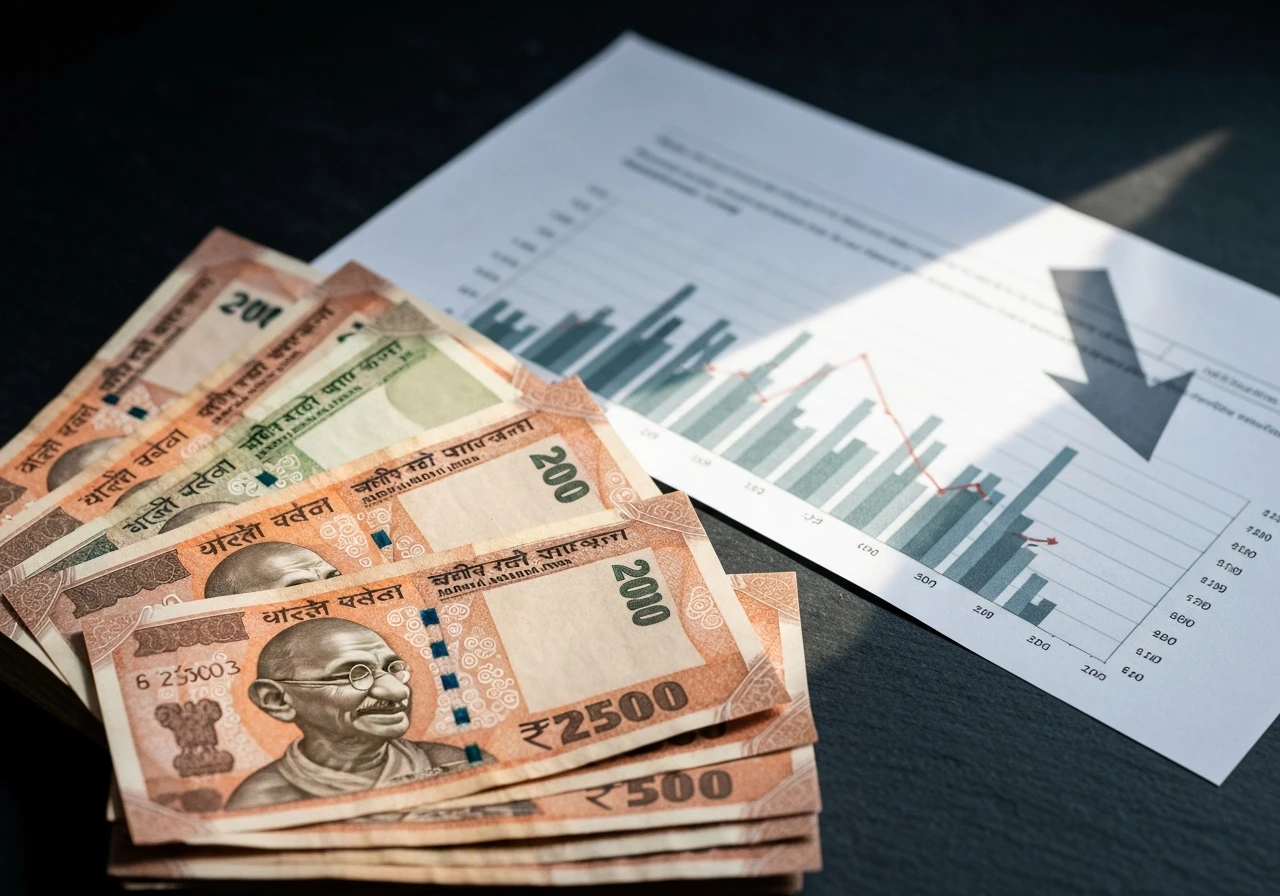
Why a 3.2% Print Counts as the Weakest May in Five Years
Context is everything with monthly tax data. May 2025 grew 16.4 percent. May 2024 and the years before it ran comfortably into double digits. A 3.2 percent reading is the lowest for the month across at least the past five financial years, and it follows an April that set an all-time record.
A government official pinned the soft print on the comparison base rather than current activity.
In May 2025, GST revenue included about Rs 10,000 crore of one-time payment made by a telecom operator for spectrum allocation. With no such one-time payment in May 2026, adjusted growth is therefore the right measure to evaluate the GST performance for May.
The official identified, government sources put the adjusted gross growth at roughly 9 percent once that spectrum payment is stripped from last year’s base. The math holds: take Rs 10,000 crore out of the May 2025 figure and this year’s collections rise about 9 percent on a like-for-like footing. That is a fair caveat, and worth stating plainly.
But an adjusted 9 percent is still a step down from April’s pace, and the adjustment only lifts the domestic line back to low single digits. The base effect explains why the number looks alarming. It does not explain away a domestic base that shrank in absolute terms. Both things are true at once.
Imports Carried the Month, Consumption Did Not
Strip the month to its drivers and one pattern dominates. External trade did the lifting; internal demand sat it out. That divergence has been widening all year, and May is the sharpest version of it yet.
- Rs 59,654 crore from imports, a 19.1 percent jump that outran domestic collections by a factor most months never see.
- -2.6 percent on domestic revenue, the line that mirrors household and business spending inside the country.
- Rs 27,281 crore in refunds, rising faster than gross revenue, a sign of cash-flow pressure on exporters and manufacturers.
An economy that grows its tax take only by importing more is not the same as one where shops, factories and services are humming. The rupee’s weakness feeds this loop too, lifting the rupee value of imported goods and the GST charged on them even when volumes are flat. India’s currency has been under sustained strain, sliding to record lows against the dollar amid capital flight, which mechanically inflates the import side of the GST ledger.
The West Asia Conflict Shows Up in April’s Ledger
GST collections always run a month behind the economy they measure. May’s receipts reflect transactions made in April, the second full month after the conflict in West Asia flared at the end of February. April’s record Rs 2.43 lakh crore haul, up 8.7 percent and detailed in the government’s official April GST data release, already carried the first signs of strain beneath its headline.
By May the moderation is harder to miss. Higher energy and freight costs tied to the regional tension squeeze margins and dampen discretionary buying, exactly the activity that feeds domestic GST. Importers, by contrast, often front-load purchases when supply routes look uncertain, which can briefly pump up import-linked revenue even as the domestic economy cools.
That timing lag matters for what comes next. If April was the cooling and May is the confirmation, June’s data, covering May transactions, will show whether this is a two-month dip or the start of a longer grind.
What FY27 Inherits From a 5-Year-Low Year
May does not arrive in a vacuum. It lands on top of a full financial year in which GST growth already decelerated to its weakest in half a decade, and the early FY27 (financial year 2026-27) numbers carry that weight forward.
A Soft Handoff From FY26
Gross GST collections for FY26 grew 5.57 percent to Rs 23.32 trillion, the slowest expansion since the pandemic-hit FY21. Twelve states recorded negative GST growth over the year. Factory activity was fading in parallel: the Manufacturing Purchasing Managers’ Index (PMI, a survey gauge where readings above 50 signal expansion) fell to 53.9 in March 2026, its lowest in 45 months. The structural problem was the same one May exposed, import receipts climbing while domestic consumption crawled.
The First Two Months Of The New Year
For April and May together, gross GST collections grew 6.2 percent year on year to Rs 4.37 lakh crore. That is better than May alone, propped up by April’s record, but it still sits below the double-digit pace the government built its revenue assumptions on. MS Mani, partner at Deloitte India, has argued that policymakers need to study collection differences between producing and consuming states to read these monthly swings properly, a reminder that the national average hides wide regional gaps. Household sentiment has been visible in other tax lines too, with gold purchases collapsing after a sharp import duty hike dented demand.
If June’s print confirms that domestic collections are still going sideways, the case that this is merely a base effect gets harder to make and the case for a genuine demand slowdown gets stronger. If domestic revenue snaps back above last year, the official explanation holds and May reads as a one-month quirk. The next data release, due in early July, settles which story India is actually living in.
 Windows 11 KB5095093 Lands With Point-in-Time Restore and 35-Day Pause
  Meta Cuts Smart Glasses to $299 to Outflank Snap and Apple
  Messi Leads the 2026 World Cup Golden Boot Race After Two Matches
  Australia March On as Athapaththu Ton Lights Up T20 World Cup
  Galaxy Z Fold 8 Leak Reveals Colors, Storage, and a New Ultra Variant
  Ronaldo’s Six-World-Cup Record Leads a Matchday Full of Milestones