
 Ishan Crawford
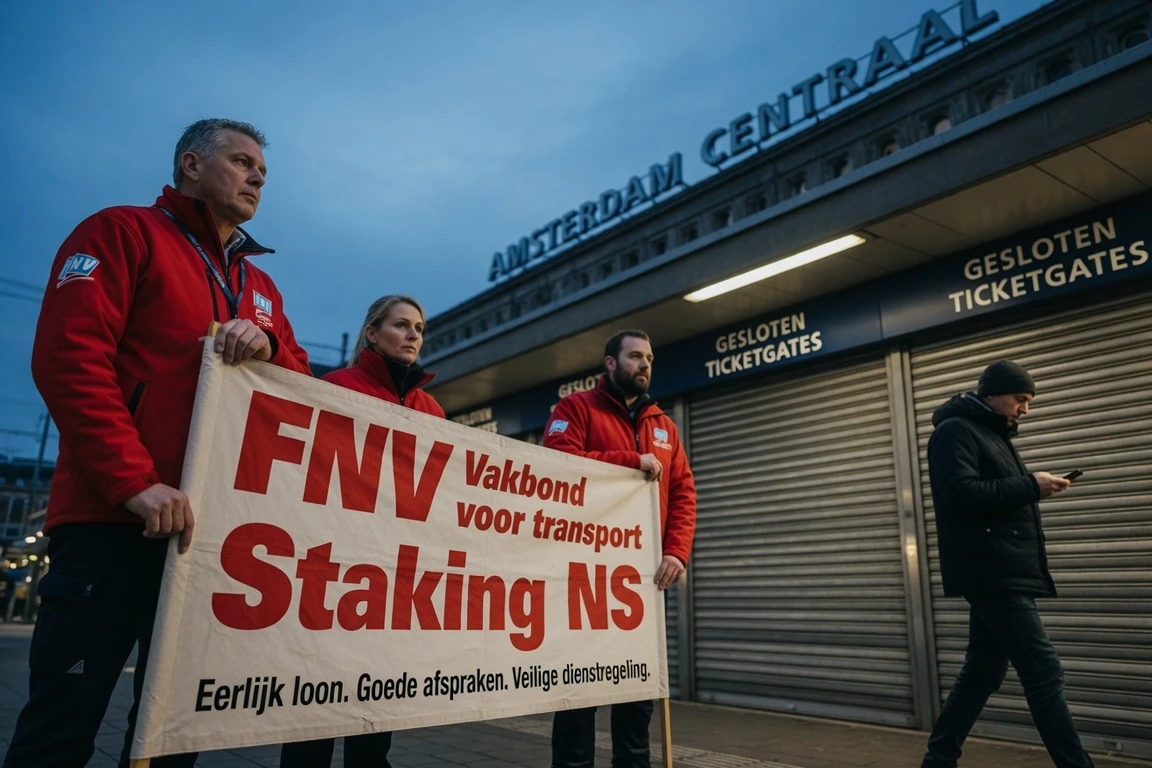
 Dutch public transport workers walked off the job at 4 a.m. on Wednesday morning, the start of a four-hour nationwide strike unions FNV and CNV had called to protest the Cabinet’s planned cuts to disability and unemployment benefits. National rail operator NS, regional and city trams, metros and buses are all off the road until 8 a.m., and most operators warn the disruption will run well past that. The walkout is the unions’ opening move in a standoff over the future of the Dutch welfare state, and they have already named what comes next.
FNV has already named what comes next. “If the plans are not taken off the table, we certainly do not rule out striking again after the summer. And then a 24-hour strike is the obvious next step,” FNV Spoor representative Henri Janssen said. The framing turns one morning into the first move in a longer standoff over the welfare state.
What Stops on Wednesday Morning
NS trains will not run between 4 a.m. and 8 a.m., and city networks in Amsterdam, Rotterdam and The Hague follow the same clock. The exceptions are narrow: GVB ferries in Amsterdam and the Sprinter service between Amsterdam Centraal and Schiphol Airport will keep operating through the strike window. The full strike notice published Tuesday afternoon sets out the schedule for national, regional and city networks.
At city and regional operators, the walkout begins at the start of the timetable and ends at 8 a.m., with services resuming from that point as vehicles are worked back out of depots. NS expects normal service to resume at 9:00 or 9:30 a.m., regional operator Arriva is targeting 8:30 a.m. for most of its buses and trains, and HTM in The Hague is aiming for around 10 a.m. The operator-by-operator restart schedule for 24 June is published by the Dutch journey planner.
Cleaning staff are also on strike in many regions, and 9292 asked travelers to take their rubbish with them where possible. International trains are split: Eurostar services to Paris and London are still running, but only for passengers with reservations, and EuroCity and EuroCity Direct will not operate during the walkout. The picture for the morning is mostly red on the public transport map, with one airport shuttle and a handful of ferries still moving.
| Operator | Strike hours | Service resumes | Notes |
|---|---|---|---|
| NS (national rail) | 4 a.m. to 8 a.m. | ~9:00 or 9:30 a.m. | Sprinter between Amsterdam Centraal and Schiphol keeps running |
| GVB (Amsterdam) | 4 a.m. to 8 a.m. | From 8 a.m. | Ferries continue; night buses run until 4 a.m. |
| RET (Rotterdam) | 4 a.m. to 8 a.m. | From 8 a.m. | Full timetable restored by ~11 a.m. |
| HTM (The Hague) | 4 a.m. to 8 a.m. | From 8 a.m. | Full timetable restored by ~10 a.m. |
| Arriva | 4 a.m. to 8 a.m. | ~8:30 a.m. | Hopes to have most services running from 8:30 a.m. |
| Connexxion, Hermes, Breng | 4 a.m. to 8 a.m. | From 8 a.m. | Full timetable restored by ~10 a.m. |
| Qbuzz | 4 a.m. to 8 a.m. | After 8 a.m. | Disruption depends on driver turnout |
| Bravo | 4 a.m. to 8 a.m. | After 8 a.m. | Cancellations expected until ~10 a.m. |
Why the Unions Are Striking
The fight is over the Cabinet’s plans for the Dutch welfare system, anchored in three programs that touch nearly every working-age Dutch person. The first is the WW, the unemployment benefit; the second is the WIA, which pays out when workers can no longer work because of illness or disability. The third is the AOW, the state pension, whose access age the Cabinet wants to push higher and faster than the current schedule. FNV, CNV and a third union, VCP, are fighting the package together. The unions describe the plan as demolition of the safety net for millions of Dutch people.
The Cabinet’s argument, as restated by Social Affairs Minister Hans Vijlbrief on 26 May, is that the reforms are needed to keep public finances healthy, resolve implementation problems and get the labor market moving. Vijlbrief also warned that, even after dropping parts of the package, the government would still need alternative measures to stabilize public finances. The unions’ counter is that the burden is being pushed onto workers who lose jobs or fall ill through no fault of their own.
The Pressure Point of a National Rail Strike
FNV and CNV did not pick the railways by accident. Dutch public transport has one of the highest union densities in the economy: between 80 and 90 percent of employees in the sector are union members, which makes calling and running a strike relatively easy. The union’s first-call notice for 24 June is published on FNV’s website.
Over a million people in the Netherlands use public transport every day, and the strike window sits squarely in the middle of the morning rush. Rijkswaterstaat, the national infrastructure agency, said thousands of workers will struggle to reach their jobs, and more drivers will switch to cars, adding to traffic jams on the roads. The economy-wide cost is borne in a single four-hour window, which is exactly the pressure the unions are looking to apply.
The Cabinet’s cuts, the unions argue, would push that cost onto a narrower group. “Employees and people who fall ill or lose their jobs through no fault of their own must not once again pay the price for political choices in The Hague,” Janssen said. If extra resources are needed, he added, they should be sought “from the wealthiest, and from the companies that make substantial profits year after year.”
We naturally assume that the Cabinet is taking our signal seriously. These demolition plans are disastrous for everyone. By dismantling the social safety net, this Cabinet is making the future of millions of Dutch people unnecessarily uncertain.
Janssen is the rail-sector representative at FNV, the Dutch trade union that organized the strike with CNV.
The Cabinet’s Concessions So Far
The Cabinet has already conceded ground. On 26 May, Social Affairs Minister Hans Vijlbrief told FNV, CNV and VCP that the government was abandoning central elements of its planned reforms, including proposals to shorten unemployment benefits, reduce maximum disability payments under the WIA system, and eliminate a separate benefit category for people who are fully and permanently disabled.
That was not enough for the unions. FNV, CNV and VCP said the revised approach remained “completely inadequate” and too unclear to accept, and they kept strike plans alive past the 30 May deadline they had set the Cabinet. The Cabinet had also separately dropped its plan to accelerate the AOW increase, another win the unions had pushed for.
What is left on the table is the harder core of the package. Vijlbrief made clear that the government still needs to find alternative measures to stabilize public finances, which means the WW and WIA debate is not over. The Cabinet has framed the original cuts as essential to keeping the welfare system solvent over the long term, while the unions have framed the same cuts as demolishing the safety net for millions of Dutch people. That is the political backdrop against which the walkout opens.
Neither side has moved off that position since May. The unions chose a national train strike for the morning because it forces the entire country to feel the cost in a single window. The Cabinet chose to keep its reform package in some form because the underlying fiscal argument has not changed. The standoff is now being fought out on the timetable, with each side pointing at a different cost. How the Cabinet responds over the coming weeks will set the terms for any post-summer escalation.
What Comes After Wednesday Morning
The week’s action stretches well beyond the rail strike. Demonstrators already gathered in Amsterdam on Tuesday, and demonstrations are also planned for Utrecht and Groningen on Thursday and for Rotterdam and Nijmegen this weekend. On Friday, workers at Eindhoven-based companies including DAF, ASML, SPIE and VDL will hold their own labor actions. The aim is to keep the political pressure on the Cabinet between the headline walkout on the railways and any escalation that follows.
The unions have named what comes next in plain terms. Janssen said a 24-hour strike is the obvious next move if the Cabinet does not take its social security plans off the table after the summer. He described the Cabinet’s program as demolition of the safety net, and said it leaves the future of millions of Dutch people unnecessarily uncertain. FNV is signaling that Wednesday morning is the entry fee, not the ceiling, and the Cabinet’s response over the coming weeks will determine whether the unions follow through on their threat of a 24-hour stoppage after the summer.
- Wednesday, 4 a.m. to 8 a.m. National public transport strike across NS, GVB, RET, HTM, Arriva and regional operators.
- Thursday. Demonstrations in Utrecht and Groningen.
- Friday. Labor actions at Eindhoven-based companies including DAF, ASML, SPIE and VDL.
- This weekend. Demonstrations in Rotterdam and Nijmegen.
- After the summer. Possible 24-hour public transport strike, per FNV Spoor representative Henri Janssen.
Getting Around During the Walkout
Commuters pushed onto the roads should expect heavier traffic and prepare for breakdowns in the heat. Rijkswaterstaat said drivers should carry water and an umbrella for shade in case they end up standing behind a guardrail waiting for help. A record-setting heatwave is also building over the country, which compounds the risk for anyone stuck on a stationary highway.
Trains and buses come back in waves rather than all at once. NS expects a normal timetable by 9:00 or 9:30 a.m., as set out in the operator’s disruption notice for 24 June. Arriva is targeting 8:30 a.m. for most services, and HTM in The Hague has told regional broadcaster Omroep West it should be back on schedule by approximately 10 a.m. RET in Rotterdam, Connexxion, Hermes and Breng are all aiming for around 10 a.m. for a fully restored service, with RET expecting its timetable back in full by 11 a.m.
Two operators are running outside the rail picture. GVB ferries in Amsterdam will keep operating through the walkout, and 9292 noted that Eurostar services to Paris and London will run during the morning, though only passengers with reservations can travel. The journey planner also flagged that cleaning staff are on strike in many regions, and asked travelers to take their rubbish with them. Bravo, a regional bus operator, said cancellations could run until around 10 a.m., longer than the four-hour strike itself.
Frequently Asked Questions
When does the Dutch public transport strike end?
The walkout runs from 4 a.m. to 8 a.m. on Wednesday 24 June, and most operators then take time to work their vehicles back out of depots. NS expects normal service between 9:00 and 9:30 a.m., RET in Rotterdam aims for a fully restored timetable by around 11 a.m., and HTM in The Hague has told regional broadcaster Omroep West it should be back on schedule by approximately 10 a.m.
Are international trains running during the strike?
Eurostar services to Paris and London are running during the morning, but only for passengers with reservations. EuroCity and EuroCity Direct services are not operating during the strike. The NS Sprinter between Amsterdam Centraal and Schiphol Airport is also still running.
What are the unions demanding?
FNV, CNV and VCP want the Cabinet to drop its planned cuts to disability (WIA) and unemployment (WW) benefits, and to abandon any faster rise in the state pension (AOW) age. The Cabinet has already scrapped the AOW acceleration and parts of the WIA and WW reforms, but the unions say the revised offer is still inadequate.
Will there be more strikes?
FNV has signaled that a day-long public transport stoppage would be the next escalation if the Cabinet keeps its social security plans on the table. The unions have lined up further demonstrations in Utrecht, Groningen, Rotterdam and Nijmegen, plus labor actions at Eindhoven companies including DAF, ASML, SPIE and VDL.
What should drivers expect on Wednesday morning?
Infrastructure agency Rijkswaterstaat expects more cars on the road because of the strike, on top of a building heatwave. The agency is advising drivers to carry water and an umbrella for shade in case of breakdowns.
 One UI 9’s Privacy Display Fix Reaches Just One Galaxy Phone
  Samsung Drops Its Own Exynos Chip for the Galaxy Watch9 and Ultra 2
  Marathon’s Vault Breaker Arrives as Bungie’s Bigger Bet Keeps Faltering
  Sony’s PlayStation Disc Cutoff Erases the Last Proof of Ownership
  Tesla’s Summer Update Hands Grok the Keys, and Musk’s Empire More Reach
  Apple’s $634 Million Masimo Payment Is Final After Appeal Denial