
NEWS
DataVita Wagers DV4 Against Scotland’s Data Centre Freeze
DataVita filed DV4 at Chapelhall, a trimmed 26-metre hall, as a local bet against unbuilt Scottish data centres and a freeze still only a motion.

DataVita has submitted a planning application for DV4, a new data centre at its Chapelhall campus in North Lanarkshire, after four public consultation events. Managing director Danny Quinn is staking the next hall on a record the firm already has on the ground, a building cut to 26 metres, and a claim that most other Scottish data-centre filings will never be built.
The outline papers went to North Lanarkshire Council on 2 September 2026. They sit inside a UK-backed growth zone, beside a hospital whose own £2.1 billion case was sent back in June, and one day before First Minister John Swinney refused to halt new halls.
A Third Hall at the Chapelhall Campus
The applicant is HFD Renewables, part of HFD Group. DataVita, the same group’s operator, would run the hall. Quinn said the company has been in Scotland for more than ten years, already underpins day-to-day services, built DV1 at Chapelhall, is building DV3, and staffs those rooms with a Scottish team. DV4, he said, is the next stage of that campus.
DV1 has run on York Road since 2016, first as a tenant in a hall raised by HFD Group, then as owner after a 2021 deal backed by £45 million ($63.1 million) from DataVita’s parent. The existing room is a 24MW, 8,000 sq m Tier III hall. DV2 sits in Glasgow, in the basement of 177 Bothwell Street, with 130 racks across 1,000 sq m. DV3, next door at Chapelhall, already has planning permission in principle, granted on 9 January 2026.
The new file is planning permission in principle, backed by studies on energy, noise, air, transport, flood risk, ecology, heritage, ground, jobs and construction. DataVita says the papers will appear on the council portal once they are validated, after which the statutory window for comments opens. Quinn urged people to read the detail rather than the rumour mill.
THE CAMPUS CLOCK
- 2016: DataVita starts operating DV1 at Chapelhall as the hall’s first occupier.
- 2021: The operator takes ownership of the site with £45 million of parent support.
- 9 January 2026: North Lanarkshire Council grants permission in principle for DV3, a 40MW extension on 1.8 hectares (application 25/01159/PPP).
- 29 January 2026: The UK government names the wider campus Lanarkshire’s AI Growth Zone, with DataVita and CoreWeave as delivery partners.
- 25 June 2026: Health Secretary Angela Constance refuses the £2.1 billion Monklands hospital business case in its current form and orders a redesign.
- 2 September 2026: HFD Renewables and DataVita submit the DV4 outline application after four public events.
That sequence is the wager. DV4 is not a cold start in a field with no operator, no staff and no hall already humming. It is also not a full consent. It is an outline bet that the council will accept another building on land bounded by the M8, the A73, Lancaster Avenue and Biggar Road, about 37 acres (15 hectares) of vacant former farmland.
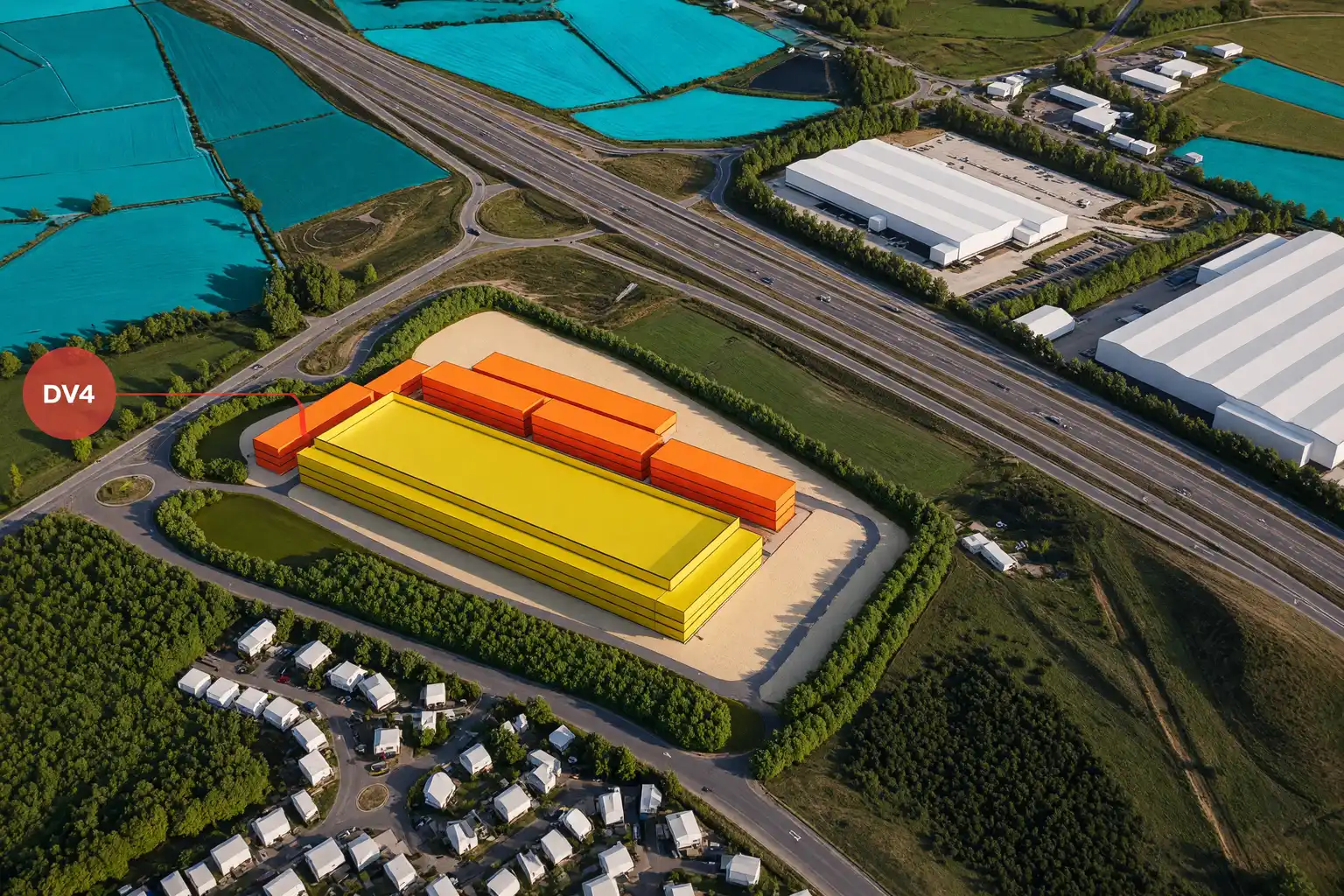
The Building Lost Four Metres and Gained a Hedge
DataVita held four consultation events, two more than the minimum, put the boards online throughout, and updated a public FAQ after each night. Feedback, the company said, changed the drawing before the file went in.
THE CONSULTATION CHANGES
- Height: The maximum building height falls from 30 metres (98 feet) to 26 metres (85 feet).
- Plant: Operational kit moves to the south of the hall, away from homes.
- Hedge: About 1,000 metres (3,280 feet) of new native hedgerow is proposed, at least double the length being taken out.
- Cooling: A closed-loop, sealed system with no evaporative cooling, and a water target of 0.05 litres per kilowatt hour or lower.
Those are neighbour-scale changes, and they are doing a lot of political work. The hall would run on 100 percent renewable electricity backed by certificated Scottish generation, with a power usage effectiveness target below 1.25. Backup plant, the earlier consultation material said, would use low-carbon fuel rather than diesel or gas, with on-site solar in the mix.
The design is written to the four tests for green data centres that planning minister Ivan McKee set out in October 2025: renewable power, efficient kit, less water, and reuse of spare heat. In that written answer he also confirmed that major “green” halls, including AI rooms, sit inside National Development 12 of NPF4, while leaving the call on each case with the planning authority. There is still no hard legal definition of green, which is why a 4-metre trim and a kilometre of hedge are in the brochure.
Local argument on X and in campaign notes has not been about the lost four metres. It has been about fields. The PAN site is described as vacant former farmland, and objectors already treat DV4 as one more industrial footprint on green belt rather than a tidy infill on a business park. Closed-loop cooling will not, on its own, settle people who can see grass from Lancaster Avenue.
What the £849.6m Application Puts on the Table
The DV4 pack is a local rates and jobs offer wrapped around a construction bill of £849.6 million over two years. DataVita puts that at 2,650 construction job-years and 120 permanent skilled roles on site, with apprenticeships, and says at least 40 percent of capital contracts should go to local suppliers. It also forecasts more than £30 million in business rates for the council over 25 years, plus £75 million over 15 years in a DV4 Community Investment Fund run by an independent board for projects that communities themselves put forward.
Keep that envelope separate from the bigger Growth Zone arithmetic published in January. The UK government, using figures DataVita supplied, designated Lanarkshire as an AI Growth Zone on 29 January 2026 and recited £8.2 billion of private investment, more than 3,400 jobs over the coming years, and a community fund of up to £543 million over 15 years. About 800 of those jobs are described as AI and operations roles, with the rest tied to building halls, kit and a renewables park. Fifty apprenticeships sit in the same pack. HFD Group also pledged £1 million a year to local charities.
DV4 MONEY AGAINST THE ZONE CLAIM
| Item | DV4 application | Lanarkshire AI Growth Zone |
|---|---|---|
| Capital | £849.6m construction over two years | £8.2bn private investment (DataVita figures, via UK government) |
| Work | 2,650 construction job-years; 120 permanent on-site roles | More than 3,400 jobs over coming years, of which about 800 are AI and operations |
| Community cash | £75m over 15 years, independent board | Up to £543m over 15 years, raised as capacity comes on |
| Power claim | About 100-124MW (council EIA screening) | 500MW of AI-ready halls (company figure used in the zone notice) |
In August, DataVita said a debt facility of about £300 million, unlocked by a £202 million National Wealth Fund guarantee and a syndicate including ING, ABN AMRO, Santander, the Scottish National Investment Bank and Siemens Financial Services, would help fund the Growth Zone rollout. That is real money behind the wager, and it still does not make DV4 a consent.
The Hospital That Was Meant to Take the Heat
Spare heat is the civic offer. DataVita says recovery is built in from day one and that it is in talks with the Monklands Replacement Hospital and the neighbouring BioCity campus. A feasibility study is also under way for a community garden and greenhouse warmed by that heat, an idea raised at the consultation nights and, if it happens, paid from the community fund.
The hospital half of that sentence moved in June. On 25 June 2026, Angela Constance told parliament she was committed to a new Monklands hospital on the Wester Moffat site in Airdrie, including A&E, but that the £2.1 billion design would not deliver value and would cost an estimated £5 million a bed. She ordered a joint redesign with NHS Lanarkshire and west of Scotland partners, with the Monklands redesign due in 2027, and promised targeted work on the existing hospital in the meantime.
The published net zero hospital energy plan already assumed an all-electric building with air-source and water-source heat pumps and a large solar array. A data-centre heat pipe would have to fit a design that ministers have now sent back. BioCity remains a neighbour with no public offtake deal. The greenhouse is a study, not a planting date.
WHAT WE KNOW
- The claim: DV4 drawings include heat recovery, and DataVita says talks with the hospital and BioCity are live.
- The hospital site: Wester Moffat remains the chosen ground, with core acute services including A&E still promised.
- The garden: Residents asked for a heat-fed greenhouse; the company has opened a feasibility study, to be funded from the community pot if it proceeds.
WHAT IS UNCONFIRMED
- A signed offtake: No hospital or BioCity heat contract has been published with the planning file.
- The 2027 hospital design: Ministers have not said whether a redrawn Monklands would still take data-centre heat.
- The greenhouse: No size, no plot, and no decision that it will be built.
Heat reuse is one of McKee’s four tests, so the talks have to stay in the application even if the customer is being redesigned. That is a planning fact, not a pipe in the ground.
One Hall Inside the 500MW Ambition
Council screening papers for DV4, referenced on the planning file as 26/00707/EIASCR, describe a green data centre of about 100-124MW. Officers decided in June that a full environmental impact assessment was not required. That is a mid-scale hall beside an existing campus, not the 500MW slogan on the Growth Zone banners.
DataVita’s own Growth Zone material, the figures the UK government recycled in January, still talks of 500MW of AI-ready capacity, more than 1GW of privately wired renewables, and innovation parks. Campaign maps treat South Lanridge, south of the M8 at Newhouse, as the likely home of that larger slice, still at pre-application under the working name DV6. CoreWeave is the named cloud partner. In the January notice, Ben Richardson, managing director of CoreWeave International, put a £1.5 billion figure on a production AI cloud with DataVita, part of a wider £2.5 billion UK AI spend, with Nvidia chips in the mix.
THE THREE CHAPELHALL HALLS
| Hall | Status | Power | Planning note |
|---|---|---|---|
| DV1 (Fortis) | Operating since 2016 | 24MW | Existing York Road hall, about 8,000 sq m |
| DV3 | Permission in principle, 9 January 2026 | 40MW | 25/01159/PPP, 1.8 hectares, under construction |
| DV4 | Outline application submitted 2 September 2026 | About 100-124MW | PPP; EIA screening 26/00707/EIASCR, EIA not required |
The operator already sells scientific compute from this campus. A green supercomputer at DataVita for University College London is the earlier chapter of the same local-operator pitch: a Scottish hall, already built, already staffed, already taking research loads. DV4 asks the council to believe that story at a larger scale, without treating the 500MW zone as a done deal.
Land and power remain the weak joints. A July energy analysis circulating around the zone argued that the private-wire wind and solar needed to match the 500MW claim would eat tens of square kilometres, far beyond the planning red lines now on file. DataVita says the zone will be grid-positive and privately wired. Until those energy parks have consents of their own, DV4’s 100 percent renewable claim rests on certificated Scottish generation and a power purchase agreement, which is a different thing from a private wire over the M8.
Holyrood’s Freeze Is Still Only a Motion
Quinn’s line about speculation is doing two jobs. It is a dig at paper campuses. It is also a pre-emptive answer to a political campaign that spent the summer trying to stop halls like his.
We don’t think of exporting barley when we talk about the success of our whisky industry, and data centres should be no different.
Danny Quinn, managing director, DataVita
The Scottish Greens have counted 24 hyperscale proposals and said that if all were built they would need up to 6,000MW, more than 1.5 times Scotland’s peak demand. Co-leader Ross Greer has pressed Swinney for a pause on approvals over 50MW until a national strategy and planning guidance exist. The SNP’s national council passed a motion in early July 2026 for a freeze on new data centres that have not yet got permission, and that motion went to ministers. Edinburgh has already refused one hall at South Gyle against an officer recommendation.
On 3 September 2026, the day after the DV4 file went in, Swinney again declined to commit to that pause. He has said existing planning policy is enough for councils to decide. NPF4 still treats major green data centres as national development. The SNP motion for a national freeze therefore sits on the desk, not in the statute book, while a 100-124MW outline application sits with North Lanarkshire.
Westminster is on the other side of the same rope. Liz Kendall, Kirsty McNeill and Rachel Reeves all fronted the January zone notice. McNeill called it the next chapter after coal and steel. Starmer sold local jobs and a cost-of-living fund. The Growth Zone status is conditional on delivery and on law. It does not replace a council vote on DV4, and it does not bind Holyrood if ministers later choose a pause.
Paper Campuses and the Operator Already on Site
Lanarkshire is crowded with drawings. Action to Protect Rural Scotland’s planning log puts several other large schemes in the same county still at notice or screening stage, including HFD’s own DV6 at South Lanridge, ILI’s Newhouse proposal, and Apatura sites at Drumshangie and Ravenscraig. Apatura’s Ravenscraig data centre plans are the clearest local comparison: a former steelworks pitch, a huge grid ask, and still no full application on the same timeline as DataVita’s third Chapelhall hall.
WHAT IS STILL ON PAPER NEARBY
- DV6, South Lanridge: HFD Renewables PAN for a large hall and battery kit on green belt south of the M8; public meetings in spring 2026, no PPP in yet.
- ILI, Newhouse: A separate hyperscale notice on fields next to the DataVita cluster, still in screening.
- Apatura, Ravenscraig and Drumshangie: Hundreds of megawatts at PAN or “EIA not required,” awaiting applications, including a Ravenscraig campus that collides with housing allocations.
Quinn’s “vast majority will never be built” line is the company’s own sorting hat. A hall already running, a second hall already consented, a third hall trimmed after four nights in a community centre, a £75 million local fund, and a National Wealth Fund-backed debt package are how DataVita wants North Lanarkshire to tell it apart from that pile. Objectors will answer with green belt, cumulative power, and a hospital that cannot yet sign for the heat.
The file is with the council and, once validated, open for comment. That is the whole of the wager until the planning committee sits.

Amazon Cargo Plane Kills Five on a Miami Perimeter Road

iQOO 16 Locks 8,400 mAh While 100W Charging Holds

The Naturepedic Serenade Shows What the Foam Years Cost

Simple Wave Chases Range as Ather Konarc Cuts Price

Mull’s Miracle Eagle Has Flown Into Adult Territory

Saksham Gaur Finds He Is His Own Company’s Client

NSE Pre-Open Session Copies the August Closing Auction

Kia Sorento Takes Aim at India’s Fortuner Class

The Rs 4.66 Lakh Crore IPO Queue Is Mostly Paper

Apple’s Foldable iPhone Hinges on Samsung Display Supply
-
 BUSINESS4 days ago
Saksham Gaur Finds He Is His Own Company’s Client
-
 BUSINESS4 days ago
NSE Pre-Open Session Copies the August Closing Auction
-
 AUTO4 days ago
Kia Sorento Takes Aim at India’s Fortuner Class
-
 BUSINESS4 days ago
The Rs 4.66 Lakh Crore IPO Queue Is Mostly Paper
-
 NEWS7 days ago
Apple’s Foldable iPhone Hinges on Samsung Display Supply
-

 BUSINESS4 days ago
Hyderabad 22-Carat Gold Jumps After a False Bargain
-

 GAMING7 days ago
Onimusha Way of the Sword Preload Hits a Windows 11 Wall
-

 NEWS5 days ago
Hugging Face Founders Sell the Open Hub to Nvidia