
 Ishan Crawford
 A 22-year-old deckhand died on Thursday, July 23, after falling from an aquaculture support vessel operated by Inverlussa Marine Services in Scapa Flow, the sheltered anchorage off Scotland’s Orkney Islands. A Royal National Lifeboat Institution (RNLI) crew from Stromness launched within minutes, boarded the workboat and got him ashore at Stromness pier, where he was pronounced dead a short time later.
The fall lands inside two overlapping stories at once. A UK safety code written for exactly this class of vessel is only now finishing a multiyear rollout, and Scotland’s aquaculture support fleet, Inverlussa’s included, is in the middle of its biggest expansion in years.
The Facts Still Missing From Stromness
Police Scotland were called to Stromness pier shortly after 2.50pm, according to STV News, after a report that a man had fallen from a boat in Scapa Flow. Officers said the death is not being treated as suspicious. Inverlussa has since posted a statement on its website confirming the crewman’s death, offering sympathy to his family and saying it is supporting other personnel who were aboard as well as colleagues across the company.
What has not been said publicly matters just as much as what has.
What we know:
- The victim was a 22-year-old man working as a deckhand aboard an Inverlussa-operated aquaculture support vessel.
- The RNLI’s Stromness lifeboat launched around 2.50pm on July 23 and two crew members boarded the workboat to help.
- He was transferred to emergency responders at Stromness pier and pronounced dead later that day.
What remains unconfirmed:
- The cause of death has not been disclosed.
- It is still unclear whether he fell into the water or suffered a fall while still on board.
- Neither Inverlussa nor Police Scotland has said whether the Marine Accident Investigation Branch (MAIB, the UK government body that investigates marine casualties) will open a formal inquiry.
That last gap will likely close first. MAIB investigates the overwhelming majority of fatal accidents aboard UK commercial vessels, and its findings, when they come, tend to arrive months after the event rather than days.
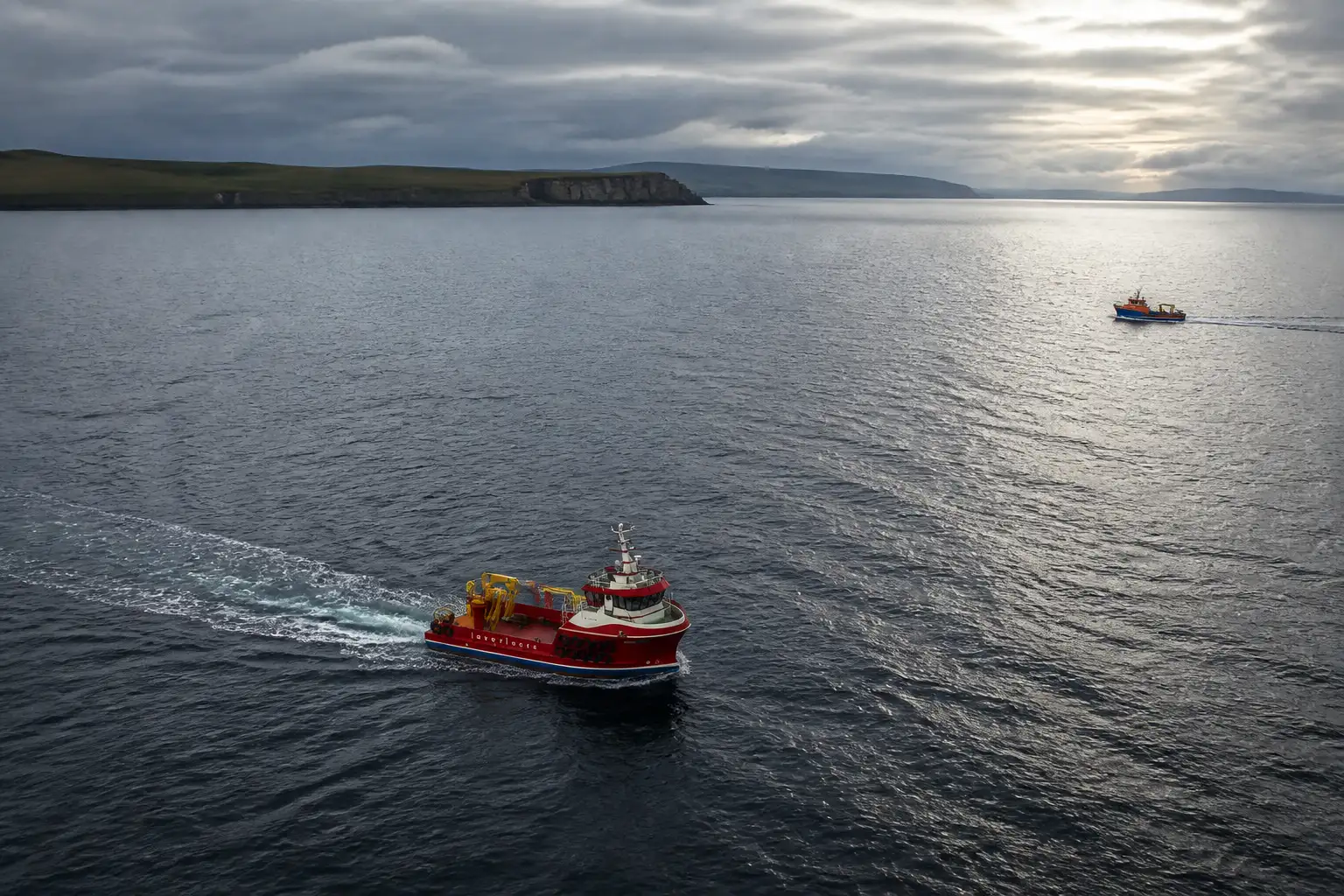
A Fleet Built for Scotland’s Salmon Boom
Inverlussa Marine Services is one of the main workboat operators serving Scotland’s salmon farms, running vessels that ferry feed, equipment and crew between shore bases and open-water pens. The company is mid-expansion. Three new hybrid vessels are due in the summer of 2027, growing its fleet from 22 to 25, according to a battery hybrid newbuild programme designed by Macduff Ship Design in partnership with the operator.
Each new vessel carries battery hybrid propulsion and IMO Tier III engines built to cut emissions and fuel burn against older tonnage. The investment is expected to create around 20 jobs in Scotland’s coastal communities.
| Vessel Type | Builder | Dimensions |
|---|---|---|
| Heavy service catamaran | Macduff Shipyards | 20 by 12 metres |
| Heavy service vessel | Nauplius Workboats (Netherlands) | 25 by 10.6 metres |
| Fish feed carrier | Parkol Marine Engineering | 27 by 11 metres |
Every cabin on the new vessels gets a private en suite, a design choice aimed partly at making longer rotations more livable for crew working Scotland’s often rough, remote sea lochs and firths.
Why Are So Many Workboats in Scapa Flow?
Scapa Flow is one of the busiest patches of water in Scottish aquaculture because it is one of the calmest. The natural harbour that once anchored Britain’s Grand Fleet through two world wars now shelters a dense cluster of salmon farms, run by companies including Cooke Aquaculture and Scottish Sea Farms.
Cooke operates several sites in the western Flow, among them Chalmers Hope, West Fara, Lyrawa Bay, Pegal Bay and Cava South, and is Scotland’s largest producer of organic-certified salmon, farmed exclusively in Orkney waters. Scottish Sea Farms has separately won planning approval to expand sites at Toyness and Bring Head, and one of its Orkney farms recently became the first in the region to meet the ASC standard, an international certification for responsible aquaculture. Every cage needs feed runs, lice treatments and staff transfers, and that work falls to workboats like the one involved on Thursday.
Orkney’s waters have taken other lives before this one. The archipelago, prized by wreck divers exploring the scuttled German fleet scuttled there in 1919, has also seen a diver’s fatal medical emergency at sea, a reminder that the same sheltered water drawing tourists and fish farmers alike carries its own risks.
Scotland Has Been Here Before
This is not the first time a Scottish aquaculture transfer has ended in death. On February 18, 2020, assistant fish farm manager Clive Hendry drowned after suffering a crush injury while being ferried by workboat Beinn Na Caillich from the Ardintoul farm to its feed barge in northwest Scotland. The farm and vessel operator was Mowi (Scotland) Ltd.
MAIB’s investigation into Hendry’s death found a chain of failures that safety regulators still cite as a cautionary case for the wider sector.
- The boat transfer had not been properly planned or briefed beforehand.
- No risk assessment had been carried out for personnel transfers by workboat.
- The crew had not run regular man overboard recovery drills and were unprepared for the emergency.
- Mowi lacked an effective marine safety management system and sufficient experienced staff to oversee its marine operations.
Nothing yet confirmed about Thursday’s fall in Scapa Flow suggests the same specific failures. But the case set a template that regulators point back to whenever a fish farm support vessel is involved in a fatality: informal transfer routines, thin supervision and safety paperwork that exists on paper more than in practice.
The Rulebook Still Filling In
Six years after Hendry’s death, the UK finally has a single, modern rulebook for vessels like the one in Scapa Flow. The Maritime and Coastguard Agency’s Workboat Code Edition 3 came into force on December 13, 2023, under the Merchant Shipping (Small Workboats and Pilot Boats) Regulations 2023. It covers commercial vessels up to 24 metres, the size band that includes most aquaculture support boats, and it requires a safety management system on every one of them regardless of size.
The code folded three older, overlapping regulatory frameworks into one document and became the first UK maritime code to set rules for remotely operated and alternative fuel vessels. But it was never a light switch. Existing vessels have until their next safety certificate renewal or December 2026, whichever comes later, to fully meet the new standard. That grace period closes this year, in the same stretch of months as this death.
Whether the workboat involved on Thursday had already completed that transition has not been disclosed.
Unpaid Crews Answer Every Call
The rescue itself fell, as it almost always does around Scotland’s coast, to volunteers. The RNLI is a charity that runs almost entirely on donations and unpaid crew rather than government funding, and it is the default responder whenever a commercial vessel gets into trouble in Scottish waters.
- 9,059 launches by RNLI crews across the UK and Ireland in 2025, the charity’s sixth busiest year on record.
- 272 lives saved in those call-outs.
- 1,251 launches around Scotland’s coast in 2023, up more than 12 percent on the year before.
- 46 lifeboat stations keep volunteer crews on standby around Scotland, Stromness among them.
Every one of Thursday’s rescuers was a volunteer, called away from ordinary jobs to answer a page for a commercial fishing company’s crewman. That arrangement is standard practice, not a failure of it, but it means the safety net under a fast-growing private industry is staffed largely for free.
A Statement, and a Question Still Open
Inverlussa’s public response has stayed narrow and careful: confirm the death, express sympathy, note that support is being offered to crew who were aboard and to colleagues across the company. No cause of death. No word yet on whether MAIB will investigate.
The company’s next hybrid vessels are still more than a year from delivery. The Workboat Code’s compliance window shuts before this year is out. Both timelines were already running before Thursday afternoon. Neither one paused for it.
Frequently Asked Questions
What Is Scapa Flow?
Scapa Flow is a large natural harbour among Orkney’s southern islands that sheltered the British Grand Fleet during the First World War and later became the scuttling site for the surrendered German High Seas Fleet in 1919. Today it hosts salmon farms, wreck-diving tourism and a steady flow of aquaculture support traffic.
Does the Workboat Code Apply to Fish Farm Vessels?
Yes. Workboat Code Edition 3 covers commercial vessels up to 24 metres, a category that includes the great majority of aquaculture support boats operating on Scottish sea lochs and firths, alongside pilot boats and offshore wind support craft.
Who Investigates Fatal Accidents on UK Workboats?
The Marine Accident Investigation Branch, an arm of the Department for Transport, investigates most fatal accidents aboard UK commercial vessels. It operates independently of police and does not apportion blame; its reports aim to establish causes and recommend safety changes, as it did after the 2020 Ardintoul fatality.
How Is the RNLI Funded?
The RNLI is a charity, not a government agency. It relies on public donations and legacies rather than state funding, and its lifeboat crews around the UK and Ireland, including the Stromness station involved on Thursday, are almost entirely unpaid volunteers.
 Scotland’s Facial Recognition Push Sparks Mask Ban Call
  Galaxy Z Flip 8 Hits $799 Only If Your Trade-In Qualifies
  If England Had Kept Water Public Like Scotland
  Samsung Smart Switch Now Moves Passwords and eSIM From iPhone
  Old Firm Spend Pulls Clear as Premiership Rivals Patch Squads
  Chinese Studios Quietly Seize the Gamescom Stage