
 Ishan Crawford
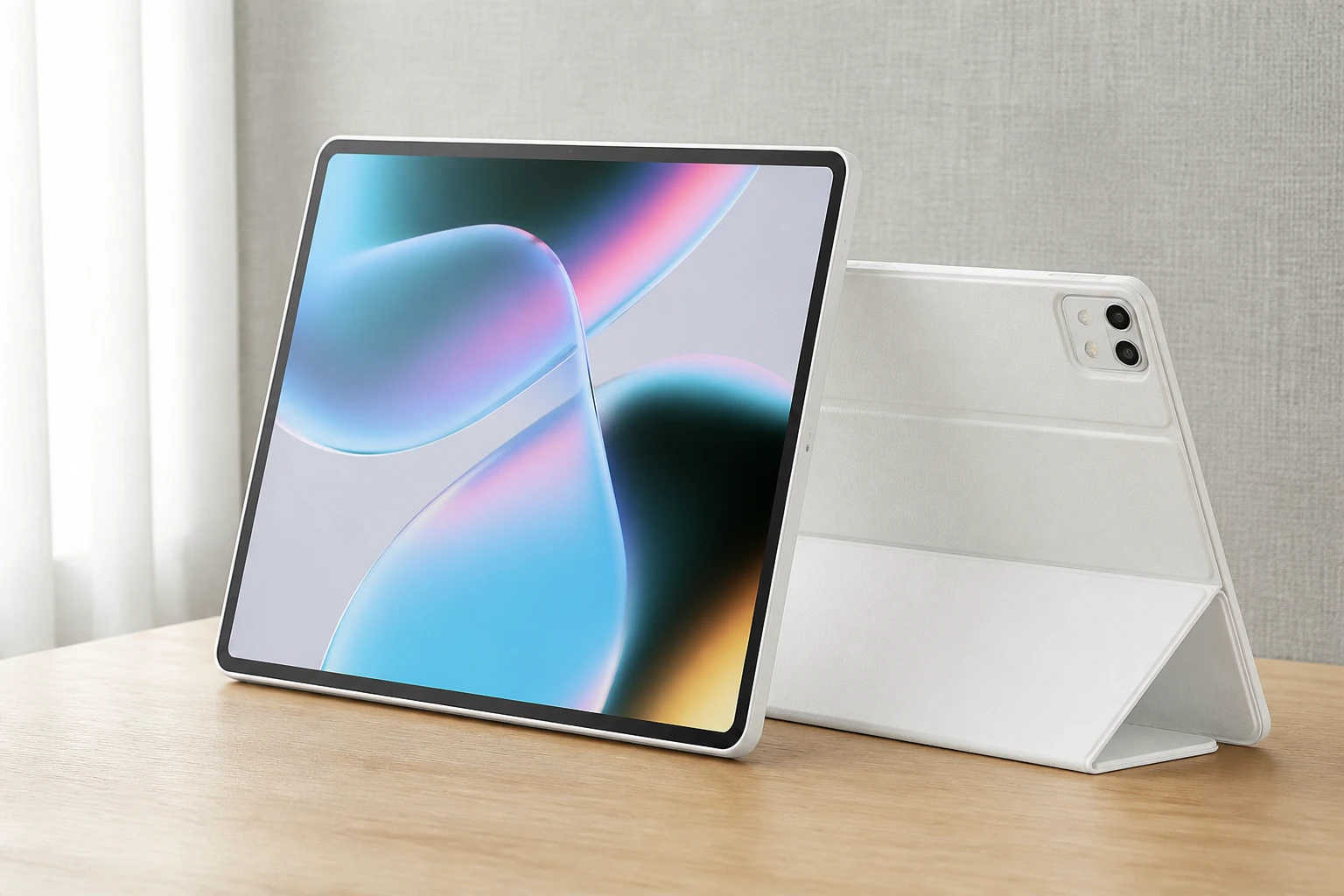
 Asus has priced the Pad T3201 at Rs 45,990 for the 8GB + 128GB model in India, packing a 12.2-inch dual-layer OLED panel that hits 2000 nits peak into a 523-gram slate. The 256GB version costs Rs 49,990. Sales start August 6 at noon IST on Flipkart, the Asus eShop, ROG Stores, Reliance Digital and authorised partners.
The move marks Asus’s return to consumer Android tablets after years focused on gaming laptops and 2-in-1s. Hardware specs land squarely against mid-premium LCD rivals while borrowing display tech long reserved for far costlier devices.
What Lands Inside the Pad T3201
The tablet measures 271.1 × 182.4 × 6.5 mm and uses a magnalium chassis with fiberglass back. It ships in Pure White only. A protective case comes in the box.
- Display: 12.2-inch (30.98 cm) dual-layer OLED, 2800 × 1840, 3:2, 144 Hz, 600 nits typical, 2000 nits HDR peak, 100% DCI-P3, Dolby Vision, 92% screen-to-body, TÜV low blue light and flicker
- Chip and memory: MediaTek Dimensity 8300 (4 nm), 8 GB LPDDR5X, 128 GB or 256 GB UFS 3.1, microSD to 1 TB
- Battery: 9000 mAh equivalent, 45 W USB-C, claimed 0-50% in 30 minutes under lab conditions
- Audio and cameras: four speakers with Dolby Atmos, 13 MP rear AF, 5 MP front with face unlock
- Connectivity: Wi-Fi 6E, Bluetooth 5.3, USB 3.2 Gen 1 Type-C with DisplayPort 1.4 and PD 3.0
It runs Android 16 out of the box with split-screen multitasking, Circle to Search and face unlock. Full details sit on the official ASUS Pad T3201 product page.
A Decade Away From Straight Tablets
Asus last pushed ZenPad models in India around 2016. After that the company leaned into Transformer-style 2-in-1s and ROG gaming gear. The June 2 Computex unveil of the Pad T3201 explicitly framed a “strong return to the tablet category after several years.”
- 2012-2016: ZenPad and Transformer series active in India and globally
- 2017-2025: Focus shifts to Windows convertibles, gaming handhelds and laptops; consumer Android tablets largely disappear
- June 2, 2026: ASUS Pad T3201 unveiled at Computex with dual-layer OLED
- July 30, 2026: India pricing and August 6 sales date confirmed
India’s tablet market itself grew in early 2026 on larger screens and higher average selling prices, per Counterpoint Research. Premium and mid-premium segments absorbed most of the volume. Asus is walking back into a category that now rewards display quality more than bare specs.
Why the Dual-Layer Panel Changes the Math
Most Android tablets at this price still ship LCD or single-layer OLED. The Pad T3201 uses a tandem (dual-layer) OLED that stacks two emission layers. ASUS says the structure delivers better power efficiency, longer panel life, higher sustained brightness and more consistent color than conventional single-layer OLEDs.
- Dual-layer OLED: two stacked organic emission layers that share the brightness load, cutting current density per layer and reducing burn-in risk while raising peak output
That architecture previously appeared mainly on high-end iPad Pro models. Peak brightness reaches 2000 nits; typical is rated 600 nits. The panel covers the full DCI-P3 gamut and carries TÜV Rheinland eye-comfort certifications. Refresh sits at 144 Hz with a 3:2 aspect ratio suited to documents and split windows. An earlier dual-layer OLED deep dive on this site unpacked the same stack when the global model first appeared.
The ASUS dual-layer OLED architecture details in the June press release stress extended viewing sessions without the usual efficiency trade-offs. Related supply-chain moves, such as Samsung OLED panel production moves for other form factors, show how panel makers are scaling advanced stacks beyond pure flagships.
Rs 45,990 Puts OLED Against LCD Rivals
The base Pad undercuts many expectations that floated in the Rs 28,000-35,000 range before pricing landed. It now sits near the OnePlus Pad 3, which starts around Rs 49,999 with a larger 13.2-inch 144 Hz LCD and stronger Snapdragon silicon but no OLED.
| Model | Display | Chip | Battery / Charge | Starting Price (India) |
|---|---|---|---|---|
| Asus Pad T3201 | 12.2″ dual-layer OLED 144 Hz 2.8K | Dimensity 8300 | 9000 mAh / 45 W | Rs 45,990 |
| OnePlus Pad 3 | 13.2″ LTPS LCD 144 Hz | Snapdragon 8 Elite | ~12140 mAh / 80 W | ~Rs 49,999 |
| Typical mid Galaxy Tab FE | often LCD or lower-tier OLED | varies Exynos/Dimensity | varies | often Rs 40k-55k range |
Asus includes a case and supports microSD expansion to 1 TB. Storage choices stay modest at launch (max 256 GB onboard). No cellular option appears in the India SKUs. Twelve-month no-cost EMI starts at roughly Rs 3,833 per month according to coverage of the pricing announcement.
On X, tech accounts flagged the hardware-to-price ratio immediately. One widely viewed post from @Gadgetsdata listed the full sheet and simply asked “Thoughts?” after noting the 2000-nit peak and sub-50k tag. Earlier Beebom coverage of the tandem OLED called it a welcome new OLED option for the Indian market.
GlideX, Stylus and the Everyday Extras
Software leans into Asus’s existing PC ecosystem. ASUS GlideX cross-device software lets the tablet share screens, transfer files and extend control with nearby Asus laptops and desktops. Circle to Search and Google Gemini features arrive with Android 16.
Optional accessories expand the pitch:
- ASUS Pen 2.0 for notes and drawing (sold separately; check local availability)
- Bluetooth keyboard support for laptop-like typing
- Included protective case for basic scratch resistance
The optional ASUS Pen 2.0 stylus support page confirms compatibility. Face unlock works for casual access but is not presented as high-security authentication for banking apps.
One recurring crowd note on launch day concerned software longevity. Asus phone policies have historically run shorter than Samsung or Google (often two OS upgrades plus a few years of security). No multi-year OS roadmap was published with the Pad T3201, so buyers who keep tablets four-plus years may weigh that against the display and battery.
Who This Tablet Targets Next Month
Students and media-heavy households get a bright, high-refresh OLED that still slips into a bag at 523 g. The 3:2 ratio and split-screen tools suit note-taking and side-by-side video. Creators who already own Asus laptops gain GlideX continuity. Price-sensitive shoppers who refused LCD mid-rangers now have a tandem OLED alternative under Rs 50,000.
Competitors keep advantages elsewhere. OnePlus offers bigger batteries and faster charging on LCD glass. Apple’s iPad entry models retain longer software support and a denser accessory ecosystem, though at higher starting prices for comparable screen quality. Samsung’s FE series often undercuts on pure value while trailing on panel grade.
Availability begins August 6. Early stock will sit on Flipkart and Asus channels. The hardware bet is clear: advanced OLED at a price that forces every LCD tablet near Rs 50,000 to justify itself.
Frequently Asked Questions
What is dual-layer or tandem OLED on the Asus Pad T3201?
It stacks two OLED emission layers so each runs at lower current density. The result is higher peak brightness, better efficiency and potentially longer panel life than single-layer OLEDs of similar size, a design previously common on premium iPad Pro models.
How thin and light is the Asus Pad T3201 exactly?
The chassis measures 6.5 mm thick and weighs 523 grams. Materials are magnalium frame plus fiberglass back cover, keeping rigidity without extra mass.
Does the Asus Pad T3201 support microSD and how much?
Yes. A microSD slot expands storage up to 1 TB beyond the 128 GB or 256 GB UFS 3.1 internal options.
What accessories ship in the box with the India model?
A protective case is included. The 45 W charger, ASUS Pen 2.0 and Bluetooth keyboard are separate purchases.
What processor node does the Dimensity 8300 use?
MediaTek fabricates the Dimensity 8300 on a 4 nm process, balancing the octa-core CPU (up to 3.35 GHz) with power efficiency for mixed tablet workloads.
 ONGC licence frees Venezuela cash and operatorship talks
  Anthropic Hits $65 Billion Run Rate and Flips the AI Cash Test
  Supreme Court grounds the fare free-for-all with three-week clock
  Gold Nears $4400 as Soft Data Meets Oil Inflation Risk
  Nifty Slips as Zaggle Circuits and Dhoot Debuts Big
  Diesel Crack Tops $100 as Iran Rhetoric Lifts Crude