
 Ishan Crawford
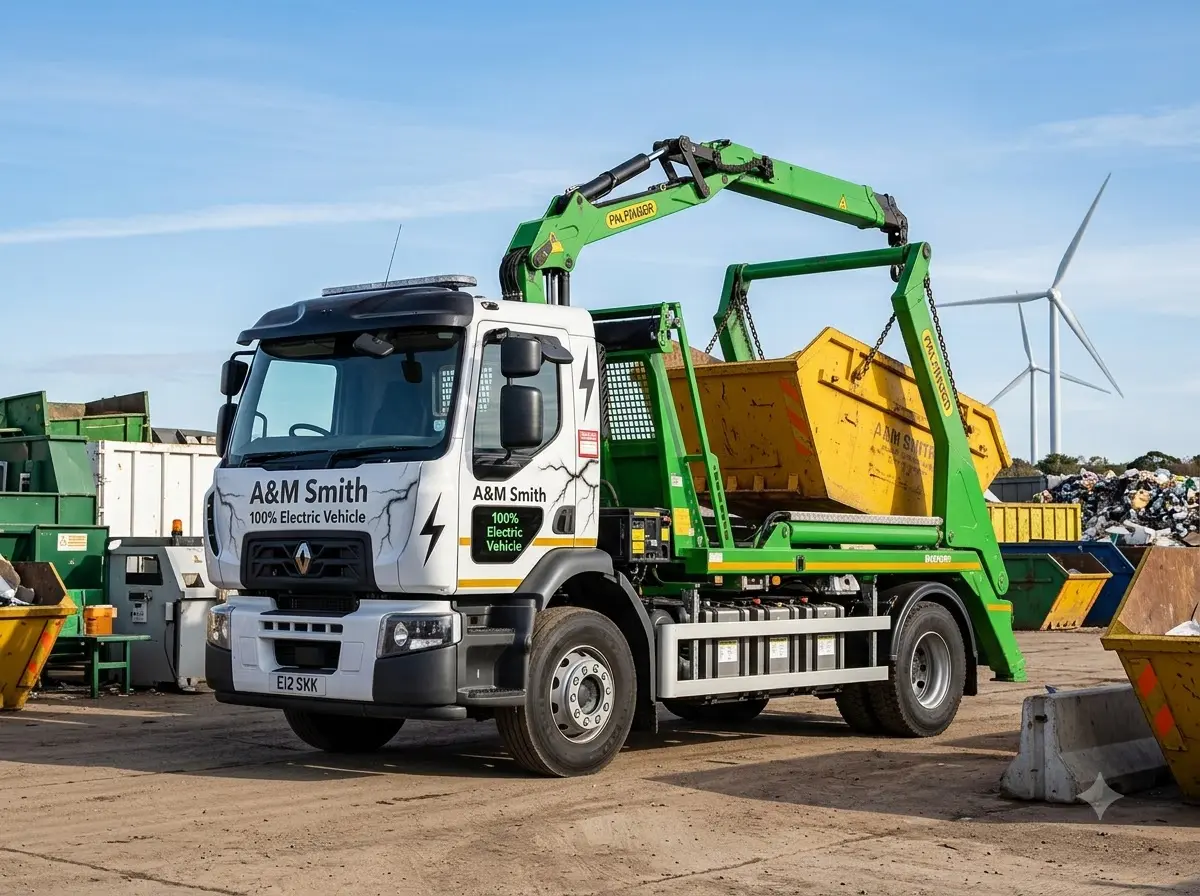
 A&M Smith Recycling has put Scotland’s first Renault Trucks electric skip loader into daily service around Aberdeen, an 18-tonne E-Tech D Wide that returns each night to the Bankhead Recycling Centre for charging while the family firm advances a separate 1MW wind turbine and battery-storage project to power vehicles and plant on site.
The move is more than a single zero-tailpipe truck. It tests whether a mid-sized waste operator can pair fleet electrification with its own renewable generation and cut the energy-cost and grid-connection barriers that still slow commercial vehicle switchovers across Scotland.
The Truck Now Running Local Aberdeen Routes
The Renault Trucks E-Tech D Wide 4×2 carries four battery packs and a Palfinger skip-loader body. It joins a 16-vehicle waste-collection fleet based at the company’s centre south of Aberdeen and handles skip deliveries and collections for residential, commercial and industrial customers before overnight depot charging.
Owner Scott Smith said the company had looked hard at cutting diesel use. “Putting our first electric skip wagon, the Renault Trucks E-Tech D Wide, on the road is an important step. This zero tail pipe emissions vehicle will have a dramatic impact on our Scope 1 emissions, as well as the benefits of the Scope 3 impacts on our offshore services customers.”
The truck is deliberately kept on selected local routes rather than longer hauls. Drivers have responded well. Lower maintenance, no AdBlue and a smooth electric driveline already point to reduced day-to-day running costs versus diesel, Smith added.
- Back-to-base cycles allow planned overnight charging at a known depot.
- Daily mileage can be mapped in advance, matching battery limits.
- Quiet running suits residential and early-morning collections.
- Visible zero-emission presence supports customer ESG reporting.
Regenerative braking returns energy on multi-stop urban routes that normally waste braking heat. A three-year repair and maintenance package backs the vehicle while A&M Smith gathers real energy-use and route data.
Why Skip Collection Fits Battery Trucks Early
Skip work returns vehicles repeatedly to the same yard. That duty cycle matches current battery-electric heavy truck strengths far better than long-distance trunking.
Renault Trucks positions the E-Tech D Wide for peri-urban goods and waste collection, with payload close to diesel equivalents. Official material cites a 265-kWh battery for waste collection configurations that have completed full working days on one charge when duty cycles align. A&M Smith has not published the exact usable capacity or measured range of its four-pack truck.
| Attribute | E-Tech D Wide (typical) | Equivalent diesel skip loader |
|---|---|---|
| GVW class | 18-26 tonnes | 18-26 tonnes |
| Power | Up to 370 kW peak / 260 kW continuous | Comparable diesel output |
| Battery / fuel | ~265 kWh packs common | Diesel tank |
| Tailpipe CO2 / NOx | Zero | Standard diesel emissions |
| Noise | ~10 dB quieter | Conventional engine and exhaust |
| Maintenance items | No AdBlue, fewer fluids | AdBlue, oil, filters, exhaust after-treatment |
Earlier UK deployments proved the concept. RiverRidge introduced Northern Ireland’s first electric skip loader in 2024 on the same E-Tech D Wide platform. Recycling Lives and others ran similar machines years earlier. Scotland’s first has arrived later, but the duty cycle that worked elsewhere is unchanged.
Family Firm Serving Offshore Customers
Scott and Kerry Smith established A&M Smith Recycling Services in 1994 on the inert landfill site begun by Scott’s parents Albert and Muriel in 1972. The business now runs from Portlethen (Bankhead) and Peterhead, handling dry waste, hazardous waste, skip hire, wood, green waste, plasterboard, tyres and recycled aggregates for local authorities, construction, small firms and offshore service providers.
The electric truck’s Scope 3 benefit for those offshore customers is deliberate. Many North Sea operators face their own decarbonisation targets and prefer suppliers who can show lower-carbon logistics. Quiet, clean arrivals at customer sites supply visible proof of investment.
The firm already runs a 12-tonne electric forklift and has installed plug-in vehicle charging points. The skip loader is the first heavy electric truck, not the first electric asset.
The 1MW Wind Turbine and Storage Bet
Depot electrification lives or dies on energy infrastructure as much as on the truck. Grid capacity, connection queues, charging schedules and electricity price all sit beside range and payload.
A&M Smith is progressing a 1MW wind turbine combined with battery storage at its main site. Company updates state the aim of powering electric vehicles with renewable electricity from that turbine, with an operational target of October 2026. The company green energy services page already lists solar, battery storage and hydrogen among broader offerings.
- 1MW planned wind capacity at the recycling centre.
- October 2026 target date for turbine operation.
- Battery storage to time-shift generation into overnight truck charging.
- Existing electric forklift and plug-in chargers already on site.
Keith Johnston, regional business manager at Renault Trucks UK, noted the wider approach: “A&M Smith is also considering the complete energy picture, including renewable generation, battery storage and charging infrastructure. That practical, long-term approach will be invaluable as the business builds its experience and considers further fleet electrification.”
If the turbine and storage perform as planned, later electric trucks can draw from on-site generation rather than solely from the grid. That changes the total cost of ownership calculation for a firm of this size.
Scotland’s Heavy Fleet Still Mostly Diesel
Scotland has roughly 37,000 registered HGVs. They form a small share of the vehicle parc yet a large slice of road-transport emissions. The Zero Emission Truck Taskforce and the published HGV Decarbonisation Pathway for Scotland map the barriers: vehicle availability, total cost of ownership, depot and en-route charging, skills and financing.
Infrastructure work continues. A 2025 phase of en-route mapping found at least 63 charger locations needed for battery-electric HGVs, with roughly 26 already built or under development and about 37 still required. Depot charging remains the practical starting point for most operators, exactly the model A&M Smith is using.
European electric medium- and heavy-truck sales rose sharply in 2025, with the UK among the faster-growing markets. Waste and municipal fleets appear early because routes are short, predictable and depot-based. Long-haul articulated work still waits on higher range, faster charging and denser motorway infrastructure. Crowd discussion on X often collapses the two use cases into one “electric trucks cannot do distance” claim; the Aberdeen skip loader simply does not need that distance.
The same local logic that makes the truck workable also underpins Scotland’s wider net-zero economy growth, where energy, waste and logistics firms are adding jobs and investment outside the old oil-and-gas core.
Running Costs, Drivers and the Next Trucks
Early feedback inside A&M Smith is positive on driveability and potential cost savings. Fewer maintenance items and no AdBlue remove two familiar diesel expenses. Regenerative braking on stop-start skip rounds recovers energy that diesel trucks throw away as heat. The three-year support package reduces uncertainty while real-world kilowatt-hour per kilometre figures accumulate.
Renault Trucks has done a great deal of groundwork on electric vehicles and, in our view, is one of the leaders in terms of knowledge and practical experience. Keith and the team at Renault Trucks understand the product and the industry, and worked hard to find a commercial solution that enabled us to put this vehicle into operation.
Scott Smith said that support mattered because the firm was investing in new technology for the first time.
The truck will stay on carefully chosen local work while the company learns. Further electric HGVs will depend on the data, the turbine project and the economics that emerge once on-site generation is available. For now the combination of one electric skip loader, depot charging, an existing electric forklift and a concrete wind-plus-storage plan gives a clear test bed for other Scottish waste and recycling SMEs watching the same numbers.
Quiet mornings on Aberdeen streets and a planned turbine on the Portlethen skyline are the visible parts. The quieter calculation is whether self-generated power can finally make the second and third electric trucks an easy yes.
 ONGC licence frees Venezuela cash and operatorship talks
  Anthropic Hits $65 Billion Run Rate and Flips the AI Cash Test
  Supreme Court grounds the fare free-for-all with three-week clock
  Gold Nears $4400 as Soft Data Meets Oil Inflation Risk
  Nifty Slips as Zaggle Circuits and Dhoot Debuts Big
  Diesel Crack Tops $100 as Iran Rhetoric Lifts Crude