
 Ishan Crawford
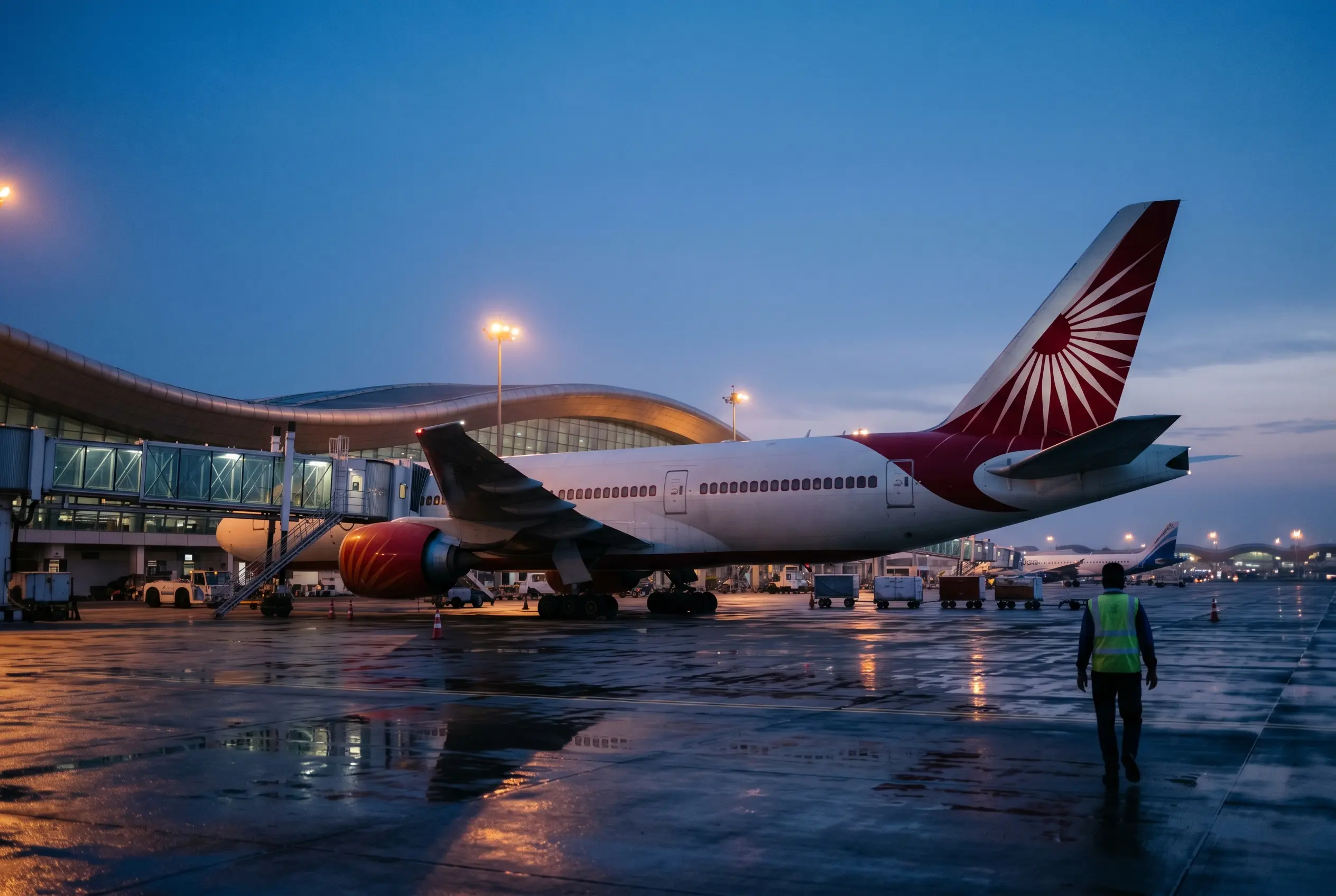
 Air India will trim about a fifth of its domestic flying between June and August, the carrier said on Wednesday, layering a fresh 22 percent reduction onto a 27 percent international pullback announced earlier this month. The two cuts together remove close to a thousand weekly departures from the network that had been the airline’s growth story since the Tata Group took the carrier back from the government in 2022.
The trigger is a jet fuel market that has roughly doubled since late February, when fighting in West Asia and the choking of the Strait of Hormuz pushed crude into a war premium that has refused to ease. The domestic schedule, which still runs about 3,600 weekly services, is the part of the business that had been quietly subsidising the loss-making long-haul book. That cross-subsidy has now snapped.
Twenty-Two Percent of the Home Network Trimmed for the Summer
The airline’s official statement on the route rationalisation, issued from its New Delhi headquarters, said the cut applies to “select domestic routes” between June and August 2026 and frames the move as a continuation of the earlier international rationalisation. Air India did not publish a route-by-route list, but industry trackers point to the metro corridors that absorb the bulk of capacity.
Key elements of what the carrier confirmed:
- Roughly 20 to 22 percent of weekly domestic departures will be removed for the three-month window
- The change runs in parallel with reductions on 29 international routes filed in mid-May
- Affected passengers will be offered rebooking on alternative dates, switches to other Air India flights, or full refunds
- Frequencies will be restored “once the situation stabilises”, the airline said, without committing to a calendar
The math is steep. The carrier runs about 4,400 weekly flights in total, around 3,600 domestic and 800 international. Strip out 22 percent of the domestic block and you are looking at roughly 790 fewer departures every week. Add the 145 weekly international cuts already filed with regulators and the flag carrier loses close to a thousand flights every seven days before the summer is out.
Jet Fuel Doubled in Four Weeks
The price chart is what every airline finance team in Asia has been staring at since February. The IATA global jet fuel benchmark closed the week ending 27 March at $195.19 a barrel, nearly double the $99.40 it printed at the end of February. That is the fastest four-week move on the IATA series in more than a decade.
- 40 percent of India’s crude imports normally move through the Strait of Hormuz, which Tehran has effectively closed to most shipping
- $108 a barrel is where Brent traded on Day 75 of the war, before easing toward the mid-$90s in late May
- 2.5 to 3 times is the multiple by which Air India’s effective fuel bill has risen, according to internal guidance from the carrier’s chief executive
Hormuz is the single biggest swing factor. The waterway normally carries about a fifth of seaborne oil; with traffic restricted, refiners across Asia are bidding up cargoes from West African, Latin American and US Gulf alternatives, and insurance premiums sit on top. India’s three big jet fuel suppliers, Indian Oil, Bharat Petroleum and Hindustan Petroleum, reset prices on the first and 16th of each month, and the May revisions caught the airlines mid-summer-schedule.
The government has been trying to keep the cost shock from spilling further. The export duty on aviation turbine fuel (ATF, the kerosene-grade product that powers commercial jets) was raised to ₹29.50 a litre to keep domestic supply intact, after refiners began routing more product overseas at premium prices. The duty does not bring the per-litre price down for airlines; it only stops the spread from widening.
Metro Corridors Will Do the Heavy Lifting
Carriers customarily protect tier-2 and tier-3 frequencies because Ude Desh ka Aam Naagrik (UDAN, the regional connectivity subsidy programme) makes those routes politically sensitive. The new cuts will therefore land hardest on the dense metro pairs where the carrier and IndiGo run near-hourly rotations and where there is room to thin without leaving a city stranded.
The carriers have not published an official thin-out list, but the corridors most exposed share three traits: high frequency on both airlines, a saturated slot file at the origin airport, and a fare base elastic enough to absorb a step-up. The metro grid below is where industry analysts expect the bulk of the reductions to land in June.
| Corridor | Typical Air India weekly frequency | Reduction risk for June-August |
|---|---|---|
| Delhi to Mumbai | ~140 weekly (both carriers combined) | High; densest slot file in the country |
| Delhi to Bengaluru | ~110 weekly | High; tech-corridor demand softening |
| Mumbai to Chennai | ~70 weekly | Medium; fewer alternate carriers |
| Delhi to Hyderabad | ~80 weekly | High; overlapping IndiGo dominance |
| Bengaluru to Hyderabad | ~50 weekly | Medium; short-haul price-sensitive |
Industry estimates put the average domestic fare already up 13 to 15 percent in the past two months, with international tickets running 35 to 40 percent above year-ago levels. The Ministry of Civil Aviation lifted its emergency airfare cap earlier this year after the December IndiGo operational meltdown, which means there is no regulatory ceiling absorbing the summer pop.
IndiGo Picks Up What Air India Drops
The competitor dynamic matters because India’s domestic market is the closest a major economy has to a duopoly. IndiGo, which controlled about 59.6 percent of domestic seats in December, has flagged its own 5 to 7 percent capacity trim for the same window. That is roughly a quarter of the haircut Air India is taking, which means the share gap that narrowed all year on the back of the Vistara merger is about to widen again in the market leader’s direction.
The Gurugram-based low-cost carrier has also been redeploying aircraft pulled off thinner overseas legs back into the domestic grid. Its first Airbus A321XLR (an extended-range narrow-body that opens long-thin city pairs) is due in service this year and unlocks routes from secondary metros that previously needed a wide-body. If Air India does not restore frequencies promptly in September, the market leader’s slot grandfather rights at Delhi and Mumbai will consolidate further.
The smaller carriers cannot soak up the vacated capacity. Akasa Air is still in growth mode, but its incoming 26-aircraft delivery line cannot turn out summer capacity in weeks. SpiceJet remains capital-constrained and has been running closer to a survival mode than an expansion one. The net effect is that fares are climbing on every screen because the absorbed-capacity story is mostly a one-name story.
Bigger picture, the Indian aviation map for the summer of 2026 looks like a hardening duopoly with one player visibly limping. That is the structural reading shareholders at Tata and Singapore Airlines, which jointly own the carrier, are reportedly weighing as they discuss fresh equity or debt support.
The 26,765-Crore Hole Behind the Pullback
Air India reported a loss of ₹26,765 crore (about $2.8 billion) for the fiscal year ended March, the biggest annual loss since Tata took the airline back in 2022. The carrier had been narrowing losses through fiscal 2025 on the back of the Vistara merger and aggressive long-haul expansion. Fuel and conflict reversed the arc inside a single quarter.
Campbell Wilson, who has run the airline since 2022 and will step down later this year, told staff in an internal note that costs were the immediate focus.
Maintain a relentless focus on costs. The combination of airspace closures, rupee depreciation and a 2.5 to 3 times increase in jet fuel prices compared with earlier levels makes operational discipline non-negotiable.
Campbell Wilson, chief executive of Air India, in a 7 April note to employees later confirmed by the airline.
The pullback is also defensive in a cash sense. Shrinking the schedule shrinks the cash-burn surface area while the shareholders decide on a recapitalisation. Singapore Airlines, which holds a 25.1 percent stake after the Vistara absorption, has already taken a writedown on its India accounting position. A second writedown in two years would be politically awkward in Singapore and is one reason both sides are reportedly motivated to inject capital before the next results window.
The board met on 7 May to review costs, succession and the West Asia exposure. No public communique followed, but the international rationalisation surfaced six days later and the domestic one followed two weeks after that.
Refunds, Rebooking and the Smaller Carriers
Passengers holding tickets on routes affected between June and August have three formal options under the airline’s stated policy:
- Rebook on an alternative Air India flight on the original or a nearby date at no charge, subject to seat availability
- Switch to a different city pair through a connecting itinerary if the original route is suspended outright
- Request a full refund to the original payment method, processed within the standard 7 to 14 working-day window
Travel insurance with trip-disruption cover may also apply for non-refundable hotel or onward-connection costs; check the policy wording for “airline schedule change” rather than just “cancellation”. Bookings purchased through online travel agents need to be amended through the OTA, not the airline call centre. Indian carriers other than IndiGo, particularly Akasa on east-coast and west-coast metro pairs, still have spot inventory at fares closer to the pre-spike base.
The schedule’s restoration depends on a fuel-price reversion that the airline can neither schedule nor hedge. If Hormuz traffic resumes and the IATA benchmark drifts back toward the $120 range that Indian carriers can absorb through surcharges, the September schedule comes back close to plan. If the war premium settles in as a structural feature of the second half, the same statement will be repeated in November, with a different set of routes and a similar sentence about restoring frequencies once the situation stabilises.
 ONGC licence frees Venezuela cash and operatorship talks
  Anthropic Hits $65 Billion Run Rate and Flips the AI Cash Test
  Supreme Court grounds the fare free-for-all with three-week clock
  Gold Nears $4400 as Soft Data Meets Oil Inflation Risk
  Nifty Slips as Zaggle Circuits and Dhoot Debuts Big
  Diesel Crack Tops $100 as Iran Rhetoric Lifts Crude