
NEWS
Who Else Cashes In When College Athletes Get Paid
College NIL earnings now arrive with 1099 tax bills, agent cuts, and wealth shops hunting 19-year-olds, while a House bill would withhold 30 percent up front.

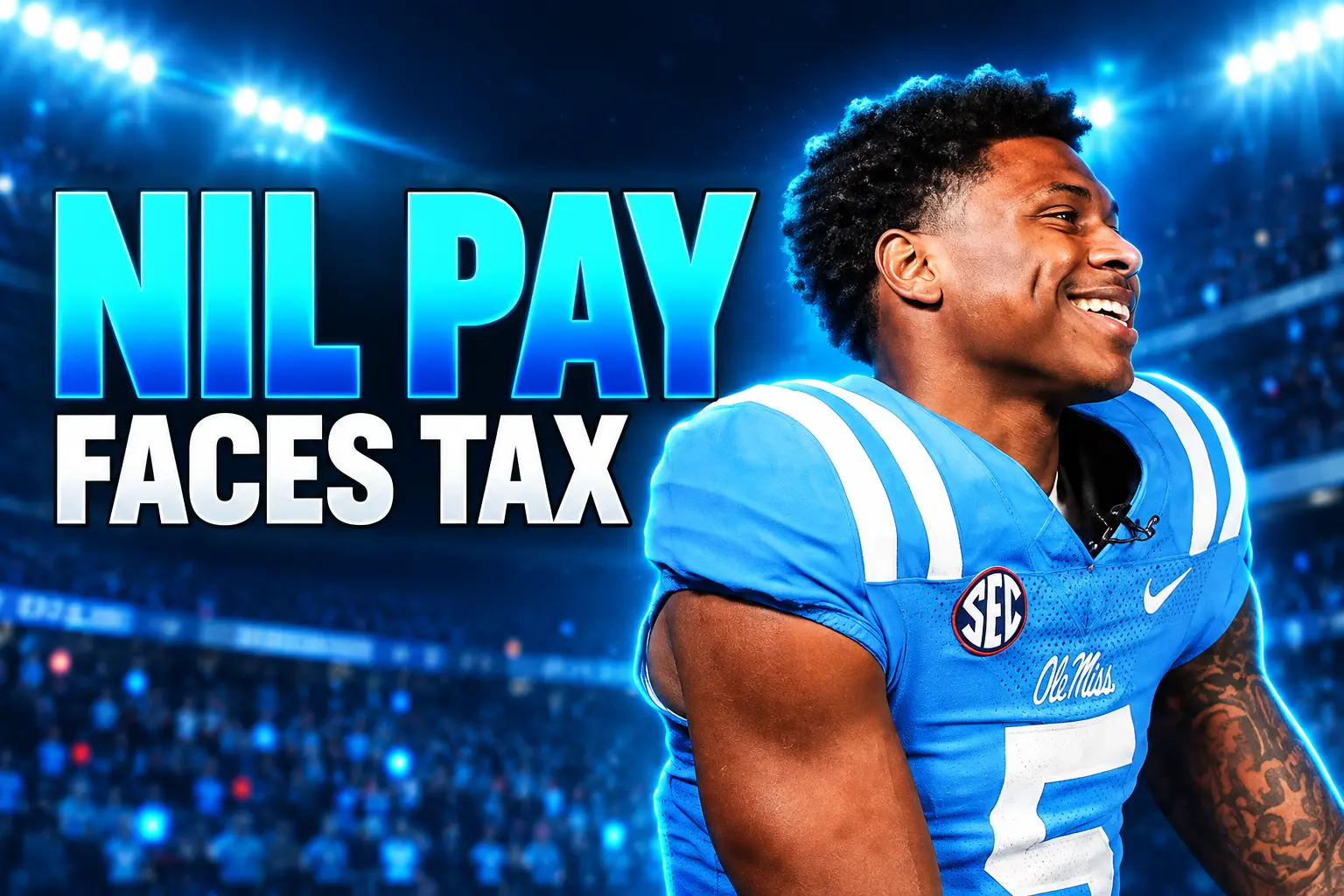
College athletes now cash NIL earnings with little tax withheld, and Merrill advisor Gordon Whittaker says to treat each check as a head start. Direct school pay started on July 1, 2025, after Judge Claudia Wilken approved the House v. NCAA settlement. In early September 2026, two House members moved to force tax withholding on NIL deals.
Those checks also feed the IRS, agents, and a wealth-management circuit that has spent two years building products for 19-year-olds.
The First Year of Direct School Pay
For most of college sports history, a school could offer a scholarship and little else. The settlement let Division I programs that opt in pay athletes out of athletic-department revenue, on top of outside NIL deals. The 2025 to 2026 cap was about $20.5 million per school, set at 22 percent of average power-conference take from media rights, ticket sales, and sponsorships.
The College Sports Commission, the body stood up to run the deal, set the 2026 to 2027 figure at approximately $21.58 million per school. The cap is built to rise about 4 percent a year at first, a path that points toward about $33 million by the mid-2030s. The four power conferences opted in. The Ivy League opted out.
THE PAY CALENDAR
- July 1, 2021: The NCAA adopts an interim policy that lets athletes earn from their name, image, and likeness.
- June 6, 2025: U.S. District Judge Claudia Wilken grants final approval to the House v. NCAA settlement.
- July 1, 2025: Direct school payments begin for programs that opt in.
- 2026 to 2027 academic year: The College Sports Commission publishes a cap of about $21.58 million per school.
- September 8, 2026: Reps. Terri Sewell of Alabama and Danny Davis of Illinois introduce a bill to withhold 30 percent of NIL pay for federal tax.
Back pay of about $2.8 billion for athletes who competed from 2016 to 2024 is still on hold while appeals move. Current pay did not wait. Up to $2.5 million in Alston academic awards and up to $2.5 million in new scholarship costs can count against the cap, which is one reason some schools folded those awards into direct pay.
How a campus splits the pool is a local choice. Texas Athletic Director Chris Del Conte has described a 75 percent / 15 percent / 5 percent / 5 percent split among football, men’s basketball, women’s basketball, and the rest of the roster as a pattern other big departments copy. A starter at quarterback and a reserve in a non-revenue sport can share a locker room and live in different money markets.
Outside NIL did not shrink when school pay arrived. Opendorse, which tracks athlete deals, revised its 2026-27 market estimate to $4.5 billion after missing low at $2.8 billion, a 61 percent jump. It puts about $735 million of that in above-cap commercial channels. Average pools tell the rest: about $36.6 million at Power 4 programs, $7.7 million in the Group of 6, and $205,400 for the rest of Division I, a gap of about 178 times inside one division. UNLV Athletic Director Erick Harper has said his Mountain West program had $7.5 million for NIL and revenue share in 2025 to 2026 and is aiming at $10.75 million in 2026 to 2027, still well under the power-school cap.
— Opendorse (@opendorse) July 23, 2026
The IRS Treats Most NIL Pay as a Business
Gordon Whittaker, a managing director and wealth management advisor at Merrill Lynch in Charlotte, and a CFP who is also a registered player financial advisor with the NFL Players Association, keeps returning to a basic point. Young athletes may see real money before they have filed a serious tax return. The IRS has already written the rule they will meet.
Student-athletes must report all NIL income without a form if a payer skips a 1099 or a W-2. Cash, gift cards, free food, apparel, legal work, and the use of a car all count. Income for personal services is generally subject to Social Security and Medicare tax, either as FICA on a wage or as self-employment tax. For 2026, Form 1099-NEC is used for payments of $2,000 or more. That $2,000 line is a payer reporting rule. It is not a license to omit smaller amounts, and it is separate from the $600 review trigger on third-party NIL deals that run through the NIL Go clearinghouse.
The settlement was written to avoid calling athletes employees of their schools. Classification still turns on facts, the IRS says, including how much control a school or brand has over the work. In practice, most of this money arrives with no tax taken out, which is why April becomes a cliff.
HOW THE CHECKS GET TAXED
| Income stream | Typical form | Tax taken at pay | Extra levy |
|---|---|---|---|
| Outside NIL deals | 1099-NEC | Usually none | Self-employment tax of 15.3% |
| School revenue share | 1099-MISC or 1099-NEC | Usually none | Depends on whether the athlete provided services |
| Royalty-only use of a likeness | 1099-MISC | Usually none | Ordinary income, generally no self-employment tax |
| Qualified scholarship tuition | None | Not applicable | Often tax-free |
Self-employment tax of 15.3% is the piece that blindsides people who grew up around W-2 jobs. It is 12.4 percent Social Security plus 2.9 percent Medicare, paid by the athlete because there is no employer to split it. Royalty pay for the bare use of an image, with no personal service attached, is supposed to land on Schedule E instead. A photo-shoot fee and a later royalty on the same campaign can split across both forms. State tax follows the places where the work is done, which for a football season can mean more than one state. NIL income also goes on the FAFSA and can cut need-based aid, including Pell Grant math.
Today’s NIL tax landscape effectively turns many student-athletes into small business owners, a shift that can carry significant tax burdens for athletes likely unfamiliar with the tax code.
National Taxpayer Advocate, Taxpayer Advocate Service blog, March 2026
The same office warned that athletes are often shocked by 1099s for perks they thought were free, including food vouchers, trading cards, trips, and cars, then have to find cash to pay tax on value they already ate, wore, or drove. The National Taxpayer Advocate said the new pay rules turn student-athletes into small business owners who still have to track every dollar and send estimated payments four times a year.
A New Client Class for the Banks
Whittaker’s public advice is the visible edge of a quieter land grab. Merrill research found that 96 percent of athletes aged 18 to 24 either have NIL deals or expect them. Kim Curtis, a partner at Cerity Partners and a former college basketball player, called the settlement one of the most unusual planning openings of the last decade for advisors. Morgan Stanley Global Sports and Entertainment launched Money in the Making, a digital course with an NIL section, and a related program with TheLinkU set the door as low as $1,000 so the shop could talk to athletes who are not yet rich.
That is the tell. Wealth management used to wait for a pro contract. College pay pulled the funnel down into dorms. The high end of the pitch is an LLC taxed as an S corporation, a solo 401(k), and a stack of deductions for training, content, travel, and agent fees. That kit can be rational for a seven-figure personal brand. It is a mismatch for the roster majority.
Opendorse’s football cut found that athletes with agents earned 2.1 times as much NIL as unrepresented teammates, and that a plurality of Power 4 football players, 30.5 percent, made $10,000 to $49,000, while 1.5 percent made more than $1 million. The “you are a CEO now” speech is true for a thin slice and marketing copy for everyone else. School does not teach a freshman how to run a one-person company, and the people who show up offering to teach it often work at firms that want the account.
Who Keeps an NIL Dollar
Whittaker is right that a deal’s size matters less than what happens after it clears. He is not the only party in that sentence. A dollar of athlete pay is claimed in a fixed order before anyone “saves” it.
WHO ELSE TOUCHES THE MONEY
- The IRS: Income tax is due, and service income often carries self-employment tax of 15.3 percent, with quarterly estimates if nothing was withheld.
- State collectors: Florida, Texas, and Tennessee take no state income tax, Arkansas has exempted NIL pay, and Mississippi’s House passed a similar bill in March 2026 as a recruiting tool.
- Agents and marketers: Represented athletes earn more on Opendorse’s books, which also means a fee comes out of a larger pot.
- Wealth shops: Merrill, Morgan Stanley, and independent advisors now treat college rosters as a feeder into sports-and-entertainment books.
- Families and campuses: Relatives lean on a sudden check, and schools count extra scholarships and some academic awards against the same cap that funds the athlete.
Irregular pay makes that stack worse. A collective check in August can look like a salary until the next one is late, or gone, after an injury, a transfer, or a brand that has moved on. Whittaker’s own warning is that NIL money is real and also more fragile than a paycheck, and that the damage is not only overspending. It is a bad contract, a tax miss, a shaky side business, or a lifestyle that locks in before the career does.
Schools Owed Literacy Training in the Year Pay Started
The NCAA already lists financial literacy education among core guarantees that Division I schools must provide, along with NIL education, career counseling, and mental-health resources. The same page notes that a blanket waiver affecting those requirements was approved for 2025, the calendar year school checks started. An NCAA survey, cited in a September 2026 campus-business briefing, found nearly 50 percent of student-athletes reporting a need for financial literacy help.
Some campuses did not wait for the waiver to lapse. Penn State’s College of Education, working with Robinhood Markets and the Sokolov-Miller Family Financial and Life Skills Center, launched credit-bearing “Money Drills” courses for Division I athletes, with one-on-one coaching tied to the athletic department. Opendorse named Collegiate, the student banking platform from Michigan State University Federal Credit Union, as its exclusive financial-literacy partner in January 2026, with modules on NIL, tax season, investing, and international athletes. The pattern is patchy: a required topic, a 2025 waiver, then a scatter of credit unions, brokerages, and a few universities filling the hole with their own brands attached.
Whittaker has told athletes to ask who is being paid, how the advisor is paid, and whether the advice matches their goals. That is the right question, and it applies to the school workshop as much as to the person in a team hotel conference room. A course funded by a brokerage is still a course. It is also a sales channel.
A House Bill Would Withhold 30 Percent
The cleanest fix for a surprise tax bill is to take the tax out before the money hits a checking account. On September 8, 2026, Reps. Terri Sewell and Danny Davis introduced a bill that would require payers of college athletes’ NIL deals to withhold 30 percent for federal income tax, a floor meant to stop athletes from spending a gross check and meeting the IRS empty-handed. Daniel S. Greene, a NIL attorney in Syracuse, New York, described the bill in those terms the day it moved.
Thirty percent is a blunt instrument. It will be too high for some athletes and too low for others once self-employment tax and state tax stack on. It would, at least, convert a 1099 surprise into something that looks like a paycheck. Until a bill like that becomes law, the default remains what the Taxpayer Advocate laid out. The athlete is the bookkeeper, the estimated-tax payer, and the person who owes the balance if a collective never issued a form.
States are running the other way, using tax as a recruiting flyer. A school in a no-income-tax state can tell a recruit that more of the same NIL number stays in the account. That is a hidden stakeholder too: governors and revenue committees, not just boosters.
Live Like a Student, Whittaker Says
Whittaker’s prescription is unfashionable on purpose. While athletes are in school, he argues, the budget for living should stay small, because the ongoing costs are still a student’s costs. Anything above that, he says, should go to savings and assets so compound interest has decades to work, including for players who will never see a pro locker room.
We just encourage them to live like college students and retain those assets, start to own assets and allow that force of compound interest to take effect over the next several decades.
Gordon Whittaker, managing director and wealth management advisor, Merrill Lynch
He has put the split in plainer math. You are not going to work until 65 in this job, so of every dollar, 10 cents may be for now and 90 cents is for the gap after the primary career ends. That line only works if the other claimants on the dollar, the IRS first among them, are paid on purpose instead of in a panic. The size of the deal will keep making headlines. The quieter contest is who else has already learned how to invoice it.
Disclaimer: This article is news reporting and analysis for information only. It is not investment, tax, or legal advice and should not be treated as a plan for any athlete’s NIL, revenue-share, or settlement pay. Readers should consult a qualified tax professional, a certified financial planner, or an attorney licensed in their state before signing a deal, forming an entity, or spending money that may be owed in tax. Figures, caps, and filing rules reflect the IRS, College Sports Commission, NCAA, and Opendorse materials cited here and can change with new guidance, state law, or court orders.

CUREE Found Nearly 25 Times More Fish at One Pillar

New Bat Family Tree Places Their Origin in Europe

Tax on FD Interest Now Hits Bank Funding Too

Perseverance Shows Jezero Carbonates Formed in Groundwater

Xiaomi’s Privacy Screen Already Costs Side-On Image Quality

Volkswagen Sells the Osnabruck Plant to Clear a Board Fight

Onimusha Way of the Sword Preload Hits a Windows 11 Wall

The Rs 4.66 Lakh Crore IPO Queue Is Mostly Paper

Saksham Gaur Finds He Is His Own Company’s Client

Thom Browne Takes Homeward to a Birnam Family Farm
-
 AUTO3 weeks ago
Volkswagen Sells the Osnabruck Plant to Clear a Board Fight
-
 GAMING4 weeks ago
Onimusha Way of the Sword Preload Hits a Windows 11 Wall
-
 BUSINESS4 weeks ago
The Rs 4.66 Lakh Crore IPO Queue Is Mostly Paper
-
 BUSINESS4 weeks ago
Saksham Gaur Finds He Is His Own Company’s Client
-

 BUSINESS4 weeks ago
NSE Pre-Open Session Copies the August Closing Auction
-
 LIFESTYLE4 weeks ago
Thom Browne Takes Homeward to a Birnam Family Farm
-

 AUTO4 weeks ago
Simple Wave Chases Range as Ather Konarc Cuts Price
-

 AUTO4 weeks ago
Kia Sorento Takes Aim at India’s Fortuner Class