
NEWS
Landry Takes the LSU Fight After the School Stands Down
Gov. Jeff Landry kept the LSU-SEC fight alive on television after the school locked its roster and presidents announced no sanctions.

Louisiana Gov. Jeff Landry said Thursday the SEC’s threat to expel LSU is ridiculous. He said it while conference presidents met by video and then announced no sanctions.
LSU had already locked a 105-man football roster without the two former NFL signees at the center of the fight. The leftover conflict is no longer with the school’s president. It is with the state.
Landry Took the Fight After LSU Stepped Back
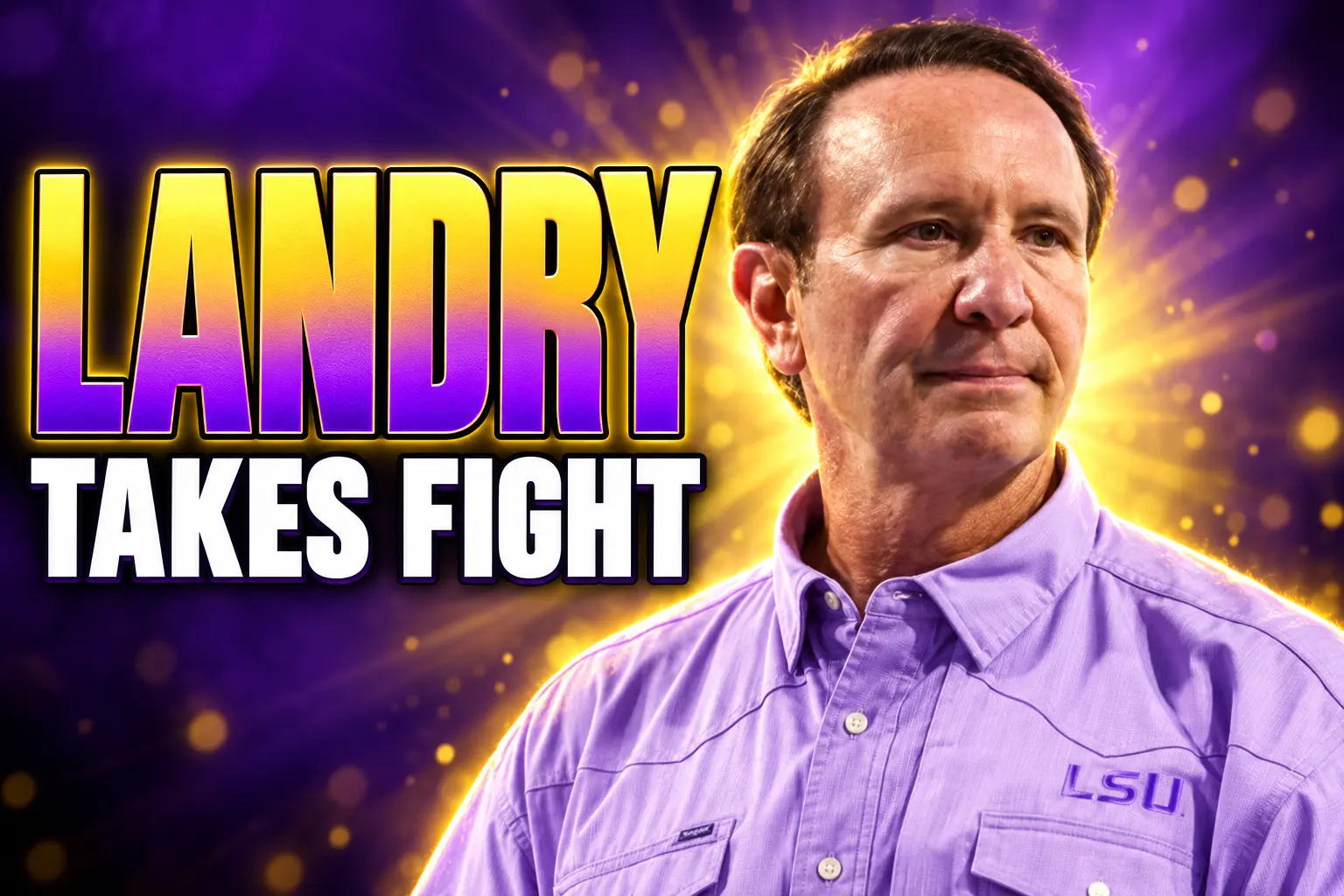
Landry sat for a national television interview in an LSU visor and a purple shirt with an LSU logo, while the league’s presidents and chancellors were on a closed Zoom call. He did not talk like a campus that had just complied. He talked like a state that still wants a fight.
“The SEC sued us,” Landry said. “It’s extremely dangerous for Greg Sankey and them to continue this.” He called the whole episode “ridiculous” and said fans care more about the product on the field than “what goes on in the court room.”
LSU president Wade Rousse had spent the previous 24 hours doing the opposite. In a nine-sentence letter to commissioner Greg Sankey on Wednesday, Rousse wrote that the Tigers would not place tight end Dae’Quan Wright or defensive tackle Zxavian Harris on the roster, that the last two spots were filled on September 8, and that “LSU complied with SEC rules. This issue is moot.”
Rousse then joined Thursday’s call only briefly. He told the other presidents that, because he and LSU are named in the conference’s federal suit, counsel had advised him not to stay. The remaining 15 held the meeting without him. Landry, who is not a defendant, went on air anyway.
That split is the thing the conference already put in writing. In the amended Alabama complaint and in Sankey’s sworn declaration, the presidents’ worry is not only two players. It is that coach Lane Kiffin, Louisiana Attorney General Liz Murrill, and the governor have been treating the roster fight as a public campaign the university administration cannot, or will not, shut off.
Thursday’s Meeting Produced Two Sentences and No Vote
Court papers filed Tuesday had said the September 10 gathering would “decide whether to terminate Louisiana State University.” Under Section 3.1.5 of the SEC constitution, involuntary removal needs a vote of at least two-thirds of all chief executives, which is 11 votes of 16, counting absences and abstentions as no. LSU has been a member since 1933. The meeting happened. The vote did not.
The conference’s entire public account was two sentences, posted from its official account:
Statement from the Southeastern Conference: pic.twitter.com/pZ5TnbK3sM
— Southeastern Conference (@SEC) September 10, 2026
The presidents and chancellors of the Southeastern Conference met Thursday by videoconference to discuss recent matters involving conference expectations and responsibilities. Those discussions will continue as the conference and its member universities work toward an appropriate resolution.
Southeastern Conference, official statement, September 10, 2026
The statement did not name LSU, Kiffin, Wright, or Harris. It did not close the Alabama case. It also did not use the penalties the league wrote down on August 26, a half-season coach suspension, a fine equal to 50% of the sport’s annual budget, and a loss of conference voting rights, because a Baton Rouge judge has already blocked those tools against schools that take in the players covered by his order.
So the nuclear option came off the agenda, the ordinary penalties are enjoined, and the public product of a week of emergency filings was a promise that talks will continue. Landry’s line that expulsion looks easy on paper and ugly in practice is the outcome the Zoom call just performed.
Why LSU Left Wright and Harris Off the Roster
Wright, an undrafted tight end, spent time with the Philadelphia Eagles and Cleveland Browns this summer. Harris signed with the New Orleans Saints as an undrafted free agent and was waived in early August. Both played for Kiffin at Ole Miss. Both were seniors last season. Both joined a Louisiana suit, Pyburn v. NCAA, after the NCAA’s new eligibility model left their high-school class on the wrong side of the line.
On June 23, the Division I Cabinet approved an age-based model that gives athletes a five-year age-based eligibility period from full-time enrollment or the academic year after their 19th birthday, whichever comes first. The NCAA itself says calling that “5 for 5” is not accurate, because delayed enrollment can shorten the window. The change also did not cover athletes who had already used their fourth season by the end of spring 2026. That carve-out is what sent the Class of 2022 into court.
Landry said the rule left those players unable to plan, called the resulting mess “stupid,” and said it is “time to play football.” East Baton Rouge Parish Judge William Jorden saw it the players’ way. He issued a temporary restraining order on August 19, then a preliminary injunction on September 3 covering Wright, Harris, and more than 40 other athletes, blocking the NCAA and the SEC from punishing schools that roster them.
THE WEEK THE VOTE COLLAPSED
- August 25: SEC presidents, including Rousse, vote in Birmingham to bar players with NFL, NBA, or WNBA contracts from returning to college.
- August 26: The same group sets the half-season, 50% budget, and voting-rights penalties. Rousse abstains.
- September 3: Jorden grants the injunction. The SEC sues LSU officials the same day in the Northern District of Alabama, before Judge Annemarie Carney Axon.
- September 4: Rousse calls Sankey to say Wright and Harris will not be rostered. LSU files a roster without them and leaves two spots open. Fifteen other presidents meet about LSU without Rousse in the room.
- September 5: LSU beats Clemson 51-10. At 31-3, Kiffin tells sideline reporter Holly Rowe, “Imagine if we had pro players.” The line goes into the amended complaint as evidence he is still needling the league.
- September 8: LSU fills the last two spots with already-injured players, hitting the 105-man cap. The SEC amends its Alabama suit, names Murrill, and says Thursday’s meeting will consider termination “whether or not” Wright or Harris ever appear on the roster.
- September 9: Rousse’s letter lands. Axon postpones the federal hearing with no new date. Sankey pulls the emergency ask.
- September 10: Presidents meet. No sanctions. Landry goes on television.
Kiffin still had a national TV quip in his pocket after a blowout. He did not have two roster spots. The conference got the roster it demanded without having to take the vote it had just asked a federal judge to protect.
The First Amendment Suit Collides With Public Campuses
The Alabama case is built on a right of expressive association. The conference says it cannot be forced to tie its name, championships, and media properties to conduct it has “expressly repudiated.” The amended filing drops LSU as a defendant and recasts the case against 22 people in their official roles, Rousse, athletic director Verge Ausberry, Kiffin, the 17 members of the Board of Supervisors, and Murrill, so the suit can proceed against state officers rather than the state itself.
Landry’s answer is that this theory runs into the membership list.
The SEC is not a true organization in the legal sense. It’s not a corporation, and it’s not an LLC. It’s not a juridical person. It’s an affiliation of 16 universities, of which 15 of the 16 are public universities. That means they are government universities, and those government universities don’t get a First Amendment right.
Jeff Landry, Governor of Louisiana, on America Reports
People who actually read association cases will say the right belongs to the private conference, not to the public campuses inside it. That is a fair legal objection, and it is the objection the suit is designed to tee up in Birmingham. Landry is making a different point, and it is a political one: a league whose voting body is 15 public universities is asking a federal court to treat a fight with Louisiana officials as a private club’s speech right.
Murrill sat at the plaintiffs’ table in Baton Rouge, said “Geaux Tigers” on the courthouse steps, and called the federal case “legal garbage.” Sankey’s declaration says her account of his testimony was “a complete mischaracterization.” The governor is described in the same papers as supporting LSU. He is not named as a defendant. He is now the loudest official still talking.
Two Players and a District Attorney Are Still in It
Wright and Harris won in Baton Rouge and still have no LSU season. West Baton Rouge District Attorney Tony Clayton, who represents them, said after the roster locked that he plans to go after Sankey, the SEC, and the NCAA, and not LSU. He said the conference “completely destroyed the character of these players” and put “a scarlet letter around the neck of each and every one of them.”
Clayton also said the Alabama filing is “all for show,” and that Sankey “got his feelings hurt.” Tom Mars, a lawyer who has beaten the NCAA on eligibility, called the amended complaint a “press release.” Gabe Feldman, who runs Tulane’s sports law program, said before the roster closed that he found an actual expulsion “highly unlikely,” and that both sides were posturing toward a settlement.
WHO WALKED AWAY WITH WHAT
| Party | What they wanted | Where it stood after Thursday |
|---|---|---|
| SEC presidents | A usable way to enforce the no-pros rule, including a path to remove LSU | The roster complies. No vote. No announced penalty. Talks “will continue.” |
| LSU / Wade Rousse | Stay in the league without a contempt fight in Baton Rouge | Membership intact. President recused from the call. Federal case still live. |
| Lane Kiffin | Wright and Harris, plus a public argument that the rule is wrong | 51-10 without them. The halftime jab is now an exhibit. |
| Wright and Harris | A fifth year in Baton Rouge after NFL camps ended | Injunction in hand, no roster spot. Clayton plans a new case. |
| Jeff Landry / Liz Murrill | Stop the conference from punishing Louisiana’s flagship over the PI | School stood down. State officials did not. |
The table is why Landry’s interview was not leftover noise. LSU the campus took the deal that ends the expulsion scare. Louisiana the government is still describing the same week as a smear. “LSU did not create the litigation in Louisiana. LSU did not create the litigation in Alabama. The SEC did,” Landry said. “The SEC tries to villainize LSU.”
Media Contracts Make Expulsion a Costly Bluff
Landry did not deny the bylaws. He said a supermajority can still kick a member out, and that this might have looked simple in 1932, when the conference was created. He said it does not look simple now.
WHAT LANDRY SAYS AN EXPULSION UNLOCKS
- The contracts: He argued that media-rights deals and media contracts make removing a member “extremely complicated” in a way a 1932 constitution never pictured.
- The NIL problem: He said a removal would open every remaining school, not the conference as a separate person, to antitrust claims from athletes in football and in every other sport on campus.
- The price tag he used: He warned of “litigation that causes universities hundreds, if not billions, of dollars worth of liabilities,” and used Tennessee as the example of a school you would be foolish to shove out.
The money underneath that warning is not theoretical. S&P Global Market Intelligence puts the SEC on about $710 million in media rights annually once the ESPN partnership and the SEC Network extension are counted together, with the network deal running through 2034. The same research house has described the core 10-year ESPN deal valued at $3 billion that began in 2024. Sankey said in May that he believes the ESPN pact is undervalued, and that he would rather over-deliver than the reverse.
Section 3.1.6 of the constitution says a school that is removed stops receiving conference distributions on the effective date. There is no removal fee on that path. The $30 million to $45 million exit fees apply to a school that leaves on its own. None of that writes ESPN out of the picture, and none of it tells a volleyball player at a remaining public university that she has no damages theory if her league just ejected a founding member in the middle of a season.
The threat worked as a threat. LSU filled the roster. The moment the presidents had to convert the threat into a recorded vote, they issued two sentences instead. That is the media-rights math talking, whether or not Landry is the lawyer who would try the case.
The Alabama Case Has No New Date
Landry was asked how the SEC’s claim that LSU recruited professionals with NFL contracts would play out from here. “It’s in the SEC’s hands right now,” he said. The conference still has a live complaint in Birmingham and a postponed hearing with no date on the docket. Jorden’s injunction is still in force in Baton Rouge. Clayton said, “I just want you to stay tuned.”
The school that was going to be expelled is 1-0 and still drawing up for this season in the same league it helped found. The two players who won the right to be on that roster are not. The president who wrote that the dispute is moot was not in the room for the vote that never came. The governor who was never on the caption of the Alabama case is the one still naming Sankey on television.
A conference that sued to prove it can police a member now has a compliant roster, an open federal file, an enjoined penalty memo, and a statehouse that has not stood down. That is a different problem than the one Thursday’s two sentences described.

CUREE Found Nearly 25 Times More Fish at One Pillar

New Bat Family Tree Places Their Origin in Europe

Tax on FD Interest Now Hits Bank Funding Too

Perseverance Shows Jezero Carbonates Formed in Groundwater

Xiaomi’s Privacy Screen Already Costs Side-On Image Quality

Volkswagen Sells the Osnabruck Plant to Clear a Board Fight

Onimusha Way of the Sword Preload Hits a Windows 11 Wall

The Rs 4.66 Lakh Crore IPO Queue Is Mostly Paper

Saksham Gaur Finds He Is His Own Company’s Client

Thom Browne Takes Homeward to a Birnam Family Farm
-
 AUTO3 weeks ago
Volkswagen Sells the Osnabruck Plant to Clear a Board Fight
-
 GAMING4 weeks ago
Onimusha Way of the Sword Preload Hits a Windows 11 Wall
-
 BUSINESS4 weeks ago
The Rs 4.66 Lakh Crore IPO Queue Is Mostly Paper
-
 BUSINESS4 weeks ago
Saksham Gaur Finds He Is His Own Company’s Client
-

 BUSINESS4 weeks ago
NSE Pre-Open Session Copies the August Closing Auction
-
 LIFESTYLE4 weeks ago
Thom Browne Takes Homeward to a Birnam Family Farm
-

 AUTO4 weeks ago
Simple Wave Chases Range as Ather Konarc Cuts Price
-

 AUTO4 weeks ago
Kia Sorento Takes Aim at India’s Fortuner Class