
NEWS
OpenAI Hosts Bank Feeds Inside ChatGPT for Financial Services
ChatGPT for Financial Services puts OpenAI in the data seat, with hosted Daloopa and PitchBook feeds, a FactSet selloff.

OpenAI on September 10, 2026 launched ChatGPT for Financial Services, a ChatGPT Work plan that indexes Daloopa, PitchBook, LSEG News and Crunchbase data on its own servers. Morgan Stanley and Evercore shaped the first cut for investment banking and equity research. FactSet closed at $264.32 that session, down 5.32%.
The model on the box is GPT-6 Astra, shipped on September 3. The change that moved a data vendor’s stock is quieter: OpenAI is no longer only connecting to market feeds. It is keeping a copy.
Now available: ChatGPT for Financial Services.
This is a tailored ChatGPT Work experience that combines built-in financial data with GPT-6 Astra’s reasoning.
Teams can develop research, build financial models, and create customized client materials.https://t.co/6WP5OJdnE8 pic.twitter.com/AundGG3jtc
— OpenAI (@OpenAI) September 10, 2026
OpenAI Now Keeps a Copy of the Feeds
ChatGPT for Financial Services is a separate plan on top of ChatGPT Enterprise, built for eligible financial institutions. Nick Turley, OpenAI’s vice president of product, said in a briefing that the firm is “effectively teaching ChatGPT to research like an analyst and back up its conclusions like an analyst.” In a live demo he walked an M&A screen, pulled figures from licensed sources, and produced a PowerPoint deck in a bank’s own style guide.
That is the pitch every wire story repeated. The architecture underneath it is the part that lasts. Built-in premium data from Daloopa, PitchBook, LSEG News and Crunchbase is indexed and hosted by OpenAI, which says that setup improves retrieval, cuts latency, and makes citations that point at a specific table or passage. Teams can start on those datasets with no extra vendor contract and no MCP connector to debug.
OpenAI’s own example is a P&L normalization. A banker can inspect the reconciliation behind an adjusted EBITDA figure, see which costs were stripped out, and decide whether that number belongs in a valuation. The product then traces the claim back to the highlighted source so someone else on the desk can check the work.
Hosting is the second-order move. For years banks tried to bolt models onto terminals through Model Context Protocol connectors, then spent the afternoon watching the request fail. OpenAI’s launch post treats that mess as the problem it is absorbing. If the feed lives on OpenAI’s infrastructure, the model does not have to ask a flaky tool call for the same line item twice.
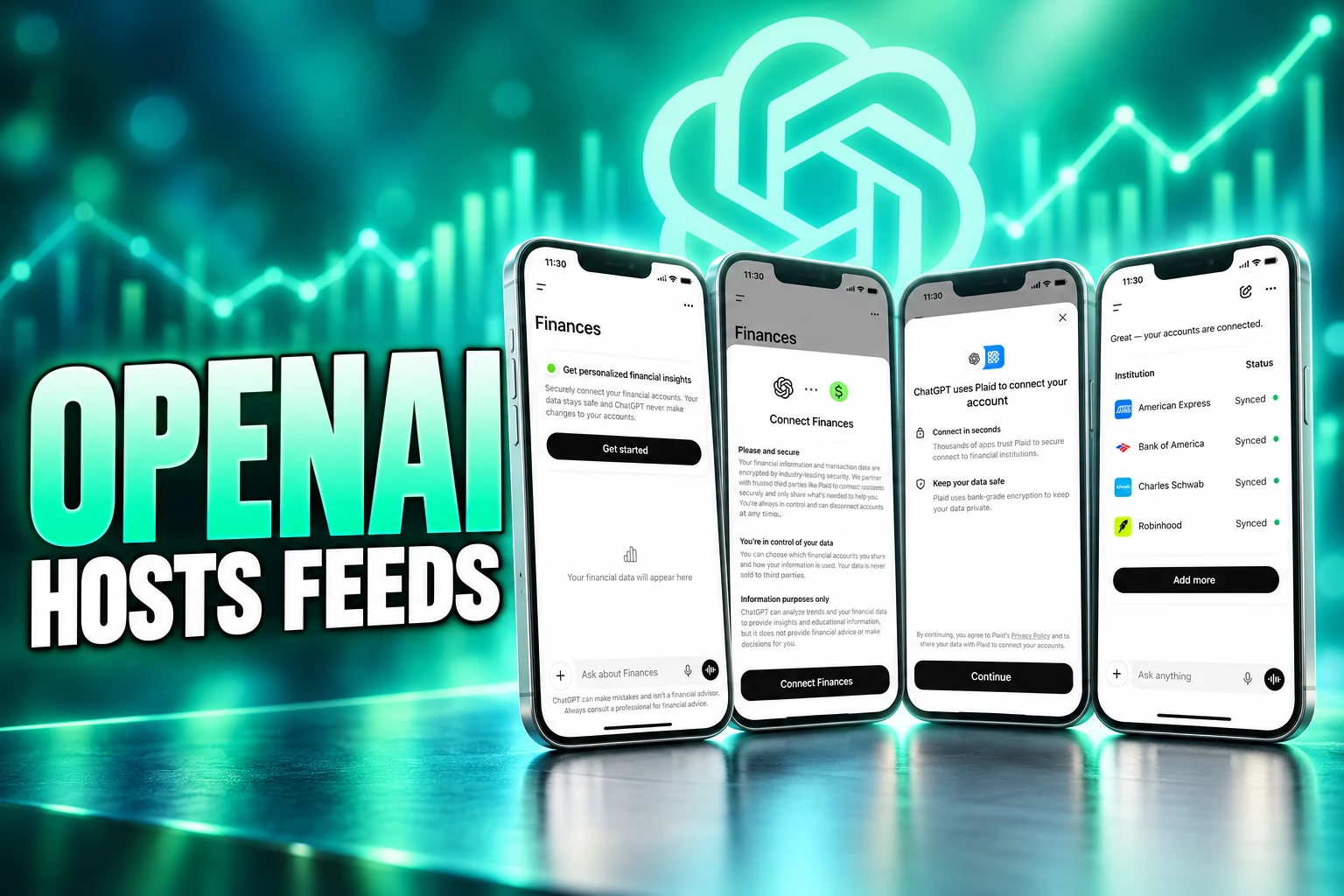
Three Ways Data Reaches the Same Chat Window
The product is not one pipe. It is three, and they are not equal. Only the first one is a copy OpenAI holds. The other two still run on seats the bank already bought.
HOW THE DESK GETS A NUMBER
| Path | Providers named | What the bank actually gets |
|---|---|---|
| Hosted by OpenAI | Daloopa, PitchBook, LSEG News, Crunchbase, Quartr, Fiscal.ai, public SEC filings | No extra contract; OpenAI indexes the slice and cites back into it |
| Shared sign-in | S&P Capital IQ, LSEG, MSCI, Dow Jones Factiva, Moody’s | Still in progress; the provider is meant to see a ChatGPT login and unlock data the user already pays for |
| MCP connectors | FactSet, Datasite, Box, Preqin, Intapp, and more than 50 others | Existing subscriptions, with some connectors tuned for fewer broken requests |
LSEG sits in two columns at once. LSEG News is in the hosted bundle. The rest of LSEG is on the entitlement track. Emily Prince, group head of enterprise AI at LSEG, said the work advances an “LSEG Everywhere AI” plan, with MCP connectivity and “a curated Reuters news selection” so licensed content shows up where customers already work.
Sally Moore, chief client officer and co-head of Market Intelligence, Kensho Data & Platforms at S&P Global, said bringing the S&P Global AI Data Portal into ChatGPT puts “verified intelligence, from financials and transcripts to market and energy data,” in the same window. That is a distribution deal, not a gift of the whole S&P stack.
Tony McManus, head of Bloomberg’s enterprise data and index businesses, spent July arguing the other side of this. In a note on Bloomberg’s own Enterprise MCP design, he wrote that connection and readiness are not the same thing, and that a coarse tool which “can return all types of financial data can deliver non-deterministic behavior and encourage hallucinations.” His list of missing pieces is point-in-time history, semantic metadata, live prices, and entitlements that survive an audit. Bloomberg is not among OpenAI’s named data partners. It is selling a governed MCP layer of its own, plus ASKB, the Terminal’s conversational interface.
The launch, then, does not retire the terminal. It copies a cheaper, citation-friendly slice and leaves the expensive seats on SSO and MCP. That is a product a compliance officer can approve. It is also why a FactSet login still matters after the demo ends.
FactSet’s 5.32% Session Was the Market’s First Read
FactSet Research Systems closed September 10 at $264.32, down 5.32%, after an intraday low of $262.93. The S&P 500 slipped 0.6% to 7,591.70 the same day. FactSet finished about 29% below its 52-week high of $371.53. S&P Global traded lower on the session as well; the prints moved around, so the clean figure is FactSet’s close.
THE SEPTEMBER 10 PRINT
- FactSet close: $264.32, down 5.32% on the NYSE.
- Session range: as low as $262.93 and as high as about $279.17.
- Gap to the high: about 29% below the $371.53 52-week peak.
- Index tape: S&P 500 at 7,591.70, down 0.6%.
FactSet is in OpenAI’s connector list, not the hosted bundle. Investors still treated the news as a threat to the firms that charge for the interface around fundamentals, estimates and comps. A hosted Daloopa file that cites the 10-K is not a full FactSet terminal. It is close enough to the first hour of a junior’s job that the multiple compressed.
Daloopa is playing both sides of that trade. Thomas Li, its chief executive, said being a native data partner “continues our strategy of being the data infrastructure for AI and agentic workflows in financial services.” Daloopa already sells MCP connectors into other assistants. OpenAI hosting the file just puts that same verified-fundamentals bet inside the ChatGPT window, with a citation instead of a scrape.
Tom Van Buskirk, PitchBook’s executive vice president of technology and engineering, called the deal “a sign of where this industry is headed: toward answers built on trusted data, not just speed.” Jager McConnell, chief executive of Crunchbase, said structured private-company data on funding, investors and acquisitions will sit “at the fingertips of financial teams using ChatGPT.” Those are distribution wins for vendors that want agents as a channel. They are a problem for anyone whose pitch is that the only safe place to read a number is inside their own glass.
How Morgan Stanley Got Comfortable With GPT
Morgan Stanley did not show up as a design partner by accident. The bank has been running OpenAI models on the wealth side since 2023, then pushing the same habit into research and banking. OpenAI’s case study on that work is the prequel to this SKU: evals first, then a tool advisers actually open.
THE PATH FROM WEALTH TO THIS DESK
- September 2023: Morgan Stanley rolls out AI @ Morgan Stanley Assistant, a GPT-4 chatbot over internal research and process documents for financial advisers.
- March 5, 2026: Morgan Stanley Research launches AskResearchGPT for investment banking, sales and trading, and research, drawing on more than 70,000 proprietary reports a year.
- July 21, 2026: Bloomberg publishes its Enterprise MCP critique, arguing that snapshot feeds and thin metadata are not production-grade.
- September 3, 2026: OpenAI releases GPT-6 Astra, then spends the next week selling it as a work model.
- September 10, 2026: ChatGPT for Financial Services ships with Morgan Stanley and Evercore as design partners.
Jeff McMillan, head of firmwide AI at Morgan Stanley, said of the wealth assistant, “This technology makes you as smart as the smartest person in the organization.” OpenAI says more than 98% of adviser teams use that assistant, and that document access inside the firm rose from 20% to 80%. David Wu, head of firmwide AI product and architecture strategy, said the stack went from answering 7,000 questions to covering a corpus of 100,000 documents. Kaitlin Elliott, head of firmwide generative AI solutions, said follow-ups that used to take days now go out within hours.
The unnamed Morgan Stanley quote on the new product page is cooler and more corporate: the bank wants intelligence “into how we research companies, develop analysis, and prepare advice.” Evercore’s matching line talks about deepening “the insights behind our advice, while building on the judgment and rigorous standards our clients expect.” Neither firm is claiming the model replaces the managing director. Both are claiming a seat at the prompt.
That history is why this launch is a packaging job as much as a research job. Morgan Stanley already proved a regulated firm will live in ChatGPT if retrieval is tight and data does not train the public model. OpenAI is now selling that pattern to every eligible bank, with hosted third-party data instead of one firm’s own research vault.
What GPT-6 Astra Changes in a Pitchbook
GPT-6 Astra is the model OpenAI calls state of the art for three jobs this product cares about: information retrieval, financial reasoning, and turning the work into files. On OfficeQA Pro, a test of whether an agent can read U.S. Treasury Bulletins, including tables, charts and footnotes, Astra scores 69.9% against 60.2% for GPT-5.6 Sol. A 9.7-point gap on a document-heavy exam is real. It still leaves roughly three in ten Treasury-bulletin questions wrong, which is why the citation pane is not a flourish.
Astra set a new high in our evals: it produced the best decks we’ve tested and followed the brief 17% more faithfully than the next-best model, while sourcing its claims to the right document 19% more often. For analysts working through dense financial materials, that means decks and answers you can hand to a client and defend line by line.
George Sivulka, Founder and CEO, Hebbia
OpenAI also says Astra can finish Financial Modeling World Cup spreadsheet challenges with computer use about four times as fast as the winning human from the 2023 Microsoft Excel World Championship. Administrators on the finance plan can publish Excel, Word and PowerPoint templates so the output comes back as a valuation model, a research note, or a pitchbook in the firm’s type and colors. Interactive charts carry the underlying series and the source list.
That is the junior-analyst workflow, compressed. The first years of the job are comps, cleaning a P&L, and 80 slides that look like last year’s 80 slides. OpenAI is selling that loop as a template job with a human still on the hook for the number. People who do that work already read the demo that way, and they are not wrong about the task list. They may be early on the headcount: a 69.9% document score and a citation trail still need someone who knows when adjusted EBITDA is junk.
We’re effectively teaching ChatGPT to research like an analyst and back up its conclusions like an analyst.
Nick Turley, Vice President of Product, OpenAI, product briefing
Yashodha Bhavnani, vice president of AI products at Box, said Astra was “>10% less likely to make confidently incorrect assertions” in Box’s tests and better at refusing conclusions the documents did not support. That is the behavior a research editor wants. It is also an admission that the previous models were a little too sure in the pitchbook.
Daloopa Arrives a Day Late and Metered
The launch post says teams can use the premium datasets immediately, with no separate contracts. OpenAI’s own product documentation is narrower. The hosted slice is a starter kit with limits the marketing page does not put in the headline.
WHAT THE INCLUDED FEEDS ACTUALLY ARE
- Daloopa: Financial statements and selected metrics, with a 24-hour delay and a cap of 3,000 datapoints per user per month.
- PitchBook Essentials: Foundational private-company profiles and recent financing activity, not a blanket PitchBook terminal inside the chat.
- Quartr: Earnings-call transcripts, investor decks and international filings across more than 16,000 public companies.
- Fiscal.ai: Company financials, fundamentals, ratios and operating metrics, listed as included in OpenAI’s help table.
- Public filings: SEC documents, hosted with the rest of the included set.
- Crunchbase and LSEG News: Named on the launch post as built-in private-company and news sources.
Quartr, which OpenAI did not put in the first sentence of the blog post, is the cleanest expression of the hosting bet. Oscar Küntzel, co-founder and chief executive, said OpenAI licensed Quartr’s first-party IR data so quotes and figures “trace back to a primary source, a transcript, a filing, a slide, with a citation users can open and verify.” He also said every AI product in finance eventually hits the same wall: where the data came from, and whether anyone can trust it.
A 24-hour Daloopa delay is not a rounding error on earnings week. A 3,000-datapoint monthly cap is not “the data teams need” if a coverage universe is wide. PitchBook Essentials is not the product a sponsor-coverage banker means when they say PitchBook. The selloff treated the bundle as a substitute. The documentation treats it as a licensed sample, with the full S&P, Moody’s, Factiva and FactSet stacks still sitting behind logins OpenAI does not own.
Seats do not mix. OpenAI’s help pages say standard Enterprise seats and Financial Services seats cannot share one workspace. That is an information-barrier feature dressed as a SKU split, and it is also a reminder that this is not ChatGPT with a finance plugin toggled on.
The Seats OpenAI Does Not Host Still Matter
The trust layer is the product. Hosted retrieval, highlighted citations, firm templates, SAML SSO, SCIM provisioning, role-based access, encryption in transit and at rest, and exportable logs through the OpenAI Compliance Platform are the items a general counsel can put in a memo. Business data is not used to train OpenAI’s models by default. Admins can set workspace retention, turn skills and app actions on or off by role, and split workspaces to enforce information barriers. Material non-public information is the reason those controls exist, and OpenAI says so in plain language.
Anthropic has been selling Claude into the same buildings, including a May 2026 set of finance agents for pitch decks, statement review and compliance escalation. Banks will keep both. The buyer is not loyal to a logo. The buyer is loyal to a room where the number comes from a licensed feed and the log can explain who asked.
WHAT WE KNOW
- The date: ChatGPT for Financial Services was introduced on September 10, 2026, on GPT-6 Astra.
- The partners: Morgan Stanley and Evercore are design partners; the first jobs in scope are investment banking and equity research.
- The copy OpenAI holds: Daloopa, PitchBook, LSEG News, Crunchbase, Quartr, Fiscal.ai and SEC filings are in the hosted set, with the Daloopa meter and delay listed in product docs.
- The rest: S&P Capital IQ, LSEG, MSCI, Factiva and Moody’s are on a promised shared sign-in; FactSet remains a connector among more than 50.
WHAT IS UNCONFIRMED
- Eligibility and price: OpenAI says the plan is for eligible financial institutions and has not published the test or the seat cost.
- When SSO lands: Shared sign-in with S&P, LSEG, MSCI, Factiva and Moody’s is described as work in progress, not a live switch.
- Bloomberg: There is no named Bloomberg feed in the product. Whether that stays a wall or becomes a connector is unsaid.
- Depth of PitchBook: The launch names PitchBook; the help table describes PitchBook Essentials. The commercial boundary between those two is not in the blog post.
OpenAI will post-train models on these datasets so they “find, interpret, and use this data like we know the best analysts can,” and it says newer models will show up in the plan as they ship. Firms and developers can still build on the API if the packaged desk is the wrong shape. For now the packaged desk is the thing that got priced: a ChatGPT window that holds a licensed copy of part of the market, cites it, and drops the slide in the house template. FactSet’s session was the first vote on what that copy is worth. The next one happens when a banker hits the 3,000-datapoint wall and opens the terminal that still has the rest.
Disclaimer: This article is news reporting and analysis of a software launch and related share-price moves. It is for information only and is not investment advice, a solicitation to buy or sell any security, or a recommendation to adopt or reject any AI or market-data product. Readers who may act on vendor choices, trading, or compliance decisions should consult a qualified investment adviser, procurement lead, or financial-services counsel who can review their firm’s licences and controls. Figures, product limits, partner lists and eligibility rules reflect the named company pages and market prints as of the dates given above and can change.

CUREE Found Nearly 25 Times More Fish at One Pillar

New Bat Family Tree Places Their Origin in Europe

Tax on FD Interest Now Hits Bank Funding Too

Perseverance Shows Jezero Carbonates Formed in Groundwater

Xiaomi’s Privacy Screen Already Costs Side-On Image Quality

Volkswagen Sells the Osnabruck Plant to Clear a Board Fight

The Rs 4.66 Lakh Crore IPO Queue Is Mostly Paper

Onimusha Way of the Sword Preload Hits a Windows 11 Wall

Saksham Gaur Finds He Is His Own Company’s Client

Thom Browne Takes Homeward to a Birnam Family Farm
-
 AUTO3 weeks ago
Volkswagen Sells the Osnabruck Plant to Clear a Board Fight
-
 BUSINESS4 weeks ago
The Rs 4.66 Lakh Crore IPO Queue Is Mostly Paper
-
 GAMING4 weeks ago
Onimusha Way of the Sword Preload Hits a Windows 11 Wall
-
 BUSINESS4 weeks ago
Saksham Gaur Finds He Is His Own Company’s Client
-

 BUSINESS4 weeks ago
NSE Pre-Open Session Copies the August Closing Auction
-
 LIFESTYLE4 weeks ago
Thom Browne Takes Homeward to a Birnam Family Farm
-

 AUTO4 weeks ago
Simple Wave Chases Range as Ather Konarc Cuts Price
-

 AUTO4 weeks ago
Kia Sorento Takes Aim at India’s Fortuner Class