
 Ishan Crawford
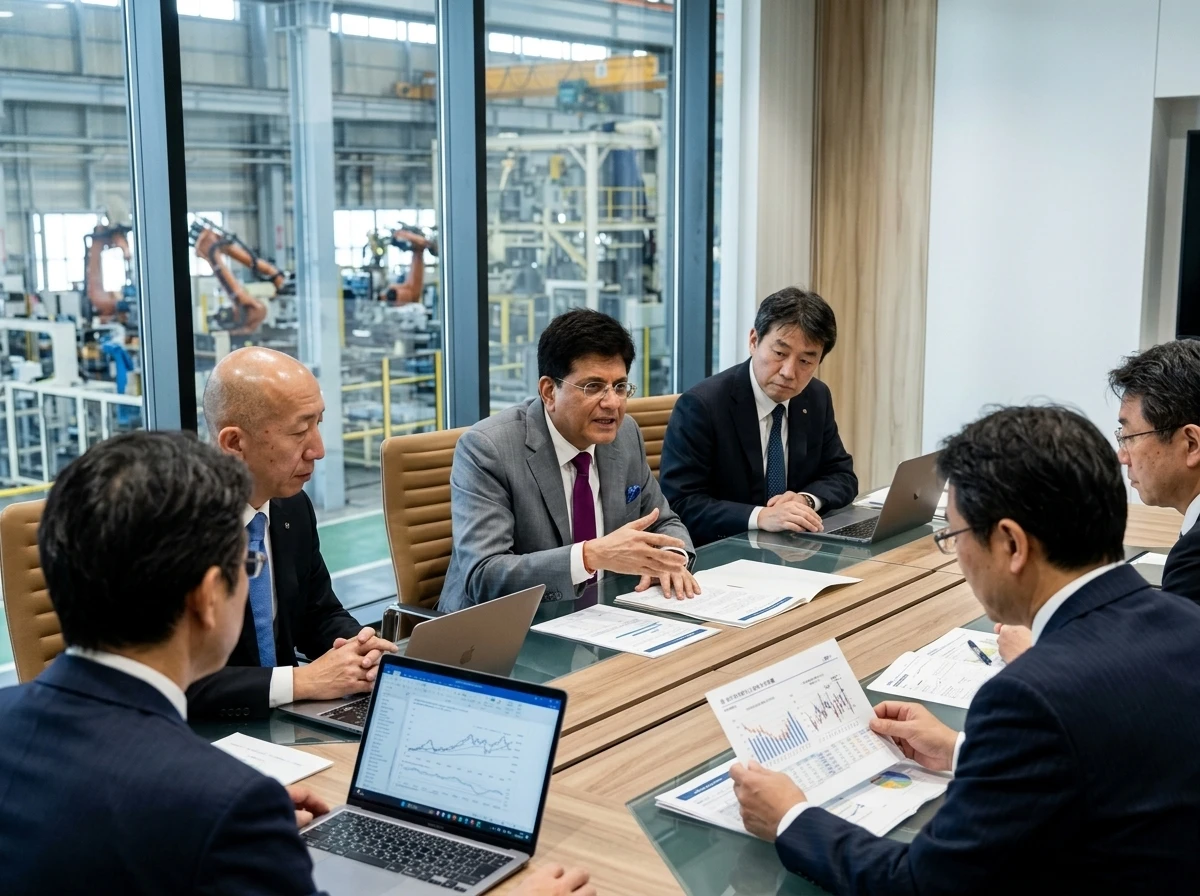
 Commerce Minister Piyush Goyal said in Nagoya on Wednesday that India wants a full review of its 15-year-old Comprehensive Economic Partnership Agreement with Japan to make the pact more contemporary and open to wider scope. Bilateral trade reached $27.5 billion in FY 2025-26, yet India’s exports stayed near $6 billion while the deficit hit $15.5 billion.
The push follows a July summit where the two prime ministers agreed the deal, signed in February 2011 and in force since August 2011, needs updating. Japan had long resisted a deep rewrite. Now the terms of reference still have to be set, and both sides accept give-and-take will be required.
Fifteen years of phased tariff cuts did not close the gap. The political signal from the July summit and Goyal’s August meetings is that both capitals now treat the imbalance as a shared problem rather than a talking point.
Trade Numbers That Kept Widening
Official bilateral trade figures for FY 2025-26 put two-way commerce at $27.47 billion. Japan shipped $21.43 billion to India. India sent $6.04 billion the other way. The gap has grown steadily.
| Year | India Exports ($ bn) | India Imports ($ bn) | Total Trade ($ bn) |
|---|---|---|---|
| 2020-21 | 4.43 | 10.9 | 15.33 |
| 2021-22 | 6.18 | 14.39 | 20.57 |
| 2022-23 | 5.46 | 16.49 | 21.96 |
| 2023-24 | 5.15 | 17.69 | 22.85 |
| 2024-25 | 6.25 | 18.9 | 25.15 |
| 2025-26 | 6.04 | 21.43 | 27.47 |
India’s main exports remain organic chemicals, vehicles, aluminium and seafood. Imports are dominated by nuclear reactors and machinery, copper, electrical equipment, chemicals and steel. Japan ranks 10th among India’s trade partners; India sits 14th for Japan.
The deficit stood near $11 billion in 2022-23. It is now $15.4 billion. Goyal told reporters both sides discussed the need for more balanced trade.
Read across the six-year table and the pattern is plain. Indian shipments oscillated in a narrow band around $5 billion to $6 billion. Japanese shipments nearly doubled from $10.9 billion to $21.43 billion over the same stretch. Total trade growth was therefore import-led.
- Indian export range, 2020-21 to 2025-26: $4.43 billion to $6.25 billion, ending at $6.04 billion
- Japanese export path: $10.9 billion rising in every listed year to $21.43 billion
- Deficit markers already stated: near $11 billion in 2022-23, $15.4 billion now
Composition helps explain the stickiness. Machinery, electrical equipment, copper, chemicals and steel carry high unit values and ride India’s industrial demand. Organic chemicals, vehicles, aluminium and seafood face tighter Japanese process gates even when tariffs are low.
How the 2011 Pact Was Built
Japan and India signed the CEPA on 16 February 2011 after years of talks. It entered force on 1 August 2011. An outline of the original 2011 agreement from Japanese customs shows it covered goods, services, investment, intellectual property, customs procedures and movement of natural persons.
- February 2011: Agreement signed in Tokyo.
- August 2011: CEPA enters into force; tariffs begin phased cuts.
- 2011-2021: Japan eliminates tariffs on roughly 97 percent of lines covering Indian goods; India eliminates or reduces on about 90 percent, protecting agriculture, certain autos and sensitive industrial items.
- March 2026: Seventh Joint Committee Meeting reviews implementation.
- July 2026: Prime Ministers Modi and Takaichi agree to discuss making the pact contemporary.
- August 2026: Goyal meets METI minister Akazawa Ryosei and presses expansion of scope.
On paper the deal removed duties on more than 94 percent of traded items over ten years. Textiles received immediate duty-free access. Generics were supposed to receive treatment parallel to Japanese domestic drugs. Seafood, garments, leather and dyes were listed as Indian winners.
In practice utilisation stayed low on the Indian side. Japanese exporters of machinery, electrical goods and chemicals used the preferences heavily. Indian firms ran into rules of origin, standards and registration walls.
The asymmetry was built into the original bargain. Japan opened almost all tariff lines. India kept shields on agriculture, certain autos and sensitive industrial items. That design protected Indian producers at home. It did little to guarantee that Indian exporters could clear Japanese non-tariff gates once duties fell.
Sub-committees on SPS, TBT and services were meant to grind down those gates over time. They have met repeatedly. Results have been limited, which is why the July political decision to reopen the pact matters more than another routine joint committee round.
Barriers That Survived the Tariff Cuts
Industry voices travelling with Goyal made the point bluntly. FICCI president Anant Goenka said Indian pharmaceutical companies still find it virtually impossible to register products in Japan. Certification and registration requirements remain the chief complaint across sectors.
- Multi-year product registration for generic drugs and medical devices at Japanese regulators
- Stringent sanitary and phytosanitary rules that have blocked or delayed agricultural goods, including past mango shipment issues
- Technical standards and conformity assessments that do not recognise many Indian certifications
- Language and local certification demands that limited the movement-of-natural-persons chapter for IT professionals, nurses and engineers
- Rules of origin and customs procedures that sometimes left Japanese importers unable to claim preferences
Goyal said the commerce department is helping exporters with registrations and has asked industries to list every process, language and timing obstacle. He told Japanese counterparts that many of the hurdles are procedural rather than outright bans, and that India’s mission stands ready to support every sector. He also urged Indian pharma firms to pursue global registrations, Japan included.
Japan has its own complaints. Earlier METI reports flagged Indian customs requirements under CAROTAR rules that demanded cost data Japanese exporters viewed as confidential, slowing preferential clearance.
The practical effect is a two-way friction tax. Indian generics, devices, farm goods and professionals stall on registration, SPS and language. Japanese machinery and materials stall when CAROTAR cost disclosures clash with confidentiality norms. Tariff schedules alone cannot fix either side’s file.
The Investment Track That Is Moving Faster
While goods trade stayed lopsided, capital has accelerated. Japan set a private investment target of 10 trillion yen (roughly $67-68 billion) over ten years at the August 2025 summit. Goyal said about 15 percent, or more than Rs 1 lakh crore ($10 billion-plus), has already arrived in the last ten months. He told audiences the full sum could land in three to four years if the current pace holds. An earlier 5 trillion yen target was met ahead of schedule.
Key investment markers
- $44.97 billion cumulative Japanese FDI equity into India from 2000 to mid-2025, ranking Japan fifth among sources
- 1,434 Japanese companies registered in India (JETRO/embassy survey), with roughly 5,200 establishments; manufacturing accounts for half
- Target: double the company count toward 3,000
- Financial services have been the hottest recent bet; autos, electronics, chemicals and machinery remain core
Goyal met Aichi Steel’s president, Mitsui, Toray, Uniqlo’s parent Fast Retailing, Mizuho and others. He said several firms showed urgency rather than hesitation. Japan remains a top partner for metros and the Mumbai-Ahmedabad high-speed rail. Eleven Japanese industrial townships operate across eight states.
JBIC’s 2025 survey again ranked India the most promising destination for Japanese firms over the next three years.
Capital and companies are therefore moving on a faster clock than merchandise balance. The earlier 5 trillion yen goal was cleared early. The new 10 trillion yen goal already shows about 15 percent delivered in ten months. That pace, if held, would complete the pledge inside three to four years rather than ten.
What the Review Is Supposed to Fix
Goyal was clear that teams have not yet written the terms of reference. Once they do, India is open to expanding the scope, scale and extent of the engagement. Japan will not surrender existing concessions lightly. The ministers also discussed semiconductors, AI, critical minerals and MSME links during the August visit.
A March 7th Joint Committee Meeting in Tokyo already flagged the need for more diversified and balanced trade. Commerce Secretary Rajesh Agrawal pressed potential in textiles, pharmaceuticals, agriculture and services, and called for full use of the movement-of-persons provisions.
Possible upgrades on the table in industry and official talk include mutual recognition agreements for pharma and standards, simpler registration timelines, lower local-value-addition thresholds for rules of origin, yen-rupee settlement options, and fresh chapters on digital, green tech and supply-chain resilience. The old agreement’s sub-committees on SPS, TBT and services have met repeatedly; results have been limited.
We haven’t got down to work on terms of reference, but once the teams have discussed, we will be open to expanding the scope, scale and the extent of the engagement because Japan today is one of our key strategic partners.
Piyush Goyal, Commerce and Industry Minister, Nagoya media interaction
Until terms of reference exist, none of those upgrades are commitments. They are the working list that industry and officials already circulate. Mutual recognition and shorter registration clocks speak directly to the pharma and standards complaints. Rules-of-origin thresholds and customs process fixes speak to utilisation. Digital, green and supply-chain chapters would pull the 2011 text into areas the original negotiators did not cover.
Where Goods Lag and Capital Leads
Place the goods scorecard beside the investment scorecard and the contrast is sharp. Two-way trade is $27.47 billion with Indian exports still near $6 billion. Cumulative Japanese FDI equity already stands at $44.97 billion, and a fresh 10 trillion yen private target is in motion.
| Track | Latest marker | Direction |
|---|---|---|
| Goods exports from India | $6.04 billion in FY 2025-26 | Flat near the $6 billion line |
| Goods imports from Japan | $21.43 billion in FY 2025-26 | Rising year after year |
| Trade deficit | $15.4 billion | Up from near $11 billion in 2022-23 |
| Japanese FDI equity stock | $44.97 billion (2000 to mid-2025) | Fifth among sources |
| New investment pledge | 10 trillion yen; ~15% in ten months | Faster than the ten-year clock |
| Japanese firms on the ground | 1,434 companies; target 3,000 | Expansion goal still open |
Factories, townships, metros and the high-speed rail corridor show what long-term Japanese capital already finances. Financial services, autos, electronics, chemicals and machinery remain the core bets. JBIC’s latest survey keeps India first among preferred destinations for the next three years.
That split shapes bargaining leverage. India wants the goods chapter and the regulatory annexes to perform more like the investment channel. Japan wants the investment climate and customs predictability to keep matching the survey optimism. The review has to serve both pressures at once.
How Give and Take Could Surface in Talks
Both sides already know the other side’s pain points. India lists multi-year drug and device registration, SPS delays, unrecognised certifications, language barriers for professionals, and rules-of-origin friction. Japan lists CAROTAR cost-data demands that slow preferential claims and touch confidential information.
Give-and-take therefore has a practical map even before lawyers draft terms of reference.
- Indian ask cluster: mutual recognition on pharma and standards, shorter registration timelines, fuller use of movement-of-persons provisions, and easier origin rules for exporters
- Japanese ask cluster: smoother preferential clearance without forced disclosure of sensitive cost data under CAROTAR practice
- Shared expansion themes already named: semiconductors, AI, critical minerals, MSME links, digital trade, green technology and supply-chain resilience
Japan had long resisted a deep rewrite. The July summit changed the political posture. Existing concessions will still be defended. India’s openness to wider scope is explicit, yet it will be matched against Japanese caution on any erosion of current market access.
The Seventh Joint Committee in March and Goyal’s August meetings with Akazawa Ryosei already rehearsed the tone. Diversified and balanced trade is the agreed headline. Textiles, pharmaceuticals, agriculture and services are the Indian opportunity sectors on record. The first negotiating rounds will show whether procedural fixes can be traded for customs predictability and whether new chapters can be added without reopening every old tariff line.
Strategic Weight Behind the Commercial Talks
The CEPA review sits inside a larger Special Strategic and Global Partnership. Both countries want resilient supply chains less dependent on single sources for critical minerals, APIs and electronics. Goyal’s roundtables in Tokyo and Nagoya pulled in Tokyo Electron, Preferred Networks, Kyocera, NEC, MUFG and others on semiconductors and AI.
India now holds preferential access to markets worth tens of trillions of dollars through other FTAs. Japan is the technology and capital partner that can help convert that into manufacturing depth. The 10 trillion yen pledge and the push to double Japanese firms on the ground are the tangible side of that bet.
Yet the goods deficit remains the visible scorecard. Fifteen years after tariffs fell, Indian exporters still describe the Japanese market as hard to enter on process and language grounds. Japanese manufacturers continue to sell high-value machinery and materials into India’s growth. The review that finally has political blessing will be judged by whether it changes that pattern or simply updates the language around an unchanged imbalance.
Goyal’s four-day visit ends with the message that both sides want the relationship to grow. The next concrete step is the scope of the review itself. Until the terms of reference are written and the first negotiating rounds begin, the 2011 structure stays in place and the numbers keep moving in the same direction.
Political cover is now present on both sides. Delivery will be measured in registration times, origin claims that clear, professionals who can move, and whether the export line finally climbs while investment stays on its faster track.
 Hyderabad Gold Dip Freezes Buying as Duty Talk Hits Wedding Season
  HDFC Bank’s US Class Action Turns Deposit Scheme Into Securities Reckoning
  Gold Holds Above $4600 as Treasury Buybacks Fuel Debasement Bid
  Scotland’s Prevention Push Leaves Community Groups Squeezed
  Amazon Locks Three Million Nvidia GPUs Even as Trainium Grows
  Nvidia’s 70% Growth Call Carries Its Own Margin Squeeze