
 Ishan Crawford
 A Society of Antiquaries of Scotland grant will fund the first fieldwork this autumn for a project that aims to document about 200 sculpted stone fragments south of the Forth-Clyde line, most unstudied for more than a century and many now housed in churches already sold or marked for closure.
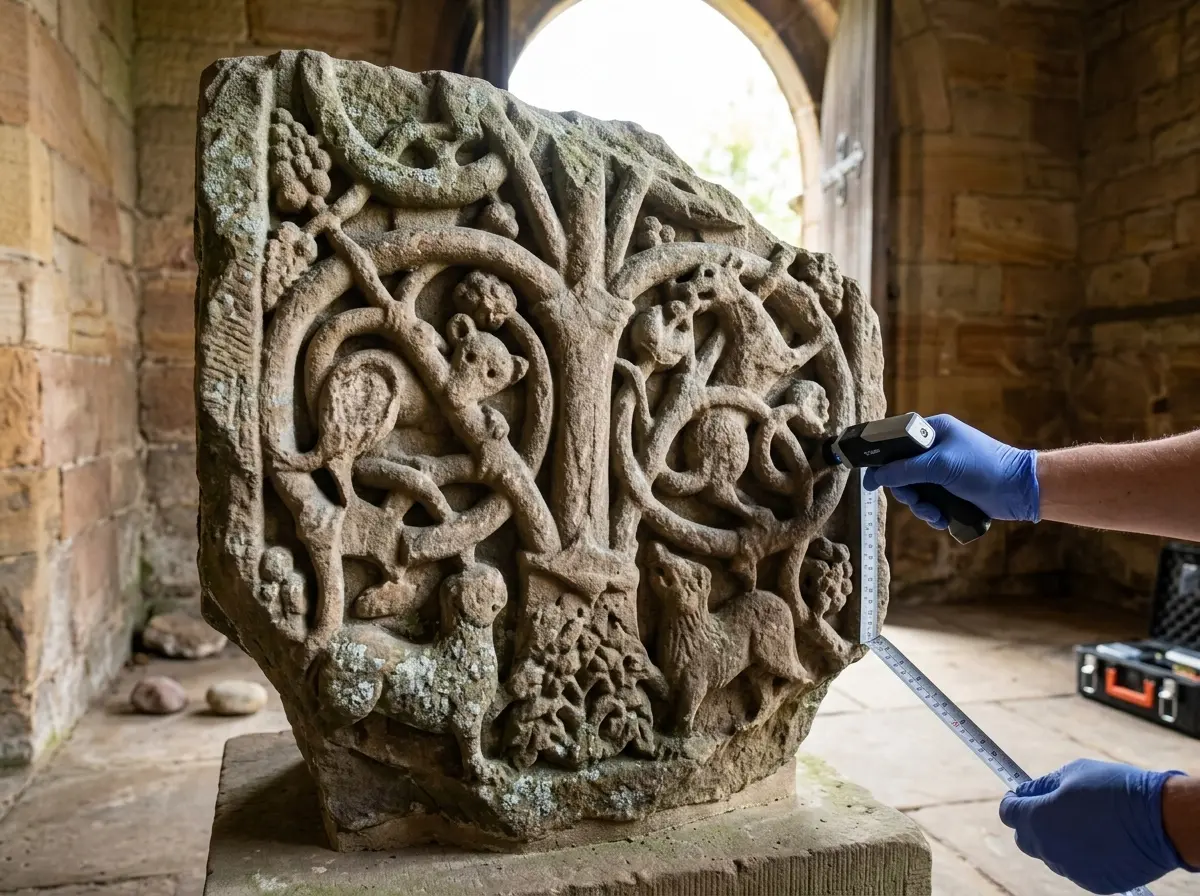
The Sculpting Southern Scotland project, coordinated by Durham University archaeologist Dr Christina Cowart-Smith FSAScot, will produce 2D and 3D images plus design data covering the period AD 500 to 1100. The work targets a contested border zone once claimed by the kingdoms of Northumbria and Strathclyde.
That border zone left few contemporary written sources. The stones therefore stand as the main surviving record of how power, worship and identity were made visible across six centuries of shifting control.
Recording Starts Before More Churches Change Hands
Initial sites include Abercorn, Coldingham, Melrose, Auldhame, Tyninghame, Aberlady, Morham and Jedburgh. Funding also comes from the Pictish Arts Society and the Hunter Historical and Archaeological Trust, the latter supporting a south-west pilot.
Dr Cowart-Smith said stone sculpture from early medieval southern Scotland is one of the country’s most under-exploited, at-risk historical resources. It presents a unique witness to a crossroads of cultures, showing how individuals and communities constructed identity, expressed political affiliation, organised worship and negotiated differences.
Dr Helen Spencer, SAS head of research, noted that many churches housing these stones are changing use, making proper recording essential so the pieces remain available for study.
- About 200 fragments south of the Forth-Clyde line
- Most not studied for over a century
- Fieldwork begins autumn 2026
- Open-access digital database planned
- Eventual coverage of Lothians, Borders, Ayrshire, Dumfries and Galloway
The project complements a two-year SAS and Scotland’s Churches Trust initiative already recording at-risk church buildings and their heritage value.
Together the two efforts treat fabric and fittings as linked problems. One records the buildings under pressure. The other captures the early medieval sculpture those buildings still hold before titles change hands again.
The south-west pilot funded by the Hunter Historical and Archaeological Trust will test whether the same recording workflow holds in Ayrshire and Dumfries and Galloway, where the later phases of the project intend full coverage.
Northumbria’s Reach and Strathclyde’s Return
From about AD 600 to 700 large parts of southern Scotland formed an integral part of the Kingdom of Northumbria, also known as Bernicia. Monasteries and bishoprics appeared at places such as Melrose, Tyninghame and Abercorn. After Viking raids fractured Northumbrian power, the Clyde-based Kingdom of Strathclyde expanded eastward and even into Cumbria.
Boundaries shifted repeatedly across the six centuries under study. Monumental sculpture helped create and advertise kingdom identities and relationships. With few surviving contemporary texts from this zone, the stones become primary evidence.
- AD 500-600: Early Christian foundations and first sculptural experiments appear across the region.
- AD 600-700: Northumbrian expansion integrates southern Scotland; stone churches and high crosses multiply.
- AD 700-850: Peak of Anglian influence and artistic exchange with Pictish and British neighbours.
- AD 850-950: Viking disruption; Northumbrian centres contract while Strathclyde revives.
- AD 950-1100: Kingdom of Alba consolidates; sculpture continues under changing patronage.
The Corpus of Anglo-Saxon Stone Sculpture catalogue has long documented the English side of this material. Southern Scotland’s share has lagged.
That lag matters because the same artistic networks crossed the later national border. Motifs, tool habits and workshop practices visible on the English side cannot be read in full without the southern Scottish pieces that shared those circuits.
When Northumbrian power contracted after the Viking raids, sculpture did not simply stop. Strathclyde’s eastward push and Alba’s later consolidation both left marks in stone. The sequence of styles therefore charts political recovery as well as loss.
Church Sales Turn Heritage into an Immediate Problem
Scotland’s Churches Trust has tracked the scale of disposals. The trust has identified 114 Church of Scotland churches closed or sold since 2020 or currently on the market, plus two already demolished. A further 547 sit in the “B” category on recent presbytery plans, a status that in most cases signals eventual disposal, while 734 remain “A” for now.
More than 400 churches of all denominations have closed since the start of the decade, according to the same monitoring. One church closes roughly every week. Sales documents often treat fixtures as secondary. Stones built into walls, standing in porches or stored in vestries face uncertain futures once titles change.
| Category | Number (Church of Scotland) | Implication |
|---|---|---|
| Closed, sold or on market since 2020 | 114 | Immediate risk to associated artefacts |
| “B” on presbytery plans | 547 | Likely disposal in next rounds |
| “A” retained for now | 734 | Temporary safety |
| No data available | 134 | Unknown status |
At Morham in East Lothian, already on the project list, the Church of Scotland sought permission to exhume remains from a crypt during reorganisation. Similar cases elsewhere have delayed sales only when specific artefacts could not be rehoused. Kirkinner’s 10th-century cross was removed from a sold church. The pattern is clear: once a building leaves ecclesiastical ownership, the stones’ next location is rarely guaranteed.
The weekly pace of closure means the recording window is short. Fragments that have waited more than a century for fresh study now face a far tighter timetable set by property decisions rather than research schedules.
Fixtures listed as secondary in sale papers can include crosses, panels and architectural sculpture that once defined the character of the building. Without prior documentation, those pieces become easy to overlook once ownership passes to a new party with different priorities.
How the Images and Database Will Work
Cowart-Smith will generate both conventional 2D photographs and 3D models. Design details, motifs, tool marks and context will be recorded systematically. The resulting open-access searchable database draws direct inspiration from Professor Katherine Forsyth’s 2021-25 EpiDoc-based OG(H)AM open digital corpus of ogham.
That model already allows comparison across Ireland, Britain and the Isle of Man. The new southern Scotland resource aims for the same interoperability so researchers can track sculptural hands, workshop traditions and political messaging across former borders.
Cowart-Smith’s own PhD examined the British high cross between AD 600 and 1100. She has previously worked on newly excavated sculpture from Lindisfarne and manages the Corpus of Anglo-Saxon Stone Sculpture social media presence. The pilot will test methods before wider rollout.
At a time when many of the churches which house early medieval carved stones in southern Scotland are changing use, it is essential that these beautiful and intricate pieces of heritage are properly recorded and available for study in the future.
Dr Helen Spencer, Head of Research, Society of Antiquaries of Scotland
Systematic capture of tool marks and motifs will let later users test whether several fragments share a single carver or workshop. Context records will keep the link between a stone and its original setting even if the object itself later moves.
Interoperability with the OG(H)AM model means the southern Scottish data can sit alongside Irish, British and Manx records without translation into a closed local format. Cross-border questions about influence and exchange become practical rather than speculative.
Sites That Still Hold the Evidence
Abercorn once held a Northumbrian bishopric. Coldingham and Melrose were major monasteries. Jedburgh retains ornately carved panels and a shrine that has already travelled for exhibition. Auldhame, Tyninghame and Aberlady sit on the coastal corridor that linked Bernicia to the North Sea. Morham preserves both sculpture and later elite burials.
Many of these stones sit in or beside buildings now subject to the same rationalisation process that has already moved more than a hundred properties. The digital record will not replace the objects, but it will ensure that if a stone is relocated, sold with a building, or simply left exposed, scholars and the public retain a high-fidelity surrogate.
| Site | Historic Role | Current Status Note |
|---|---|---|
| Abercorn | Northumbrian bishopric | Ecclesiastical site targeted |
| Jedburgh | Abbey with carved panels | HES-managed elements |
| Morham | Early sculpture and crypt | Recent exhumation discussion |
| Melrose | Anglian monastery | Core project location |
| Coldingham | Coastal foundation | Included in first round |
The Society of Antiquaries of Scotland research grants awarded £9,237 across nine projects in the latest round. Cowart-Smith’s work sits inside that small but targeted support system while the society also fundraises for a national heritage hub.
The first-round list mixes coastal corridor sites with inland monastic centres. That spread lets the pilot sample both the North Sea-facing zone of Bernician contact and the inland places where later Strathclyde and Alba patronage left its own mark.
- Abercorn, Tyninghame and Aberlady sample the coastal Bernician corridor
- Melrose and Coldingham represent major monastic foundations
- Jedburgh supplies ornate panels already known through exhibition
- Morham links early sculpture with later elite burial evidence
A Catalogue Gap Leaves Evidence Hard to Compare
The Corpus of Anglo-Saxon Stone Sculpture has already organised the English material into a shared reference frame. Southern Scotland’s roughly 200 fragments, most untouched by modern study for more than a century, have had no equivalent backbone.
Without that backbone, questions about workshop range and political messaging stop at the modern border even when the early medieval kingdoms did not. The new open-access database is designed to close that break in the record.
Inspiration from the OG(H)AM corpus supplies a proven route to interoperability. Design data, 2D images and 3D models can then be read against both the English corpus entries and the wider ogham dataset rather than remaining a sealed local collection.
Cowart-Smith’s prior work on the British high cross and on newly excavated Lindisfarne sculpture supplies direct experience of the same period and material class. The pilot therefore starts with methods already tested on related stones rather than from a blank sheet.
What Digital Access Changes for Local Groups
Communities facing church closure often lose everyday contact with the carved stones at the same moment the building leaves use. An open database cannot restore the physical setting, yet it can keep the imagery and design record available for later reinterpretation or redisplay.
Local groups that later seek to explain or show the stones will have high-fidelity surrogates even if the originals have moved into store, private ownership or another site. Researchers gain the same baseline for comparison across the Lothians, Borders, Ayrshire and Dumfries and Galloway.
The complementary SAS and Scotland’s Churches Trust building record supplies the architectural half of the story. Read together, the two datasets show both the structures under pressure and the early medieval sculpture those structures still contain.
Funding from the Society of Antiquaries of Scotland, the Pictish Arts Society and the Hunter Historical and Archaeological Trust keeps the first phase modest in scale and focused on method. Wider rollout follows only after the pilot confirms that the imaging and data standards work in the field.
What the Stones Still Carry
The carvings show political affiliation through style and iconography. They mark worship spaces and burial places. They negotiate cultural difference at a time when Gaelic, British, Anglian and Scandinavian influences met. Once recorded, the dataset will let analysts ask how many hands worked a given workshop, whether motifs travelled with royal marriages or monastic networks, and how sculpture signalled continuity after political collapse.
- Style and iconography as signals of political affiliation
- Markers of worship spaces and burial places
- Evidence of contact among Gaelic, British, Anglian and Scandinavian traditions
- Clues to workshop hands, motif travel and post-collapse continuity
Communities that lose a church often lose the quiet presence of these objects at the same time. Digital access returns some of that presence to researchers and to local groups who may later seek to reinterpret or redisplay the stones. The physical risk remains. The recording race is the practical answer now available.
Fieldwork begins in the autumn. The first images will start filling the database before the next wave of presbytery decisions lands.
Each season of delay raises the chance that another fragment leaves its recorded setting without a 3D model or a systematic design entry. The autumn start is therefore both a research timetable and a direct response to the weekly rhythm of church closures already measured by Scotland’s Churches Trust.
 Scotland’s Facial Recognition Push Sparks Mask Ban Call
  Galaxy Z Flip 8 Hits $799 Only If Your Trade-In Qualifies
  If England Had Kept Water Public Like Scotland
  Samsung Smart Switch Now Moves Passwords and eSIM From iPhone
  Old Firm Spend Pulls Clear as Premiership Rivals Patch Squads
  Chinese Studios Quietly Seize the Gamescom Stage