
 Ishan Crawford
 MeitY cleared 31 applications under the fifth ECMS tranche for Rs 7,877 crore in investment on 17 August, with projected production of Rs 82,243 crore and 9,588 direct jobs. Kaynes Technology’s PCB plant near Chennai is due live within a month, Dixon’s display and camera module unit in Noida in about four months, and Motherson’s Kanchipuram enclosure plant plus Wipro’s copper-clad laminate facility in two to three months.
Of 106 total approved projects, 38 plants already make components and another 16 sit in advanced construction or machinery installation. The scheme has now locked investment of Rs 69,548 crore against its original Rs 59,350 crore target.
That overshoot on committed capital, paired with a still-open job gap, frames the fifth tranche as both a scale-up and a stress test. Fresh money is landing in materials and capital goods, not only in familiar assembly lines. The commissioning calendar through year-end will show whether the extra investment converts into the production volumes already written into the approvals.
What the fifth tranche actually cleared
The 31 new applications cover more than 20 products across 10 states and bring the running total to 106 projects spanning 30 products in 15 states. Projected production from all approvals stands at Rs 5,34,101 crore, above the original Rs 4,56,500 crore goal. Employment estimates reach 74,628 direct jobs against a 91,600 target, with MeitY Secretary S Krishnan noting the shortfall will close shortly.
The Rs 7,877 crore figure combines Rs 6,844 crore in fresh proposals plus a Rs 1,033 crore investment increase already approved for Wipro Global Engineering and Electronic Materials Private Limited to expand copper-clad laminate output. The fifth tranche alone is expected to generate the Rs 82,243 crore in production and nearly 10,000 jobs Krishnan cited.
- Total approved investment: Rs 69,548 crore (target Rs 59,350 crore)
- Projected production: Rs 5,34,101 crore (target Rs 4,56,500 crore)
- Direct jobs estimated: 74,628 (target 91,600)
- Plants already manufacturing: 38 of 106, plus 16 advanced
Union Minister Ashwini Vaishnaw said the scheme is accelerating a deep-rooted Swadeshi electronics value chain that moves past assembly into critical components and essential raw materials.
The product and state counts matter because they spread risk. Twenty-plus products in a single tranche reduce dependence on any one sub-assembly. Ten states in the new round, and fifteen overall, keep capacity from clustering in a single industrial corridor.
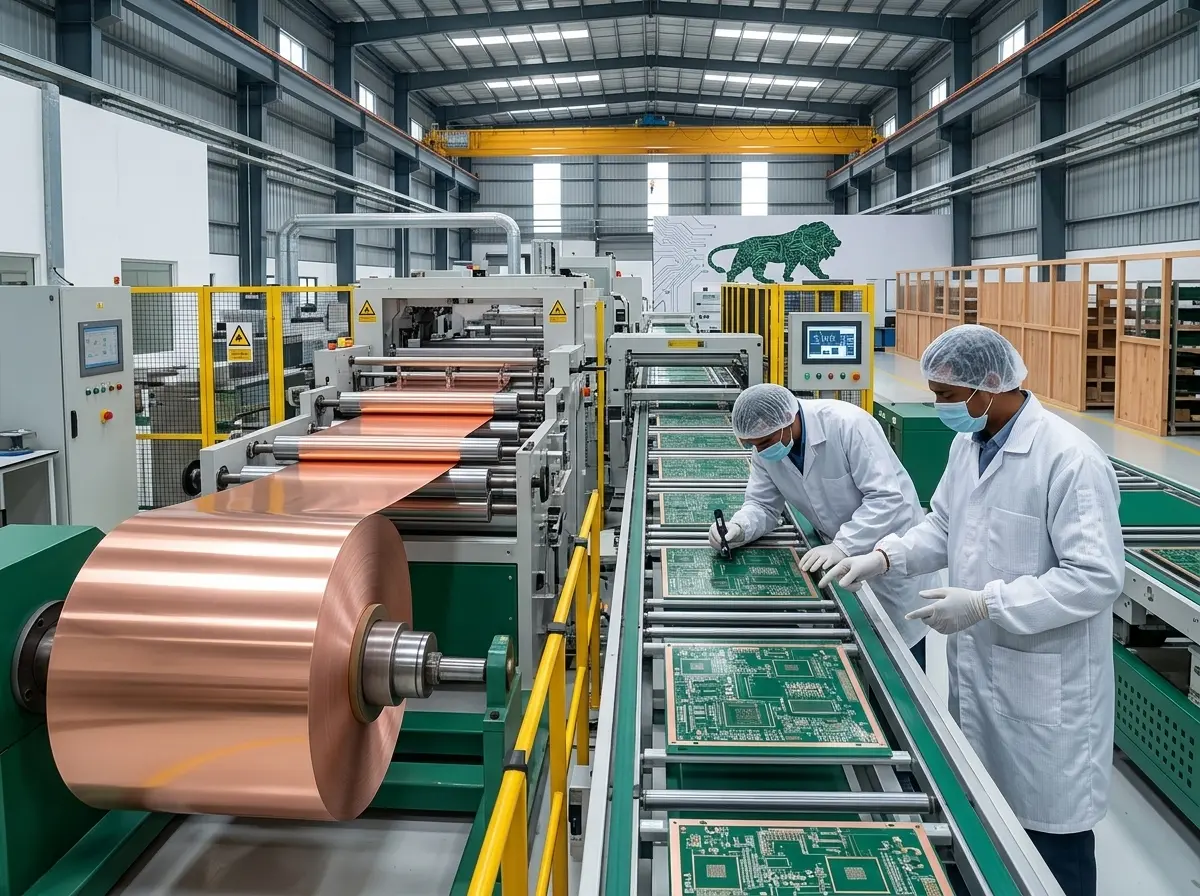
Plants already running and the ones opening next
ATL’s lithium-ion cell units at Rewari and Sohna are operational, as is Tata Electronics’ enclosure plant in Hosur. Krishnan told reporters the pace of construction and commissioning has been rapid across sites.
- Within one month: Kaynes Circuits PCB plant near Chennai
- Two to three months: Motherson enclosure plant, Kanchipuram; Wipro Global copper-clad laminate plant
- Around four months: Dixon Technologies display and camera module facility, Noida
- Around six months: USAM enclosure plant; Secure Circuits PCB plant
Several other approved projects are expected to come on stream within six months. Krishnan said the writing is on the wall for projects that are grounded and where electronic-sector production is picking up.
The near-term slate mixes bare boards, enclosures, laminates and camera-display modules. That mix matters for downstream EMS lines that still import those inputs. Once Kaynes, Motherson, Wipro and Dixon are live, the 38 operating plants gain a thicker local feeder layer rather than another wave of final assembly alone.
Who secured the larger commitments this round
High-value items in the tranche include Wipro’s laminate expansion and capital-goods work by Jyoti CNC. The full list of fresh approvals spans sub-assemblies, bare components, supply-chain materials and capital equipment.
| Company / entity | Focus | Notable commitment |
|---|---|---|
| Wipro Global | Copper-clad laminate | Rs 1,033 crore additional |
| Jyoti CNC Automation | Capital goods | Rs 1,021 crore |
| Micromax Precision Moulding | Enclosures | Rs 565 crore |
| Quantum Magnetics | Rare earth permanent magnets | Rs 400 crore |
| PCBL Chemical | Acetylene black | Rs 329 crore |
| Minda Instrument | Display modules | Rs 270 crore |
| Acutaas Chemicals | Electrolyte additives | Rs 119 crore eligible |
| Syrma SGS | Coils | Rs 60 crore |
| Centum Electronics | Transducers / filters | Rs 50 crore range |
Other clearances went to Amphenol, Rosenberger and Ennovi for connectors; Allied Engineering and Gruner for relays; SkyQuad for camera modules; SFO Technologies, GX Quantum Photonics and Huber+Suhner for optical SFP transceivers; Epsilon for anode material; and Mitsubishi Electric India among the capital-goods group. States receiving projects include Tamil Nadu, Uttar Pradesh, Gujarat, Karnataka, Maharashtra, Haryana, Telangana, Himachal Pradesh, Uttarakhand and Goa.
The ticket sizes show a barbell. Wipro and Jyoti CNC anchor the top end above Rs 1,000 crore. Mid-tier bets from Micromax, Quantum Magnetics and PCBL fill enclosures, magnets and conductive additives. Smaller coil, transducer and filter lines round out niches that larger EMS names rarely build in-house.
What is interesting is the rapid pace of work, and you can see the way in which various factories have come up and which are currently under construction in different parts of the country.
S Krishnan, MeitY Secretary, said that after the latest approvals.
First domestic runs of materials that used to be 100 percent imported
The tranche adds capacity for filters, coils, speakers and microphones for the first time under the scheme, plus raw materials that sit deep in the bill of materials. Acetylene black (PCBL) and electrolyte additives (Acutaas) feed lithium-ion cell chemistry. Rare-earth permanent magnets (Quantum Magnetics) and anode material (Epsilon) address further upstream gaps. Hermetic terminals and metallized films for capacitors round out the supply-chain list.
- Anode material capacity already projected near 110 percent of domestic demand
- Optical transceiver-SFP output at roughly 350 percent of demand
- Relays at about 200 percent, creating surplus for export
- Enclosures approaching 100 percent domestic coverage
Earlier tranches had already targeted PCBs, camera and display modules and mobile enclosures. The cumulative effect is that approved capacity now meets or exceeds demand in several niches that previously relied on imports, most of which came from China and Hong Kong.
Surplus in relays, SFPs and anode material is the clearest early proof that ECMS can push past pure substitution. When approved output clears 100 percent of domestic need, the extra volume has nowhere to go except export or inventory. That is the mechanism by which a components scheme starts to support the wider electronics trade balance.
How the scheme is structured and why applications keep arriving
The Electronics Component Manufacturing Scheme objectives centre on attracting investment across sub-assemblies, bare components, selected high-density PCBs, supply-chain items and capital equipment. Incentives mix turnover-linked, capital-expenditure and hybrid forms. Tenure runs six years with an optional one-year gestation for turnover support; capital support lasts five years. The original outlay was Rs 22,919 crore; the Union Budget 2026-27 raised it to Rs 40,000 crore.
Application windows for most segments closed in September 2025, though Segment D remains open until April 2027. Krishnan said more applications remain under consideration and that ECMS has become one of the government’s fastest-moving manufacturing programmes. The earlier third-tranche ECMS approvals baseline already showed large Dixon, Samsung Display and Hindalco commitments that helped push totals past original targets.
The budget lift from Rs 22,919 crore to Rs 40,000 crore gives MeitY room to clear the pipeline still under review without starving earlier awardees. Hybrid incentive design also explains repeat interest: firms can match turnover support to ramp curves or take capital support when tooling is the binding constraint. Segment D’s longer window keeps a door open for later capital-goods and materials entrants after the main gates shut.
Import dependence and the capacity still needed
India exported electronics worth about $38.56 billion in 2024-25 while importing components worth $36.8 billion in the same period, with China supplying nearly 40 percent of those parts and Hong Kong another 16 percent in the first half of fiscal 2025. Early ECMS plants were projected to cover roughly 20 percent of domestic PCB demand and 15 percent of camera-module sub-assembly from the first seven projects alone, with 60 percent of that output earmarked for export.
Later projections have lifted PCB localisation expectations toward 50 percent and lithium-ion cells toward 61 percent in some coverage, though rare-earth magnets remain closer to 25 percent of demand. The newest materials approvals close remaining holes in conductive additives and electrolyte chemistry. Full 106 ECMS projects and plant status details show the geographic spread and the mix of foreign and domestic applicants now on the ground.
Market reaction on X and in trading focused on listed EMS names such as Syrma SGS and Dixon, whose shares rose on the news. Deeper in the chain, smaller or specialised firms such as Acutaas, PCBL and Quantum Magnetics received less attention even as they filled the materials gaps that determine whether the assembly layer can actually localise.
The export and import totals sit close enough that every percentage point of localisation on the components side moves the net figure. China and Hong Kong together still dominate the inbound mix, so magnets stuck near 25 percent of demand remain a visible soft spot even as PCBs and cells climb.
Approved Totals Pull Ahead of Opening Targets
Side by side, the scheme’s scorecard is uneven in a revealing way. Capital and output projections have already cleared their original marks. Direct employment has not.
| Metric | Original target | Status after fifth tranche |
|---|---|---|
| Approved investment | Rs 59,350 crore | Rs 69,548 crore |
| Projected production | Rs 4,56,500 crore | Rs 5,34,101 crore |
| Direct jobs | 91,600 | 74,628 |
| Scheme outlay | Rs 22,919 crore | Rs 40,000 crore (Budget 2026-27) |
Investment is running above plan because fresh proposals and expansion tops such as Wipro’s laminate hike keep stacking on the early large tickets. Production projections follow that capital. Jobs lag in part because many of the 106 projects are still building or installing machinery; 38 plants are in manufacturing mode and 16 more are advanced, so the headcount curve trails the rupee curve.
Krishnan’s note that the employment shortfall will close shortly rests on that pipeline. Each plant that moves from construction into steady shifts adds operators, technicians and supervisors the approval tables already count but payrolls do not yet show.
Materials Gaps Close While Magnets Trail
The fifth tranche’s materials list is best read against the localisation percentages already on record. Anode material toward 110 percent of demand, relays near 200 percent and optical SFPs near 350 percent show where approved capacity has overshot home need. Enclosures nearing full domestic coverage complete that set.
- Strong cover: anode material, relays, optical SFP transceivers, enclosures
- Rising cover: PCBs toward 50 percent; lithium-ion cells toward 61 percent
- Still thin: rare-earth permanent magnets near 25 percent of demand
- Newly addressed: acetylene black, electrolyte additives, hermetic terminals, metallized films
Quantum Magnetics’ Rs 400 crore rare-earth line is therefore strategic out of proportion to its ticket size. Magnets remain the laggard on the published demand-cover list. PCBL’s acetylene black and Acutaas’s electrolyte additives plug chemistry holes that cell plants cannot solve with assembly labour alone.
Earlier focus on PCBs, camera and display modules and mobile enclosures built the mid-stack. The new filters, coils, speakers and microphones extend that stack into parts that every handset and device bill of materials still tends to source abroad. Together the waves explain why Vaishnaw can describe a value chain moving past assembly: the approvals now reach raw materials, bare components and the capital goods that tool them.
The path from Rs 69,548 crore committed to the $500 billion target
Prime Minister Narendra Modi’s stated goal is $500 billion in electronics production by the end of the decade and roughly six million jobs. India’s electronics sector already exceeds $150 billion. ECMS sits alongside the broader PLI framework as the instrument meant to push value addition deeper than final assembly.
With 38 plants running, 16 more advanced and a fresh wave of Kaynes, Dixon, Motherson and Wipro facilities due online before year-end, the scheme is converting approvals into physical capacity faster than many earlier incentive programmes. Employment still trails its target, and more applications continue to arrive. The surplus already visible in relays, SFPs and anode material gives the first concrete signal that domestic output can move from import substitution into exportable volumes.
Krishnan closed the briefing by calling on industry to keep the momentum so India becomes a leading electronics manufacturer. The next six months of commissioning will show how quickly that surplus turns into steady production numbers.
 ONGC licence frees Venezuela cash and operatorship talks
  Anthropic Hits $65 Billion Run Rate and Flips the AI Cash Test
  Supreme Court grounds the fare free-for-all with three-week clock
  Gold Nears $4400 as Soft Data Meets Oil Inflation Risk
  Nifty Slips as Zaggle Circuits and Dhoot Debuts Big
  Diesel Crack Tops $100 as Iran Rhetoric Lifts Crude