
 Ishan Crawford
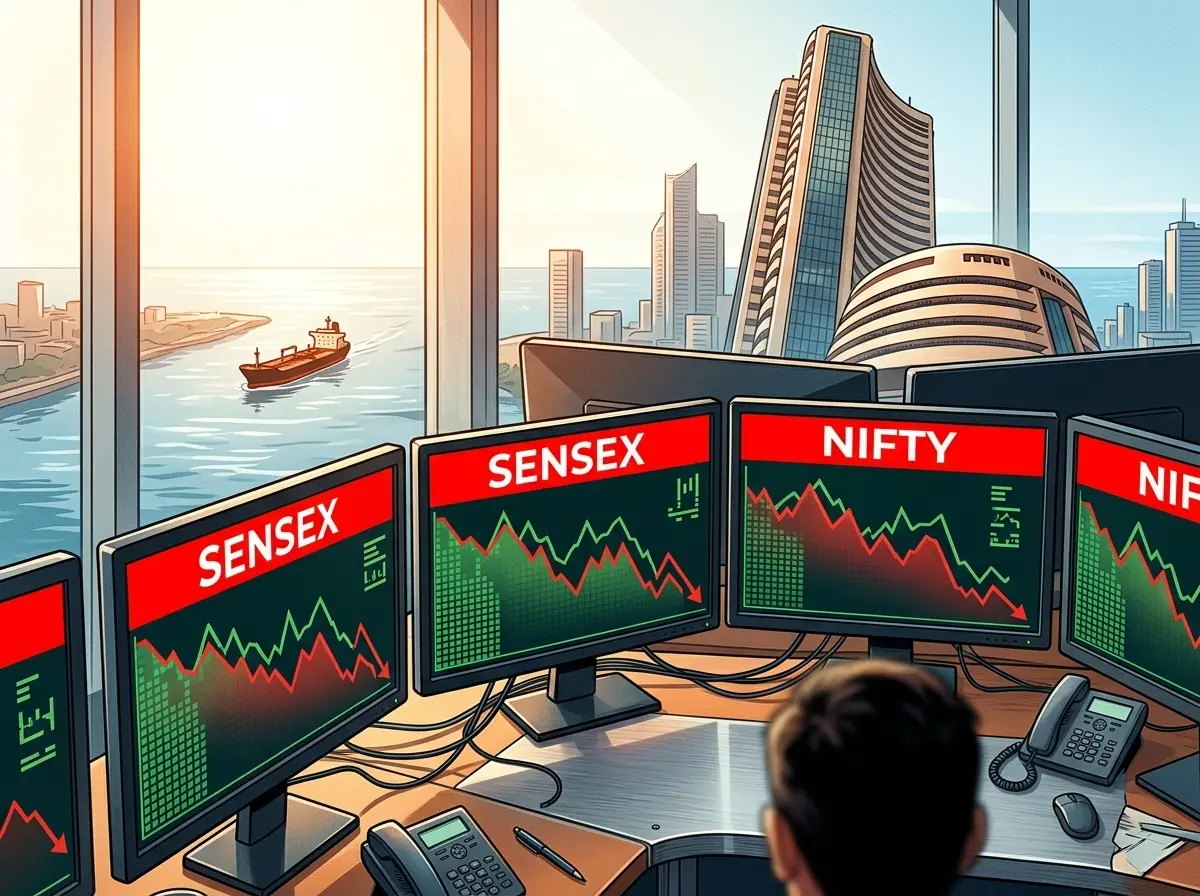
 Sensex fell more than 400 points at the open on 7 August and traded near 78,500 by midday as Brent crude climbed above $83 on fresh US-Iran friction over the Strait of Hormuz. Nifty slipped below 24,600. The move followed overnight caution on Wall Street and Asian tech weakness, yet domestic institutions bought the dip and Bitcoin ETFs kept absorbing supply inside a tight range.
The surface story is oil and geopolitics. The second layer is how selective demand is cushioning risk assets ahead of the US jobs report that could reset Fed expectations.
Bajaj Twins Drag the Open Lower
GIFT Nifty had already flagged a soft start. Nifty opened at 24,538.90 and Sensex at 78,516. The rupee opened at 95.28 against the dollar. By midday Sensex was down roughly 432 points or 0.55 percent near 78,522 while Nifty lost about 75 points or 0.3 percent to around 24,561.
| Index / Sector | Level (approx midday) | Change |
|---|---|---|
| Sensex | 78,522 | -432 (-0.55%) |
| Nifty 50 | 24,561 | -75 (-0.3%) |
| Nifty Bank | 57,768 | -0.51% |
| Nifty IT | 31,446 | +1.09% |
| Nifty Midcap | 63,424 | +0.15% |
Bajaj Finance and Bajaj Finserv led the Nifty losers. Financial services and PSU banks underperformed. IT snapped a three-day losing streak, led by TCS and HCL Tech, as some global tech bets unwound. Broader markets stayed mixed: midcaps edged higher while smallcaps were flat to slightly lower. Several Q1 results hit the tape, including SBI, Titan and Hindalco, adding stock-specific swings.
The sector split on the open was clean. Rate-sensitive names gave ground first while export-linked IT found a relative bid. Midcaps held a thin green print even as the benchmarks slipped, a sign that selling stayed concentrated rather than cascading through the full market. Results from SBI, Titan and Hindalco kept individual stocks moving on their own news even as the index tone stayed cautious.
- Financials and PSU banks led the downside drag.
- IT reversed three sessions of losses on global unwind flows.
- Midcaps stayed slightly positive; smallcaps were flat to soft.
- Stock-specific Q1 prints added noise inside the broader oil-led open.
Oil at 83 Dollars Hits the Import Bill Harder
Brent futures pushed above $83 and briefly higher after Iran floated a restrictive draft plan for the Strait of Hormuz. WTI traded near $78-80. The bounce reversed recent hopes that peace talks and an open Hormuz would keep prices softer. US President Donald Trump said he expects the conflict to end “pretty soon,” yet markets treated the conflicting statements as fresh uncertainty.
India imports roughly 88 to 91 percent of its crude. About 30 percent of that volume still moves through Hormuz even after diversification. The higher price path lifts the import bill, pressures the current account and feeds into inflation and the rupee. Every 10 percent rise in oil has historically worsened India’s current-account balance by around 0.4 percentage points of GDP. Q1 FY27 already saw the crude import bill jump about 60 percent year-on-year on elevated prices.
- Higher crude directly raises the current-account deficit and funding needs.
- Downstream refiners, airlines and transport face margin squeezes if they cannot pass costs fully.
- Fiscal space narrows if fuel subsidies or tax adjustments return to shield consumers.
- Rupee weakness from risk aversion multiplies the dollar import cost.
That import exposure is why oil spikes still punch Indian equities harder than pure global beta would suggest. Earlier Iran-linked episodes left a lasting risk premium on the indices.
The transmission is mechanical. A firmer Brent print raises the dollar outlay for the same barrels. The current-account gap widens by the historical 0.4 percentage-point rule of thumb for every 10 percent oil rise. Funding needs climb with it. At the same time a softer rupee, already opening at 95.28, multiplies the local-currency cost of those imports. Downstream margins then compress unless price hikes stick, and any fiscal response to shield consumers further narrows budget room. The equity market prices that chain in real time, which is why the open gap lower tracked the oil move so closely.
ETF Money Absorbs the Supply in Bitcoin
While Indian financials sold off, Bitcoin held near $64,300-$64,400 inside a multi-week range. US spot Bitcoin ETFs recorded net inflows of $170.1 million on 3 August, $211.5 million on 4 August and $244.4 million on 5 August. The provisional 6 August figure was smaller, taking the early-month total near $635 million. BlackRock’s IBIT alone took roughly $478-479 million across the strong sessions, more than three-quarters of the total.
| Date | US Spot Bitcoin ETF Flow |
|---|---|
| 31 July | $265 million outflow |
| 3 August | $170.1 million inflow |
| 4 August | $211.5 million inflow |
| 5 August | $244.4 million inflow |
| 3-5 August combined | $626 million haul |
| Early August total | Near $635 million |
That reversed a $265 million outflow on 31 July. It does not yet repair the heavier June outflows, when ETFs returned tens of thousands of BTC to the market. Fresh demand is currently soaking available supply and supporting the $63,000-$64,000 zone rather than forcing a clean breakout. On-chain data after a wallet exploit showed large dormant coins moving, yet only about 10 percent hit exchanges; most appeared to shift into newer wallets.
- $626 million three-day ETF haul into early August
- IBIT share roughly 76 percent of those inflows
- Fear & Greed stuck near 25 (extreme fear) while institutions bought
- Immediate BTC supports $64,000 then $63,000-$63,400
The 626 million dollars in three-day ETF inflows show institutions treating the range as accumulation even as retail sentiment stays fearful. Altcoins lagged: Ethereum hovered near $1,900, Solana and XRP slipped, and the Altcoin Season Index sat at 42. Capital is favouring Bitcoin and Ethereum over broad risk-on rotation.
IBIT’s roughly 76 percent share of the strong sessions underlines how concentrated the bid remains. The rest of the complex is not rotating with it. Ethereum near $1,900 and softer prints in Solana and XRP keep the Altcoin Season Index at 42, well short of a broad risk-on signal. The range holds because ETF demand is matching supply, not because leverage is chasing a breakout.
Domestic Buyers Meet the Oil Shock
FIIs continued short-covering in index futures while DIIs posted one of the week’s strongest buying days, around ₹4,000 crore in early tallies. That domestic bid limited the damage relative to the oil move. Traders on X noted the prior day’s narrow Doji and gap-down open acting like a magnet around 24,590 before sellers reasserted. Support near 24,500-24,470 is now the line that matters for Nifty; a clean break opens 24,400 then 24,300.
Technically, the market continues to exhibit a cautious undertone as long as the Nifty remains below the 24,800 level. A sustained move above this hurdle could pave the way towards the 25,000 mark. On the downside, immediate support is placed in the 24,500-24,400 zone.
Rajesh Palviya, Head of Research at Axis Direct, laid out that map after Thursday’s consolidation. The same cautious tone carried into Friday. Financials felt the rate and growth sensitivity; IT caught a relative bid from global unwinds. The pattern matches earlier oil-driven sessions where domestic flows and stock-specific news capped the downside.
One internal read of the five-month Iran conflict showed how the earlier Iran war risk premium on Sensex reshaped sector leadership and the rupee. Friday’s tape looked like a milder replay of that dynamic rather than a fresh panic.
The DII print near ₹4,000 crore mattered because it arrived against an oil spike, not in calm conditions. FII short-covering in index futures removed one source of fresh supply. Together those two flows kept the midday loss on Sensex near 0.55 percent and on Nifty near 0.3 percent, smaller than the headline oil move might have implied on its own. The technical magnet around 24,590 after the prior Doji simply framed where that two-way trade concentrated before sellers pressed again.
Jobs Report Becomes the Next Binary
The July employment report due Friday is expected to show 80,000 to 85,000 jobs added after June’s 57,000. Unemployment is seen steady at 4.2 percent. Average hourly earnings are forecast up 0.3 percent month-on-month. The ADP private-payroll print had already come in soft at 44,000 against a 75,000-ish expectation.
The Federal Reserve held the funds rate at 3.50-3.75 percent in July on a 9-3 vote. Three dissenters preferred a 25-basis-point hike. A firm jobs number would strengthen their case that the economy can handle tighter policy. A weak print would lower odds of further tightening and ease pressure on risk assets. July CPI follows on 12 August and PPI on 13 August. If oil stays elevated and feeds into those readings, the Fed’s room to soften shrinks.
- Early August: Brent rebounds above $83 after Hormuz draft and conflicting US-Iran statements.
- 3-5 August: US spot Bitcoin ETFs post strong consecutive inflows led by IBIT.
- 6 August: Sensex and Nifty consolidate in a tight range; Dow snaps a record streak.
- 7 August: Indian benchmarks open lower; US non-farm payrolls due 8:30 a.m. ET.
- 12-13 August: CPI and PPI complete the inflation picture.
Bitcoin’s technical map is similar: hold $64,000 and the ETF bid keeps the range intact; lose $63,000 and $62,500-$60,000 come into view. A close above $66,600 would signal demand is finally moving price. Until then the stability is a measured accumulation zone, not a leverage invitation.
The jobs print sits between two already soft reference points: June’s 57,000 and the ADP miss at 44,000. Consensus at 80,000 to 85,000 therefore carries binary weight for the three dissenters who wanted a hike in July. A number that clears the band strengthens the tighter-policy case. A miss that tracks ADP would pull odds the other way and give risk assets breathing room into the CPI and PPI prints next week. Oil at current levels complicates that path if it begins to show up in those inflation readings.
Why This Session Stays More Selective
Earlier Iran-linked tapes produced broader selling when the ceasefire narrative broke down. Friday’s price action diverged from that template. The benchmarks gaped lower with oil, yet the damage stayed uneven across sectors and market-cap bands.
IT finished higher by about 1.09 percent while Nifty Bank lost 0.51 percent. Midcaps held a small gain near 0.15 percent. That mix is the opposite of a uniform risk-off washout. Domestic institutions supplied the bid that kept the point losses contained. Bitcoin’s ETF absorption ran in parallel, holding the $64,300-$64,400 zone even as Fear & Greed remained near 25.
The contrast with prior sessions is the useful signal. When every headline once triggered full de-risking, the same oil channel now meets offsetting demand in pockets of the market. Selectivity does not cancel the import-bill risk. It does change how much of that risk reaches the index level on any single day.
The Rupee Still Magnifies the Oil Hit
The open at 95.28 against the dollar set the local cost baseline before Brent’s push above $83 was fully absorbed. Because India still sources about 30 percent of its crude through Hormuz and relies on imports for 88 to 91 percent of its needs, any rupee softness multiplies the same barrel price into a larger rupee outlay.
That dual pressure is why the equity reaction retains an India-specific edge over pure global beta. Current-account math, the historical 0.4 percentage-point GDP hit per 10 percent oil rise, and the already elevated Q1 FY27 crude bill together explain the persistent risk premium. Refiners, airlines and transport names feel the margin question first. The broader indices feel it through financials and through the funding narrative that travels with a wider deficit.
None of that mechanism is new. What changes from session to session is how much domestic and institutional demand offsets it before the close.
What the Tape Is Testing
Friday’s decline fits a familiar pattern from the longer US-Iran episode. Oil spikes still hit India through the import channel and the rupee. Yet the market is no longer treating every headline as a full risk-off event. DIIs are present. ETF flows into Bitcoin continue even while Fear & Greed sits in extreme fear. IT can catch a bid when global tech rotates.
A prior session oil-driven Sensex slide earlier in the conflict produced larger point losses when the ceasefire narrative collapsed. Today’s move is smaller and more selective. That difference is the second-order signal: domestic and institutional demand are absorbing part of the shock.
Brent rose above 83 dollars a barrel and the jobs number will decide whether yields and the dollar give risk assets more room or less. For now the ranges are holding because buyers, not just sellers, showed up.
Sensex near 78,500 and Bitcoin near $64,400 both sit inside well-watched bands. The next break will belong to whoever blinks first on the macro data.
 SEBI CAS Forces Options Traders to Recalibrate Closing Risk
  Ardee Industries IPO Rides Lead Recycling Boom at Discount
  Gold Nears 4300 but Iran Risks Cap Gains Ahead of NFP
  Scotland Construction Stalls as Skills and Tariffs Blunt Infra Gains
  Lok Sabha Bill Opens UPI Charges Path for Banks Over Merchants
  Tata Chemicals Jumps as RBI Keeps Tata Sons in NBFC Upper Layer