
 Ishan Crawford
 Tata Chemicals shares rose as much as 5% on August 7 after the Reserve Bank of India retained Tata Sons in its Upper Layer NBFC list the previous day. The stake the chemicals maker holds in the group holding company is valued at roughly Rs 20,000 crore, more than Tata Chemicals’ own market capitalisation.
At 9:38 am the stock traded 3% higher at Rs 683.85. Tata Investment Corporation climbed about 6% the same morning. The RBI move keeps listing pressure and value-unlock optionality alive even while Tata Sons’ bid to exit NBFC regulation stays under review.
RBI Leaves the Exit Door Half Open
The central bank issued its 2026-27 Upper Layer list on August 6 and kept Tata Sons Private Limited inside it. The list was drawn from financials as of March 31, 2026 under revised principle-based criteria.
Inclusion of Tata Sons Private Limited in the list of NBFC-UL is without prejudice to the outcome of its application for de-registration, which is under examination.
That note from the RBI is the hinge. Governor Sanjay Malhotra had said the day before that the framework is principle-based, so entities meeting the criteria stay covered. Tata Sons, the principal investment holding company of the Tata group, first entered the Upper Layer in September 2022.
Upper Layer status brings enhanced oversight and, under the original rules, a three-year listing clock. That clock ran out on September 30, 2025 without a listing. A person familiar with the RBI’s thinking told Reuters the regulator is unlikely to force a listing while the deregistration application remains pending.
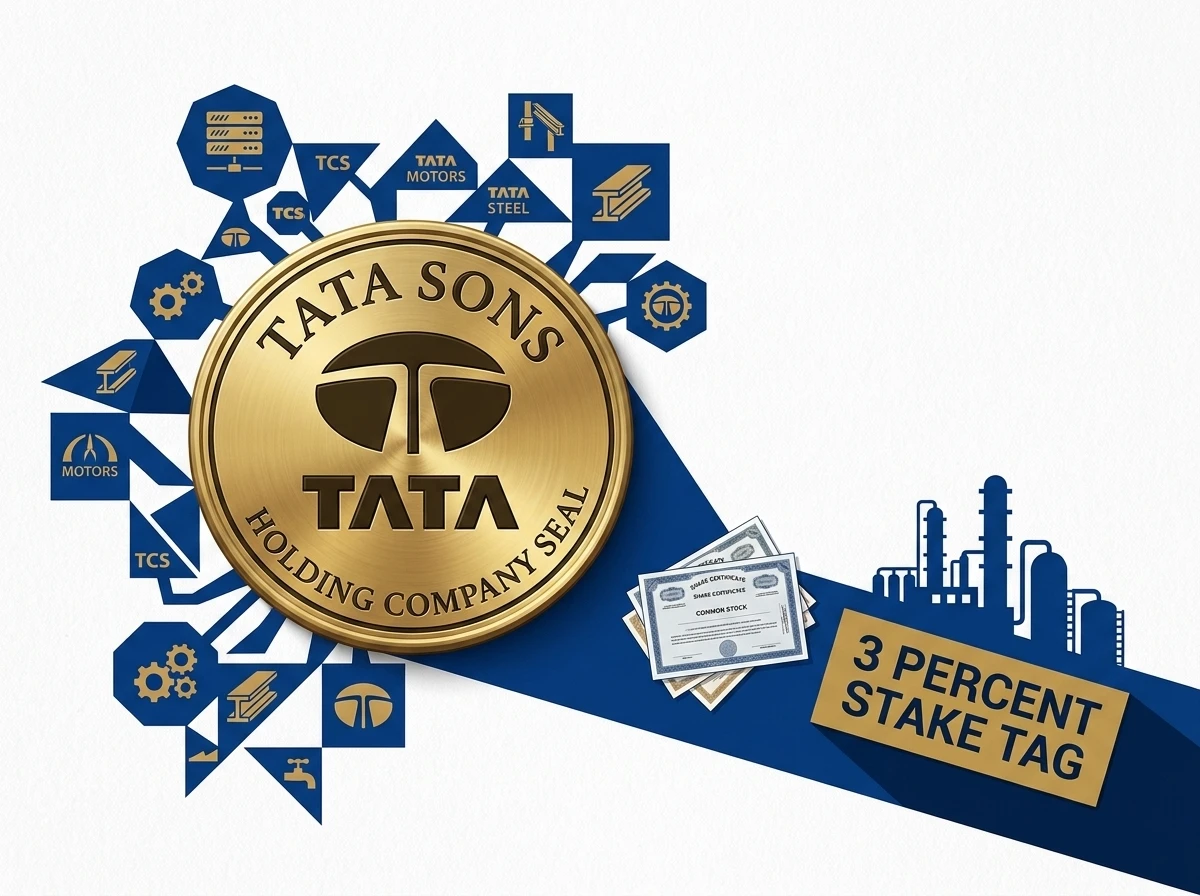
Why Tata Chemicals and Tata Investment Moved First
Investors treated the retention as confirmation that the holding company cannot simply walk away from systemic-importance rules. That preserves the long-term chance of a public market valuation for Tata Sons itself.
- Tata Chemicals: ~3% stake in Tata Sons, valued around Rs 20,000 crore, larger than the company’s market cap; shares up as much as 5%.
- Tata Investment Corporation: promoter stake of approximately 73.38% held by Tata Sons and other group entities; shares up about 6%.
- Market read: any eventual listing or structured monetisation would re-rate the embedded holding value sitting inside these listed vehicles.
Tata Chemicals has no direct control over Tata Sons decisions. Its shareholders simply own a pure-play claim on a slice of the unlisted holding company. That claim becomes more valuable the longer the listing question stays live.
The Numbers Behind the Stake Premium
| Entity | Stake / Holding | Approx Value or Move |
|---|---|---|
| Tata Chemicals in Tata Sons | ~3% | Rs 20,000 crore (exceeds Chemicals mcap) |
| Tata Investment promoters | 73.38% (Tata Sons + group) | Shares +~6% on Aug 7 |
| Shapoorji Pallonji Group | ~18.37% | Illiquid stake estimated in low-to-mid lakh crore range |
| Tata Trusts | ~66% | Controlling philanthropic block |
Standalone assets at Tata Sons are estimated at Rs 1.75 lakh crore to Rs 1.9 lakh crore, well above the revised Rs 1 lakh crore threshold that now anchors Upper Layer identification. The asset criteria themselves face review every three years.
Tata Sons together with other group entities holds 73.38% of Tata Investment Corporation, making that stock another direct conduit for holding-company value.
Seventeen Names and a Five-Year Lock
The full Upper Layer list for 2026-27 contains 17 entities. It includes REC, Power Finance Corporation, Indian Railway Finance Corporation, Bajaj Finance, Shriram Finance, LIC Housing Finance, Cholamandalam, Tata Capital, Tata Sons, Muthoot Finance, Aditya Birla Capital, HUDCO, Mahindra Finance, L&T Finance, Bajaj Housing Finance, HDB Financial Services and Piramal Finance.
Once classified, an NBFC stays under the enhanced framework for at least five years even if it later falls below the criteria. PNB Housing Finance and Sammaan Capital remain for that reason even though they no longer meet the current screen. Government-owned names receive a listing exemption that private entities do not.
For background on how the regulator defines these firms, the RBI definition and registration rules for NBFCs set the baseline requirements for certificates of registration and net owned funds.
The Shareholder Fight Under the Regulation
Market reaction on August 7 was not pure regulatory cheer. It priced the unresolved tension between owners. The Shapoorji Pallonji Group holds roughly 18.37% of Tata Sons and has repeatedly pressed for a listing so it can monetise or exit part of the holding. The group carries debt estimated at Rs 5.5 lakh crore to Rs 6 lakh crore and has explored share-swap or partial-monetisation routes.
Tata Trusts control about 66% and have long opposed a public float, arguing it would inject short-term market pressure into a structure built for long-horizon philanthropy and industrial investment. Noel Tata chairs the Trusts. A Tata Trusts governance review earlier this year already tested leadership continuity questions around the holding company.
On X, one clear-eyed take noted that underneath the regulation sits a shareholder fight: SP wants liquidity against its debt load while the Trusts and Tata Sons management have ruled out an IPO. The RBI list simply keeps the regulatory costume on that standoff.
How Tata Sons Tried to Step Off the Clock
- September 2022: RBI places Tata Sons in the Upper Layer as an NBFC-CIC, starting a three-year listing clock.
- 2023-24: Company retires direct debt, including selling TCS shares, and becomes effectively debt-free on a standalone basis.
- September 2024: Formal application filed to surrender the CIC/NBFC registration, arguing it no longer accesses public funds directly.
- September 30, 2025: Original listing deadline passes with no IPO and no final word on the application.
- June 2026: RBI finalises revised Upper Layer rules around a clean Rs 1 lakh crore asset threshold and principle-based identification; an earlier draft definition of “indirect public funds” via group entities is dropped.
- August 6, 2026: New list retains Tata Sons with the explicit without-prejudice note on the pending application.
Tata Sons owns Air India, Tata Digital and Tata Electronics plus large stakes in listed names such as TCS and Tata Steel. The Air India turnaround under Tata ownership is one of several capital-intensive bets that make funding flexibility a live issue inside the group.
What the Limbo Prices
The August 7 pop in Tata Chemicals and Tata Investment does not assume an imminent IPO. It prices the second-order reality that RBI has refused to let the holding company slip the systemic net on the strength of a debt-free balance sheet alone. As long as the deregistration stays open and the company remains on the list, the listing obligation and the enhanced governance rules remain a standing option, not a dead letter.
That optionality has different payoffs for different owners. Minority stakeholders and listed vehicles that own slices of Tata Sons gain a clearer path to eventual value discovery. The controlling Trusts retain the ability to keep the company private if the RBI ultimately accepts the exit application. SP Group keeps a live route to liquidity that a pure private structure denies it.
New group ventures have been flagged for large near-term losses, raising the separate question of where growth capital will come from. A listed Tata Sons would open one answer. An unlisted one keeps philanthropic control intact and funding more dependent on dividends from TCS and the rest of the portfolio.
For now the RBI has chosen neither final exit nor forced listing. The market’s immediate response was to mark up the purest listed claims on that unresolved choice.
 SEBI CAS Forces Options Traders to Recalibrate Closing Risk
  Sensex Drops 400 Points as Oil Spike Tests Market Resilience
  Ardee Industries IPO Rides Lead Recycling Boom at Discount
  Gold Nears 4300 but Iran Risks Cap Gains Ahead of NFP
  Scotland Construction Stalls as Skills and Tariffs Blunt Infra Gains
  Lok Sabha Bill Opens UPI Charges Path for Banks Over Merchants