
 Ishan Crawford
 Scotland would not automatically gain more carbon capture projects simply by rejoining the EU, according to energy transition expert Paul de Leeuw. The SNP pointed to 12 operational sites across Europe and none in the UK as proof the country is being left behind, yet de Leeuw called any direct membership link a push.
De Leeuw, director of the Energy Transition Institute at Robert Gordon University in Aberdeen, told The National the technology still needs government money to become viable anywhere. That basic economic fact does not vanish inside the EU.
Twelve Operational Sites Meet Nearly 200 Plans
Figures cited by the SNP and drawn from the Scottish Parliament Information Centre show 12 operational carbon capture sites in Europe and almost 200 more planned. The UK and Scotland currently have zero operational commercial projects.
Global tallies paint a broader picture. The Global CCS Institute’s 2025 status report counted 77 commercial facilities operating worldwide with 64 million tonnes per annum capacity as of late July, plus substantial capacity under construction. Europe and the UK feature in that growth, yet scale remains limited relative to net-zero needs.
- 12 operational sites in Europe per the SPICe figures used in the debate
- Almost 200 further sites planned across Europe
- 77 commercial CCS facilities operating globally with 64 Mtpa capacity
- 0 operational commercial projects in Scotland or the wider UK
Those numbers underpin the political claim. They also show deployment is still sparse even where EU funding tools exist.
Why Money Still Decides Every Project
De Leeuw was blunt about the commercial reality. Carbon capture is part of any serious net-zero pathway, yet it is not occurring at scale because the economic model requires public support.
It’s very clear that if you want us to have net zero, carbon capture is part of the solution. The challenge is, it is just not a technology that is happening at scale anywhere at the moment, and the reason is the economic model needs government support. It still needs money from somewhere to make sure it is viable. If it was commercially attractive proposition, you would see carbon capture and storage happening everywhere.
He made the point in the same interview with The National. Europe has many countries and only 12 projects so far, with more coming. Access to larger pots of funding might help, he said, but the consequence of membership cannot be stated as automatic delivery.
“The money has to come from somewhere. That challenge doesn’t go away, no matter what bloc you’re part of,” de Leeuw added. Earlier this year he called for a Scottish emission control centre and multi-year funding clarity, warning that a plan without money is only hope.
Acorn’s Road From Reserve List to Partial Backing
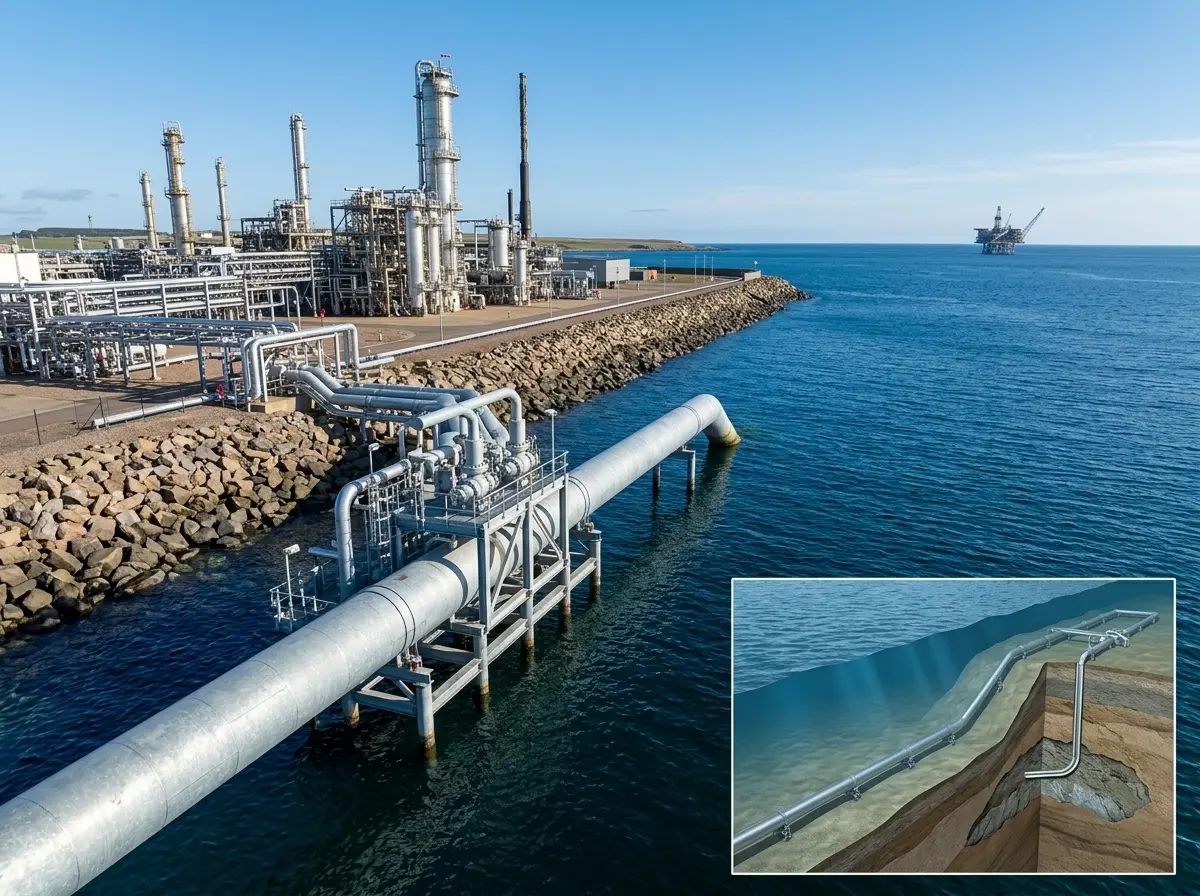
The Acorn project at St Fergus in Aberdeenshire is Scotland’s main advanced CCS effort. It would capture emissions from industrial sites and power plants, then move the CO2 through existing pipelines into depleted North Sea gas fields for permanent storage.
- 2021, Missed Track-1 support; funding went to two northern England clusters; placed on Track-2 reserve.
- July 2023, Confirmed as a Track-2 cluster alongside Viking in the Humber.
- June 2025, UK Government confirmed £200 million development funding in the Spending Review.
- December 2025, Co-owner Storegga put its 30 percent stake up for sale, adding fresh uncertainty.
- 2025-2026, Front-end engineering design targeted for completion in this window.
Project partners highlight reuse of oil and gas infrastructure as a cost advantage. Official materials state the Scottish Cluster aims for 5-10 Mtpa of capture, against Scotland’s industrial emissions of about 10.1 Mtpa. They project £17.7 billion GVA contribution to 2050, 10,800 development and construction jobs, 4,700 operational jobs and 18,800 jobs safeguarded across the UK. Scotland’s net-zero target sits at 2045.
The Scottish Greens have opposed CCS in the past, arguing it is no substitute for direct renewable investment. That view remains part of the domestic debate even as Acorn edges forward.
How the UK Chose Its Clusters
The UK Government identified industrial clusters that produce half of industry emissions and sequenced support. Track-1 selected HyNet (North West England and North Wales) and the East Coast Cluster (Teesside). Both transport and storage networks reached financial close in late 2024 and April 2025. Construction for some East Coast elements is due from mid-2025 with operations from 2028.
Track-2 named Acorn and Viking. Broader funding includes up to £21.7 billion over 25 years focused first on Track-1 and additional sums in recent spending reviews. De Leeuw noted six clusters in total, five in England and one in Scotland, and said limited public money forces prioritisation of larger industrial centres.
| Cluster | Location | Track | Status highlight |
|---|---|---|---|
| HyNet | North West England / North Wales | 1 | Transport and storage financial close April 2025 |
| East Coast Cluster | Teesside | 1 | Financial close December 2024; build from mid-2025 |
| Acorn / Scottish Cluster | North East Scotland (St Fergus) | 2 | £200m development funding 2025; ownership flux |
| Viking | Humber | 2 | Named alongside Acorn for next phase |
Official UK pages detail the business models required because the carbon price alone does not make most industrial CCS investable. The Track-1 clusters reached financial close only after years of design work and revenue-support frameworks.
Scotland’s Infrastructure Edge and Political Friction
Scotland holds mature North Sea storage sites, existing pipelines from St Fergus and an oil-and-gas supply chain that can pivot. Those assets appear in every Acorn briefing. They also feature in SNP arguments that an independent Scotland inside the EU would secure faster recognition and capital.
SNP MSP Karen Adam said Scotland is perfectly placed to lead yet is let down by UK decisions, adding it is hard not to believe EU membership and its investment would have delivered CCUS already. The party frames the 12-to-zero comparison as clear evidence of being left behind.
Crowd discussion on the topic often circles the same frustrations: repeated funding announcements followed by delays, ownership changes and cross-border blame. Those voices treat subsidy credibility as the practical test, regardless of the constitutional wrapper. Storegga’s stake sale in particular fed doubts that commercial partners see a clear path.
De Leeuw’s January evidence to a Scottish Parliament committee underlined the same priority problem. He argued Scotland needs focused emission control and multi-year money rather than a long list of unfunded ambitions. Carbon capture sits in his toolbox list, yet only if the cash and sequencing match the ambition.
What Moves Carbon Capture Projects
Both the UK and the EU rely on public instruments. The UK uses cluster sequencing, capital grants and revenue support models. The EU channels money through the Innovation Fund and earlier schemes such as NER300, which aimed at demonstration plants but delivered few commercial results. Recent Innovation Fund rounds have backed multiple CCS-related projects in cement, lime and other hard-to-abate sectors across member states.
Lists of active levers look similar on both sides of the Channel:
- Capital grants and development funding to reach final investment decision
- Revenue support or carbon contracts that close the gap to commercial returns
- Shared transport and storage infrastructure to cut unit costs
- Clear long-term regulatory frameworks for storage liability and monitoring
- Prioritisation so limited budgets hit the highest-impact emitters first
Access to EU Innovation Fund CCS project grants could enlarge the pot available to a future Scottish government. It would not remove the need to choose winners, design viable business models or attract private co-investment. Norway’s Longship project, often held up as a European success, advanced through national commitment and state backing as much as regional frameworks.
Global capacity is rising, yet every major project still shows the same pattern: public money de-risks the first movers. That pattern holds in the United States with tax credits, in the Middle East with state direction, and in Europe with fund competitions. Scotland’s geology and pipelines give it a real advantage. Converting that advantage into operating tonnes still requires the funding decision that de Leeuw places at the centre.
The expert’s core observation therefore stands independent of the independence debate. Membership may change which budget line is available. It does not rewrite the economic model that has kept commercial CCS scarce everywhere.
 ONGC licence frees Venezuela cash and operatorship talks
  Anthropic Hits $65 Billion Run Rate and Flips the AI Cash Test
  Supreme Court grounds the fare free-for-all with three-week clock
  Gold Nears $4400 as Soft Data Meets Oil Inflation Risk
  Nifty Slips as Zaggle Circuits and Dhoot Debuts Big
  Diesel Crack Tops $100 as Iran Rhetoric Lifts Crude