
 Ishan Crawford
 SpaceX shares closed down 13.6% at $108.27 on Wednesday, a new all-time low, after the company reported second-quarter capital expenditures of $18.37 billion, with $15.83 billion tied to its artificial-intelligence build-out. The figures more than doubled the prior quarter’s AI outlay and overshadowed a revenue beat in the firm’s first report as a public company.
A lockup window opened Thursday that frees up to roughly 911.5 million insider shares. Elon Musk also said SpaceX would source AI chips exclusively from Nvidia, sending AMD shares lower while Nvidia rose.
Q2 Numbers Beat Estimates Then the AI Bill Hit
Revenue reached $7.81 billion against expectations near $6.9 billion, up sharply from the prior year. The net loss narrowed to $541 million. Adjusted EBITDA came in at $3.5 billion. Connectivity, powered by Starlink, remained the profit center.
AI segment revenue hit $2.56 billion, ahead of estimates, yet the unit posted a $1.26 billion operating loss. That loss was better than the $2.39 billion some expected. Space segment revenue was $962 million with a $542 million operating loss. Connectivity delivered $4.29 billion in revenue and $1.66 billion in operating income.
| Segment | Revenue | Operating Result |
|---|---|---|
| Connectivity (Starlink) | $4.29 billion | +$1.66 billion income |
| AI | $2.56 billion | -$1.26 billion loss |
| Space | $962 million | -$542 million loss |
Overall capital spending of $18.37 billion ran slightly under one consensus figure but well above others that clustered near $13 billion. AI alone accounted for the bulk. Cash and equivalents stood at $93.5 billion after the IPO proceeds, while debt and finance leases rose to $36.8 billion. The company furnished the results in its August 4 Form 8-K earnings release.
The segment mix shows why the print landed as a split decision. Connectivity’s operating income more than covered the combined operating losses from AI and Space, yet the capital account told a different story. Nearly all of the quarterly outlay flowed to AI infrastructure rather than to the unit that is already profitable.
| Metric | Result |
|---|---|
| Total revenue | $7.81 billion |
| Consensus revenue | near $6.9 billion |
| Net loss | $541 million |
| Adjusted EBITDA | $3.5 billion |
| Total capex | $18.37 billion |
| AI portion of capex | $15.83 billion |
| Cash and equivalents | $93.5 billion |
| Debt and finance leases | $36.8 billion |
CFO Bret Johnsen said AI compute capital is seeing paybacks of less than one year and is moving so fast it starts to resemble cost of goods sold. JPMorgan later projected nearly $200 billion in annual capex for 2027 and 2028, pressuring free cash flow in line with other hyperscalers.
That framing matters for how investors read the balance sheet. Cash of $93.5 billion gives SpaceX room to keep spending at the current pace for several quarters. Debt and leases at $36.8 billion remain modest beside that cash pile. The open question is how long the market will tolerate hyperscaler-scale outlays while the AI unit still runs a nine-figure quarterly operating loss.
Thursday’s Lockup Multiplies the Available Shares
SpaceX went public on June 12 at $135 a share in the largest IPO on record, raising tens of billions and briefly valuing the company above $2 trillion. The initial public float was tiny, roughly 4-5% of the more than 13 billion shares outstanding. That scarcity amplified the early run to an intraday high near $225.
The first major unlock arrived on the second trading day after earnings. Up to 20% of locked insider holdings, or about 911.5 million shares, became eligible. That tranche alone can more than double, and in some estimates triple, the tradable float. Further staggered releases continue into 2027, eventually freeing more than 12 billion additional shares.
- 911.5 million shares eligible in the first window
- ~20% of locked insider stock freed immediately
- Current public float previously under 5% of total shares
- Additional multi-billion-share releases scheduled through mid-2027
Investors who bought at the IPO or later now face a supply wave at the same moment the company is spending at private-company rates on AI infrastructure whose full returns remain years away. Short interest had already climbed as the stock erased roughly $1 trillion in market value from its peak.
The mechanics are straightforward. A float that started at roughly one share in twenty suddenly absorbs a block large enough to double or triple what can trade. Each later unlock through mid-2027 repeats a milder version of the same math. Price discovery under that supply path depends less on any single earnings print and more on whether incremental buyers keep stepping in as locked stock becomes free.
Nvidia Gets the Exclusive and the Stock Lift
On the earnings call Musk stated that SpaceX would build its AI systems exclusively on Nvidia hardware. He called the Vera Rubin architecture the best AI computer and highlighted close partnership at multiple levels. Nvidia shares gained roughly 4% while AMD fell 6-8% despite its own solid data-center numbers.
SpaceX has committed to using Nvidia GPUs exclusively because they are the best
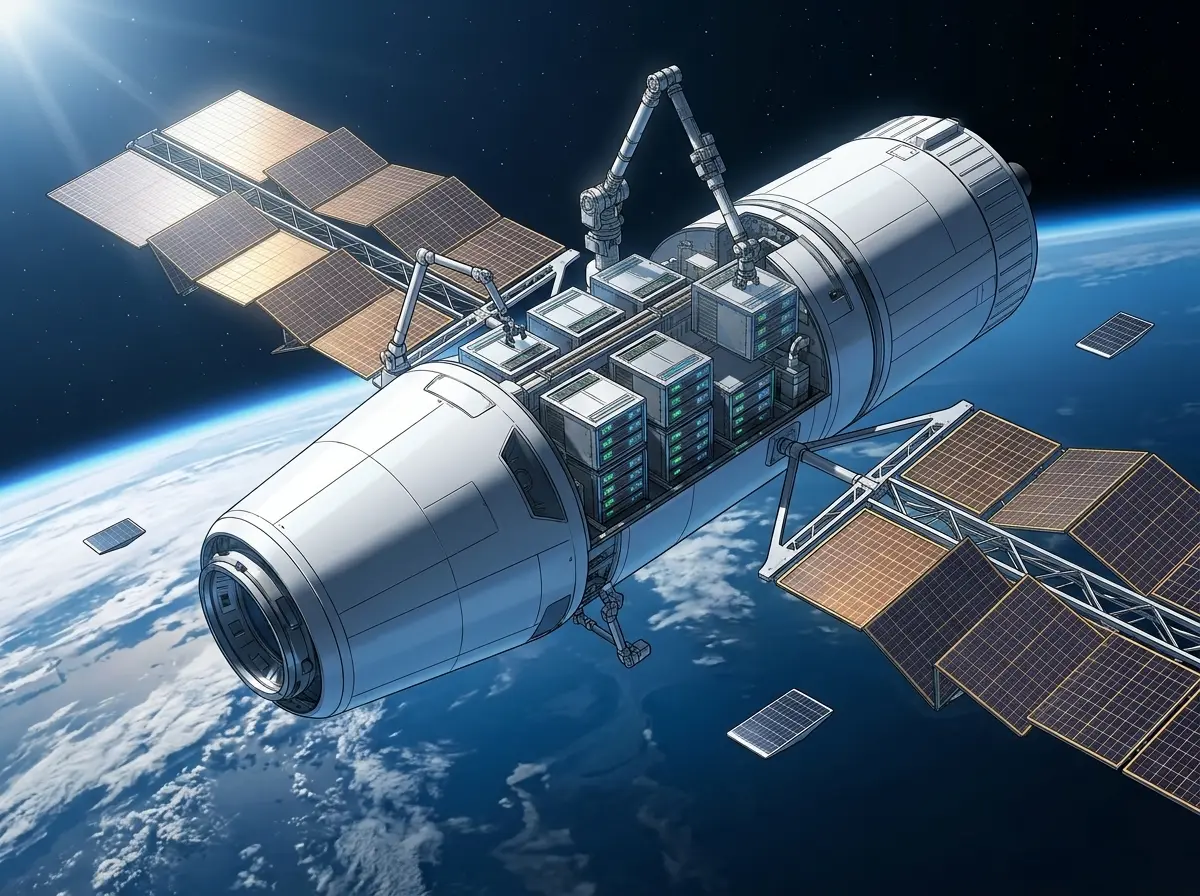
Musk posted that line the same day. SpaceX separately announced it is partnering with Nvidia on Starmind, an orbital compute payload using Rubin GPUs and Vera CPUs. Each unit targets up to 250 kW peak compute. The company has also outlined ground capacity rising past 2 GW by end-2026 and toward 10 GW the following year.
The exclusive lands as a clear win for Nvidia’s already dominant AI accelerator franchise. For AMD it removes a high-profile potential customer at the exact moment the market is scrutinizing every AI supplier’s traction. Crowd reaction on X quickly framed the rocket company as a potential monopsony buyer whose choices can freeze out rivals.
SpaceX’s own Starmind AI1 satellite compute payload page still describes the architecture as modular and vendor-agnostic, creating a mild tension with the call comments. In practice the near-term dollars and design work are flowing to Nvidia.
The capacity targets underline why the chip choice carries weight. Moving from more than 2 GW of ground capacity by the end of 2026 toward 10 GW the year after implies a multi-year hardware ramp. An exclusive steers that entire pipeline toward one supplier. Orbital units rated at up to 250 kW each would extend the same dependency into space if Starmind scales as described.
Starlink Remains the Cash Engine
Starlink subscribers reached 12 million, double the year-earlier figure and up 17% sequentially. Average revenue per user held at $66, down from $85 a year ago as the service broadened. Connectivity operating income of $1.66 billion funded much of the rest of the enterprise.
- Subscribers at 12 million, double the year-earlier level
- Sequential subscriber growth of 17%
- ARPU at $66, versus $85 a year earlier
- Connectivity operating income of $1.66 billion
Musk said it is not out of the question that Starlink could one day deliver a majority of the world’s internet in countries where it is allowed. President Gwynne Shotwell pointed to mobile partnerships and a path to standalone Starlink Mobile service by the end of 2027, using newly approved EchoStar spectrum and terrestrial build-out aimed at U.S. carrier customers.
Ad revenue at the X platform declined 14% year over year during a system migration. That remained a smaller line. The company also noted $14.1 billion in contracted cloud-services sales and said early-quarter cloud bookings already added $6.7 billion that begins ramping in October. Management guided toward a $100 billion annualized recurring revenue run-rate by year-end, including contributions from the pending Cursor acquisition.
The ARPU decline tracks a classic scale trade. Lower average revenue per user arrived alongside a doubled subscriber base and a fresh 17% sequential lift. Operating income still reached $1.66 billion, which is what lets the company absorb AI and Space losses while funding heavy capex. Cloud bookings and the $100 billion run-rate target add a second leg under the same cash-engine story, even as X advertising stays soft.
How Connectivity Income Offsets the AI Loss
The operating scoreboard makes the internal transfer plain. Connectivity produced $1.66 billion in operating income. AI lost $1.26 billion. Space lost $542 million. On a pure operating basis, Starlink covered the AI deficit and still left a buffer before the Space loss is counted.
That buffer is why management can describe AI compute paybacks of less than one year without immediate distress. The cash is coming from a mature, growing connectivity franchise rather than from new leverage alone. Debt and finance leases at $36.8 billion sit well below the $93.5 billion cash balance built with IPO proceeds.
The risk is sequencing. Capex of $18.37 billion in a single quarter, $15.83 billion of it for AI, runs far ahead of the AI unit’s revenue of $2.56 billion. Johnsen’s cost-of-goods-sold comparison implies the spend is meant to turn quickly. JPMorgan’s projection of nearly $200 billion in annual capex for 2027 and 2028 assumes the turn keeps working at far larger scale. If paybacks stretch, Connectivity’s surplus becomes the main shock absorber for longer than the bull case expects.
Cloud contracts already on the books offer a partial bridge. The $14.1 billion in contracted cloud-services sales and the additional $6.7 billion in early-quarter bookings that begin ramping in October give visibility into revenue that is not purely speculative. Those figures support the guided path toward a $100 billion annualized recurring revenue run-rate by year-end, with the pending Cursor acquisition layered on top.
From Record IPO Peak to All-Time Low in Seven Weeks
- June 12, 2026, SpaceX prices IPO at $135, raises record proceeds, opens near $150 and quickly tops $2 trillion in value.
- June 16, 2026, Intraday high near $225.64 as thin float and AI-space narrative fuel buying.
- July 2026, Stock slides more than 40% from the peak amid lockup anticipation and broader AI-spend fatigue; short sellers book large gains.
- August 4, 2026, First public earnings released after the close; shares jump 9% in the regular session then reverse hard in after-hours and the next day.
- August 5-6, 2026, Close at $108.27, new low; first lockup tranche becomes eligible.
The path compressed years of typical post-IPO digestion into weeks. Early private investors and employees who bought far below the IPO price still sit on gains even after the drop. Newer public holders who entered near the peak or the offering price face immediate supply pressure and questions about the cash-burn trajectory.
The $108.27 close sits below the $135 IPO price and far below the $225-area high. Roughly $1 trillion in market value has come off the peak. The 13.6% single-day drop on the earnings aftermath shows how quickly the market repriced the combination of heavy AI capex and a looming share unlock. Short interest that built during the July slide was already positioned for that turn.
Why the Float Shock Meets the Spend Shock
Two supply-and-demand pressures arrived in the same week. On the equity side, up to 911.5 million insider shares became eligible, against a public float that had been only 4-5% of more than 13 billion shares outstanding. On the cash-flow side, an $18.37 billion quarterly capex print, dominated by $15.83 billion of AI spending, landed in the first report of public-company life.
Either factor alone can weigh on a newly listed stock. Together they force a sharper debate about duration. Further staggered releases run into 2027 and ultimately free more than 12 billion additional shares. Over that same window JPMorgan sees annual capex approaching $200 billion. Buyers must absorb both more stock and the knowledge that free cash flow will stay under pressure.
The Nvidia exclusive adds a third cross-current. Nvidia shares rose roughly 4% on the news while AMD fell 6-8%. SpaceX equity holders underwrite the infrastructure build; Nvidia captures a locked-in hardware slot through the ground ramp past 2 GW and toward 10 GW and through Starmind’s orbital units. That split helps explain why the chip announcement lifted one supplier and still left SpaceX shares at a fresh low.
Early private holders retain a cushion. Public holders who bought near $135 or nearer the $225 high do not. The next unlocks and the next few earnings cycles will show whether Connectivity’s cash engine, cloud bookings, and sub-one-year AI payback claims can offset the dual weight of share supply and capital intensity.
Orbital Compute Is the Long Bet Behind the Spend
SpaceX argues that terrestrial data centers face hard limits on power, land and cooling. Satellites in sun-synchronous orbit can harvest continuous solar energy and radiate heat into vacuum, cutting cooling overhead dramatically. The committed to using Nvidia GPUs exclusively posture pairs with plans for a Gigasat factory and eventual in-house chip efforts alongside Tesla.
No one has yet proven gigawatt-scale orbital AI compute at commercial cost. Scientists have raised debris and environmental concerns about large constellations of heavy compute satellites. Starship’s reusability and payload capacity are presented as the enabling technology for mass deployment starting as early as late 2027.
In the meantime the public market is pricing the near-term reality: an $18 billion quarterly capex run-rate, an AI unit still deep in the red, a lockup that multiplies available shares, and a chip strategy that concentrates upside at Nvidia while leaving AMD and SpaceX equity holders to absorb the volatility. The connectivity business continues to throw off cash. Whether the AI and orbital bets convert that cash into durable returns is the question the next several unlock windows and earnings cycles will test.
 Apple’s August 26 Invite Window Locks the Ternus iPhone Debut
  Sandisk Beats Big but Rally Leaves No Room for Soft Guide
  Galaxy Z Fold 8 Pre-Orders Top Every Samsung Record
  Hotel WiFi Hacks Hit Travelers Harder Than Hotspot Tips Admit
  iOS 27 Messages One-Tap Suggestions Quietly Build Task Pipelines
  Cyclospora Wave Hits 15 States as Lettuce Recall Leaves Cases Climbing