
 Ishan Crawford
 UC San Diego engineers built a fully integrated smart ring that continuously reads up to four chemical biomarkers from passive finger sweat, including glucose and ketones that tracked commercial meters in early tests with healthy people and those with Type 1 diabetes.
The prototype, called CHARM, was published July 23, 2026. It moves smart rings past heart rate and sleep into real-time metabolic chemistry without blood draws or exercise.
That shift matters because the finger form factor already owns daily wear for recovery tracking. Adding chemistry keeps the same small package while opening metabolic insight that optical sensors alone cannot supply.
The Ring That Reads Chemistry Not Just Pulse
Commercial rings from Oura, Samsung and others rely on optical and temperature sensors for biophysical signals. CHARM adds electrochemical sensors that analyze sweat molecules.
The full biomarker set covers glucose, ketones, vitamin C (ascorbic acid), uric acid, lactate and alcohol. The device measures any four at once.
UC San Diego engineers detailed the CHARM results as the first fully integrated smart ring for daily biochemical monitoring. Co-first authors include Tamoghna Saha, Shichao Ding and Siyu Qin, working in Joseph Wang’s lab at the Jacobs School of Engineering.
- 3D-printed polymer outer shell
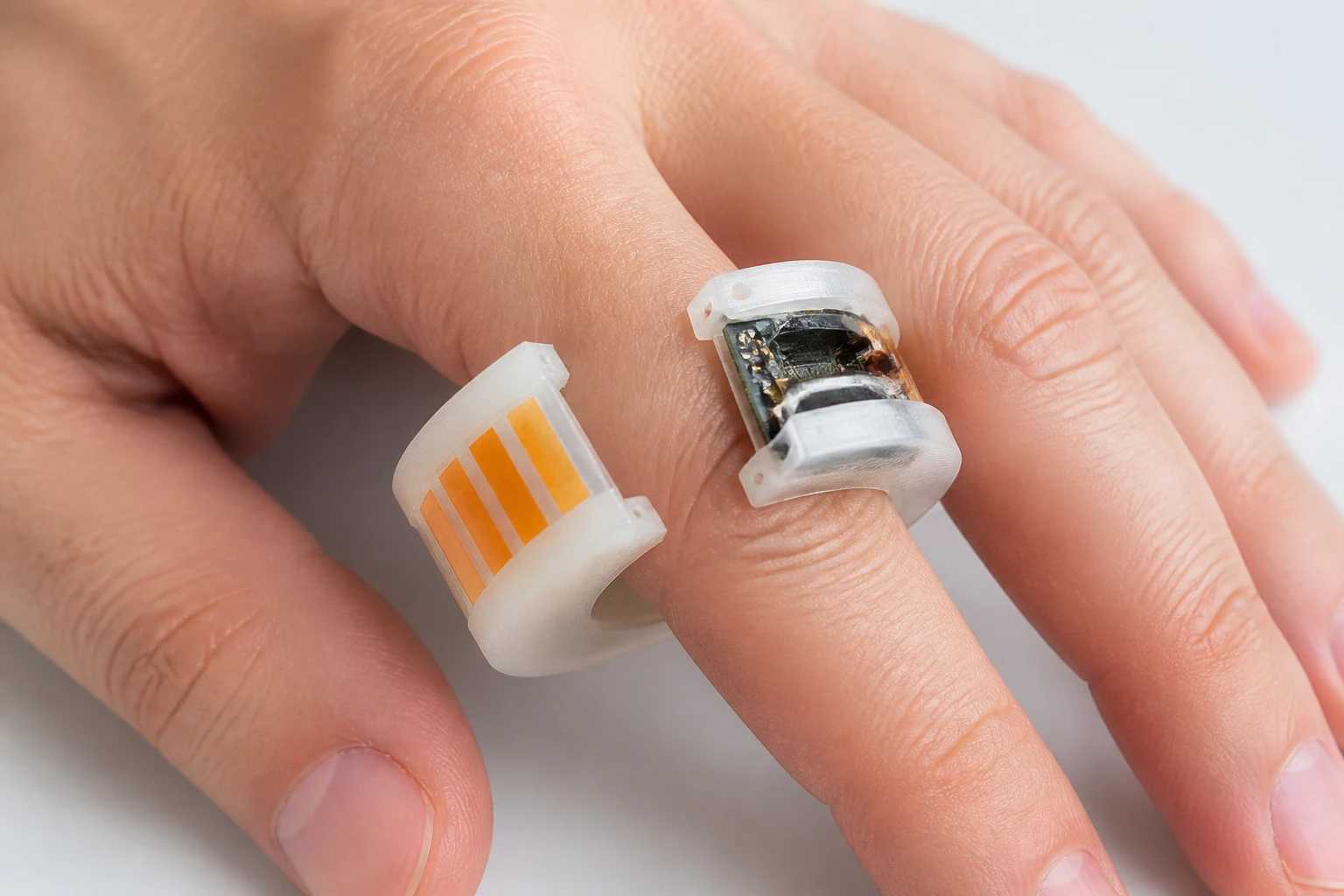
- Electrochemical sensor array and microfluidic channel
- Osmotic hydrogel for passive sweat draw
- Circuit board smaller than a US quarter
- Flexible zinc-silver oxide rechargeable battery
- Wireless link to a smartphone or custom interface
External diameter sits at about 3 centimeters. One half holds the sensors and hydrogel; the other packs the electronics and battery.
That split keeps wet chemistry away from the dry electronics. The microfluidic channel bridges the two halves so sweat reaches the sensor array without flooding the circuit board or battery.
Choosing any four markers from the six-molecule set lets the same hardware serve different users. A diabetes-focused build can lock onto glucose and ketones; a nutrition build can favor vitamin C and uric acid.
How Passive Sweat Extraction Works on a Resting Finger
The core problem was collecting enough sweat without making the wearer exercise. Saha pioneered an osmotic hydrogel that creates a gentle pressure gradient, pulling fluid from the skin the same way plants move water from soil to leaves.
The process is painless and works at rest. Collected sweat flows to the sensor array. Repeated electrochemical readings convert current into concentration values after subject-specific calibration.
Those calibration factors stayed stable for roughly two months in repeated tests with new sensor patches. Data streams wirelessly for continuous display.
Wang noted that commercial rings supply only biophysical information and lack molecular data that give deeper health insight. CHARM fills that gap.
Stability across patch swaps is what makes the two-month window useful. A wearer can replace the sensor side without repeating a full blood-reference session each time, as long as the original calibration still holds.
The osmotic draw also removes the need for heat pads or iontophoresis electrodes common in other sweat collectors. No extra power draw is spent on extraction, which helps the compact battery budget.
Trial Numbers Match Commercial Glucose and Ketone Meters
Tests covered healthy volunteers and people with Type 1 diabetes. Glucose estimates from sweat tracked commercial continuous glucose monitors closely. Ketone readings aligned with commercial blood ketone meters.
One reported mean absolute relative difference for estimated blood glucose sat near 13.7 percent against reference blood values. Commercial CGMs such as Dexcom G7 and FreeStyle Libre 3 typically post MARD figures around 8 to 10 percent, so the prototype lands in a usable early range.
| Biomarker | Comparison Standard | Result Summary |
|---|---|---|
| Glucose | Commercial CGM | Closely tracked; ~13.7% MARD vs blood |
| Ketones | Blood ketone meter | Similar readings |
| Vitamin C, uric acid, lactate, alcohol | Blood profiles | Strong correlations reported |
The full study in Nature Communications confirms validation under diverse daily settings and notes the need for broader clinical cohorts and full glycemic-range testing before any medical claim.
The 13.7 percent MARD figure is an early prototype result, not a finished consumer claim. Closing the gap toward the 8 to 10 percent band that commercial CGMs already post will require larger cohorts and tighter time-lag handling between sweat and blood.
Ketone alignment with blood meters matters for the same users. When glucose and ketones move together, a single ring stream can flag rising ketone risk without a separate finger-stick meter.
Who Gains First From Multi-Marker Finger Chemistry
People managing diabetes stand out. Simultaneous glucose and ketone tracking can support better insulin decisions, Wang said. “The ring’s ability to track both glucose and ketone continuously and simultaneously would greatly benefit optimal insulin dosing for the management of diabetes.”
Ketogenic dieters, athletes watching lactate, and anyone tracking nutrition or alcohol exposure also fit the early use cases. Fitness users already wear rings for recovery; molecular layers add diet and metabolic response.
- Diabetes management: dual glucose-ketone stream without finger sticks or arm patches
- Nutrition tracking: vitamin C and uric acid trends after meals
- Metabolic fitness: lactate and ketone shifts during training
- Lifestyle: alcohol levels for real-time awareness
The device still requires initial reference calibration and has not been tested for closed-loop insulin delivery.
That calibration step is a one-time bridge to blood references, not a daily burden. Once set, the two-month stability window supports routine wear while the dual-marker stream remains the main clinical draw for diabetes care.
Commercial Rings Still Locked to Optical Sensors
The smart ring category has grown fast. The global smart ring market valued at USD 416.9 million in 2025 is projected to reach USD 518.9 million in 2026 and climb toward several billion by the early 2030s at roughly 29 percent CAGR. Shipments jumped an estimated 49 percent in 2025 while smartwatches grew far more slowly, per IDC figures shared in industry coverage.
- March 2015: First-generation Oura Ring launches at the San Francisco Launch Festival and sets the modern form factor.
- 2025: Global market reaches USD 416.9 million; shipments rise an estimated 49 percent while smartwatches lag.
- 2026: Market projected at USD 518.9 million as more brands ship biophysical rings.
- Early 2030s: Category forecast to climb toward several billion dollars at roughly 29 percent CAGR.
Oura remains the volume leader. The first-generation Oura Ring launched in March 2015 at the San Francisco Launch Festival and established the form factor. Samsung, Ultrahuman, RingConn and others followed with similar biophysical packages: heart rate, SpO2, temperature, sleep stages and activity.
Those devices already face well-documented accuracy boundaries on some health claims. Readers can see parallel limits of current wearable health sensors in related coverage. CHARM demonstrates that the same small footprint can host chemical sensing, which is the real category shift.
Commercial rings only provide biophysical information, but they lack molecular information about biochemical markers that offers deeper insights about an individual’s health status.
Tamoghna Saha, the study’s first author and a postdoctoral researcher in Wang’s lab, made that point in the university release. The quote captures why the prototype matters beyond a single paper.
Fast shipment growth shows consumers already accept the ring as a daily device. Chemical sensing rides that acceptance instead of asking users to adopt a new body site or a bulkier form.
Battery Life and the Engineering Gaps Still Open
The flexible battery delivers up to 12 hours per charge. That trails multi-day commercial rings and will need improvement for all-day wear. Recharging convenience is not yet solved in the prototype.
Hydrogel durability for multi-day continuous extraction also requires further work. The current hinge-lock design is not fully waterproof; researchers suggest a sealed concentric shell as a next step. Time-lag correction between blood and sweat, already standard in CGMs, can be added in electronics.
- Battery endurance capped near 12 hours per charge
- Hydrogel durability still short of multi-day continuous use
- Hinge-lock shell not fully waterproof
- Time-lag correction between sweat and blood still to be added
- Broader clinical cohorts and full glycemic-range tests still required
On X, posts amplifying the UCSD release drew tens of thousands of views, with users zeroing in on the no-prick multi-marker promise for diabetes while noting the short battery and the distance to consumer hardware. Crowd reaction treats the result as a clear technical proof rather than a finished product.
Larger studies across more people and conditions remain essential. Insurance and reimbursement questions sit further out. The lab already plans hybrid rings that combine chemical and physical sensors.
Hybrid Rings Can Merge Chemistry With Pulse Tracking
The lab’s stated plan for hybrid rings follows directly from the split architecture already built into CHARM. One half already hosts electrochemical sensors; the other already holds electronics that commercial rings use for optical and temperature work.
Merging both classes of signal on one finger keeps a single daily device. Heart rate, temperature and sleep stages could share the same wireless stream as glucose, ketones or lactate without a second wearable.
That path also eases the battery problem over time. Shared power management and a single radio link avoid the drain of two separate devices, even if the chemical side still needs a stronger cell than the current 12-hour zinc-silver oxide pack.
Waterproofing and a sealed concentric shell become more valuable once physical and chemical sensors share the same band. A hybrid design that fails under water or sweat flooding would lose both data streams at once.
What Dual Marker Streams Change for Daily Care
Simultaneous glucose and ketone output is the clearest near-term clinical gain. Wang’s comment on optimal insulin dosing rests on that pairing, because ketone rise can signal risk even when glucose alone looks manageable.
Nutrition and fitness users gain from other pairings drawn from the same six-marker menu. Vitamin C and uric acid after meals, or lactate and ketones during training, reuse the identical hardware with different software selections.
None of those streams yet feed closed-loop insulin delivery. The prototype still needs initial blood-reference calibration and wider testing before any medical claim, as the Nature Communications paper states.
Even so, the finger form factor already has daily wear habit on its side. A multi-marker chemical layer that survives the open engineering gaps can ride existing ring adoption rather than fighting it.
Frequently Asked Questions
What biomarkers can the UC San Diego CHARM smart ring measure?
It can track glucose, ketones, vitamin C, uric acid, lactate and alcohol, measuring any four simultaneously from sweat. The set is chosen for metabolic, nutritional and lifestyle relevance rather than a single disease panel.
How does the ring collect sweat without exercise?
An osmotic hydrogel creates a natural pressure gradient that gently draws tiny amounts of sweat from resting skin. No heat, electricity or physical activity is required for the collection step.
How accurate were the glucose readings in the published trials?
Sweat-based glucose estimates showed a mean absolute relative difference of approximately 13.7 percent versus blood references and closely tracked commercial continuous glucose monitors in both healthy and Type 1 diabetes participants.
How long does the prototype battery last?
The flexible zinc-silver oxide battery supports up to 12 hours of continuous operation between charges. That figure is shorter than most commercial smart rings and is flagged for improvement.
Who led the research and where was it published?
Joseph Wang’s lab at UC San Diego’s Jacobs School of Engineering led the work, with Tamoghna Saha as first author among co-first authors. The peer-reviewed paper appeared in Nature Communications on 23 July 2026.
The CHARM ring proves chemical sensing fits the finger form factor that already owns sleep and recovery tracking. Commercial makers now have a clear technical map if they want to follow.
 GTA Online Summer Heist Event Doubles Classic Finales Cash
  Samsung Galaxy F70 Pro Tease Locks Flipkart While M47 Holds Amazon
  Meta AI Glasses Turn Delhi Protests Into Walking Cameras
  India’s Net Neutrality Review Follows Airtel Slicing Gap
  Galaxy Z Fold 8 Preorders Race Past S26 Benchmarks
  Maruti Hansalpur Plant D Lifts Capacity Toward Four Million