
 Ishan Crawford
 Apple is expected to put the iPhone 18 Pro Max on sale near $1,399 this September with a 2nm chip, larger battery and variable-aperture camera, while holding the standard iPhone 18 until spring 2027. The combination leaves holiday shoppers without a new mid-tier option for the first time in years.
Multiple supply-chain reports and certification filings have sharpened the picture even though Apple has confirmed nothing. The upgrades are real. So is the pressure they create on price and product timing.
The September-Only Pro Window
Fall 2026 will bring the 6.3-inch iPhone 18 Pro, the 6.9-inch iPhone 18 Pro Max and Apple’s new foldable. The more affordable iPhone 18 and iPhone 18e are slated for early 2027. Customers who want a fresh handset for the holidays will have to choose a Pro model or stick with last year’s devices.
That split is not an accident of supply. It coincides with the first mass-market use of TSMC’s costliest process node and with memory prices driven higher by AI server demand. Analysts at IDC have flagged a possible $200 step-up that would take the Pro from $1,099 to $1,299 and the Pro Max from $1,199 to $1,399.
The calendar itself becomes part of the product story. A shopper walking into a store in December 2026 will find new Pros and a foldable on the shelf, while the familiar mid-range slot stays occupied by year-old hardware. That gap is deliberate timing, not a temporary shortage.
- September 2026: iPhone 18 Pro, iPhone 18 Pro Max and the new foldable arrive together
- Holiday 2026: no new base model; buyers choose Pro pricing or prior-year stock
- Spring 2027: iPhone 18 and iPhone 18e finally land as the affordable refresh
- Pro and Pro Max launch alongside the foldable in September 2026
- Base iPhone 18 and 18e delayed until spring 2027
- New Klarna-backed Apple Upgrade leasing program already live in the US to spread payments
- 12 GB RAM on Pro models required for the fullest on-device AI features
The leasing program, rolled out days before this writing, turns a $200 jump into roughly $8 more per month on a 24-month term. Apple is building the payment story before the sticker arrives.
By the time the base models appear, the Pros will already have defined the AI feature floor for another half-year. That sequence steers attention, and average selling price, toward the higher tier during the busiest shopping months.
What the A20 Costs
The A20 Pro is set to be Apple’s first chip on TSMC’s N2 process. TSMC N2 volume production in 4Q25 introduced gate-all-around nanosheet transistors after years of FinFET designs. Published gains run 10 to 15 percent faster at the same power or 25 to 30 percent more efficient at the same speed, with density up more than 15 percent.
Those gains arrive expensive. N2 wafers are reported near $30,000 each, a 50 to 66 percent premium over the 3 nm wafers used for the A19 Pro. Apple has locked more than half of early N2 capacity for the A20 family and M-series parts. Packaging shifts to wafer-level multi-chip module technology that places RAM closer to the logic die for speed and power savings.
| Metric | A19 Pro (3 nm) | A20 Pro (2 nm) |
|---|---|---|
| Process | N3E FinFET | N2 GAA nanosheet |
| Wafer price (approx.) | ~$18,000-20,000 | ~$30,000 |
| Performance / efficiency | Baseline | +10-15% speed or +25-30% efficiency |
| Packaging | Prior generation | WMCM with closer RAM |
Counterpoint Research estimates the full bill of materials for a 1 TB Pro Max could rise nearly $300, with NAND alone possibly topping $250 under AI-driven memory shortages. Even a $200 retail increase may leave Apple with slightly thinner hardware margins than last year.
The wafer premium alone does not explain the full BOM move. Memory inflation from AI server demand stacks on top of the process jump. Closer RAM placement through WMCM recovers some power and latency, yet it does not erase the higher input costs. Apple’s early capacity lock protects supply; it does not lower the per-wafer bill.
That cost stack is why the company can accept thinner unit margins while still lifting the average selling price through mix. The chip is faster and thriftier. It is also the dearest silicon Apple has put in a phone.
Battery Jump and the Thicker Body
Chinese 3C filings and later reports list the US eSIM-only iPhone 18 Pro Max at 5,567 mAh, up from 5,088 mAh on the 17 Pro Max. That is roughly a 9.4 percent gain. The China model, which still needs a physical SIM tray, sits at 5,391 mAh. The same pattern appears on the smaller Pro: 4,288 mAh US versus 4,056 mAh China.
Those figures match the detailed 5,567mAh US versus 5,391mAh China split already tracked on this site. Apple is expected to make the chassis a fraction thicker, somewhere between 8.8 mm and 9 mm, and about 240 grams, partly to fit the cell and possibly a vapor chamber. The camera plateau itself may grow another 2 mm to house the new optics.
- 5,567 mAh, US Pro Max eSIM model
- 5,391 mAh, China Pro Max with SIM tray
- ~9.4% capacity gain over prior Pro Max
- Slightly thicker body and heavier feel as the trade-off
Paired with the more efficient A20 and an upgraded LTPO+ display, real-world endurance should improve more than the raw milliamp-hour number alone suggests. On X, users already note the battery win while joking about the extra bulk.
The regional gap follows a simple mechanical rule. Removing the SIM tray frees volume for cell chemistry in the US eSIM unit. China retains the tray and therefore a smaller pack. Both versions still clear the prior generation, and both lean on the same efficiency gains from the new process node and display stack.
Thickness and weight become the visible trade. A body between 8.8 mm and 9 mm, near 240 grams, gives the larger cell and optional vapor chamber room to work. The camera plateau growing by another 2 mm continues that same packaging logic: more capability, slightly more mass.
Variable Aperture and the Rest of the Camera
The main 48-megapixel camera is tipped to gain a physically variable aperture. Current iPhones use a fixed opening. A movable iris can open wider in low light or stop down for greater depth of field in bright scenes. Telephoto lenses may also receive larger apertures. Sony or Samsung stacked sensors are expected to cut noise and improve dynamic range.
Bloomberg’s Mark Gurman has called the package the biggest camera hardware leap in years. Manual control over aperture would give photographers tools long limited to dedicated cameras, though the software interface remains unknown. Component costs for the new module add another modest line to the rising BOM.
Fixed apertures forced every prior iPhone into a single compromise between light gathering and depth of field. A movable iris breaks that compromise scene by scene. Wider in dim rooms, tighter in harsh sun: the hardware finally matches what dedicated cameras have offered for decades.
Stacked sensors from the usual suppliers aim at the noise and dynamic-range side of the same problem. Larger telephoto openings would extend the low-light story beyond the main camera. None of these pieces is free, and each adds a quiet increment to the already climbing bill of materials.
Dark Cherry and the Cleaner Front
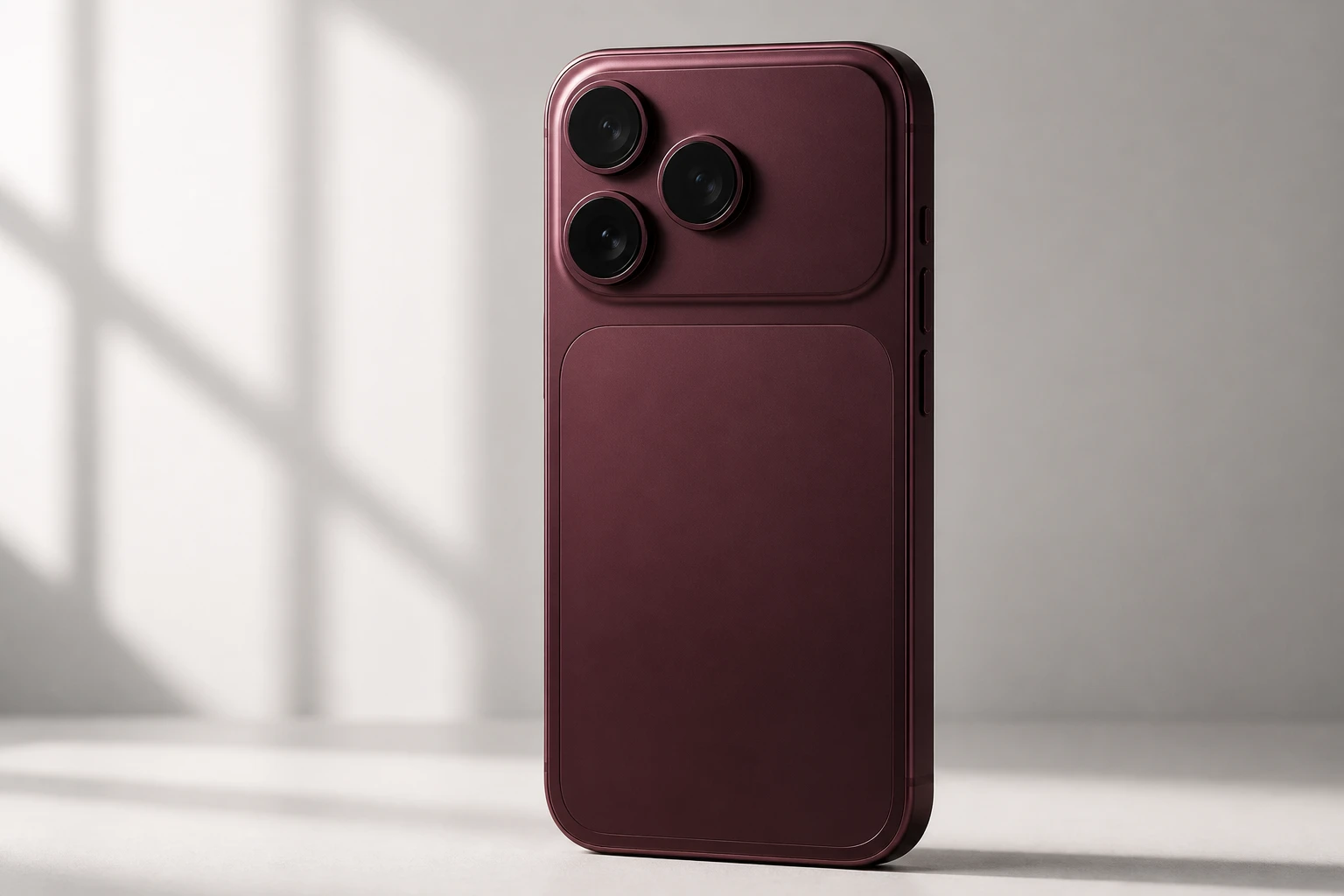
Color leaks center on a new Dark Cherry finish described as a deep red with a purple tinge, Pantone 6076. It is expected to sit alongside Light Blue (2121), Dark Gray (426C) and Silver (427C). Dummy units and earlier reports have already popularized the palette; the Dark Cherry Light Blue Black finishes match what supply-chain sources continue to circulate.
On the front, the Dynamic Island is widely expected to shrink. One leaker put the reduction at roughly 35 percent narrower. Some Face ID parts may move under the display, though full under-display Face ID appears delayed. The rear glass is said to match the aluminum frame more closely, dropping the two-tone look of recent Pros. Flat edges remain.
The color story is evolutionary rather than radical. Dark Cherry joins three familiar tones instead of replacing the whole range. Dummy units have already normalized the look in photos, so the reveal may feel less like a surprise and more like confirmation.
A narrower Dynamic Island and closer rear glass-to-frame match push the design toward visual simplicity. Partial Face ID migration under the glass is a step, not the full under-display goal. Flat edges keep the hand-feel continuous with recent Pros even as the front cutout shrinks and the back loses its two-tone break.
How the Math Changes for Buyers
A buyer who wants a new iPhone this holiday season faces a binary choice: pay the elevated Pro price or keep an older model whose AI features already sit behind the 12 GB RAM wall. The base iPhone 17 shipped with 8 GB. Even the spring 2027 iPhone 18 is rumored at 9 GB and will miss some of the advanced on-device models. Only the Pros and certain Air variants clear the floor.
if apple decide to not drop the 18 along side the 18 pro and foldable in sept then they the greediest cunts in the world. shifting the charge of RAM shortages onto us by increasing prices by £200 and then coercing u into buying the pro
That blunt take from an X user named junior captures a common thread in the replies. Memory and storage, not the processor or display, are driving most of the BOM inflation according to one widely shared cost breakdown. Apple’s scale still gives it leverage on cameras and chips, yet it appears willing to accept slightly lower margins while pushing average selling price higher through the product mix.
Not every analyst expects the full $200 hike. Jeff Pu of GF Securities has argued Apple may hold starting prices flat to defend share. IDC’s Nabila Popal has said the era of $50 increases is over. The leasing program softens either outcome. Still, the absence of a new $799-class phone in the peak shopping window is a structural shift.
Resale values of current non-Pro models could also fall faster once Apple markets 12 GB as the AI baseline in 2027. The second-order result of the leaks is therefore less about any single camera or battery number and more about who is steered toward which device, and at what monthly payment, for the rest of this year.
The Leasing Program Softens the Jump
The Klarna-backed Apple Upgrade program is already live in the US. It arrived days before the latest round of supply-chain notes, which means the payment path was ready before the price debate fully formed.
On a 24-month term, a $200 increase works out to roughly $8 more per month. That framing turns a headline sticker shock into a line item most buyers can absorb without rewriting a household budget. Apple is selling the monthly number as hard as the device itself.
| Scenario | Starting price move | Rough monthly impact (24 mo.) |
|---|---|---|
| Full IDC-style step-up | +$200 | ~$8 more |
| Flat hold (Jeff Pu view) | $0 | No change from lease math |
| Smaller historic-style rise | Under +$200 | Less than ~$8 more |
Either outcome still leaves the holiday shelf without a fresh mid-tier handset. Leasing changes how the Pro feels to carry, not whether a new base model exists in December. The program defends mix and ASP even if the final sticker lands closer to flat than to the full step-up.
Buyers who refuse the Pro tier keep last year’s phones and last year’s RAM ceiling. Buyers who accept the lease lock in 12 GB and the fuller on-device AI set. The monthly math is the lever between those two paths.
Why Base Models Arrive Months Later
Holding the iPhone 18 and 18e until spring 2027 is not a simple supply delay. It lines up with the costliest process node Apple has ever used in volume and with memory prices still elevated by AI server demand.
Pro models carry the N2 silicon, the higher RAM floor, and the camera and battery upgrades that justify a premium. Base models do not need that full stack on day one. Spreading the launches lets Apple prioritize early N2 capacity for the parts that can absorb the wafer premium through higher selling prices.
- Pros and foldable absorb early N2 and high-spec memory first
- Base iPhone 18 rumored at 9 GB, still short of the 12 GB AI floor
- Holiday window becomes a Pro-or-wait decision by design
- Spring 2027 refresh reopens the mid-tier after peak ASP season
The foldable joins the September group rather than the spring group, which keeps the fall event crowded with high-ASP hardware. When the base phones finally appear, the AI feature conversation will already have spent half a year treating 12 GB as the practical baseline.
That sequence protects margins on the expensive silicon while still promising a broader lineup later. It also trains the market to associate the newest on-device models with the Pro tier long before a cheaper door opens.
Apple has not confirmed launch dates, prices or specifications. Final details will arrive only when the company takes the stage, most likely in early September. Until then the filings, dummy units and supply-chain notes keep painting a consistent picture: a more capable, more expensive Pro Max that arrives alone at the top of the range.
 GTA Online Summer Heist Event Doubles Classic Finales Cash
  Samsung Galaxy F70 Pro Tease Locks Flipkart While M47 Holds Amazon
  Meta AI Glasses Turn Delhi Protests Into Walking Cameras
  India’s Net Neutrality Review Follows Airtel Slicing Gap
  Galaxy Z Fold 8 Preorders Race Past S26 Benchmarks
  Maruti Hansalpur Plant D Lifts Capacity Toward Four Million