
 Ishan Crawford
 Adani Ports and Special Economic Zone posted a consolidated net profit of Rs 3,650 crore for the April-June quarter, up 10% from Rs 3,311 crore a year earlier, as revenue climbed 19% to Rs 10,821 crore and EBITDA rose 19% to Rs 6,541 crore. The standout shift sat outside India: international ports revenue jumped 80% to Rs 1,747 crore while that segment’s EBITDA surged 256% to Rs 730 crore.
Domestic ports still supplied the bulk of earnings at a 74% EBITDA margin. Yet the overseas arm and marine business moved from scale stories into clear profit contributors, the exact second-order change that now underwrites the company’s capacity race and larger global ambitions.
The quarter’s shape matters as much as the headline growth. Core transport lines carried the print even as port development and SEZ revenue fell from a high base. That mix keeps the full-year targets intact and leaves the balance sheet with room for both the domestic build and any larger overseas step.
The Print That Held Full-Year Targets
APSEZ released its unaudited consolidated numbers on 29 July 2026. Margin edged up to 60.4% from 60.2%. Management kept full-year guidance unchanged at revenue of Rs 43,000-45,000 crore and EBITDA of Rs 25,000-26,000 crore, with net debt to EBITDA capped at 2.5x. Reported net debt to EBITDA stood at 1.9x.
| Particulars (Rs Cr) | Q1 FY27 | Q1 FY26 | YoY |
|---|---|---|---|
| Revenue | 10,821 | 9,126 | 19% |
| EBITDA | 6,541 | 5,495 | 19% |
| PAT | 3,650 | 3,311 | 10% |
| Domestic ports revenue | 6,964 | 6,200 | 12% |
| International ports revenue | 1,747 | 973 | 80% |
| Marine revenue | 901 | 541 | 67% |
| Logistics revenue | 1,173 | 1,169 | 0.3% |
The official Q1 media release and presentation filed with the exchanges laid out the segment split and the credit-rating update in the same package. Port development and SEZ revenue fell sharply after a high base, but the core transport lines more than offset it.
Holding guidance after a first quarter that already delivered 19% revenue and EBITDA growth signals confidence in the run-rate. Net debt to EBITDA at 1.9x leaves a clear buffer under the 2.5x ceiling. That gap is the financial space management can use if cargo mix stays favourable and international assets keep converting volume into margin.
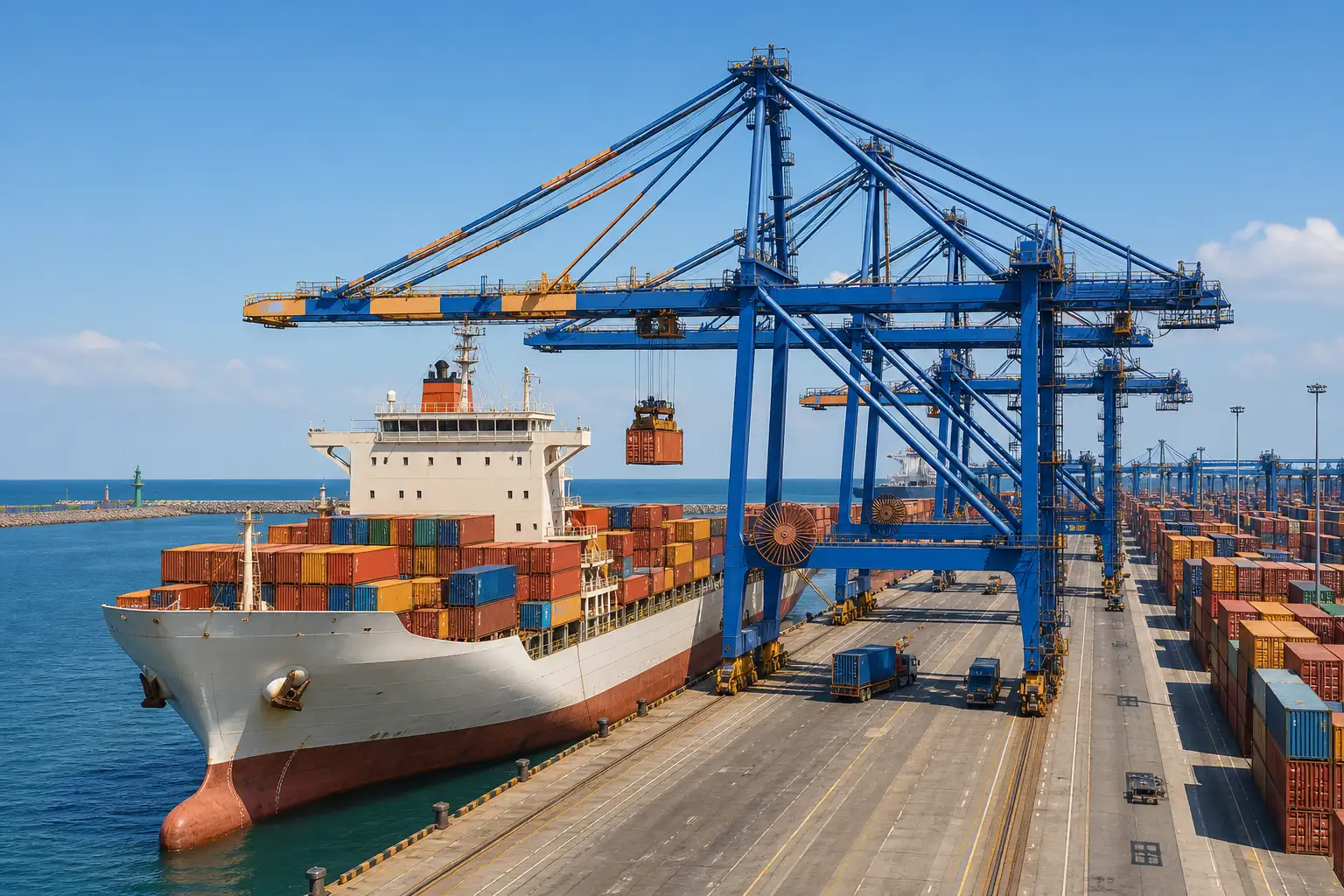
Overseas Ports Flip From Scale to Value
International ports handled 22.8 MMT of cargo, up from 7.7 MMT a year earlier. NQXT Australia, consolidated from Q4 FY26, contributed 10 MMT. Colombo added 6.9 MMT, Tanzania 3.7 MMT and Israel 2.2 MMT. Colombo revenue rose five-fold and its EBITDA margin widened to 41.8% from 21.1%. Tanzania revenue climbed 36%.
- Australia: 10 MMT, highest single overseas contributor after the NQXT addition.
- Colombo: 6.9 MMT with margin more than doubling on scale.
- Tanzania and Israel: steady volumes that keep the four-port platform diversified.
| Overseas port | Cargo (MMT) |
|---|---|
| Australia (NQXT) | 10 |
| Colombo | 6.9 |
| Tanzania | 3.7 |
| Israel | 2.2 |
| International total | 22.8 |
Whole-time Director and CEO Ashwani Gupta said the international portfolio, together with marine and logistics, has “transitioned decisively from scale to scale-value.” That language matches the numbers: overseas EBITDA of Rs 730 crore now sits in the same conversation as the domestic cash engine rather than as a rounding item.
The volume jump from 7.7 MMT to 22.8 MMT is not evenly spread. Australia alone accounts for nearly half the overseas tonnage after the NQXT consolidation. Colombo’s margin move from 21.1% to 41.8% shows what operating leverage looks like once a hub clears its fixed-cost base. Tanzania and Israel supply geographic spread so the platform is not a single-asset story.
Domestic Ports Still Fund the Next Wave
Domestic ports handled 115.3 MMT versus 112.9 MMT a year ago. Revenue rose 12% on better cargo mix and higher realisations. EBITDA margin held at a best-in-class 74%. All-India cargo market share was 27.6%; container share was 44.8%.
Capacity stood at 653 MMT on 30 June 2026. The company is running one of its largest expansion programmes, targeting 1,000 MMT of domestic capacity by December 2030. That build is the foundation of Ambition 2031. The domestic margin profile is what makes the capital spend financeable while international assets mature.
Readers tracking other large India corporates can compare the tone of this print with another major India corporate Q1 print that also mixed solid operations with market debate over capital allocation.
A 74% EBITDA margin on the domestic book is the practical reason the capacity race can run alongside overseas growth. Modest tonnage growth of 115.3 MMT from 112.9 MMT still produced double-digit revenue growth because mix and realisations improved. Container share at 44.8% and all-India cargo share at 27.6% anchor that pricing power inside the Indian market.
Marine Adds Vessels and New Geographies
Marine revenue rose 67% to Rs 901 crore. The fleet stood at 135 vessels against 118 a year earlier. APSEZ pointed to a partnership with Oceaneering International aimed at deepwater engineering and offshore work in Europe, plus a 10-year contract supporting Argentina’s first LNG exports to India. Those contracts extend the marine arm beyond Indian coastal work into subsea and South American energy logistics.
- Fleet: 135 vessels, up from 118 a year earlier.
- Europe: partnership with Oceaneering International for deepwater and offshore engineering.
- South America: 10-year contract tied to Argentina’s first LNG exports to India.
Logistics was the softer line. Rail container volumes fell because of the Middle East disruption (145,310 TEUs versus 179,479). Trucking revenue still rose 26% year-on-year and the International Freight Network business climbed 28% sequentially as the company pushed asset-light models.
Marine’s jump in revenue and vessel count turns the segment into a visible earnings line rather than a support function. The Oceaneering link and the Argentina LNG contract give the fleet work outside Indian coastal routes. Logistics, by contrast, absorbed the rail volume hit from the Middle East disruption while trucking and the International Freight Network offset part of the drag through asset-light growth.
Balance Sheet and the BBB Step-Up
Gross debt was Rs 56,776 crore with cash of Rs 12,428 crore. Net debt to EBITDA of 1.9x (1.8x on a proforma basis including TTM NQXT) sits comfortably inside the 2.5x guidance ceiling. Average debt maturity was 5.1 years.
S&P Global Ratings upgraded the long-term issuer credit rating and the senior unsecured notes to BBB from BBB- with a stable outlook, aligning APSEZ with India’s sovereign rating from S&P. CARE and ICRA reaffirmed the domestic AAA rating. The company also noted it was the first Indian transport firm to issue a TNFD nature-related financial disclosures report.
- Net debt / EBITDA: 1.9x reported, guidance ceiling 2.5x.
- S&P move: BBB / stable, matching sovereign.
- Domestic agencies: AAA reaffirmed by CARE and ICRA.
These credit steps lower the cost of capital for the capacity programme and any larger overseas transaction.
Gross debt of Rs 56,776 crore against cash of Rs 12,428 crore leaves a manageable net position when EBITDA is already running at Rs 6,541 crore for the quarter. A 5.1-year average maturity spreads refinancing risk. Matching the sovereign BBB rating from S&P, while keeping domestic AAA from CARE and ICRA, is the rating stack that supports both rupee and hard-currency funding for the next phase of spend.
Shares Slip While Global Ambition Widens
Despite the clean operational print, Adani Ports shares traded around Rs 1,734-1,735, down roughly 2.2-2.3% on the day while the broader market stayed green. The stock was still up about 17% year-to-date into the print. Short-term traders appeared to treat the numbers as in-line rather than a fresh catalyst.
That reaction sits beside a larger strategic picture. The same day brought fresh reporting that Adani Ports is weighing a controlling stake in the UK’s largest ports operator. The reported interest in Associated British Ports would, if pursued, fit the pattern the Q1 numbers just validated: use high-margin Indian cash flows and a stronger overseas earnings base to underwrite multi-geography scale.
Supported by our domestic capacity expansion program targeting 1,000 MMT by 2030, a growing international portfolio, and a rapidly scaling logistics ecosystem, APSEZ is steadily building a more diversified, resilient, and globally relevant transport platform capable of sustaining long-term value creation.
Ashwani Gupta, whole-time director and CEO, made that case in the results commentary. The 19% EBITDA growth and segment detail on the company newsroom page, together with the full investor materials on the APSEZ investor relations calendar and filings, give the same sequence: domestic bedrock, international profitability inflection, marine geographic stretch, balance-sheet headroom.
The market can mark the shares down on any given results day. The second-order change is already in the P&L: overseas ports and marine are no longer optional extras. They are now material engines that make the 1,000 MMT domestic target and any ABP-scale bid look like extensions of an existing platform rather than leaps into the dark.
Indian Margins Keep the Expansion Affordable
The 74% domestic EBITDA margin is the hinge between today’s cash generation and the 1,000 MMT capacity target set for December 2030. Capacity already stands at 653 MMT. Closing that gap requires sustained capital spend. High domestic margins are what keep net debt to EBITDA at 1.9x while that programme runs.
International ports now contribute Rs 730 crore of EBITDA on Rs 1,747 crore of revenue. That is no longer a development-stage drag. It is a second cash stream that can share the load of funding growth. Marine at Rs 901 crore of revenue adds a third line that is no longer confined to coastal India.
Guidance still caps net debt to EBITDA at 2.5x. The present 1.9x reading, or 1.8x on the proforma basis that includes TTM NQXT, is the headroom figure investors will watch if an Associated British Ports-scale transaction moves from report to process. Domestic profitability is what makes that headroom usable rather than theoretical.
Four Ports Build a Diversified Overseas Base
The overseas book is no longer a single-country bet. Australia, Colombo, Tanzania and Israel together moved 22.8 MMT in the quarter. NQXT’s first full contribution after the Q4 FY26 consolidation supplied 10 MMT and made Australia the largest overseas node overnight.
Colombo’s five-fold revenue rise and margin lift to 41.8% show how quickly a scaled hub can improve returns once volumes compound. Tanzania’s 36% revenue increase and Israel’s 2.2 MMT keep Africa and the Eastern Mediterranean in the mix. The four-port spread reduces reliance on any one trade lane.
Gupta’s “scale to scale-value” phrase is the frame management wants on this shift. Overseas revenue at Rs 1,747 crore and EBITDA at Rs 730 crore put the international arm in the same earnings conversation as the domestic ports engine. That is the condition under which a wider global bid starts to look like platform extension rather than a greenfield leap.
Frequently Asked Questions
What was Adani Ports consolidated net profit in Q1 FY27?
Consolidated PAT was Rs 3,650 crore, a 10% rise from Rs 3,311 crore in Q1 FY26, according to the company’s exchange filing and media release.
How much cargo did international ports handle in the quarter?
International ports moved 22.8 MMT versus 7.7 MMT a year earlier, with Australia at 10 MMT, Colombo 6.9 MMT, Tanzania 3.7 MMT and Israel 2.2 MMT after the NQXT consolidation.
What domestic port capacity target has APSEZ set for 2030?
Domestic capacity stood at 653 MMT on 30 June 2026 and is targeted to reach 1,000 MMT by December 2030 under the company’s current expansion programme.
Did Adani Ports change its full-year FY27 guidance after Q1?
No. Management reiterated revenue guidance of Rs 43,000-45,000 crore and EBITDA of Rs 25,000-26,000 crore, with net debt to EBITDA up to 2.5x.
What credit rating action did S&P take on APSEZ?
S&P upgraded the long-term issuer credit rating and senior unsecured notes to BBB from BBB- with a stable outlook, placing the company on par with India’s sovereign rating from S&P.
Disclaimer: This article is for informational purposes only and does not constitute investment advice. Consult a qualified adviser before making any financial decisions.
 Runlayer Trial With Rippling Ends in Clone Lawsuit
  Finfluencer Tips Hold Steady as SEBI Registration Barely Moves
  KPIT Tech Q1 Beat Masks Outsourcing Tail from OEM Pain
  Air India Easy Connect Opens Amritsar to 27 Global Cities
  Gold Stalls Near $4050 as Iran Oil Shock Lifts Fed Hike Bets
  Brezza Facelift Drops Turbo Below Old Base and Locks Five Stars