
 Ishan Crawford
 Jon Prosser’s new iPhone 18 Pro video spends most of its runtime on one feature: a first-ever variable aperture camera. It never once mentions the modem. Leaked supply-chain files say the U.S. version of that same phone will keep running on Qualcomm hardware while the rest of the world switches to a chip Apple built itself.
That split is the tell. Apple has spent seven years and more than a billion dollars trying to build a modem that could replace Qualcomm everywhere Apple sells a phone. In the market Apple cares about most, it still hasn’t.
What Prosser’s New Video Shows
Front Page Tech host Jon Prosser published the video this week, showing off the iPhone 18 Pro and iPhone 18 Pro Max weeks before Apple is expected to reveal them for real. Apple has been tipped to hold a September 8 unveiling event at Apple Park, where the company’s new chief executive, John Ternus, is expected to take the stage.
Most of the design details have circulated for months already. What Prosser adds is confirmation and a clearer look at color. The video and the reporting around it point to a handful of specifics:
- A lead color called Dark Cherry, shown alongside blue, silver and dark gray options
- A new main camera sensor paired with a true variable aperture, a first for any iPhone
- A thicker aluminum case built to hold a bigger battery
- The 2 nanometer Apple A20 Pro chip
- Battery capacities of 4,288 mAh in the iPhone 18 Pro and 5,567 mAh in the Pro Max
- A smaller Dynamic Island cutout on the display
Color rumors have moved around. An earlier Prosser video had pointed to burgundy, brown and purple as contenders for the Pro line’s signature shade. The newest video settles on Dark Cherry, a similarly deep red, as the one Apple is actually building toward. A separate leak has already shown a Dark Cherry, light blue and black lineup for the Pro Max specifically.
Prosser’s track record matters here because he is not a neutral source. Apple sued him and a collaborator, Michael Ramacciotti, in federal court in July 2025 over allegations the pair misappropriated trade secrets tied to earlier leaks, according to Gadget Hacks. That case is still open.
The Detail the Video Leaves Out
AppleInsider first reported the modem split in late June, after reviewing files stolen from Apple supplier Tata Electronics in a cyberattack. Notebookcheck’s write-up of Prosser’s video pointed out that he skips the region-specific differences entirely, the modem chief among them.
The leak describes two different iPhone 18 Pro configurations. U.S. models keep Qualcomm modem hardware, including parts identified as the SDX80M and SDR875, to preserve mmWave 5G support. Models sold everywhere else move to Apple’s own C2 chip.
MacRumors has been careful to note it has not seen the stolen files directly, though it says AppleInsider’s analysis of the material checks out. MacObserver reported the same component list independently.
Why Can’t Apple’s Own Modem Handle mmWave Yet?
Apple’s in-house modems, the C1 in the iPhone 16e and the C1X in the iPhone Air, both skip millimeter wave 5G, the ultra-fast, short-range band U.S. carriers spent billions building out. Apple has prioritized power efficiency and a simpler chip over that speed, and the C2 reportedly continues the pattern, according to AppleInsider’s review of the leak.
Millimeter wave, usually shortened to mmWave, delivers the fastest 5G speeds available, but only over short distances and mostly in dense areas like stadiums and city blocks. Sub-6GHz 5G, the band Apple’s chips do support, covers far more ground at lower peak speeds.
Qualcomm’s Snapdragon modems support both bands, and the iPhone 17, iPhone 17 Pro and iPhone 17 Pro Max all use Qualcomm hardware today. Apple’s C1X, used in the iPhone Air, still can’t match that, a trade-off Apple has accepted in exchange for battery life. AppleInsider’s reporting on the Tata files puts it plainly: until Apple ships a modem that can handle mmWave, U.S. Pro buyers get Qualcomm hardware by default.
One Phone, Two Modems, Depending on the Zip Code
The practical result is two different phones sold under one name.
| Detail | U.S. iPhone 18 Pro | International iPhone 18 Pro |
|---|---|---|
| Modem | Qualcomm hardware | Apple’s C2 chip |
| mmWave 5G | Supported | Not supported, per the leaked files |
| Identified components | SDX80M, SDR875, QDM8771 and related parts | Apple in-house silicon, no Qualcomm parts listed |
| Reported trade-off | Faster peak speeds in mmWave-equipped cities | Possible gains in battery efficiency and newer features |
Memeburn’s analysis of the leak argues the international version might come out ahead on balance, pointing to potential battery and satellite connectivity gains on top of the modem switch. A related leak has already flagged a battery-capacity difference between market versions of the Pro Max, so the modem might not be the only place this phone diverges by region.
A Nine-Year Wager Against Qualcomm
Apple bought Intel’s modem business in 2019 for roughly a billion dollars, a deal aimed at cutting Qualcomm out of the iPhone. Qualcomm’s fee structure, which charged Apple once for each chip and again in royalties, a practice Apple has called “double dipping,” was the target.
The first product of that bet, the C1 modem, arrived in the iPhone 16e last year. It skipped mmWave entirely, a compromise a 9to5mac report tied to Apple’s focus on power efficiency, citing analyst Ming-Chi Kuo. Qualcomm and Apple have already extended their modem licensing agreement once, through March 2027, a move Qualcomm chief executive Cristiano Amon announced on an earnings call, according to GSMArena.
Qualcomm $QCOM has already zeroed out Apple revenue for 2027 and beyond.
Patrick Moorhead, a longtime chip industry analyst, made that point on X, adding that Apple has been trying to do this since July 2019, when it bought Intel’s modem assets.
The Bill Qualcomm Would Face If the Break Finishes
Qualcomm’s own numbers show how much is riding on the outcome. In its most recent quarterly filing with the Securities and Exchange Commission, the company warns that Apple’s in-house modem shift will have a “significant negative impact” on its chip revenue, results of operations and cash flows.
- $5.7 billion to $5.9 billion: estimated annual Qualcomm modem revenue from Apple sales today, per Futurum Group analysis
- $7.3 billion to $7.8 billion: the total annual revenue hole once RF components and other subsystems are included
- 75/25 to 50/50: Qualcomm’s targeted shift in handset versus automotive and IoT revenue between 2024 and 2030
Futurum Group analysts project a $7.3 billion annual revenue shortfall for Qualcomm once Apple’s exit is complete, but argue its push into automotive and IoT chips, growing toward $22 billion by 2030 on the firm’s numbers, should cover the gap. Bloomberg has separately reported that Qualcomm’s share of iPhone modems will fall to about 20 percent this year and toward zero by 2027.
The Camera Bet Apple Got Right
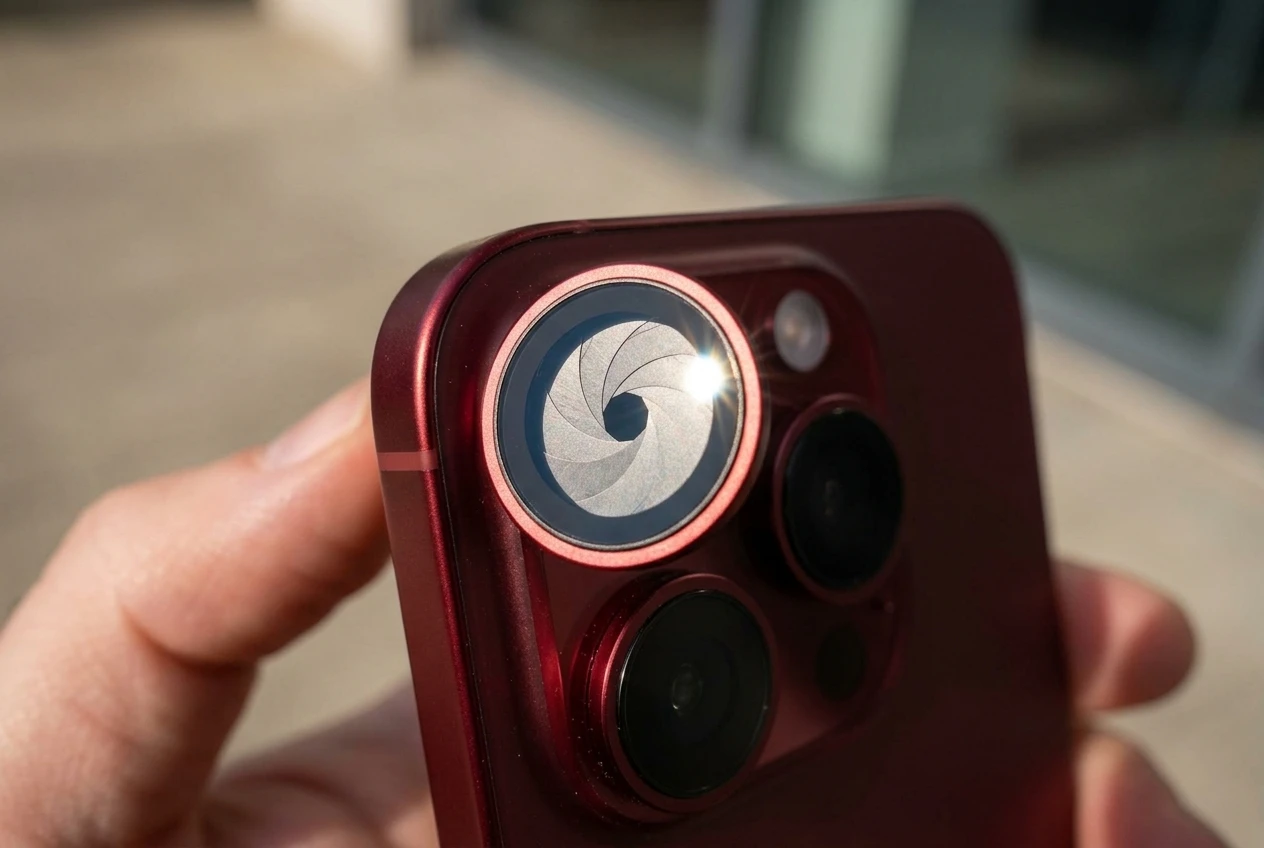
The variable aperture is the feature Prosser spent his video on, and Notebookcheck’s own analysis backs him up as a genuinely significant addition. A mechanical iris regulates how much light reaches the sensor, going beyond what software-only exposure control can do. It can narrow depth of field or turn point light sources into the kind of starburst effect photographers chase with real camera glass.
Notebookcheck also noted that variable aperture has quietly disappeared from most Android flagships within a few generations of launch, Huawei being the lone continued holdout.
That history is what makes the camera bet different from the modem bet. Apple is chasing a feature its rivals gave up on, wagering its version sticks around longer than theirs did. Whether either wager pays off will be clear only when Apple confirms it on stage at Apple Park in early September.
Frequently Asked Questions
Does the iPhone Air Use the Same Modem Split as the iPhone 18 Pro?
No. Leaked schematics indicate every iPhone Air model uses Apple’s own modem worldwide, with no Qualcomm version. The region-based split, Qualcomm hardware in the U.S. and Apple’s C2 chip elsewhere, appears specific to the iPhone 18 Pro line.
Will the iPhone 18 Pro Get Satellite Internet Features?
Leaks tied to both Prosser’s video and the Tata Electronics breach point to expanded satellite connectivity arriving alongside the C2 modem rollout, though neither source has detailed which regions get it first.
Has Apple Split Cellular Hardware by Region Before?
Yes, in a smaller way. Coverage of the iPhone 17 lineup already noted a mixed setup in cellular hardware between models, so a regional split is not new for Apple, even if the iPhone 18 Pro’s version touches the modem itself rather than a secondary radio.
Who Leaked the iPhone 18 Pro’s Modem Plans?
The details trace back to a ransomware breach at Tata Electronics, an Apple assembly partner in India. A group calling itself World Leaks published more than 630 gigabytes of internal data, including chip schematics and supplier documents, on the dark web in late June.
 One UI 9’s Privacy Display Fix Reaches Just One Galaxy Phone
  Samsung Drops Its Own Exynos Chip for the Galaxy Watch9 and Ultra 2
  Marathon’s Vault Breaker Arrives as Bungie’s Bigger Bet Keeps Faltering
  Sony’s PlayStation Disc Cutoff Erases the Last Proof of Ownership
  Tesla’s Summer Update Hands Grok the Keys, and Musk’s Empire More Reach
  Apple’s $634 Million Masimo Payment Is Final After Appeal Denial