
 Ishan Crawford
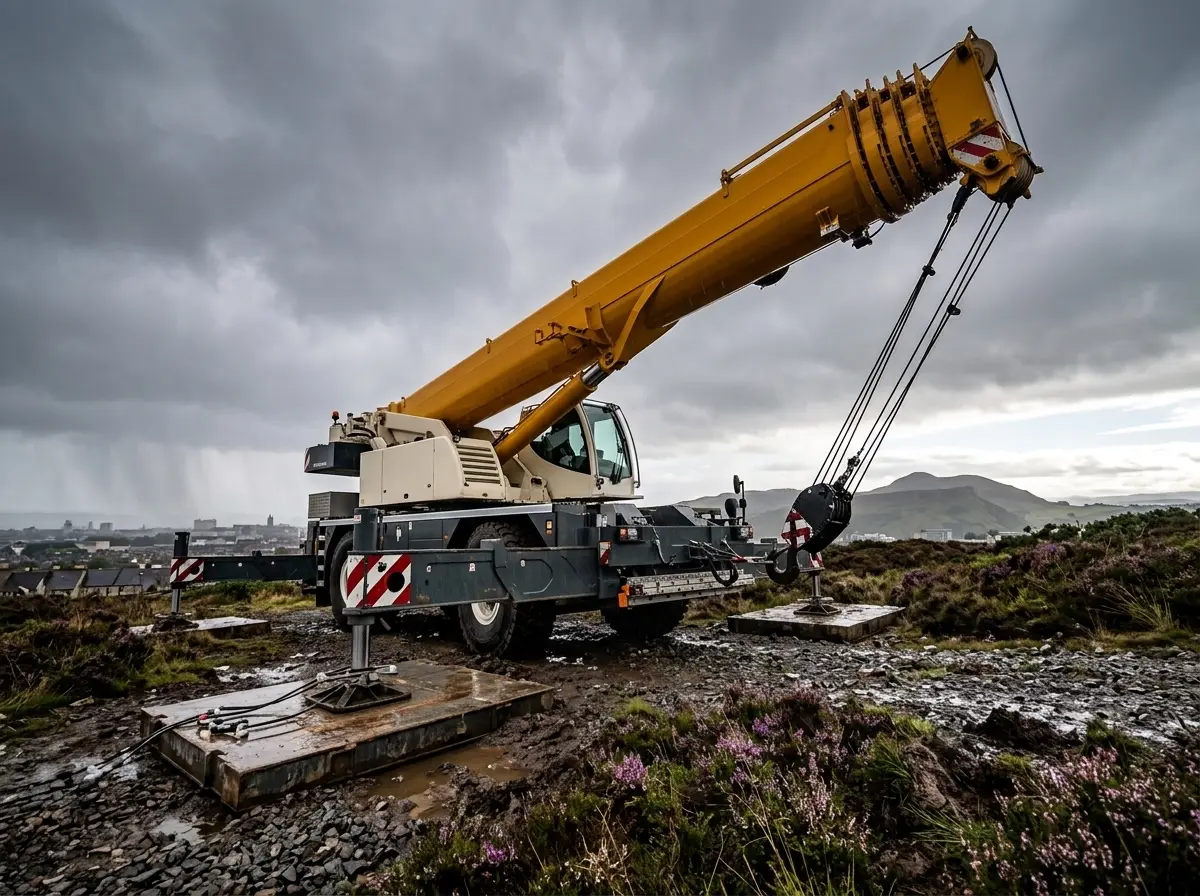
 Bernard Hunter has taken delivery of a 90 tonne Liebherr LRT 1090-2.1, the first rough terrain crane of its kind to enter service in Scotland. The Edinburgh rental firm’s newest arrival carries a 47 metre main boom, a bi-fold swingaway extension and Liebherr’s VarioBase outrigger system.
It also lands as the latest entry in a run of Liebherr milestones Bernard Hunter has notched since 2021, a run that has included the biggest crane the company has ever bought and, now, one of the smallest it has bought in years.
The Machine That Just Joined the Fleet
The LRT 1090-2.1 rides on two axles rather than the multi axle chassis of Bernard Hunter’s bigger all terrain cranes, and it is built for ground where paved roads and level pads run out. Liebherr rates it at 90 tonnes of maximum capacity, with a 47 metre telescopic main boom and a 10.5 to 19 metre bi-fold swingaway extension that adds up to 40 degrees of offset for awkward lifts.
It comes standard with VarioBase, Liebherr’s variable outrigger system that reads each leg’s support status and rebuilds the crane’s load chart automatically to match. An ECOmode setting trims fuel use and noise by matching engine speed to the job automatically, and the wide, tilting cab gives the operator a better line of sight on tall lifts.
“This the first ever Liebherr LRT1090-2.1 Rough Terrain Crane in Scotland delivered to Bernard Hunter in Edinburgh,” said Lyle Sibbald, Liebherr’s UK sales manager. “Huge thanks to Mark and Jim Rafferty and all the team at Bernard Hunter.”
The addition of the LRT 1090-2.1 adds a whole new offering to our versatile fleet of modern cranes, as we seek to offer our customers a complete range of lifting services.
Mark Rafferty, Bernard Hunter’s managing director, said that in announcing the delivery.
Despite its lifting numbers, the crane’s own road weight stays modest: under 55 tonnes fully rigged with ballast, or under 40 tonnes stripped down for transport between jobs. In the United States, Liebherr sells the identical platform as a 100 ton crane. The 90 tonne rating is simply the metric conversion used everywhere else.
Bernard Hunter Keeps Collecting Scottish Firsts
Bernard Hunter took delivery of its first Liebherr crane, a 50 tonne LTM 1050.4, on 22 January 1995. Everything since has built on that one purchase.
- 1995: Bernard Hunter buys its first Liebherr, a 50 tonne LTM 1050.4, the start of a three decade relationship with the manufacturer.
- 2021: An eight axle Liebherr LTM 1650-8.1 arrives as Scotland’s first 700 tonne capacity crane and only the second of its type in the UK.
- 2022: A 110 tonne LTM 1110-5.1 becomes the firm’s 35th Liebherr crane in 27 years.
- 2025: Bernard Hunter takes delivery of a 150 tonne LTM 1150-5.3, then places an order at bauma for a 300 tonne LTM 1300-6.2.
- 2026: The 300 tonne LTM 1300-6.2 is delivered in April, Bernard Hunter ordered the crane at ConExpo 2026, and the 90 tonne LRT 1090-2.1 lands in Edinburgh that July as the first rough terrain Liebherr in Scotland.
Two of those five moments were explicitly billed as Scottish firsts. The rest were simply the biggest, newest or most capable crane Bernard Hunter itself had ever run. Either way, Vertikal.net, Heavy Lift News and Project Plant have all covered each addition.
Lyle Sibbald oversaw the 2022 handover too, back when he was Liebherr’s regional sales manager for Scotland and the north of England. He has since become the manufacturer’s UK sales manager, a promotion that has tracked roughly alongside Bernard Hunter’s own expansion.
Eighty Years in the Family
Bernard Hunter was founded in 1946 by the man whose name the firm still carries. Eighty years on, it is still family-owned by its third generation, run today from a yard in Gilmerton on Edinburgh’s southern edge.
Cranes are only part of what that yard holds. Beyond the mobile crane fleet, Bernard Hunter’s equipment list includes:
- A 12 tonne Böcker truck crane at the small end of the range, alongside four and six axle Spierings mobile self-erecting tower cranes.
- Maeda spider cranes and mini crawler cranes for confined or delicate lifts.
- Tracked carriers and glass handling equipment for specialist facade and window work.
- Telehandlers topped by a 16,000kg, 10 metre Manitou MHT-10160, plus an in-house operator training programme for its own crews and its customers.
The 700 tonne LTM 1650-8.1 remains the flagship of that fleet, delivered in 2021 as the biggest single investment in the company’s history at the time.
What Does a Rough Terrain Crane Do That an All-Terrain Can’t?
A rough terrain crane runs on four oversized tyres built for mud, gravel and uneven ground, picking up a load and carrying it across a single site rather than driving between jobs on public roads. An all-terrain crane, built for the opposite job, self-drives at highway speed between sites and still handles rough ground once it arrives.
Liebherr had not sold a rough terrain crane at all for two decades before the LRT 1090-2.1 and its larger sibling, the LRT 1100-2.1, launched together at the CONEXPO-CON/AGG show in Las Vegas in March 2017. The manufacturer’s marketing at the time re-entered the rough terrain market after 20 years with a design guided by surveys of what contractors actually needed from the class.
Set beside the rest of Bernard Hunter’s Liebherr fleet, the size difference is obvious.
| Model | Crane Class | Max Capacity | Main Boom | Axles |
|---|---|---|---|---|
| LRT 1090-2.1 | Rough terrain | 90 tonnes | 47 metres | 2 |
| LTM 1300-6.2 | All terrain | 300 tonnes | 78 metres | 6 |
| LTM 1650-8.1 | All terrain | 700 tonnes | 50 to 80 metres | 8 |
Liebherr has grown the rough terrain range further since 2017, adding the 120 tonne LRT 1130-2.1 at bauma in October 2022. That model now works far beyond Scotland too.
Rough Terrain Demand Is Climbing Fast
Bernard Hunter’s timing lines up with the wider market. Worldwide sales of rough terrain cranes reached an estimated $7.85 billion in 2023, and Fact.MR expects the category to reach $14.1 billion by 2033, a six percent annual growth rate over the decade.
Europe already accounts for roughly 30 percent of the global rough terrain crane market, with Germany, France and the UK named among the main drivers of that share. The UK’s broader crane market, spanning rough terrain, all terrain, crawler and tower cranes, was valued near $1.01 billion in 2021 and is forecast to reach $1.33 billion by 2027, growing about 4.6 percent a year.
Renewable energy buildouts are one category analysts expect to lean on rough terrain machines hardest, since wind and solar sites rarely come with paved access roads already built. Industry researchers covering the sector also flag the same headwinds everywhere: heavy upfront costs, expensive maintenance, and a shortage of operators trained on increasingly complex lifting equipment.
Liebherr’s own order book shows how routine deliveries like this have become. Earlier in July 2026 alone, the manufacturer handed a new LTM 1230-5.1 to Germany’s Schlamann-Autokrane, the first of four cranes ordered for the year, and gave Ghana’s Rocksure International its first ever LRT 1130-2.1 rough terrain crane.
Liebherr’s Books Show a Cooler 2026
The manufacturer behind Bernard Hunter’s new crane is not having an easy year at group level. Liebherr Group revenue rose just one percent to €14.77 billion in 2025, while pre-tax profit fell 29 percent last year to €437 million, driven mostly by higher staff and operating costs.
Crane sales across mobile, crawler, tower and maritime lines brought in around €5.7 billion, roughly 38 percent of the group’s total revenue. Steffen Günther, managing director of Liebherr’s holding company, said the group expects 2026 to stay difficult, describing conditions of “global uncertainties, geopolitical tensions and ever increasing competitive pressures.”
“Numerous product segments are expecting customers to remain cautious when it comes to investments,” Günther said. “Even though the group has started the year with a promising volume of orders, we are not anticipating a marked period of growth until 2027.”
None of that caution has reached Gilmerton yet. Bernard Hunter’s Liebherr fleet now runs from the 90 tonne rough terrain crane that arrived this month to the 700 tonne flagship bought five years earlier, with a 300 tonne all-terrain crane and a 150 tonne all-terrain crane in between.
 Scotland’s Facial Recognition Push Sparks Mask Ban Call
  Galaxy Z Flip 8 Hits $799 Only If Your Trade-In Qualifies
  If England Had Kept Water Public Like Scotland
  Samsung Smart Switch Now Moves Passwords and eSIM From iPhone
  Old Firm Spend Pulls Clear as Premiership Rivals Patch Squads
  Chinese Studios Quietly Seize the Gamescom Stage