
 Ishan Crawford
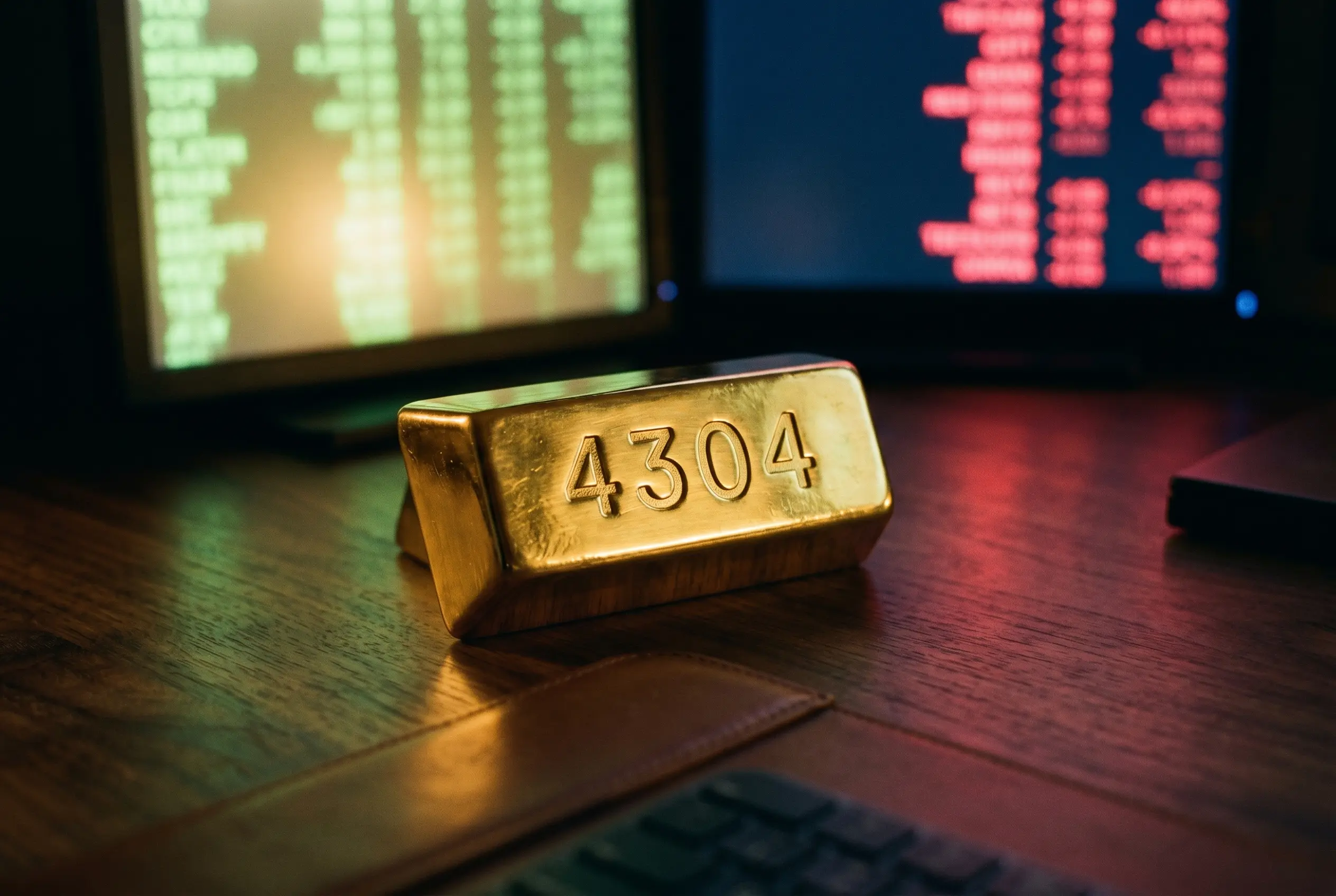
 Spot gold rose 1.1% to $4,304.89 an ounce by 21:20 ET on Thursday, recovering from the previous session’s 1.7% drop as investors welcomed the signing of a US-Iran interim peace agreement and weighed the Federal Reserve’s signal for a possible rate hike later this year. US gold futures slipped 1.3% to $4,325.97, leaving the two gauges pointing in opposite directions for a second straight day. The split captured a market caught between the relief of falling oil and the drag of a dollar the Fed appears willing to defend.
Wednesday’s session had taken 1.7% off the price after the Fed held its policy range and raised its inflation projections, sending the dollar higher and bullion toward the lower end of a multi-week range. Thursday’s bounce traced back to a single announcement: the electronic signing of a 14-point memorandum between US President Donald Trump and Iranian President Masoud Pezeshkian that opens a 60-day negotiation window and clears the way for the Strait of Hormuz to reopen. Investors read the deal as a brake on the energy-driven inflation the Fed had just warned about. They read the Fed as a reason the rally could not run further.
Gold Recovers After Iran Deal Cheer
Spot gold’s Thursday climb unwound most of Wednesday’s slide but stopped short of recapturing the level it traded at before the Fed meeting. By 21:20 ET, the metal sat 1.1% higher on the day at $4,304.89 an ounce. US futures told a different story, easing 1.3% to $4,325.97 as the dollar firmed in New York trading.
The two gauges diverged because the same news that relieved inflation pressure also reinforced the case for higher US rates. A stronger greenback makes dollar-denominated gold more expensive for overseas buyers, and higher interest rates lift the opportunity cost of holding a non-yielding asset. The Tuesday and Wednesday session had already priced both forces; Thursday simply repriced the relief side higher.
Wednesday’s 1.7% decline in spot gold came on the back of the Fed decision, with a stronger US dollar and rising bond yields doing the damage. Gold has spent most of June pinned inside a band roughly between $4,400 and $4,500, caught between the same two crosswinds: a US-Iran deal that pulls energy and inflation risk lower, and a Fed that has stopped cutting. A similar standoff earlier in the month, covered in gold’s drop below $4,450 under dollar and oil pressure, ended with bullion giving up more ground than it gained.
What’s Inside the 14-Point US-Iran Memorandum
The text released by the US side commits Washington and Tehran to negotiate a final agreement within a maximum 60-day window that is extendable by mutual consent. The memorandum was electronically signed Sunday by Trump and Pezeshkian after weeks of shuttle diplomacy mediated by Pakistan. An in-person signing ceremony is scheduled for Friday at the Swiss mountaintop resort of Burgenstock, with mediators Pakistan and Qatar attending alongside US and Iranian delegations, according to the full US-Iran memorandum signing coverage.
The most market-sensitive clause covers the Strait of Hormuz, the chokepoint through which roughly 20% of the world’s prewar oil and liquefied natural gas flowed. The deal calls for traffic through the strait to be restored to full capacity within 30 days, and Trump announced the reopening on his social media account on Sunday. The full text, quoted in Trump’s social media post announcing the Hormuz deal, authorizes the “toll free opening of the Strait of Hormuz” and the removal of the US naval blockade.
- 14-point memorandum: the framework text electronically signed by Trump and Pezeshkian on Sunday.
- 60-day window: the negotiation period, extendable by mutual consent.
- 30-day target: Strait of Hormuz traffic returned to full capacity.
- 20% of prewar oil and LNG flows: the share that previously transited the strait.
Iran will allow toll-free passage through Hormuz for the duration of the 60-day window, according to statements from Iranian officials. Iran has not enriched any uranium since 2025 strikes disabled the cascade, and the deal defers the question of how to handle Iran’s existing stockpile to the talks. Top Democratic lawmakers on three House committees have asked the administration for the full text of the memorandum and a classified briefing on the negotiation strategy, citing reports of a $300bn reconstruction fund under discussion.
The Fed Holds and Tilts Hawkish Under Warsh’s First Meeting
The Federal Reserve held its benchmark interest rate range at 3.50%-3.75% on Wednesday in a unanimous decision, the first policy meeting under Chair Kevin Warsh since he took over from Jerome Powell last month. The Fed simultaneously raised its inflation forecasts and signaled that policymakers still see scope for tighter monetary policy later this year. Updated projections showed that 9 of 19 FOMC participants expect at least one rate increase in 2026, a marked shift from the rate-cut expectations that prevailed at the start of the year, as reported in the Fed’s unanimous rate decision under Chair Warsh.
Warsh used his first press conference to commit the central bank to restoring price stability. Inflation hit 4.2% on last week’s consumer price index release, a three-year high driven primarily by energy prices that jumped 23.5% in May during the Hormuz disruption. Even with oil now retreating, the Fed’s statement warned that “inflation remains elevated relative to the Committee’s 2 percent goal, in part reflecting supply shocks that have driven price increases in certain sectors, including energy.” CME FedWatch had put the probability of an unchanged decision at 99% before the meeting, but the SEP projection shifted market attention to the December meeting, where the tracker now shows a more than 50% probability of a rate hike if labor and financial conditions hold.
Persistently high prices are a burden for the American people. But the recent past need not be prologue. I am pleased to report that members of the FOMC are unambiguous and unanimous. This committee will deliver price stability.
Kevin Warsh, in his first press conference as Federal Reserve chair, June 17, 2026. Warsh announced five new internal task forces covering productivity, jobs, and inflation, and said the Fed will drop its practice of forward guidance on monetary policy. Capital Economics chief economist for North America Stephen Brown said a “Trump-friendly Warsh would probably still try to toe the line between sounding neutral and acknowledging that hikes are a possibility.” Capital Economics forecasts a rate hike in December 2026 and another early in 2027; Goldman Sachs has said the central bank will probably not cut rates until mid-to-late 2027.
Silver, Platinum and Copper Track the Same Crosswinds
Other precious and industrial metals moved in patterns consistent with gold’s split verdict. Silver, which often trades as a higher-beta proxy for gold, rose 1.3% to $68.78 per ounce. Platinum gained 1.1% to $1,759.89 per ounce, helped by the same oil-relief trade that supported bullion. Palladium did not trade in the same window.
Copper told the opposite story. On the London Metal Exchange, copper fell 0.9% to $13,713.33 a ton, while US copper futures rose 0.5% to $6.39 a pound. The LME gauge reflects global industrial demand, where a stronger dollar and slower growth expectations weighed; the US futures contract is more sensitive to near-term supply-and-demand on Comex.
| Metal | Latest price | Daily move |
|---|---|---|
| Silver | $68.78 / oz | +1.3% |
| Platinum | $1,759.89 / oz | +1.1% |
| Copper (LME) | $13,713.33 / ton | -0.9% |
| Copper (US futures) | $6.39 / lb | +0.5% |
Why Gold Cannot Break Free of Either Force
The 60-day negotiation window is extendable, but the unresolved questions are the ones markets usually price hardest. Sanctions relief and the reported $300bn reconstruction fund remain under negotiation. Republican Senator Lindsey Graham, a Trump ally and longtime hawk on Iran, said on social media that “Iran’s view of the agreement seems different than what the American negotiating team is claiming,” noting that at least three different Iranian versions of the memorandum had circulated before Sunday’s signing.
That uncertainty is the wedge the Fed has chosen to lean into. With inflation running at a three-year high and energy prices only now retreating from their Hormuz-induced spike, Warsh’s Fed has little reason to cut and a politically awkward reason to consider hiking. The metal has been here before: gold’s earlier stall between ceasefire and rate-hike bets saw spot barely move while the same two forces blew at full strength. Thursday’s bounce undid Wednesday’s drop. It did not change the ceiling.
Spot gold’s 1.1% Thursday climb looked like a relief rally, not a trend break. Capital Economics forecasts a rate hike in December 2026 and another early in 2027. Goldman Sachs forecasts that the central bank will probably not cut rates until mid-to-late 2027. Until the 60-day window produces a final agreement and the Fed’s SEP shifts back toward easing, gold’s two winners will keep cancelling each other out.
Frequently Asked Questions
Why did gold prices rise on June 18, 2026?
Spot gold rose 1.1% to $4,304.89 an ounce on Thursday after the electronic signing of a 14-point US-Iran memorandum the previous Sunday. The deal opens a 60-day negotiation window and calls for Strait of Hormuz traffic to return to full capacity within 30 days, easing the energy-driven inflation fears that had pushed US consumer prices to a three-year high in May.
What did the US-Iran peace deal change for oil and inflation?
The memorandum authorizes the toll-free reopening of the Strait of Hormuz, the chokepoint that carried roughly 20% of the world’s prewar oil and liquefied natural gas flows. Oil prices had spiked in May after Iran closed the strait during the war, contributing to a 23.5% monthly jump in US energy prices. The deal removes the supply-shock premium that the Fed had cited in its June 17 statement.
Did the Federal Reserve cut interest rates this week?
No. The Federal Reserve held its benchmark rate range at 3.50%-3.75% on Wednesday in a unanimous decision, and 9 of 19 FOMC participants now expect at least one rate increase in 2026. CME FedWatch puts the probability of a December 2026 hike at more than 50% if current labor and financial conditions hold.
How does a stronger US dollar affect gold?
A stronger US dollar makes dollar-denominated gold more expensive for buyers using other currencies, which tends to reduce demand. Higher US interest rates also raise the opportunity cost of holding gold, which pays no yield. The combination of a firmer dollar and a hawkish Fed is the main reason gold fell 1.7% on Wednesday and only partially recovered on Thursday.
Disclaimer: This article is for informational purposes only and does not constitute financial advice. Commodity prices, interest rates, and geopolitical events are subject to rapid change. Past performance does not guarantee future results. Consult a qualified financial professional before making investment decisions. Figures cited are accurate as of publication on June 18, 2026.
 ONGC licence frees Venezuela cash and operatorship talks
  Anthropic Hits $65 Billion Run Rate and Flips the AI Cash Test
  Supreme Court grounds the fare free-for-all with three-week clock
  Gold Nears $4400 as Soft Data Meets Oil Inflation Risk
  Nifty Slips as Zaggle Circuits and Dhoot Debuts Big
  Diesel Crack Tops $100 as Iran Rhetoric Lifts Crude