
 Ishan Crawford
 India’s central bank has pushed back hard against a claim that it quietly sold gold to prop up a falling rupee. The Reserve Bank of India (RBI), the country’s central bank, said on June 3 that an estimate it offloaded roughly $12 billion of gold over two weeks is “not correct,” and that its physical gold stock sits unchanged at 880.52 tonnes. The estimate came from Bloomberg Economics, the research arm of news provider Bloomberg.
The dispute is narrow and technical. A drop in the dollar value of India’s gold holdings got read as a stealth sale during a currency crisis. RBI says the metal never left the vault, and that gold’s share of reserves rose over the same stretch rather than shrinking.
Where the $12 Billion Gold Figure Came From
The number traces to Bloomberg Economics and its senior India economist, Abhishek Gupta. His reading of publicly available RBI data suggested the central bank sold close to $12 billion of gold in the two weeks through May 22, while adding about $7.5 billion of foreign currency assets (FCA, the dollar, euro and other currency holdings that make up the bulk of reserves).
The logic was straightforward. India’s total reserves slipped from $688.9 billion to $681.4 billion in that window. Inside that total, the slice attributed to gold appeared to fall sharply in dollar terms while the currency slice climbed. Read together, that pattern looks like a swap: sell bullion, buy dollars, and use the dollars to slow the rupee’s slide.
The timing made the story land. The rupee was in open retreat, dragged down by the US-Iran conflict in West Asia, which pushed crude oil prices higher and triggered capital outflows from emerging markets. A central bank reaching for its gold to defend the currency fit the mood of the week. The estimate spread quickly across Indian financial media before the government weighed in.
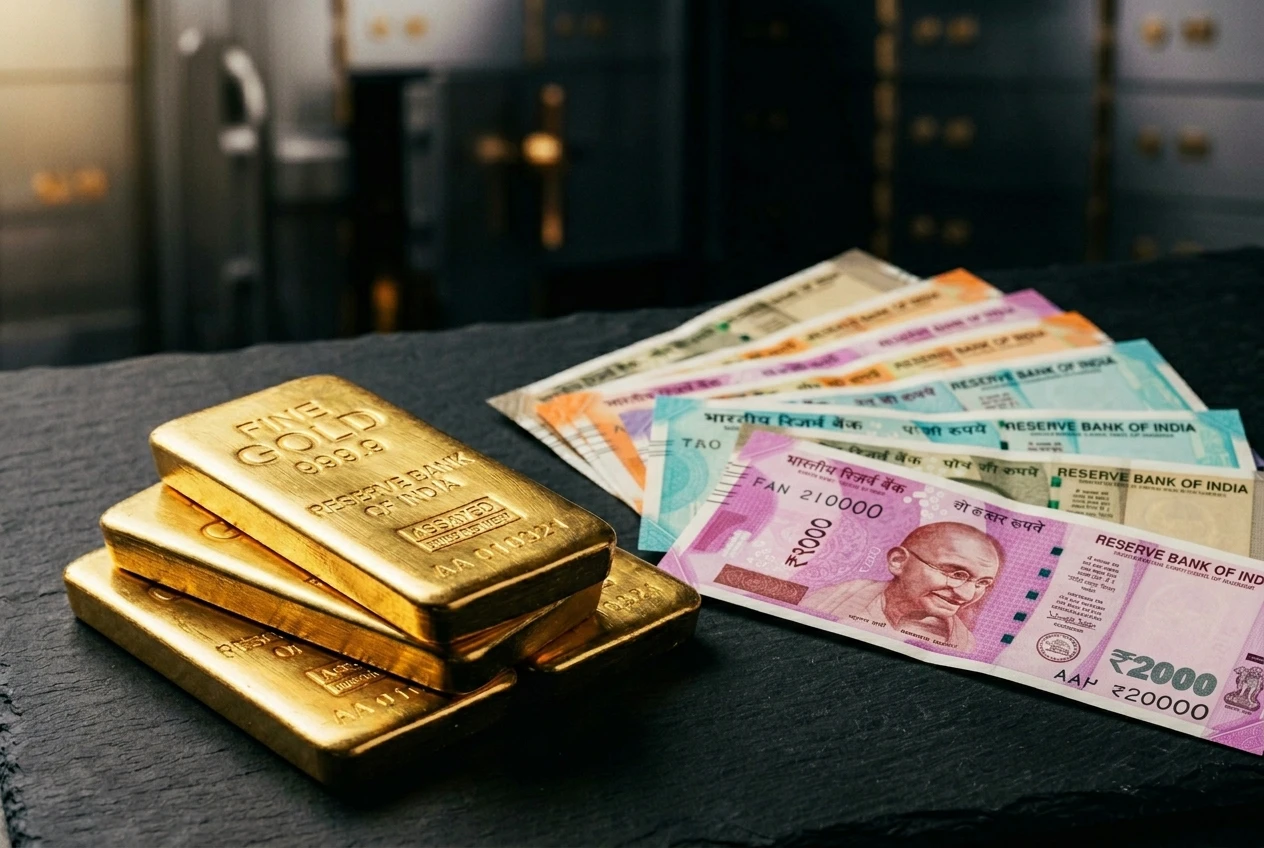
RBI Points to Tonnage That Barely Moved
RBI’s rebuttal rests on a number it can measure directly: the weight of the metal it holds. The bank said its physical stock stands at 880.52 tonnes and has not changed. A year earlier, on March 31, 2025, it held 879.58 tonnes, so the holding actually edged up by 0.94 tonnes over the financial year.
The RBI emphasises that these reports are not correct.
That line came in the central bank’s clarification, issued the same day finance ministry sources separately dismissed the claim through India’s official channels, including the Press Information Bureau (PIB, the government’s communications and fact-check body). The bank’s case does not stop at tonnage. It also points to gold’s share of total reserves, which moved the wrong way for a seller.
| Reference date | Physical gold (tonnes) | Gold as share of FX reserves |
|---|---|---|
| Mar 31, 2025 | 879.58 | not stated |
| Sep 30, 2025 | not stated | 13.92% |
| Mar 31, 2026 | 880.52 | 16.70% |
| May 22, 2026 | 880.52 | 16.85% |
Gold’s weight in the reserve mix climbed from 13.92% at the end of September to 16.85% by May 22. A bank dumping $12 billion of bullion in those final two weeks would have shrunk that figure, not lifted it. The detail sits in the RBI’s annual report for 2025-26, which you can read on the central bank’s annual report archive.
Can a Price Swing Look Like a Sale?
Both sets of numbers can be right at once, and that is the heart of the confusion. The fight is over what a change in dollar value proves.
Valuation Versus Physical Stock
The dollar value of a gold reserve is the tonnage times the market price of gold times the exchange rate. Two of those three inputs move every single day, and only one of them, the tonnage, reflects an actual transaction. So the value of a fixed pile of gold can drop on a weak price print or a stronger dollar, with no bar ever changing hands. Reading a weekly value dip as a sale skips that step.
The Revaluation Account Doing the Work
RBI runs those swings through a dedicated buffer, the Currency and Gold Revaluation Account (CGRA, where unrealised gains and losses on gold and currency holdings are parked). That account swelled to 21.69 trillion rupees at the end of March 2026, up from 13.03 trillion a year earlier. The value of gold held against currency in issue rose 64.1% over the year to 3.88 trillion rupees, and the RBI tied that gain to the rise in the gold price, not to any change in volume.
None of this rules out the Bloomberg Economics estimate as a good-faith reading of patchy weekly data, which carries reporting lags and valuation quirks. It does mean the headline jumped past a quieter explanation. A move in the value of the gold slice, sitting next to a rise in the currency slice, is exactly what a volatile gold price and active dollar intervention produce together.
India’s Long Run of Buying Gold
A sudden sale would also cut against years of the opposite behaviour. RBI has been a steady accumulator of gold, part of a wider move by emerging-market central banks to lean less on the dollar and hold more bullion. World Gold Council figures on monthly central bank gold buying have shown India among the consistent net purchasers.
The structural shift shows up in the share data. Gold made up under 8% of India’s reserves a few years ago and now sits near 17%. Several forces drove that climb:
- Price. A multi-year rally in gold lifted the value of holdings the bank already owned.
- Fresh buying. RBI added tonnes in most recent years rather than trimming.
- Diversification. Holding more gold reduces exposure to any single reserve currency, a priority across central banks tracked in the global gold reserves by country tables.
Against that backdrop, a two-week reversal of strategy during a crisis would have been a sharp break, and the same institution that is busy reviving its polymer banknote plan and managing a growing balance sheet would have had to do it without leaving a tonnage trail. So far, the tonnage trail shows nothing.
The Rupee Pressure No One Disputes
Strip out the gold argument and a real strain is left over. The rupee touched a record low near 96.96 to the dollar in late May before heavy RBI intervention pulled it back to about 95. The currency has shed roughly 6% so far this year.
The reserve drawdown is just as concrete. India’s stockpile of foreign exchange numbers:
- $681.4 billion in total reserves for the week ending May 22, the lowest in more than a year.
- $7.5 billion drop in a single week, the headline fall that fed the sale chatter.
- Around $543 billion sitting in foreign currency assets, the largest single component.
- About 6% lost on the rupee in the year to date, with crude doing much of the damage.
India imports more than 85% of the oil it burns, so a spike in crude lands straight on the trade bill and on the currency. That squeeze is visible in the trade data, where India’s swelling oil import bill from the crude surge has cut both ways on the deficit. Market participants believe RBI sold dollars through state-run banks across several sessions to brake the fall, and the bank has not denied leaning on its currency assets to do it. The weekly numbers sit on the RBI’s weekly statistical supplement.
What the Reserve Math Means Now
Why does it matter whether the defence came from gold or from currency assets? Composition is a signal. Selling dollars to steady the rupee is routine intervention, and reserves of $681.4 billion still cover well over a year of imports. Selling gold during a crisis would have hinted at deeper stress, a central bank reaching past its first line of defence. That is the version RBI is keen to kill.
For now, the honest read is that the bank is spending dollars, not bullion, and that its forex transaction gains rose 52% to 1.69 trillion rupees in the last financial year, giving it room to keep intervening. The gold question turns on a single auditable figure, the weight of metal in the vault, and that figure has held.
The RBI’s weekly statistical supplement is the document to watch from here. A genuine sale would surface there as falling tonnes over the coming weeks, and through the data published so far, the tonnes have not fallen.
Disclaimer: This article is for informational purposes only and does not constitute investment, currency or financial advice. Foreign exchange reserves, gold prices and currency markets carry risk and can move sharply. Readers should consult a qualified financial professional before acting on any information here. Figures are accurate as of publication on June 3, 2026.
 ASUS ROG Turns 20 With Edition 20 Lineup at Computex
  Google’s $80 Billion AI Raise Tests the Capex Bill
  CCI Probe Puts Mrs India Inc Pageant Contracts Under Fire
  Suzuki XL7 Facelift Spy Shots Put India’s XL6 on Alert
  Meze ARTA Headphones Put a $6,000 Bet on Repairable Hi-Fi
  Cyberpunk and Blue Prince Give Apple Design Awards a Mac Edge