
 Ishan Crawford
 Foreign investors pulled another Rs 32,963 crore out of Indian equities in May, the third straight month of net selling and enough to push total foreign portfolio investor (FPI) outflows for 2026 to Rs 2.25 lakh crore, or roughly $23 billion. That single-year figure has already blown past the Rs 1.66 lakh crore foreign funds withdrew across the whole of 2025. The selling has run almost without pause since January.
The money did not sit in cash. Much of it crossed into North Asia, where Taiwan and South Korea are riding an artificial-intelligence chip rally so fierce that Taiwan has overtaken India in the global market-capitalisation table.
Where the Rs 2.25 Lakh Crore Went
The shape of the year is easy to read in the monthly data from the National Securities Depository Limited (NSDL), the agency that tracks foreign flows into Indian markets. One month of buying, surrounded by heavy selling on either side.
- January: net outflow of Rs 35,962 crore
- February: net inflow of Rs 22,615 crore, the strongest month in 17 months
- March: record outflow of Rs 1.17 lakh crore
- April: net outflow of Rs 60,847 crore
- May: net outflow of Rs 32,963 crore
February was the one green month, and it did not last. By March the exit had become a stampede, with the largest single-month withdrawal foreign funds have ever recorded in India. April and May eased off that peak but stayed firmly negative.
What stands out is not just the size but the persistence. Five months in, the running tally already exceeds an entire prior year of selling, a pace you can follow through NSDL’s foreign portfolio investment data. For a market that spent a decade as a magnet for global capital, that is a sharp turn.
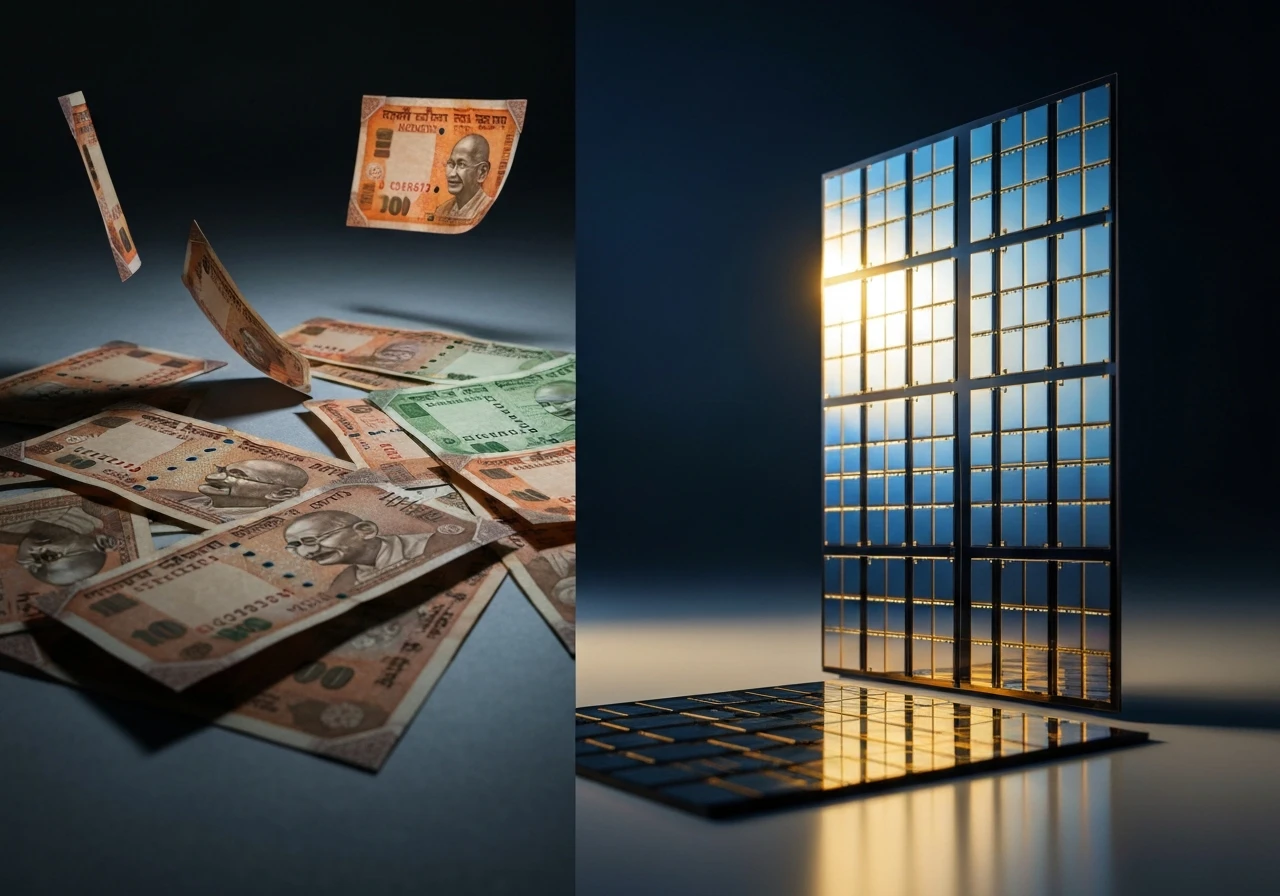
The Rupee and the Crude Bill Did the Pushing
Foreign money chases returns measured in dollars, and 2026 has been brutal for anyone holding rupees. The currency has slid to about 95.5 against the US dollar, down nearly 6% this year and close to 10% over the past twelve months, falling from the mid-80s despite the Reserve Bank of India (RBI) spending reserves to slow the descent.
A weaker rupee eats directly into dollar-denominated returns. “A weaker rupee directly impacts dollar-denominated returns for foreign investors, making it one of the biggest reasons for continued FPI selling,” said Sachin Jasuja, Head of Equities and Founding Partner at Centricity WealthTech.
The currency’s weakness is tied to a second problem: oil. India imports more than 80% of the crude it burns, and Brent prices have climbed from around $70 a barrel to between $95 and $105 amid disruptions around the Strait of Hormuz. Every dollar added to the oil price widens the import bill and the current account deficit, which in turn pressures the rupee, a loop that feeds itself.
Earnings did the rest. Corporate profit growth in India has lagged what investors can find elsewhere, and when a market looks expensive and its currency is sliding, the case for staying thins out fast.
Taiwan and Korea Caught What India Dropped
The capital that left India found a better story two time zones east. South Korea’s Kospi index has surged about 80% in 2026, a pace no other major market has matched, powered by Samsung Electronics and SK Hynix and the high-bandwidth memory (HBM, the stacked DRAM chips that feed AI accelerators) they sell into the boom. Taiwan’s benchmark has run up roughly 40%, with TSMC alone now worth more than 40% of the island’s entire market.
V K Vijayakumar, Chief Investment Strategist at Geojit Investments, put the rotation plainly. “The strong artificial intelligence-led rally in markets such as South Korea and Taiwan has also attracted foreign capital away from India,” he said, listing it alongside weaker domestic earnings as a reason global funds keep trimming Indian exposure.
| Market | 2026 index gain | Market cap | Global rank |
|---|---|---|---|
| Taiwan (Taiex) | ~40% | $4.95 trillion | 5th |
| India (Sensex / Nifty) | broadly flat | $4.92 trillion | 6th |
| South Korea (Kospi) | ~80% | $4.54 trillion | 7th |
The pull is concentrated and obvious: these are pure plays on the one trade global money wants right now. You can follow the run in the Taiwan Stock Exchange weighted index, which recently closed above 44,000 for the first time.
Domestic Buyers Kept the Floor From Falling
Here is the part that explains why Indian indices have not buckled under all this selling: domestic money has been buying almost everything foreigners sell. Mutual funds and retail savers, feeding the market through systematic investment plans (SIPs, fixed monthly contributions into funds), have become the counterweight.
- Rs 1.7 lakh crore: approximate domestic institutional investor (DII) inflows into equities so far in 2026
- Around 90%: share of FPI selling absorbed by domestic buyers
- Rs 32,087 crore: record monthly SIP contribution logged in March
That steady drip changes how the market behaves. SIP money does not flee when prices fall; if anything, the same rupee buys more units, which turns domestic flows into a stabiliser rather than an accelerant. The exchange’s daily FII and DII activity reports show the pattern session after session.
India Slipped to Sixth in the Global Pecking Order
The league-table change is the part that stings. For years India sat comfortably as the world’s fifth-largest equity market, a status that drew passive flows almost automatically. In late May, Taiwan’s total market value rose to $4.95 trillion and edged past India’s $4.92 trillion, knocking the country down to sixth.
Korea, at about $4.54 trillion, now sits seventh, close behind. A year ago that ordering would have looked unlikely. Korea and Taiwan run smaller economies than India, yet their markets are tightly geared to semiconductors, the one sector global investors cannot get enough of.
Rankings are not just vanity. Index weightings, passive fund allocations and benchmark-tracking exchange-traded funds all key off market size, so a slip in the table can quietly redirect future flows away from a country even after the active selling stops.
It is also a concentration bet. TSMC accounts for more than 40% of Taiwan’s market, while Samsung and SK Hynix together make up a record 42.2% of the Kospi, a clustering that J.P. Morgan’s 2026 Asia market outlook flags as both the engine and the risk in the trade.
Why the Selling Eased but Did Not Stop
One number offers a sliver of comfort: the selling is slowing. May’s outflow of nearly Rs 33,000 crore sat well below March’s record and April’s Rs 60,847 crore, a sign that foreign funds are growing less aggressive about cutting their India exposure.
One of the key reasons behind this trend has been the gradual improvement in global risk sentiment. Concerns around global trade tensions, tariff-related developments, and growth uncertainties, while still present, have eased somewhat from the elevated levels seen a few months ago.
That was Himanshu Srivastava, Principal of Manager Research at Morningstar Investment Research India, reading the moderation as steadier nerves rather than renewed appetite for Indian stocks. Jasuja, for his part, doubts a real turnaround arrives until macroeconomic conditions improve in a meaningful way.
If the rupee steadies and oil retreats from its Strait of Hormuz premium, the funds that rotated into Taiwan and Korea have a reason to glance back at cheaper Indian valuations. If crude stays north of $95 and the currency keeps sliding, the 2026 outflow record that already dwarfs last year still has seven months to grow.
Frequently Asked Questions
Why are FPIs selling Indian equities in 2026?
Foreign investors are leaving for three main reasons: a rupee that has weakened close to 10% over the past year, weaker corporate earnings growth in India compared with global peers, and a costly oil import bill as Brent crude trades between $95 and $105. Together they erode dollar returns and make Indian stocks less attractive.
How much have foreign investors withdrawn from India in 2026?
Cumulative FPI outflows reached Rs 2.25 lakh crore through May, roughly $23 billion. That already exceeds the Rs 1.66 lakh crore foreign funds pulled out across all of 2025, with March alone accounting for a record Rs 1.17 lakh crore.
Where is the money going instead of India?
Much of it has rotated into South Korea and Taiwan, where an AI-driven semiconductor rally has lifted the Kospi about 80% and Taiwan’s benchmark roughly 40% this year. Taiwan’s market value has overtaken India’s, making it the world’s fifth-largest equity market.
Why has the Indian market not crashed despite the selling?
Domestic institutional investors, fed by record SIP contributions, have absorbed around 90% of the foreign selling, pumping roughly Rs 1.7 lakh crore into equities in 2026. That steady local buying has cushioned indices and broken the old link between foreign flows and market direction.
Disclaimer: This article is for informational purposes only and does not constitute investment advice. Equity and currency markets carry risk, and capital flows can reverse quickly; readers should consult a qualified financial adviser before making investment decisions. All figures are accurate as of publication.
 Craig Gordon Retires at 43 as Scotland’s Oldest World Cup Player
  Scotland Fans Fill Glasgow Pubs to Cheer Argentina’s Win Over England
  11 Scotland Towns Where Main Streets Are Winning the Long Game
  Ferguson Marine Loses Skilled Trades While Ministers Stall On Ship Deal
  Scotland U20s Drop Six Nations Regular MacArthur for Wales Final
  Scotland’s First Dual Recovery Court Cuts Drug Deaths by Up to 17%