
 Ishan Crawford
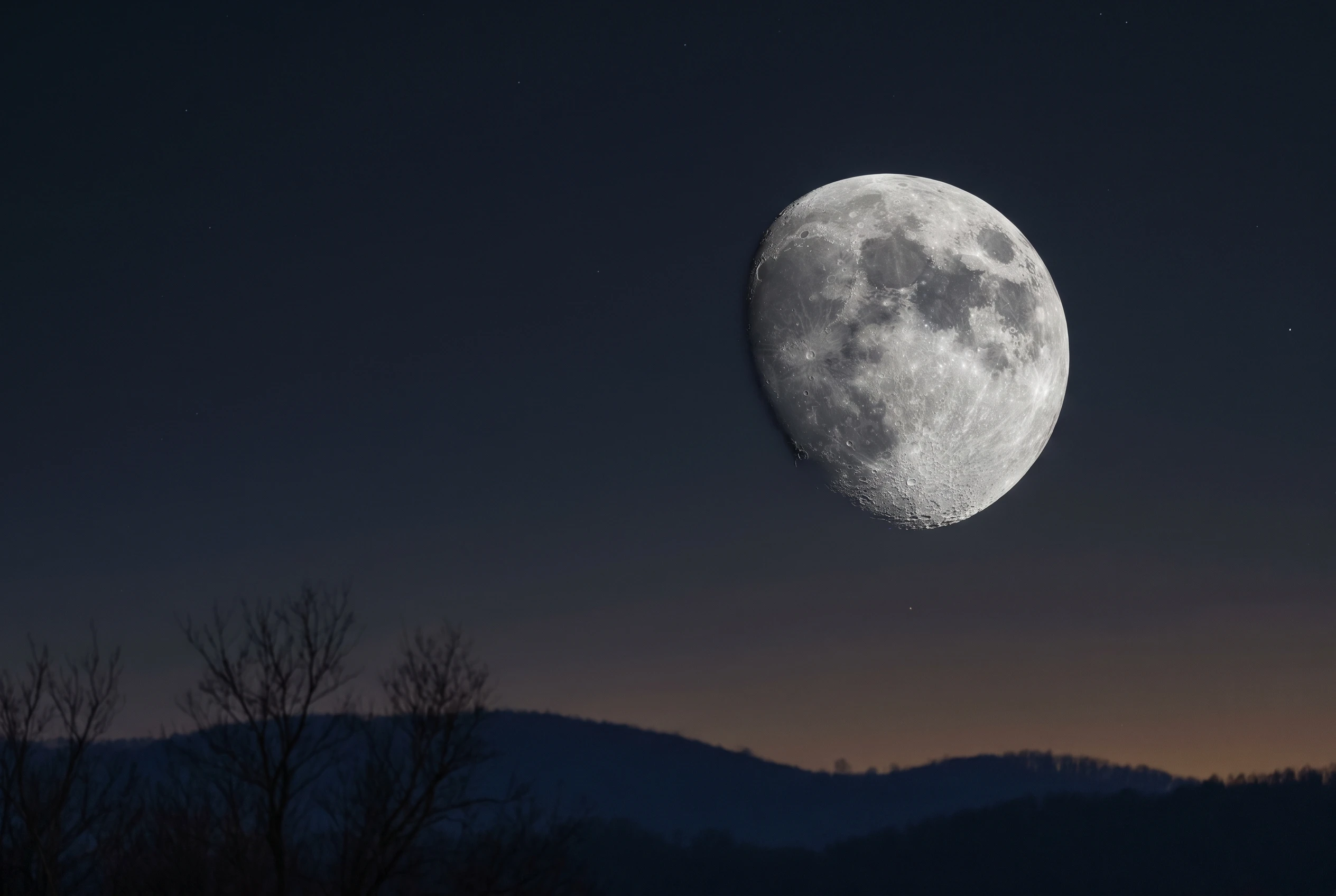
 The moon phase on Friday, May 29, 2026 is a waxing gibbous, roughly 96 percent illuminated and two nights shy of full, according to NASA phase data. It is climbing toward the May 31 Blue Moon, the second full Moon to fall inside a single calendar month, and the night astronomy headlines have circled all week.
Here is what those headlines skip. The Blue Moon will not look blue, it is set to be the smallest and faintest full Moon of the whole year, and the crispest views of craters and mountains are happening right now, on these gibbous evenings, rather than on the date everyone is waiting for.
What the Moon Looks Like Tonight
You do not need a telescope to enjoy a 96 percent Moon. On a clear night it rises in the east not long after sunset and stays up most of the night, bright enough to throw shadows across a garden. With nothing but your eyes you can pick out the large dark plains and a couple of the brighter bright spots that mark fresh impact craters.
What you can spot scales with the gear in your hands. Here is a quick guide to the features on show as the disk approaches full.
| Equipment | Features to Look For |
|---|---|
| Naked eye | Mare Imbrium, the Aristarchus Plateau, and Kepler Crater |
| Binoculars | Posidonius Crater, Archimedes Crater, and Clavius Crater |
| Telescope | The Caucasus Mountains, the Descartes Highlands, and Schiller Crater |
Aristarchus is worth hunting first. It is the brightest large feature on the near side, a young crater whose pale walls almost glow against the darker plain around it. Even from a city balcony, a steady pair of binoculars will pull it out.
Why a Near-Full Moon Hides Its Best Detail
There is a quiet irony in waiting for the full Moon to go cratering. The fuller the disk, the worse it gets for surface detail. At full phase the Sun sits almost directly behind us, so it lights the near side head on and casts almost no shadow back toward Earth.
Shadow is everything. The line between lunar day and night, called the terminator, is where crater rims and mountain peaks throw long dark shadows that reveal their height and shape. On a gibbous night like this one, that terminator still cuts across part of the disk, so the relief along it stands out in sharp three dimensional relief.
Come full Moon, the terminator has slid off the edge entirely and the surface flattens into a bright, glary, almost two dimensional poster. That makes May 31 close to the worst night of the month for studying craters, even as it draws the biggest crowds. If detail is what you want, point your binoculars up tonight or tomorrow, not on the headline date.
The May 31 Blue Moon, and Why It Isn’t Blue
A Blue Moon has nothing to do with color. The common version of the term simply means the second full Moon to land inside one calendar month, which is a quirk of arithmetic rather than astronomy. The Moon completes its cycle in about 29.5 days, slightly shorter than most months, so every two to three years a single month catches two full Moons.
May 2026 is one of those months. The first full Moon, the Flower Moon, rose on May 1. The second arrives on the 31st, which earns it the Blue Moon label and explains the worn old phrase “once in a blue moon” for something that happens rarely. You can read the full calendar definition of a Blue Moon and the rarer seasonal version that gave the name its start.
So why the persistent idea that it turns blue? Genuine blue Moons do happen, but only when the air is choked with smoke or volcanic ash of just the right particle size, scattering red light and leaving the disk looking faintly blue. No eruption, no blue.
If anything, this one may lean the other way. Low on the horizon, where it sits at moonrise, the Moon’s light passes through more atmosphere, which scatters away the blue and can leave the disk glowing orange or coppery. The Blue Moon, in other words, is far likelier to look amber than blue.
A Micromoon Hiding Inside the Blue Moon
The detail that genuinely sets this full Moon apart is one most coverage buries. It is a micromoon, the mirror image of a supermoon, because it falls when the Moon is near apogee, the most distant point of its slightly oval orbit. That makes it the most remote full Moon of the year, and therefore the smallest and faintest.
- 406,366 km the Moon’s distance near apogee on June 1, the farthest full Moon of 2026.
- About 6 percent smaller in apparent width than an average full Moon.
- Roughly 10 percent dimmer than a full Moon seen at its average distance of 384,400 km.
That is the exact opposite of what Scotland saw at the start of the year, when January’s Wolf supermoon lit up Scottish skies at a close, swollen perigee. A supermoon looms large and bright; this micromoon does the reverse.
Will you actually notice it shrink? Honestly, no. A 6 percent difference in width is far too subtle to catch with the eye when there is no full Moon hanging beside it for comparison. The label is a fact about geometry, not about what your eyes will register at moonrise.
The Eight Phases Behind the Cycle
Tonight’s waxing gibbous is one stop on a loop the Moon repeats roughly every 29.5 days. The same hemisphere always faces us because the Moon is tidally locked to Earth, spinning once on its axis for every orbit it completes, a behaviour NASA calls synchronous rotation. What changes night to night is how much of that near side the Sun lights up.
That sweep produces eight named phases in a fixed order, laid out in NASA’s guide to the lunar phases:
- New Moon the Moon sits between Earth and the Sun, so the lit side faces away and it is invisible.
- Waxing Crescent a thin sliver of light appears on the right in the Northern Hemisphere.
- First Quarter the right half is lit, looking like a half Moon.
- Waxing Gibbous more than half is lit but not yet full, where the Moon sits on May 29.
- Full Moon the entire near side is illuminated.
- Waning Gibbous light starts retreating from the right edge.
- Third Quarter the left half is lit, the other half Moon.
- Waning Crescent a last sliver lingers on the left before the cycle resets.
This current run began earlier in the month, when the slim waxing crescent of May 19 opened the climb toward the Blue Moon. A slight wobble called libration, caused by the Moon’s uneven orbital speed, lets careful observers peek a little way around its eastern and western edges over a month.
How to Catch It This Weekend
The plan is simple. On any clear evening through Sunday, look low to the east shortly after sunset and the Moon will already be up, brightening as the sky darkens. No filter, no app, and no special timing are needed for a casual look.
The full phase peaks at 08:45 UTC on May 31, which is the small hours of the morning across the Americas and breakfast time in the UK, so the best viewing for most people is the evening of the 30th or the 31st when the Moon is high and easy to find. For anyone clouded out, the Virtual Telescope Project runs a live online feed of the Blue Micromoon. The next monthly Blue Moon will not come around again until 2028, so this is the last calendar two-fer for a while.
Catch it at moonrise, though, and the geometry stops mattering. As that amber disk lifts over the eastern horizon, no one squinting up at it will be measuring six percent or counting full Moons; they will just be watching the biggest light in the night sky climb.
Frequently Asked Questions
What Moon Phase Is It on May 29, 2026?
The Moon is a waxing gibbous, roughly 96 percent illuminated and two nights from full. It rises in the east soon after sunset and is visible most of the night, with the disk growing brighter each evening toward the May 31 full Moon.
Is the May 31 Blue Moon Actually Blue?
No. The Blue Moon name refers to the second full Moon in a single calendar month, not to any color. A genuinely blue tinted Moon only happens when fine smoke or volcanic ash scatters red light, which is not the case this month. Near the horizon it is more likely to look orange.
Why Is the May 2026 Blue Moon Called a Micromoon?
Because it falls near apogee, the farthest point in the Moon’s elliptical orbit, at about 406,366 km. That makes it the most distant, smallest and faintest full Moon of 2026, roughly 6 percent narrower and 10 percent dimmer than an average full Moon.
What Time Is the May 31, 2026 Full Moon?
The Moon reaches full phase at 08:45 UTC on Sunday, May 31, which is 4:45 a.m. EDT. For most observers the best practical viewing is the evening before or after, when the Moon is high in the sky and easy to spot.
When Is the Next Blue Moon After May 2026?
The next monthly Blue Moon, meaning a second full Moon in one calendar month, is not due until 2028. These events occur only once every two to three years because the lunar cycle of about 29.5 days is slightly shorter than most months.
What Can I See on the Moon Without a Telescope Tonight?
With the naked eye you can pick out the dark plain of Mare Imbrium, the bright Aristarchus Plateau, and Kepler Crater. A steady pair of binoculars adds Posidonius, Archimedes and Clavius craters. Detail shows best along the shadowed terminator, which is sharper now than at full Moon.
 Windows 11 KB5095093 Lands With Point-in-Time Restore and 35-Day Pause
  Meta Cuts Smart Glasses to $299 to Outflank Snap and Apple
  Messi Leads the 2026 World Cup Golden Boot Race After Two Matches
  Australia March On as Athapaththu Ton Lights Up T20 World Cup
  Galaxy Z Fold 8 Leak Reveals Colors, Storage, and a New Ultra Variant
  Ronaldo’s Six-World-Cup Record Leads a Matchday Full of Milestones