
 Ishan Crawford
 Scientists working with the Ocean Census project logged 1,121 new marine species in a single year, the largest annual haul in the mission’s short life and a 54 percent jump over its previous rate. The catalogue runs from a deep-sea ghost shark off Australia to a symbiotic worm tucked into a volcanic seamount near Japan, recorded across 13 expeditions to some of the planet’s least-mapped waters.
Strip away the charismatic creatures, though, and a far less photogenic figure carries the announcement. The gap between finding a marine species and formally naming it has averaged 13.5 years, long enough that some vanish before the paperwork ever clears.
A Ghost Shark, a Death-Ball Sponge and More
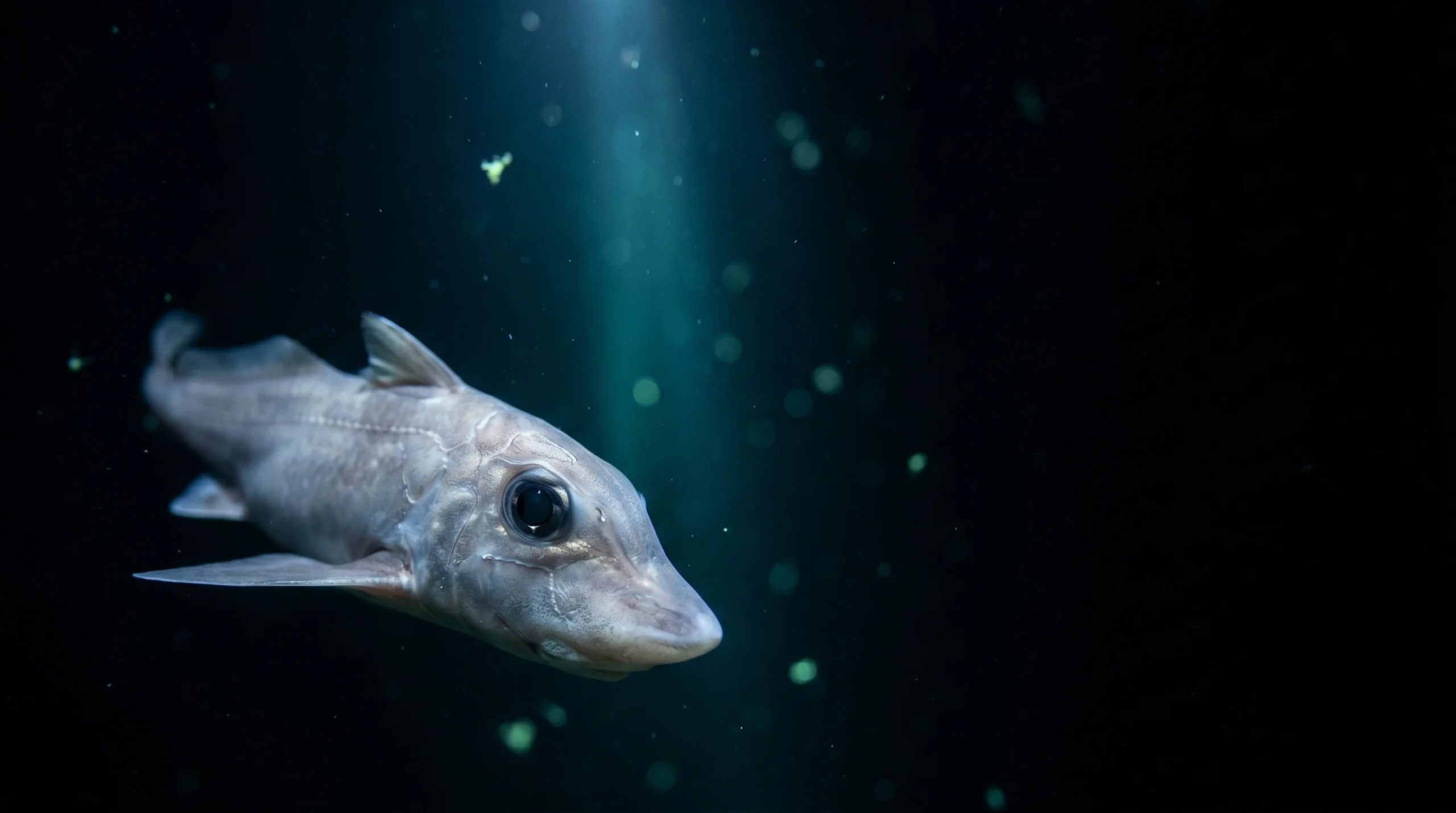
The year-three results, published in mid-May, read like a field guide to the unfamiliar. Taxonomist Dr. William White identified a new species of deep-sea ghost shark, a cartilaginous relative of sharks and rays, hauled from between 802 and 838 metres in the Coral Sea. Dr. Nato Jimi described a bristle worm living symbiotically on a seamount off Japan, while teams logged corals, crabs, shrimps, sea urchins, anemones and a carnivorous “death-ball” sponge among the haul.
The fieldwork itself was unusually broad. Ocean Census ran the expeditions in partnership with JAMSTEC (the Japan Agency for Marine-Earth Science and Technology), CSIRO (Australia’s national science agency, the Commonwealth Scientific and Industrial Research Organisation) and the Schmidt Ocean Institute, reaching a maximum depth of 6,575 metres.
Geography mattered as much as depth. Several finds came from shallow, accessible water that simply had not been surveyed with this kind of coordinated attention before.
| Species | Where it was found | Depth |
|---|---|---|
| Ghost shark (Chimaera sp.) | Coral Sea, Australia | 802 to 838 m |
| Symbiotic worm (Dalhousiella yabukii) | Shichiyo Seamount, Japan | 791 m |
| Ribbon worm | Timor-Leste | 1 to 5 m |
| Mediterranean shrimp | Marseille, France | 15 to 35 m |
You can browse the full set in the landmark Ocean Census year-three results, which lists discoveries by region and depth.
The 13.5-Year Wait Behind Every New Name
Finding a creature and naming it are two very different jobs. A species counts as formally “described” only after a taxonomist publishes a written diagnosis, assigns a valid scientific name and deposits a holotype, the reference specimen, in a recognised institutional collection. That process is slow, unglamorous and chronically underfunded.
The slowness is structural. The world has a shrinking pool of specialist taxonomists qualified to describe each group of animals, a shortage researchers have long called the taxonomic impediment. Even for well-studied groups the lag is steep; one analysis of frogs named between 2000 and 2023 found a median of 7.3 years from first specimen to publication, with some descriptions taking over a century.
That backlog is the quiet constraint on every discovery headline.
- 13.5 years is the historical average between a marine species being found and being formally described.
- Thousands of specimens sit in scientific limbo because the rate of collection has outpaced the rate of naming.
- The bottleneck is people and funding, not technology; there are simply too few trained describers, as research on species-description timelines documents.
How a ‘Discovered’ Status Skips the Queue
This is where the count gets less interesting than the workflow. Ocean Census and its collaborators are now recognising “discovered” as a formal scientific status in its own right, recorded immediately rather than years later. A species earns the label once it is logged with images, location, depth and taxonomic notes, well before the published description and holotype that confer “described” status.
The recording happens on the open-access Ocean Census NOVA platform, which the project says can publish a find within weeks or even days.
- Discovered: logged with evidence and metadata on NOVA, citable as a known find from day one.
- Described: the traditional milestone, requiring a published diagnosis, a valid name and a deposited holotype.
- Open by default: any scientist in the network can submit a find directly, rather than waiting on a single journal pipeline.
Naming Species Before They Vanish
The urgency is not rhetorical. Up to 90 percent of ocean species are still undiscovered, and the ones turning up now are increasingly under pressure from warming, acidification and habitat loss.
Peer-reviewed work has put a sharp point on the stakes. A conservation study found that undescribed species carry a higher extinction risk than ones already on the books, partly because anything without a name is invisible to the protections that depend on naming it. The same literature shows the share of threatened species among newly described animals climbing from under 12 percent in the eighteenth century to roughly 30 percent in the last decade.
Conservation managers feel that lag elsewhere too. In Scotland, a University of St Andrews team documented a 20 percent decline in west-coast harbour seals between 2018 and 2023, a reminder that even well-named, well-watched species can slip while the data catches up.
With many species at risk of disappearing before they are even documented, we are in a race against time to understand and protect ocean life.
That was Dr. Michelle Taylor, Head of Science at Ocean Census, framing the year’s results not as a trophy cabinet but as a deadline.
The $100 Million Bet on Faster Discovery
Speed costs money, and Ocean Census is open about the bill. The mission, founded by The Nippon Foundation and the marine research group Nekton, is seeking $100 million in catalytic capital to scale its work, against more than $75 million already pledged by partners. Its network now spans over 1,400 taxonomists drawn from 660 institutions across 85 countries.
Director Oliver Steeds argues the spending is modest against the alternative ledger of exploration budgets.
“We spend billions searching for life on Mars or going to the dark side of the moon,” Steeds said in the project’s announcement, carried by the UN Ocean Decade partner network. “Discovering the majority of life on our own planet, in our own ocean, costs a fraction of that.”
What the Census Still Cannot Catalogue
The new status does not erase the old one. A find logged on NOVA still needs the slow, formal description to count fully in the scientific record, and the shortage of taxonomists who do that work has not gone away. Faster discovery without faster naming just shifts the bottleneck downstream.
So the headline figure and the constraint figure belong in the same sentence: 1,121 finds in a year against a 13.5-year wait the project is trying to outrun, and the next count will show whether the funding keeps pace with the catalogue.
 ONGC licence frees Venezuela cash and operatorship talks
  Anthropic Hits $65 Billion Run Rate and Flips the AI Cash Test
  Supreme Court grounds the fare free-for-all with three-week clock
  Gold Nears $4400 as Soft Data Meets Oil Inflation Risk
  Nifty Slips as Zaggle Circuits and Dhoot Debuts Big
  Diesel Crack Tops $100 as Iran Rhetoric Lifts Crude