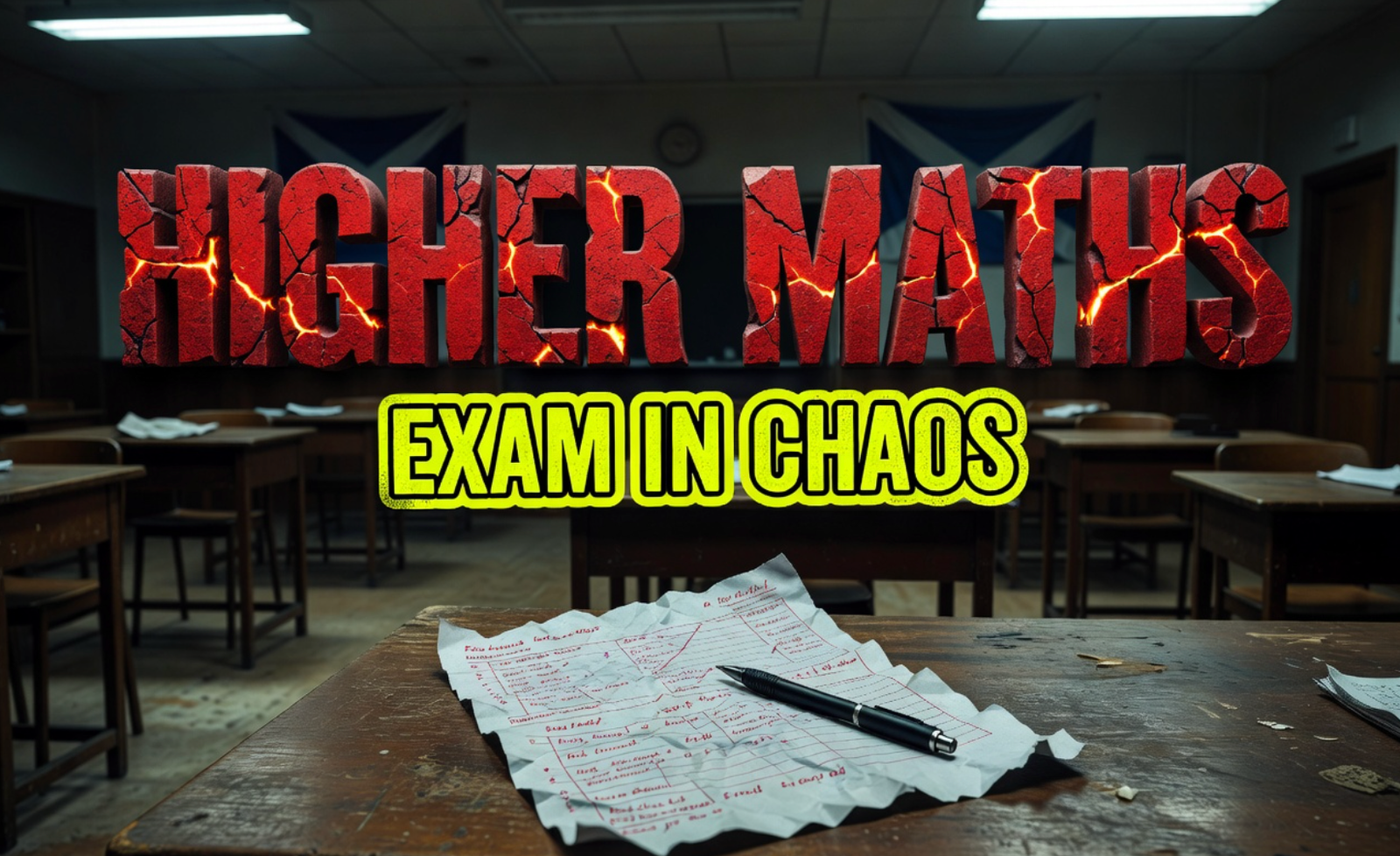
Thousands of Scottish students walked out of their Higher Maths exam in tears this week, saying the paper felt nothing like anything they had prepared for. More than 11,000 people have now signed a petition demanding a full review, shining a harsh light on Qualifications Scotland, the brand-new exam body created just months ago to replace the discredited SQA.
What Went Wrong With the 2026 Higher Maths Paper
The Higher Maths exam was sat on May 7, 2026, with around 20,000 pupils across Scotland taking the two-paper test.
The heart of the complaint is not simply that the paper was hard. The petition is careful to make that distinction clear. Students say the 2026 Higher Maths Paper 1 was “poorly worded, inconsistently structured, and out of step with every previous paper” they had used to prepare.
A key issue raised across the board involves what are known as “command words.” These are the specific terms used in a question to tell students exactly how they should answer. Pupils say the command words used in this paper were different from what they had been taught throughout their course, leaving many unsure of what was being asked even when they knew the underlying maths.
One widely flagged example is question 11. Students say they were asked about a “linear factor” when they had always been taught to look for “real roots.” Same concept. Different language. Under timed exam conditions, that distinction can cost precious marks.
The petition puts it plainly: “When a paper’s wording is inconsistent with established standards, it does not test mathematical ability. It tests whether a student can interpret unusual language under exam pressure. That is not a fair assessment.”
Pupils Speak Out: “It Could Change My Future”
The human cost behind this story is impossible to ignore.
An S5 pupil from Aberdeen, who hopes to study medicine, told the BBC she had done four years of past papers and earned an A in her prelim. She went into the exam feeling confident.
“I thought I was really prepared, and had the impression that I was over-prepared but it was so different to what I’d done before.” She is now seriously worried about her chances of getting into medical school if her final grade suffers.
The stress from Paper 1 did not stay in the exam room. She walked into Paper 2 an hour later still rattled from the first paper. “I scraped a finish in the second paper. I felt like I was running out of time because I was so stressed. I think it affected my performance.”
An S5 pupil from South Lanarkshire had hoped to keep his straight-A streak and pursue electrical engineering or law. He described the scene when Paper 1 ended.
“There were people in tears coming out that paper.”
He felt Paper 2 offered no relief either. “It was as if both papers were constructed in a way that was preventing people from getting top marks.” Ben, a student in Perth and Kinross, captured the core issue precisely: “For many students, the problem was not knowing what the question was actually asking or which method was intended, despite understanding the mathematical content itself.”
What the Petition Is Demanding
The petition has collected over 11,000 signatures within days of the exam sitting. It is not asking for results to be scrapped. It is asking for accountability and fairness.
Here is what it formally calls on Qualifications Scotland to do:
- Conduct a full independent review of the 2026 Higher Maths Paper 1
- Explain why the paper differed so significantly from every previous paper
- Make transparent grade boundary adjustments to account for the confusion caused by non-standard wording
- Issue a public statement acknowledging student concerns
- Provide assurances that future papers will be reviewed for clarity before students sit them
Higher Maths is not a minor subject. It is a gateway qualification for entry to university courses in STEM, medicine, finance and law. For S5 students, one grade in this exam can open or close an entire career path.
Qualifications Scotland and Teachers Respond
Qualifications Scotland issued a statement defending the exam. The body said all papers are checked before publication to ensure they are “clear, fair and suitable.” It also confirmed that it monitors social media reactions to exams and that quality assurance measures are in place both before and after papers are sat.
The EIS, Scotland’s largest teaching union, contacted its maths teachers network for early feedback. The initial response from teachers was that the exam was fair. However, many teachers had yet to formally weigh in at the time of reporting.
There is a clear divide forming between the institutions and the students on the ground.
The timing could not be more loaded for Qualifications Scotland. The body was formally established under the Education (Scotland) Act 2025 and replaced the SQA on February 1, 2026. The SQA was disbanded after years of scandal: first for downgrading 124,000 pupil results during the COVID pandemic in 2020, and then for its handling of the 2024 Higher History exam. The stated mission of the new body was to “win back trust.” An 11,000-signature petition in its very first exam season is a difficult way to begin.
What Could Happen Next for Students
Students may not have to wait long for some indication of action.
Within roughly a week of an exam sitting, staff at Qualifications Scotland typically begin reviewing how the paper was received across the country. If a question or a set of questions is found to have tripped up the vast majority of pupils, those marks can be removed from the overall score. Alternatively, the pass mark itself can be lowered.
This has happened before. Back in 2015, after a near-identical uproar over the Higher Maths paper, the pass threshold for a grade C was dropped as low as 34%.
The formal decisions on grade boundaries happen during the “awarding stage,” when examiners review the full spread of results and set the cut-off points for grades A through C. That process runs in the weeks following marking.
“You can’t do this to people. It needs to be fair. What was done just wasn’t fair.”
S5 pupil, South Lanarkshire
Results day is set for August 4, 2026. Between now and then, Qualifications Scotland faces its most important early test: whether it will live up to the promise of being a more open and responsive body than the one it replaced, or whether thousands of students who worked hard in good faith will face the consequences of a paper they say was never designed to let them show what they know. Every signature on that petition represents a young person whose future hangs in the balance, and they deserve more than a dismissal.
What are your thoughts on how Scotland’s exam system has handled this situation? Share your views in the comments below.


