
BUSINESS
Gold Falls as Hormuz Fighting Feeds Rate-Hike Bets
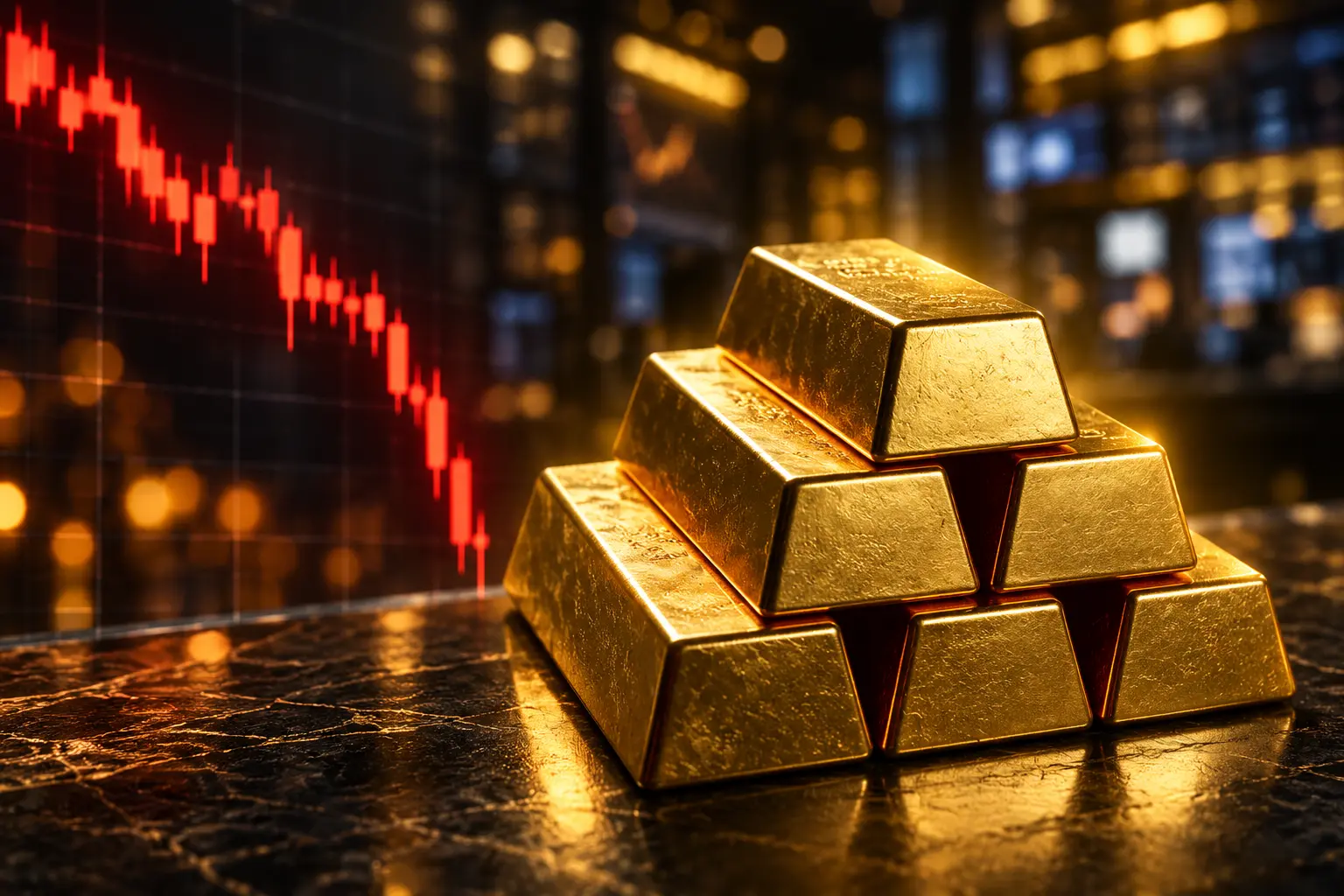
Gold futures fell to $4,353.10 as Hormuz strikes lifted oil, yields and a 67% chance of a September Fed hike, even after August’s Treasury-led rally.

COMEX gold futures fell to $4,353.10 an ounce on Wednesday, down 0.98% after an intraday low of $4,350.10, as U.S. and Iranian forces traded fresh strikes around the Strait of Hormuz. Silver futures dropped 1.80% to $64.19.
Bullion usually catches a bid when missiles fly. This week the same fighting has lifted oil, the dollar and bets that Federal Reserve Chair Kevin Warsh will raise rates at the Sept. 15-16 meeting, and that mix is knocking the metal down.
Gold Keeps Falling as Hormuz Fighting Returns
Spot gold had already slipped 0.4% to $4,431.55 on Monday, with futures at $4,480.00, after the first U.S.-Iran fire in more than a month. By Tuesday, spot was down about 2% to $4,368.58. Wednesday’s futures print extended that slide.
The U.S. military told reporters it struck two Iranian rocket launchers on Larak Island on Sunday, saying the weapons were being readied to fire sea mines into the strait. Iran answered with missiles aimed at U.S. forces in Jordan and the United Arab Emirates, the first major exchange since July 29.
Jordan’s armed forces said they shot down eight missiles that entered its airspace that night. The UAE said it intercepted drones over its waters and denied a hit on al-Minhad Air Base. Fighting did not stop there. U.S. Central Command said it hit more Iranian military sites after attempted attacks on shipping and U.S. troops, and Tehran claimed strikes on American interests in Jordan, Bahrain, Kuwait and Iraq on Wednesday.
The war is now in its seventh month. U.S. and Israeli attacks in late February killed Iran’s supreme leader, Ayatollah Ali Khamenei, and the strait has been a chokepoint for oil ever since, with Tehran restricting traffic and Washington running a counter-blockade of Iranian ports. Brent crude was up 0.7% at $95.34 a barrel on Wednesday.
THE WEEK THAT TURNED THE TAPE
- August 19, 2026: Treasury says it will at least double long-end buybacks, from $2 billion to at least $4 billion per operation, from Sept. 9 through Nov. 4.
- August 28, 2026: Warsh, in his first Jackson Hole keynote as chair, says inflation has not improved enough and that the Fed will have work to do if it does not.
- August 30, 2026: U.S. forces hit two Iranian rocket launchers on Larak Island; Iran fires at U.S. sites in Jordan and the UAE.
- September 2, 2026: COMEX gold prints $4,353.10 as more strikes land and traders price a 67% chance of a 25-basis-point hike on Sept. 16.
Tony Sycamore, senior market analyst at IG, said the drop from last week’s high near $4,697 to Monday’s low around $4,397, a $300 slide, came from Warsh’s speech plus the return of Hormuz risk, which pushed yields up and left gold exposed into the next Fed meeting.
Warsh Put Inflation Back in Front
Warsh, who took the chair in May after Jerome Powell’s term ended, used Friday’s Jackson Hole meeting to close a gap he had left at his first press conferences. He said the Fed’s 12-month inflation goal, measured by the personal consumption expenditures price index, is “firm” and “fixed,” and that prices, not the labor market, should lead the next decision.
Here is my standard: We must be confident that underlying inflation is moving to our objective, clearly and at sufficient speed. Otherwise, we have work to do. That’s our job… our mandate… and our charge to keep
Kevin Warsh, Federal Reserve chair, Jackson Hole keynote
He also said the Fed would have work to do unless that test is met, and that “the Fed’s predominant focus right now should be on prices.” July PCE inflation was 3.7% over 12 months and 4.1% at a six-month rate. Recent readings, he said, “do not tell me that underlying trends have meaningfully improved.”
WHAT WARSH SAID HE IS WATCHING
- The PCE print: The 12-month index at 3.7% and the six-month pace at 4.1% in July, both well above the 2% goal.
- The basket: About half the items in PCE still rising at more than a 3% annual rate, below the pandemic peak but above the old norm.
- The funds rate: Unchanged in a 3.50% to 3.75% band since December, with “few signs of policy restraint” in credit and loan markets.
- The July vote: Three policymakers dissented from the hold at the July 28-29 meeting, so a hike already had a constituency inside the room.
Priya Misra at JPMorgan Asset Management called the speech hawkish and said Warsh was making a forceful case for price stability. Former Philadelphia Fed President Patrick Harker put it more bluntly: after almost six years above target, “you can’t keep saying this is our job” and then not act. Markets moved. CME FedWatch odds of a 25-basis-point increase next month jumped from about 40% before the speech to about 60% after it, and by Wednesday those odds were 67%, up from 39.6% a week earlier.
Deutsche Bank is still penciling in two 25-basis-point increases, one in September and one in December. Warsh did not give a date. He said the remarks were not forward guidance. He also said the Fed needs market signals “as unfiltered as possible,” a line that sat poorly next to the Treasury’s own buying in the long bond.
The August Rally Was a Treasury Trade
Gold still booked nearly 10% in August, its strongest month since January, and it is up about 65% through 2025 as investors hedged deficits and a weaker dollar. That summer spike did not start at the Fed. It started at the Treasury.
On Aug. 19 the department said it was raising liquidity-support buybacks of 10- to 20-year and 20- to 30-year notes from a $2 billion cap to at least $4 billion per operation, from Sept. 9 through Nov. 4. It framed the step as extra support in sectors that already draw strong offers, and said it would revisit sizes at the Nov. 4 quarterly refunding.
The 30-year yield had just printed a 19-year high of 5.34%. After the notice it fell to 5.184%, and the 10-year yielded 4.647%. The dollar softened. Gold ran toward $4,697, and at one point New York futures tagged $4,723.30, the highest since mid-May. Carolin Schulze Manthey at ING wrote that the buybacks refocused the market on government borrowing and currency worry, which is why bullion kept rising after the yield dip faded.
Julius Baer made the same point: more official buying of long bonds caps yields, trims the dollar’s extra return, and pulls money back into assets that do not depend on Washington’s credit. That is the debasement trade in plain terms. It is also why a hawkish Fed chair and a Treasury that is buying its own long bonds can yank gold in opposite directions in the same fortnight.
Why Gold Sold Off During the Strikes
Haven demand is not missing because no one noticed the war. It is losing to the rate channel. Higher crude feeds inflation, and inflation is the case Warsh just rebuilt for a hike. Gold pays no interest, so a higher path for the funds rate raises the cost of holding it against bills and notes.
The dollar has helped the sellers. The U.S. Dollar Index was at 99.55 on Monday and near a two-week high of 99.67 on Wednesday, making dollar-priced metal more expensive for buyers abroad. The 10-year yield was around 4.80% on Wednesday. Gold also slipped back under its 200-day moving average near $4,526, a technical break that invites more short-term selling.
WHAT THE TAPE WAS PRICING BY WEDNESDAY
| Marker | Latest reading | Pull on gold |
|---|---|---|
| COMEX gold | $4,353.10 an ounce, down 0.98% | Price already giving back August’s spike |
| CME FedWatch, Sept. 16 | 67% chance of a 25bp hike, up from 39.6% a week earlier | Higher odds, heavier opportunity cost |
| U.S. 10-year yield | Around 4.80% | Notes paying more against a metal that pays none |
| Dollar index | 99.67, a two-week high | Stronger dollar, weaker overseas bid |
| Brent crude | $95.34, up 0.7% | Oil up, inflation case for a hike up with it |
On Monday, silver and platinum still diverged a little, with XAG/USD up 0.1% at $66.59 and platinum up 0.8% at $1,810.90 while gold fell. By Wednesday silver had joined the drop. The split did not last once yields and the dollar kept climbing.
That is the twist in this tape. A closed strait and a six-month war would, in an older playbook, be a gold story. This week they are an oil-and-Fed story, and bullion is trading like a rate asset that happens to be sitting next to a war.
Five Straight Weeks of Fund Buying
The selling is concentrated in the futures screen. Fund demand has not flipped with it. Gold-backed ETFs had already put together five straight weeks of net inflows, including their largest one-day take since September 2025, before this week’s air strikes.
World Gold Council figures show July’s $3 billion of net inflows after two months of redemptions, adding 23 tonnes and lifting assets under management 1% to $530 billion. Collective holdings rose to 4,068 tonnes, still short of the 4,176-tonne peak on Feb. 27. Krishan Gopaul, a senior EMEA analyst at the Council, then logged nearly 47 tonnes of weekly inflows, about $6 billion, in the week to Aug. 21, the strongest week since mid-October 2025, with North America leading and every region positive.
FUND DEMAND STILL ON THE BUY SIDE
- July rebuild: $3 billion and 23 tonnes after two months of outflows, AUM at $530 billion.
- Mid-August week: Nearly 47 tonnes, about $6 billion, the strongest week in 10 months.
- Streak: Five straight weeks of net inflows, with one session the largest since September 2025.
- Gap to the peak: Holdings at 4,068 tonnes, 108 tonnes below the Feb. 27 record of 4,176 tonnes.
Central banks added 289 tonnes in the second quarter, the strongest second quarter in the Council’s series since 2010. That official bid does not set the daily price, but it does mean the people who buy gold as a reserve were not the ones dumping it into Warsh’s speech.
Futures can still run ahead of the metal in vaults. Paper selling is a familiar way to knock an August spike down before physical holders move. The open question is whether those fund inflows reverse now that gold is under the 200-day average, or whether the same buyers treat $4,353.10 as the first decent entry since the Treasury notice.
The Debasement Trade Has Not Been Called Off
A large share of the argument around this selloff is that Warsh is talking for the bond market and will not raise the 3.50% to 3.75% band on Sept. 16. Peter Schiff, the Euro Pacific chief economist, wrote that traders are “once again being fooled by the Kevin Warsh show,” and that the chair’s hard line has lifted hike odds the Fed “likely has no intention of delivering.”
Robin Brooks, a senior fellow at the Brookings Institution, took a colder version of the same bet. If the Fed hikes in September, he wrote, it will be to pin down long-term yields, “though obviously that won’t be the stated reason,” and gold will keep rising because yield caps against rising debts are “the bread and butter of the debasement trade.”
That view fits the August tape, when extra Treasury buying of the long end did more for bullion than any Fed hint. It sits poorly next to Wednesday’s screen, where a 67% hike probability, a 4.80% 10-year and $95 oil are winning. Warsh was picked by President Donald Trump and has been pressed to look independent; a hold after last Friday’s warning would reopen the charge that the chair will not fight prices. A hike would test whether the debasement bid, which survived a 65% year in 2025, can live with tighter money.
Friday’s August payrolls report is the last big jobs print before that meeting. Strong hiring would make a hold harder to defend. Soft hiring would give the bluff camp its opening. Buybacks at the new size do not start until Sept. 9, so the Treasury’s extra bid is still a calendar date, not a flow the market has in hand.
WHAT WE KNOW
- The price: COMEX gold at $4,353.10 on Wednesday, down from a recent high near $4,697.
- The odds: 67% chance of a 25-basis-point hike on Sept. 16, up from 39.6% a week earlier on the CME FedWatch tool.
- The war: U.S. strikes on two Larak Island launchers on Sunday, with further exchanges into Wednesday.
- The buybacks: Caps rise to at least $4 billion per long-end operation from Sept. 9 through Nov. 4.
WHAT IS UNCONFIRMED
- The hike: Warsh has not committed to September, and one more inflation report plus Friday’s jobs print still sit on the calendar.
- The haven bid: Whether Hormuz starts to support gold again if oil’s inflation hit is overtaken by outright flight from risk.
- The funds: Whether five weeks of ETF inflows reverse once the 200-day average has been lost.
Until one of those three breaks, gold is trading the rate path, not the strait. The metal that rallied on Treasury buying is now being sold on a war that makes that buying look more necessary, and more inflationary, at the same time.
Disclaimer: This article is news reporting and market analysis for information only. It is not investment advice, a recommendation to buy or sell gold, silver, oil, bonds or any other asset, and it is not a forecast of Federal Reserve policy. Readers should consult a licensed financial adviser or commodities specialist who can judge their own holdings, time horizon and risk before acting. Prices, yields, CME FedWatch odds and the military situation are those published as of 2 September 2026 and can change with the next print, the next strike or the Sept. 15-16 decision.

The BMW iX4 Undercuts Mercedes and Trails Its Twin

Scotland’s Ten Big Supermarkets Already Hold the Weekly Shop

Scotland EMS Faces a State Probe After a Wagram Death

Meritz Signs Ripple to Race Korea’s 2027 Token Rules

Pocognoli’s First Camp Leaves Scotland Third and Exposed

Volkswagen Sells the Osnabruck Plant to Clear a Board Fight

Saksham Gaur Finds He Is His Own Company’s Client

Tata Motors’ Iveco Tender Opens as Holders Still Decide

Onimusha Way of the Sword Preload Hits a Windows 11 Wall

Apple’s Foldable iPhone Hinges on Samsung Display Supply
-
 AUTO2 months ago
Volkswagen Sells the Osnabruck Plant to Clear a Board Fight
-
 AUTO2 months ago
Tata Motors’ Iveco Tender Opens as Holders Still Decide
-
 BUSINESS2 months ago
Saksham Gaur Finds He Is His Own Company’s Client
-
 GAMING2 months ago
Onimusha Way of the Sword Preload Hits a Windows 11 Wall
-
 NEWS2 months ago
Apple’s Foldable iPhone Hinges on Samsung Display Supply
-

 ENTERTAINMENT3 years ago
What is SD on Amazon Prime? – All You Need to Know
-

 AUTO2 months ago
Simple Wave Chases Range as Ather Konarc Cuts Price
-

 NEWS2 months ago
iQOO 16 Locks 8,400 mAh While 100W Charging Holds