
 Ishan Crawford
 An X account that fell silent on the day Scotland voted on independence in September 2014 came roaring back to life this weekend, cracking a joke about £1.5 million in “missing” campaign cash. Its former boss says he had no idea it still existed.
Solicitor Aamer Anwar, who represents former Yes Scotland chief executive Blair Jenkins, says the post went out without Jenkins’ knowledge or approval. As far as Jenkins was concerned, the account had been closed for twelve years. Nobody involved has yet explained who actually still holds the login.
An Account Silent Since Referendum Day Speaks Again
The post landed on X at 9.05pm on Saturday, from the handle that once promoted the official campaign for a Yes vote in 2014. It read:
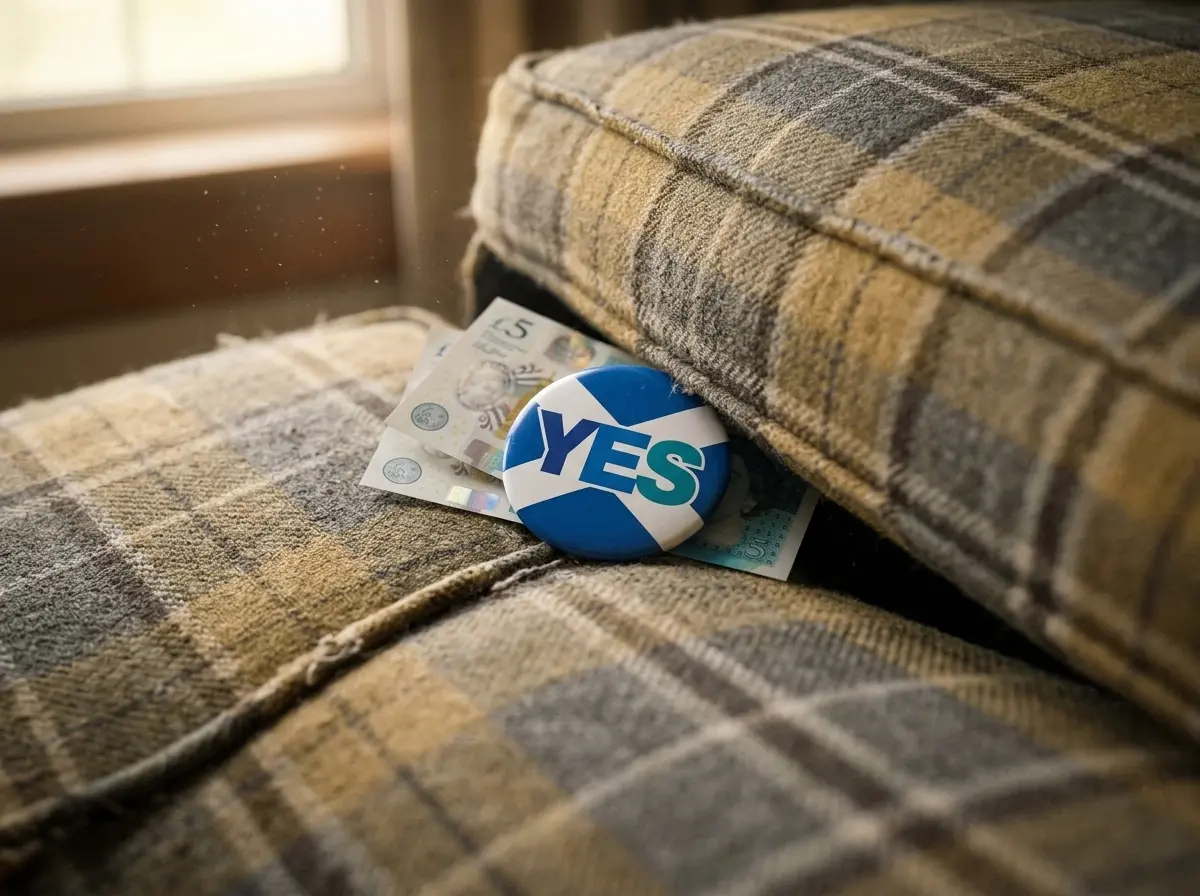
It’s been a while. Some would say a generation or so ago. Woken up excited to hear that there is £1.5M missing. Must have been in the sofa given to a recycling charity after the referendum. Reward of two ‘Yes’ mugs to anyone with info leading to its recovery. DMs are open.
It was the account’s first post since polling day itself, according to reporting on the row. Blair Jenkins’ lawyer moved quickly to distance his client from it.
“Mr Jenkins has been made aware of a message posted from the official Yes Scotland account on X, which seems to make light of recent allegations that £1.5 million is ‘missing’ from the organisation’s accounts,” Anwar said in a statement. “As far as Mr Jenkins was concerned, the Yes Scotland social media account was closed some 12 years ago. The message was posted without the knowledge or approval of Mr Jenkins.”
Anwar added that “the false allegations of ‘missing money’ have caused extreme anger and distress for Mr Jenkins and his family over the last two weeks,” and made clear his client “does not regard such allegations as a laughing matter.”
Two Campaigners Reopen an Old Ledger
Sean Clerkin and David Henry are no strangers to SNP finance rows. Clerkin’s complaints originally set off Operation Branchform, the Police Scotland investigation that ended this summer with Peter Murrell’s conviction. Last week the pair took a fresh complaint to detectives, this time about Yes Scotland’s books.
Speaking outside Fettes police station in Edinburgh, the two men said senior officers had told them it would take two to four weeks just to assess the material before deciding whether to open a formal inquiry.
Clerkin said Murrell “had very close control over all the donations that were coming into Yes Scotland.” Henry has separately asked why the SNP transferred £825,000 into Yes Scotland’s accounts in 2015, and why a multimillion pound donation from a lottery winning couple proved so hard to trace in the group’s public filings.
So Is Any Yes Scotland Money Actually Missing?
No, according to the lawyer for the group’s former chief executive. Aamer Anwar says Yes Scotland’s 2012 to 2013 accounts show income of £2,403,976 against a balance sheet surplus of £878,978, which works out to roughly £1.5 million in ordinary operating costs. He calls that spending, not theft. A separate explanation from another figure in the row blames a prior year accounting adjustment.
“A balance sheet surplus of £878,978 and income of £2,403,976 doesn’t mean that over £1.5 million had gone missing or been stolen, rather that Yes Scotland’s operating costs were about £1.5 million in 2012-13,” Anwar said. “To be clear, there is no ‘missing’ £1.5 million, but what is missing is any explanation as to why it did not occur to those making the allegations that the £1.5 million represents spending by the campaign.”
Mr Martin, the SNP’s in-house solicitor for years until January 2025 who also fielded questions on Yes Scotland’s books, gave a more technical answer in the Sunday Post. “It’s a prior year adjustment,” he said. “The technical reason for it is to do with whether donations should be recognised when they are received, or when it’s spent.”
The explanations have not settled the argument. Three people close to the row now hold three different positions:
- Mr Millar, a tax and accountancy expert: says Yes Scotland’s use of small company filing exemptions made its published accounts an open invitation to fraud, while stressing he has seen no evidence anyone actually exploited it.
- Mr Martin, the SNP’s solicitor: insists every donation and every pound spent can be reconciled, and points to a change of accountants as the source of the confusion.
- David Henry and Sean Clerkin: say the explanations still do not account for why a multimillion pound donation was so hard to identify in the group’s public filings.
Yes Scotland Ltd filed only abbreviated accounts under the small company provisions of the Companies Act 2006, which do not require a detailed income and expenditure statement. That gap is what Henry and Clerkin want closed.
Six Numbers Behind the Row
The figures moving through this story rarely match the ones that moved through the last one. Here is how they compare:
| Figure | Amount | Context |
|---|---|---|
| Yes Scotland’s 2012 to 2013 income | £2,403,976 | Cited by Aamer Anwar from the group’s filed accounts |
| Yes Scotland’s balance sheet surplus | £878,978 | The figure Anwar says proves the £1.5 million was spent, not stolen |
| Weir family donations to Yes Scotland | £3.5 million | Given by EuroMillions winners Colin and Christine Weir |
| SNP transfer into Yes Scotland | £825,000 | Sent in 2015, according to campaigner David Henry |
| Electoral Commission recorded campaign spend | £1.42 million | Spent between 30 May and 14 September 2014, the regulated period |
| Peter Murrell’s proven embezzlement | £400,310.65 | Stolen from separate SNP accounts between 2010 and 2022 |
Yes Scotland and the SNP have not disputed any of the sums in that table this month.
The Lottery Winners Who Never Got Their Answers
Long before Murrell went to prison, another set of donors was already asking hard questions. Colin and Christine Weir won a £161 million EuroMillions jackpot in 2011 and became the biggest financial backers Scottish independence ever had.
Between 2011 and 2017, Christine gave £2.25 million to the SNP and Colin matched it. Yes Scotland alone received £3.5 million of the couple’s money, and the wider Weir fortune fed roughly £9 million into the SNP and the Yes campaign combined.
The relationship soured. Colin grew unhappy with how his donations for a second independence referendum were being used. By 2021, Police Scotland was examining emails Murrell had sent soliciting donations, and reports at the time said Weir had asked for some of his money back.
Colin and Christine divorced amicably in September 2019. Colin died two months later, at 71, without ever getting the full accounting he had wanted.
A Proven Fraudster’s Shadow Falls on a Different Ledger
The reason any of this attaches to Yes Scotland at all is Peter Murrell. He ran the SNP as chief executive from 2001 to 2023, and in May pleaded guilty to embezzling £400,310.65 from the party between 2010 and 2022.
He was sentenced to five years and three months in prison on 23 June. Assistant Chief Constable Stuart Houston, who oversaw the investigation, said the sentence was proof that “those who flout the law, who break the trust of those around them, and who embezzle vast sums of money will not escape justice, regardless of how high a profile or role they may hold.”
Murrell spent party funds on a lifestyle far removed from campaign frugality:
- A £124,550 motorhome, bought in 2020 and later seized by police from his mother’s home near Dunfermline
- A £57,500 Jaguar I-Pace, purchased in 2019 and resold two years later for £47,378.76
- Two Bremont watches worth a combined £9,350
- A £4,225 fountain pen and a £3,500 silver wine coaster
Anwar says Yes Scotland’s books were never touched by any of it. “To make it perfectly clear, Mr Murrell never at any time had access to Yes Scotland’s accounts,” the solicitor said last week, calling attempts to connect the two cases “a desperate attempt to link Peter Murrell’s criminal conduct in the SNP to the financial affairs of Yes Scotland.”
What Happens to the Complaint Now
Police Scotland has given itself two to four weeks to decide whether Clerkin and Henry’s complaint becomes a formal investigation. Operation Branchform itself ran for almost four years and cost close to £2.7 million before it produced a single conviction.
Police Scotland is making that call while grappling with budget cuts and a surge in public protests that have already stretched its resources thin.
The account has not posted again since Saturday night. The reward, as far as anyone has publicly said, remains unclaimed.
 ONGC licence frees Venezuela cash and operatorship talks
  Anthropic Hits $65 Billion Run Rate and Flips the AI Cash Test
  Supreme Court grounds the fare free-for-all with three-week clock
  Gold Nears $4400 as Soft Data Meets Oil Inflation Risk
  Nifty Slips as Zaggle Circuits and Dhoot Debuts Big
  Diesel Crack Tops $100 as Iran Rhetoric Lifts Crude