
 Ishan Crawford
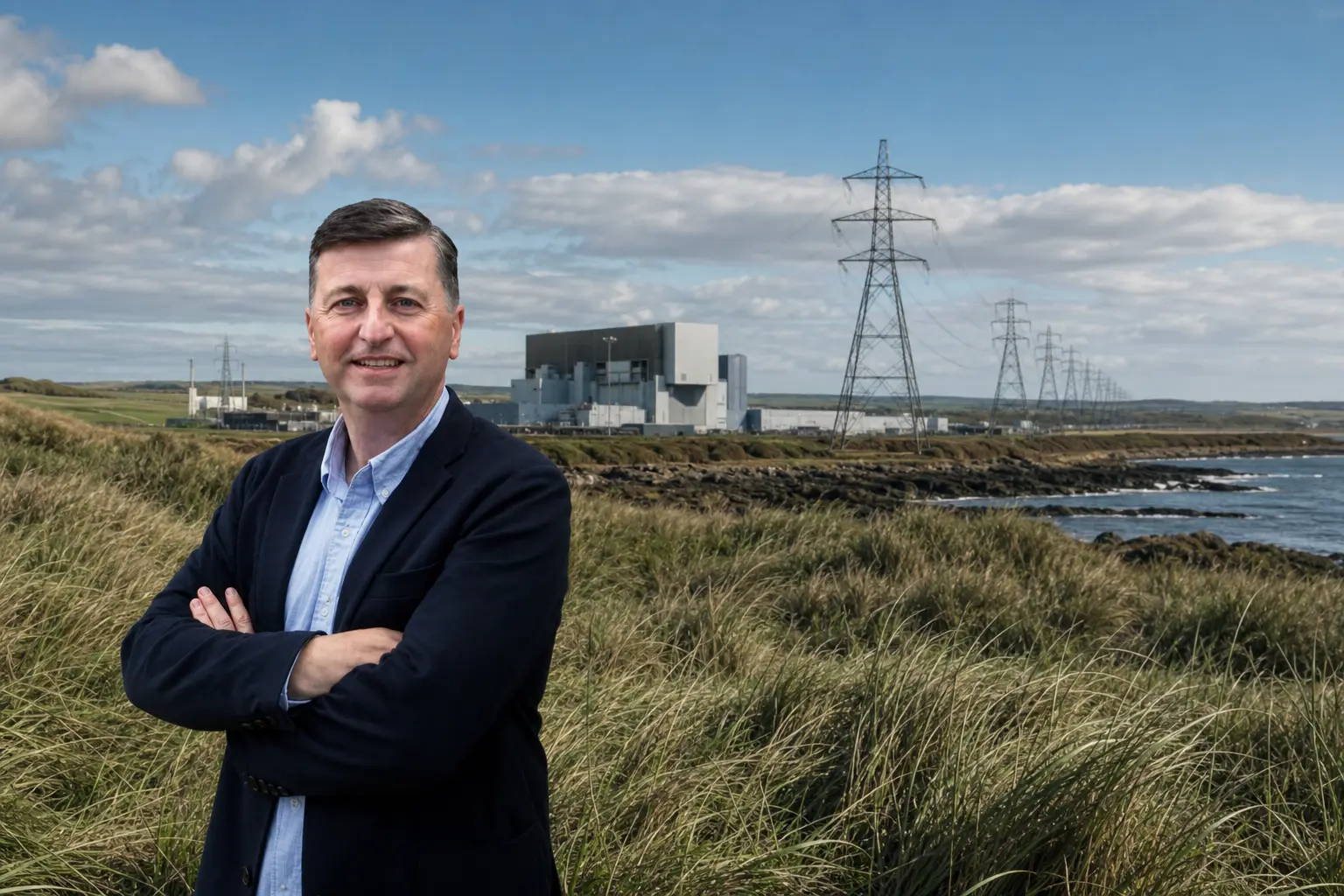
 A UK government study has named Torness, East Lothian, among six Scottish sites judged fit for a new nuclear reactor. Scotland’s devolved government still will not allow one to be built there. Douglas Alexander, the Labour MP for Lothian East and now Secretary of State for Scotland, used a local newspaper column this month to argue that gap is no longer abstract. It has a price tag.
Analysis from the Nuclear Industry Association (NIA), the trade body for Britain’s civil nuclear sector, puts that price at more than £2 billion in electricity costs Torness alone has kept off the system since the 2021 gas crisis. The plant is still Scotland’s only working reactor, still profitable, and still scheduled to shut in under four years. Nothing in Holyrood’s position has moved to change that.
Six Coastal Sites, One Familiar Answer
The technical study behind this month’s row was commissioned by Ed Miliband, the UK Secretary of State for Energy Security and Net Zero, who asked Great British Energy, Nuclear (GBE-N), the government’s nuclear delivery body, to map out where new reactors could physically go in Scotland. GBE-N published its findings on 30 June, concluding that areas with high potential for new nuclear development exist across the country from a technical standpoint.
The report assessed six locations in total. Three already carry nuclear history. Three do not.
- Torness in East Lothian, Scotland’s only operating nuclear plant
- Dounreay in Caithness, a former fast reactor site now being decommissioned
- Hunterston in North Ayrshire, which closed in January 2022 after more than 45 years of service
- Stirling, an inland brownfield site the study suggested suits smaller reactors rather than full scale plants
- The Angus and Aberdeenshire coast, where an existing offshore wind and oil and gas workforce could transfer skills
- The north shore of the Firth of Forth estuary
GBE-N was careful about what its own findings actually prove. The study repeatedly stressed it was a technical exercise, not a policy recommendation, and that no site could move forward without further work on grid connections, community consultation and, critically, a commercial case for investors. That caveat matters, because commercial interest is exactly what Scotland’s planning ban prevents anyone from testing.
Why Won’t Holyrood Approve New Nuclear?
Planning consent for power stations is devolved to the Scottish Parliament, and the SNP government has used that power to block new nuclear since the 1970s, when opposition first hardened around the construction of Torness itself. Ministers argue the technology is too slow and too expensive next to renewables, a position the Scottish Greens share, which together gives opponents of new nuclear a working majority at Holyrood even though the SNP governs alone as a minority administration.
Cabinet Secretary for Climate Action and Energy Gillian Martin has made the cost argument explicit, telling MSPs in January that new nuclear plants take decades to build and leave long term waste liabilities. She pointed to Hinkley Point C in Somerset, once budgeted at £18 billion and now running at an estimated £46 billion with completion pushed back to 2031. After GBE-N’s study landed in June, the Scottish Government accused Westminster of a fixation on the technology, and SNP figures including Kristopher Leask argued renewable energy delivers jobs and lower bills for a fraction of nuclear’s cost. Scottish Greens MSP Mark Ruskell went further, arguing the push for new sites overrides devolution and ignores what communities actually want.
The dispute is not simply Westminster against Holyrood. It splits opinion inside the Scottish Parliament itself.
- UK Government and NIA – Ed Miliband, Michael Shanks and NIA chief executive Tom Greatrex argue Scotland has the sites, the skills and the community support, and is turning down investment other parts of Britain are actively competing for.
- SNP ministers – Gillian Martin and energy minister Stephen Gethins argue nuclear’s cost overruns and waste legacy make it the wrong bet next to offshore wind and other renewables.
- Scottish Greens – Mark Ruskell frames any new site selection as Westminster overriding a devolved decision the Scottish Parliament has already made.
What the Standoff Has Cost So Far
Whatever the politics, the NIA has tried to put a number on what the existing plant has already delivered, and separately, on what its absence elsewhere is costing. The analysis compares Torness’s output against gas-set market prices going back to winter 2021.
| Metric | Figure | Detail |
|---|---|---|
| Torness savings since winter 2021 | £2.12 billion | Nuclear output priced against gas-set baseload rates, per NIA |
| Scotland’s share of that saving | £170 million | Equivalent to roughly £27 per customer |
| Hunterston B savings before its 2022 closure | £114 million | Plant shut in January 2022 after over 45 years |
| Skilled jobs Scotland is said to be missing out on | 5,000 | NIA estimate tied to the absence of new projects |
| Current Torness workforce | About 730 | 550 full-time staff plus roughly 180 contractors |
The NIA folded those figures into a Scotland manifesto published ahead of May’s Holyrood election, timed deliberately so parliamentarians would face the numbers before voters went to the polls.
The latest gas shock is a reminder that we need more cheap, reliable, sovereign power that nuclear delivers.
Tom Greatrex, chief executive of the NIA, made that argument as the group pushed for what it called a pragmatic reset of Scottish energy policy. Separate NIA data, drawn from YouGov polling, found nuclear power is now Scotland’s most popular energy source, a finding Michael Shanks, the UK energy minister, cited alongside separate polling showing more than half of Scots back nuclear generation.
A Landslide Win Changed Nothing
Miliband’s decision to commission the GBE-N study in October last year was not incidental. He asked for it explicitly in the lead-up to the Scottish Parliament elections, hoping the findings would land before voters weighed the nuclear question. Instead, GBE-N did not publish until 30 June, weeks after Scots had already gone to the polls in May.
The SNP was returned to government in that election. Commentary from anti-nuclear campaign group Beyond Nuclear International described it afterward as a sweeping victory that left the country’s nuclear moratorium secure. Scottish Labour leader Anas Sarwar had campaigned on ending what he called the SNP’s ideological prohibition on new nuclear power, warning it left Scotland vulnerable to volatile gas markets controlled by hostile states abroad. The SNP’s Keith Brown countered that Scottish families already pay what he termed a nuclear tax funding Hinkley Point C and Sizewell C, and pointed to Norway, where a government appointed commission had just recommended against new nuclear investment.
None of it changed the outcome. The party that opposes new nuclear kept its hold on the only parliament with the power to approve it.
East Lothian’s Closing Window
Whatever Holyrood eventually decides, the clock at Torness itself keeps moving. The plant began generating power in 1988 on a planned operational life that was later pushed back repeatedly. EDF, the French firm that has owned Britain’s nuclear fleet since 2009, brought Torness’s expected closure forward to 2028 in 2021 after a review of ageing graphite bricks in the reactor core. In December 2024, following further inspection work, EDF reversed course again and extended operations to March 2030, a decision Alexander welcomed as confirmation the plant remained safe to run.
That leaves roughly four years before Scotland’s last reactor goes offline for good, with no replacement legally able to take its place under current policy.
- About 730 people currently work at the Torness site, including contractors
- 307 terawatt hours of electricity generated since 1988, more than any other low carbon source in Scotland’s history
- 101 million tonnes of carbon dioxide emissions avoided over the plant’s lifetime
- March 2030 is the current scheduled closure date, already revised twice
Michael Shanks has warned that Scottish nuclear engineers are already leaving the country to use their skills on projects in England and Wales, where Sizewell C and small modular reactor programmes in North Wales are hiring. East Lothian Council has previously said it intends to work with EDF and the Nuclear Decommissioning Authority to protect local jobs through decommissioning, whenever that eventually begins. For now, the workforce, the savings and the site itself remain assets with a shrinking shelf life, and a devolved government that shows no sign of using them.
Frequently Asked Questions
What is a small modular reactor?
A small modular reactor, or SMR, is a nuclear reactor built at a fraction of the size of a plant like Hinkley Point C, using factory built components rather than custom construction on site. Backers, including the UK Government, argue SMRs are cheaper and faster to build than full scale stations, which is why GBE-N’s Scottish study flagged sites like Stirling as better suited to smaller designs.
Why does Scotland have veto power over new nuclear plants?
Planning consent for power stations is a devolved matter under the Scotland Act, meaning Holyrood, not Westminster, decides whether a new nuclear site can go ahead. The UK Government can fund research, siting studies and industry investment, but it cannot force planning approval through in Scotland the way it can in England and Wales.
What happened to Hunterston and Dounreay?
Hunterston B in North Ayrshire closed in January 2022 after more than 45 years generating power, while Dounreay in Caithness, once home to experimental fast reactor technology, has been in decommissioning for years. Both remain on GBE-N’s list of technically suitable areas because of their existing grid connections and nuclear trained workforces.
Could Torness run beyond March 2030?
EDF has already extended Torness’s life twice, from an original 2023 target to 2028 and then back out to 2030 after further checks on the reactor’s graphite core. NIA data shows that of Britain’s current reactor fleet, only Sizewell B is expected to keep running past March 2030, suggesting a third extension for Torness is not currently on the table.
 ONGC licence frees Venezuela cash and operatorship talks
  Anthropic Hits $65 Billion Run Rate and Flips the AI Cash Test
  Supreme Court grounds the fare free-for-all with three-week clock
  Gold Nears $4400 as Soft Data Meets Oil Inflation Risk
  Nifty Slips as Zaggle Circuits and Dhoot Debuts Big
  Diesel Crack Tops $100 as Iran Rhetoric Lifts Crude