
 Ishan Crawford
 Britain’s rivers still pay for a 1970s aquaculture gamble. North American signal crayfish brought in for farms escaped, multiplied and now infest waterways across England, Wales and Scotland while carrying a plague that kills the only native species.
The invaders outcompete white-clawed crayfish, burrow into banks and simplify food webs. Conservation has shifted to isolated ark sites and tighter rules, yet the debt keeps growing.
The 1970s Farm Experiment That Got Loose
British aquaculture businesses imported signal crayfish, Pacifastacus leniusculus, from North America in the mid-1970s to create a new freshwater fishery for restaurants and markets. The first UK records date to 1975-76. They escaped through watercourses and over land.
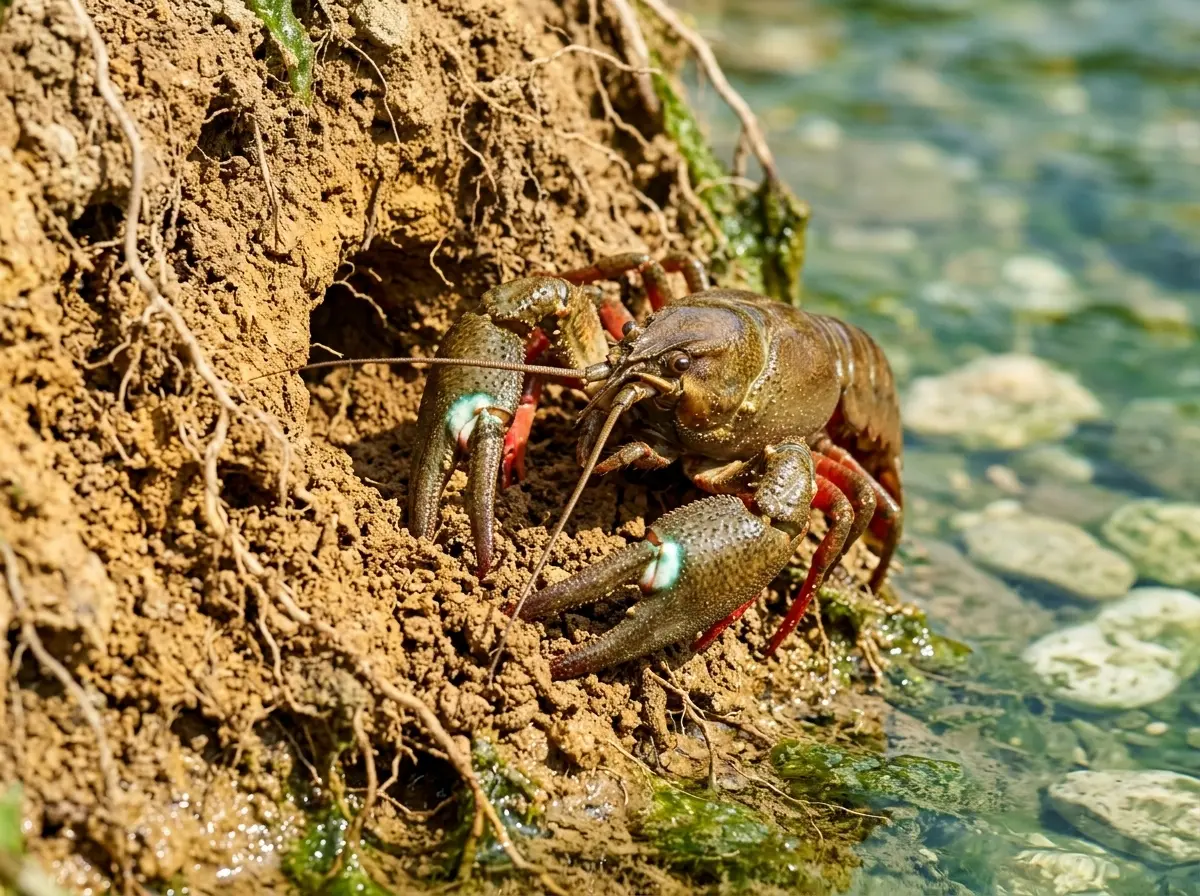
The species is larger, faster-growing and more aggressive than the native white-clawed crayfish, Austropotamobius pallipes. Females carry 200-400 eggs through winter. Young hatch resembling adults and feed widely. Adults reach 16-18 cm and live up to 20 years.
That combination of size, fecundity and longevity gave the newcomers a structural edge from the start. A single berried female can seed a stretch of river with hundreds of offspring that already behave like miniature adults. Over a 20-year lifespan the same animal can contribute to many breeding seasons while natives, smaller and less productive, cannot match the output.
According to the signal crayfish factsheet and invasion history from the GB Non-native Species Secretariat, they spread rapidly through the 1970s and 1980s. They now dominate much of England and parts of Wales and Scotland. Illegal human transfers continue to accelerate the range.
- 1975-76: First introductions for farming; escapes begin.
- 1980s-90s: Rapid colonisation of connected river systems; native die-offs noted.
- 1990s-2000s: Signals replace natives in many catchments; Schedule 9 listing makes release an offence.
- 2010s-present: Expansion continues at up to 2.4 km per year in some upland rivers; eDNA and ark programmes expand.
Thames, Anglian and South West regions alone saw a 43% rise in occurrence between 1997 and 2001. The pattern shows how quickly a farm escape becomes a catchment-scale problem once animals move through linked watercourses and people move them further still.
Why Signal Crayfish Spread So Fast
Signals tolerate a wide range of water conditions and cross barriers that stop natives. They move upstream and downstream and travel hundreds of metres over land in a night. Densities in invaded UK streams often reach 20 or more per square metre.
They outcompete for food and shelter. They also predate fish eggs, amphibian larvae and aquatic invertebrates. Commercial salmonid fisheries feel the pressure through lost refuges and egg predation.
High density multiplies every other effect. At 20 animals per square metre, foraging pressure is constant, shelter is monopolised, and any native crayfish still present face both competition and direct predation. Land travel of hundreds of metres in a single night lets signals bypass weirs, dry banks and other obstacles that once limited native range.
| Trait | Signal crayfish | White-clawed crayfish |
|---|---|---|
| Size | 16-18 cm | 10-12 cm |
| Eggs per female | 200-400 | ~80 |
| Plague response | Carrier, largely unharmed | Usually fatal |
| Status | Widespread invasive | Endangered |
| Burrowing | Deep tunnels to 2 m | Minimal |
NBN Atlas records already run to more than 10,000 signal observations. White-clawed records remain higher in total but show sharp local losses. The gap between raw record counts and local reality is the story of replacement: natives still appear in the archive, yet many of the waters those records came from no longer hold them.
Crayfish Plague Turns Rivers Lethal
The hidden weapon is crayfish plague, caused by the water mould Aphanomyces astaci. Signals carry it with little harm. White-clawed crayfish have no immunity. Contact usually means mass die-off.
The pathogen spreads in water and on damp gear, clothing and boats. Once established in a catchment it is hard to eradicate. Studies of UK signal populations have found the pathogen in more than half of sites tested, with prevalence inside infected groups ranging from a few percent to 80%.
That range matters for managers. A site with only a few percent prevalence can still seed neighbouring water if a single infected animal or a damp net moves. A site at 80% is already a reservoir. Either way the mould travels farther than the crayfish themselves once people, boats and kit enter the picture.
This dynamic has driven white-clawed crayfish toward local extinction in many rivers and earned the species endangered status. Declines of 50-90% or more have been recorded across parts of the range since the 1970s, on top of earlier losses from pollution and habitat change.
- Carrier signals shed plague into shared water with little harm to themselves
- Natives lack immunity, so contact commonly ends in mass mortality
- Damp gear, clothing and boats move the mould between catchments
- More than half of tested signal sites have held the pathogen
- Local native declines of 50-90% or more compound older pollution losses
Banks Collapse and Food Webs Thin
Signals do more than replace one crayfish with another. Their burrows, sometimes two metres deep with interconnecting tunnels, weaken soil and trigger erosion in streams and ditches. Collapsed banks raise flood risk and threaten livestock and riverside structures.
As generalist predators and scavengers they strip invertebrates, fish eggs and plants. Rich communities give way to simpler systems dominated by the invader. Studies in the Tees catchment and other upland streams document lower macroinvertebrate diversity, reduced densities of young salmonids and the near-disappearance of some benthic fish.
- Riverbank erosion and increased flood risk from deep burrows
- Predation on fish eggs and competition with salmonids for cover
- Reduced aquatic invertebrate diversity and altered food webs
- Direct competition and predation on remaining white-clawed crayfish
- Ongoing management and restoration costs estimated in the low millions of pounds per year
Older government figures put annual UK costs around £2.5-2.7 million for conservation, bank work, angling impacts and research. Cumulative estimates for 2000-2020 run higher. The bill continues.
Bank collapse and food-web thinning feed each other. Eroded channels hold less complex habitat for invertebrates and juvenile fish, while the same high crayfish densities that dig the tunnels also eat the eggs and invertebrates that once sustained richer communities. Fisheries and flood managers then share a bill that began as an aquaculture experiment.
One Northumberland Scare and the Ark Network
In autumn 2024 roughly 100 white-clawed crayfish died in the River Wansbeck catchment, a nationally important stronghold with one of the highest densities in the world. Symptoms included unusual orange patches and ulcers. Neighbouring Tyne and Blyth areas showed similar signs.
The Environment Agency and National Trust ran 76 surveys through 2025. Environment Agency Wansbeck surveys findings showed the symptoms are not fatal at population level. Younger animals often recover by moulting. Some older crayfish that carried symptoms in 2024 were still alive later. No further deaths were reported after that autumn. No signal crayfish are known in the catchment and plague was ruled out.
The River Wansbeck supports one of the highest density populations of white clawed crayfish in the world, and when the initial deaths were reported we were concerned this could have a devastating impact. While it’s too early to tell what the long-term implications are for the Wansbeck population, there are hopeful signs that the impact is limited and it will remain a stronghold for the species.
Sarah Jennings, Area Environment Manager, Environment Agency
Healthy berried females were rescued from the National Trust’s Wallington Estate, held at Northumberland Zoo and hatched in April 2025. Offspring are heading to ark sites. Ark sites are isolated water bodies free of signals and plague where natives can breed. Networks now include dozens to around 100 sites across England and Wales, with new hatcheries and translocations in Yorkshire, Derbyshire, Nottinghamshire, Devon and elsewhere. Recent moves have shifted hundreds of animals at a time after quarantine.
An eDNA crayfish and plague detection method validated by the Environment Agency detected a 2023 plague outbreak early enough to relocate healthy animals before mass mortality. The tool works year-round and matched expected presence or absence in 67 of 72 tests.
Government species recovery funding announced in 2026 includes white-clawed crayfish among more than 350 threatened species backed by tens of millions of pounds. The Wansbeck episode showed both the fragility of even the densest strongholds and the value of fast survey, captive holding and ark capacity when symptoms appear.
What River Users Must Do Now
Policy treats signal crayfish as a textbook case of how non-native introductions damage biodiversity. They sit on Schedule 9 of the Wildlife and Countryside Act. Release or allowing escape is illegal. Keeping or moving most non-native crayfish requires licences required for non-native crayfish from Natural England, Natural Resources Wales or the Fish Health Inspectorate. Trapping needs Environment Agency consent and landowner permission; live transport away from the catch site is banned without further authority.
The practical line for anglers, boaters, canoeists and walkers is simple. Follow the Check Clean Dry biosecurity steps: check kit and clothing for mud, plants or animals and leave anything found at the site; clean thoroughly with hot water where possible; dry for at least 48 hours or disinfect before use elsewhere. Some invasive organisms survive more than two weeks in damp conditions.
| Action | Requirement |
|---|---|
| Release or escape of signals | Illegal under Schedule 9 |
| Keeping or moving non-native crayfish | Licence from the relevant body |
| Trapping | Environment Agency consent plus landowner permission |
| Live transport from catch site | Banned without further authority |
| Kit and clothing between waters | Check, clean, dry at least 48 hours |
Anyone who sees crayfish, alive or dead, should leave them and report to the Environment Agency on 0800 807060. Handling without the right licences is illegal.
On social media some river users push commercial trapping and eating signals as control. Licensed trapping occurs and restaurants have experimented, yet scientists note that removal rarely eradicates established populations and illegal movement remains a bigger risk. The official priority stays containment, ark expansion and stopping new introductions.
Isolation Holds the Last Breeding Refuges
Ark sites work because they break the two pathways that unfinished rivers cannot: contact with signals and contact with plague. An isolated water body free of both gives white-clawed crayfish room to breed without the size, egg-count and aggression gaps that favour the invader in open catchments.
The network scale, dozens to around 100 sites across England and Wales, reflects how many separate refuges are needed once main rivers are compromised. Quarantine before translocation, hatchery steps such as the Wallington females held at Northumberland Zoo, and moves of hundreds of animals at a time all aim to stock those refuges without importing disease.
eDNA support makes the model tighter. Year-round detection that matched expected presence or absence in 67 of 72 tests gives managers a way to clear or reject sites and to spot plague early, as in the 2023 outbreak that allowed relocation before mass mortality. Isolation is not a full restoration of lost rivers. It is a holding pattern that keeps breeding stock alive while containment rules try to slow further spread.
The Cleanup Bill Outruns the Old Farms
The farms that brought signals in closed long ago. The costs did not. Annual figures around £2.5-2.7 million cover conservation, bank repair, angling impacts and research, and cumulative estimates for 2000-2020 run higher. Expansion at up to 2.4 km per year in some upland rivers keeps adding water that needs watching.
Those sums sit beside the biology already measured: 200-400 eggs per signal female against roughly 80 for natives, adults to 16-18 cm living up to 20 years, burrows to 2 m, and plague in more than half of tested signal sites. Each trait raises either the speed of spread or the price of living with the result.
Species recovery funding announced in 2026 places white-clawed crayfish among more than 350 threatened species backed by tens of millions of pounds. That investment buys ark capacity, monitoring and enforcement. It does not reverse the 1970s introductions. Prevention at the farm gate would have been cheaper than decades of Schedule 9 rules, biosecurity campaigns and refuge building. The rivers are still collecting the interest.
The 1970s farms closed long ago. The signals remain, the plague remains, and the white-clawed crayfish survive mainly where humans have built walls of isolation around them. Prevention was always cheaper. The rivers are still collecting the interest.
 Hyderabad Gold Dip Freezes Buying as Duty Talk Hits Wedding Season
  India Pushes Japan CEPA Review After 15 Years of One-Way Gains
  HDFC Bank’s US Class Action Turns Deposit Scheme Into Securities Reckoning
  Gold Holds Above $4600 as Treasury Buybacks Fuel Debasement Bid
  Scotland’s Prevention Push Leaves Community Groups Squeezed
  Amazon Locks Three Million Nvidia GPUs Even as Trainium Grows