
 Ishan Crawford
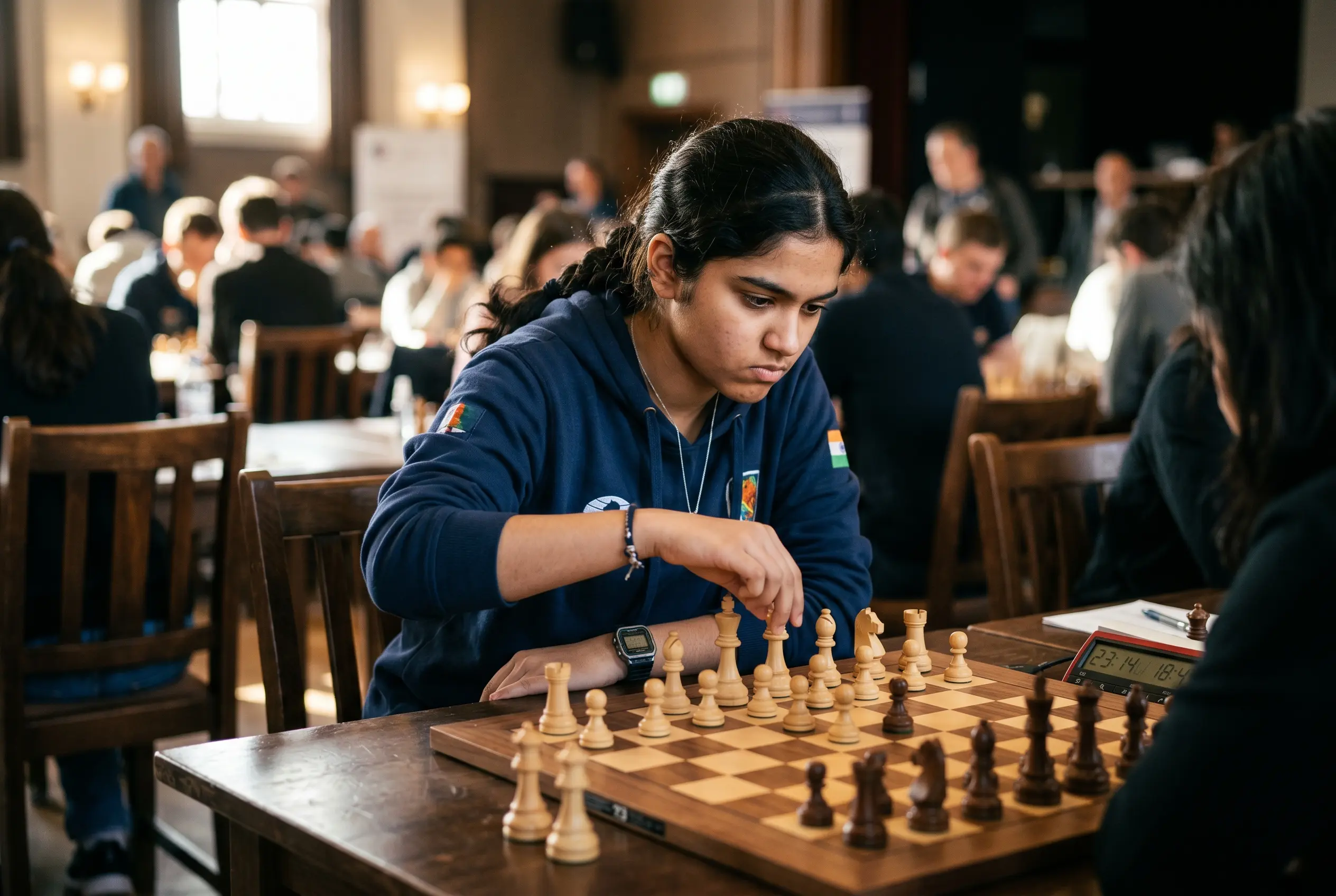
 Shubhi Gupta, a 16-year-old chess player from Ghaziabad, gained 184 Elo points at the Munich Chess Festival to climb to World No. 32 in the FIDE women’s rankings and India No. 5. She was the biggest mover on the FIDE June 2026 list, a list that now puts eight Indian women in the world top 100. The climb started in a school chess club in Ghaziabad.
Her rise from school hobby to top-table contender has run through a pharmacy in Uzbekistan, a mental collapse in Durgapur, and a family that turned itself into a training squad. The next target, by the family’s own account, is the WGM, the IM, and the Grandmaster title.
The Eye-Drop Tournament That Almost Wasn’t
March 2024, and Shubhi was fifteen, sitting at the board for her first independent international tournament in Uzbekistan. A medical store near the venue had dispensed a 1% solution instead of 0.1% of the eye drop she needed. The bottle was 100 times stronger than the one she had used for years, and within hours of the first round her vision had gone soft, the 64 squares in front of her blurring into a wash of beige and brown.
The medical store gave us a 1% solution instead of 0.1%; it was 100 times stronger than what we normally used. It completely affected her eyesight, making everything blurred for seven to eight days. As a result, her entire first tournament in Uzbekistan in March was ruined because she simply could not see the board clearly.
Father Pradeep told the Times of India in an exclusive conversation that the family had travelled at their own expense and had not realised the mistake until the first round was already unplayable. The pharmacy had handed them the wrong concentration. Shubhi recovered, but the tournament was over, and the 15-year-old flew home with a single line on her record and a lesson no parent ever wanted to learn about checking pharmacy labels abroad.
A School Hobby That Refused to Stay a Hobby
Shubhi was introduced to chess at the age of eight as a hobby class at her school’s chess club in Ghaziabad. A third-place finish in an inter-school competition got her father, Pradeep, to enrol her in a weekend academy.
In 2019, barely six months into serious play, she travelled to her first major event, the Under-9 National Championship in Ahmedabad. She finished 10th, opening her initial FIDE rating at 1070. Then the pandemic hit, and the family reached out to Delhi-based coach Prasenjit Dutta in 2020, when her rating sat at a modest 1095.
Online success of that speed drew sceptics. Whispers about fair play followed her onto the chess servers, where a new face tearing through online tournaments with that kind of accuracy tends to attract suspicion. Dutta, watching the work behind the results, was not among them. “Whatever study material I gave her, she immediately worked on it,” he told the Times of India, recalling the lockdown years. “Her fundamentals were missing initially, so we worked incredibly hard on those.”
Dutta was also waiting for the lockdown to end and over-the-board tournaments to return. In the meantime, Shubhi won gold in the National School Under-11 Championship, bronze in the 2021 National Under-14, and individual and team golds at the Western Asian Under-12 Championship. By the time the board returned in 2022, she had a stack of online medals and a coach who had stopped counting.
The North Star’s First National Title
Over-the-board chess returned in 2022, and Shubhi silenced the doubters on the board. She won the National Amateur Championship in the under-2000 category and followed it up with a gold medal at the National Under-12 Championship in Mandya, near Bangalore.
Indian chess infrastructure and prodigies have traditionally been concentrated in the South. Bringing the national trophy to Ghaziabad marked a rare breakthrough for North India, and especially Uttar Pradesh, in junior chess. Pradeep called it the first time a national title had come back to North India. The boost, he said, raised the morale of every young player in the region who’d been told the southern academies were the only path. The national title qualified her for the World Cadet Championship 2022 in Batumi, Georgia, where she represented India against players from over 70 countries.
There, she clinched the Under-12 gold medal and the World Champion tag. Coach Dutta stayed awake through the night watching her games live. Her moves were coming with around 98 to 99% accuracy, matching the top engine recommendation. For a player at that age, virtually mistake-free play signalled a leap in strength. The trophy is on the wall of his Delhi academy, alongside a photo of the team. “My dream was always to have a student become a World Champion,” Dutta said.
The Durgapur Collapse and the Reset
Late in 2024, the 16-year-old led the field at the National Women’s Championship in Durgapur, West Bengal, until the final stretch. She lost the final two rounds and dropped to a heartbreaking fourth-place finish, taking Rs 3.5 lakh in prize money but no national title.
Pradeep admitted the family was upset, and the missed title sent Shubhi into a depressing state. The parents also admitted they had scolded her badly after losses in the past. This time, they handled it differently: “It’s just one game. It’s not the last tournament,” they told her, a line the family now uses after every setback. Shubhi detached from chess completely, turning to Mandala art, sketching, and movies. The break worked. Days later, she won the National Under-19 Championship in Jamshedpur, Jharkhand, erasing the ghost of Durgapur in the same month. Off the board, she cleared her Class 10 board exams in one and a half months of self-study, scoring 96%.
The Munich Double
In March 2025, Shubhi returned to Uzbekistan, the country of the eye-drop incident, and cleanly secured her third Woman International Master norm. A few weeks later, she and her mother Urmila were in Munich, Germany, for the Munich Chess Festival. In two back-to-back international tournaments, she scored a Woman Grandmaster norm in the first event and a full International Master norm in the second, a result that briefly put her at World No. 4 in FIDE’s Girls’ rating list for players aged 20 and younger. The performance moved her to India’s No. 1 spot in the girls’ division at the time.
We didn’t claim the WIM title. Her dream is not to stop here. She is aiming directly for the WGM, the IM, and ultimately, the absolute Grandmaster (GM) title.
Father Pradeep said this in the same Times of India interview. Her current classical rating, listed on Shubhi Gupta’s official rating history, is 2426, and the 184-point gain is documented in the June 2026 rating list movers and changes.
The Family That Built a Prodigy
Elite chess is an expensive proposition, and the Gupta family has funded it directly. Pradeep works in IT to bankroll the travel and coaching. Shubhi’s mother, Urmila, who initially did not know a single rule of the game, has become her full-time training partner, analyst, and travel companion.
With Shubhi’s elder brother completing his final year of engineering, the family treats chess as a bonding activity. If anyone is free, they prefer moving a piece or two over the board. Shubhi and her mother, however, spend nearly 80% of their time away from home, on the road for events. The travel, the hotels, the entry fees, the second-pair-of-eyes coaching: each one is a line item the family tracks. Urmila has become the analyst Shubhi does not have the time to be for herself. Sponsors have come forward to ease a portion of the financial burden off the family’s shoulders.
The backing has allowed the teenager to train under top-tier Grandmasters, including GM Swapnil Dhopade and GM Srinath Narayanan. “Srinath Sir was especially eager to push her to play international open tournaments abroad because domestic opportunities can become limited at her level,” Pradeep noted.
That push is what took Shubhi to Uzbekistan in March 2025 and to Munich a few weeks later. The Munich back-to-back was structured around gaining two of the hardest norms a teenage girl can chase in one stretch. She took both. The next stops on the calendar are the tournaments that turn norms into titles, and the family will pick them the way it picks everything else: by the entries, the opposition, and the cost.
Eight Indians in the Women’s Top 100
The June 2026 FIDE rating list also confirmed the depth of Indian women’s chess. Eight Indian women sit inside the world top 100, a number that has held steady through the spring. Shubhi’s arrival at World No. 32 added the most recent name to a list led by Koneru Humpy, Divya Deshmukh, R. Vaishali, and Harika Dronavalli.
India remains the world’s second-ranked federation in women’s classical chess, trailing China by 71 Elo points on the federation average. The eight Indians in the top 100 span Shubhi at 16 up to Padmini Rout at the century mark, a spread that shows the depth of the pipeline. Humpy at 2535 is the highest-rated Indian woman on the list, with Divya Deshmukh at 2500 next. The other four Indians in the top 100 cluster between World No. 57 and World No. 100.
The full Indian top eight, with world ranks and classical ratings where sourced, is below, drawn from the India women’s classical rankings for June 2026. The June 2026 list also confirmed the depth of the Indian women’s pipeline.
| India rank | Player | World rank | Classical rating |
|---|---|---|---|
| 1 | Koneru Humpy | 6 | 2535 |
| 2 | Divya Deshmukh | 11 | 2500 |
| 3 | R Vaishali | 13 | n/a |
| 4 | Harika Dronavalli | 17 | n/a |
| 5 | Shubhi Gupta | 32 | 2426 |
| 6 | Vantika Agrawal | 57 | 2388 |
| 7 | Savitha Shri B | 89 | n/a |
| 8 | Padmini Rout | 100 | n/a |
Frequently Asked Questions
How Did Shubhi Gupta Reach World No. 32 in Women’s Chess?
She gained 184 Elo points at the Munich Chess Festival by scoring a Woman Grandmaster norm in the first event and a full International Master norm in the second, the biggest single jump by an Indian woman on the FIDE June 2026 list.
What Happened With the Eye Drops at Her Uzbekistan Tournament?
A medical store in Uzbekistan dispensed a 1% solution of the eye drop she needed instead of the 0.1% version her family had packed, leaving her with blurred vision for seven to eight days and forcing her to play through the first round of her March 2024 trip essentially unable to see the board.
What Is the Difference Between WGM, WIM, and IM Titles in Chess?
The Woman Grandmaster (WGM), Woman International Master (WIM), and full International Master (IM) are FIDE titles earned by meeting performance norms against titled opposition. WGM and WIM are restricted to women, while IM is open. Shubhi earned WIM and WGM norms in Munich and an IM norm in the same stretch, and the family has chosen not to claim the WIM she is eligible for as she targets the higher titles.
How Many Indian Women Are in the FIDE World Top 100 Right Now?
Eight. Koneru Humpy, Divya Deshmukh, R. Vaishali, Harika Dronavalli, Shubhi Gupta, Vantika Agrawal, Savitha Shri B, and Padmini Rout all sat inside the top 100 on the FIDE June 2026 classical list.
What’s Next for Shubhi Gupta?
The WGM, IM, and Grandmaster titles, in that order, according to her father. The WIM title she has earned sits unclaimed while the family focuses on the higher targets.
 ONGC licence frees Venezuela cash and operatorship talks
  Anthropic Hits $65 Billion Run Rate and Flips the AI Cash Test
  Supreme Court grounds the fare free-for-all with three-week clock
  Gold Nears $4400 as Soft Data Meets Oil Inflation Risk
  Nifty Slips as Zaggle Circuits and Dhoot Debuts Big
  Diesel Crack Tops $100 as Iran Rhetoric Lifts Crude