

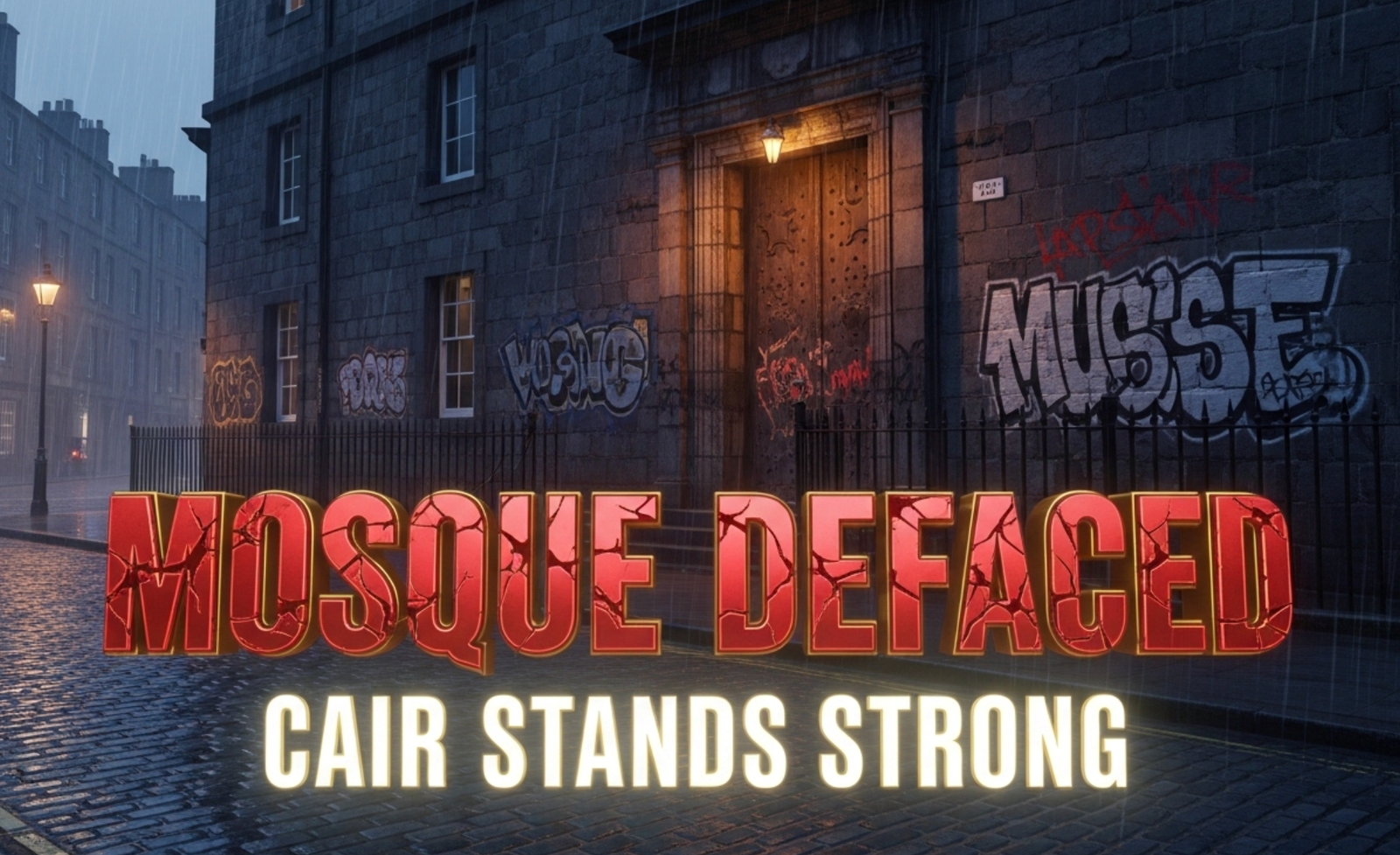
Edinburgh, Scotland – Worshippers arriving for Friday prayers found their sacred space violated. Offensive anti-Muslim graffiti covered the walls of Edinburgh Central Mosque in one of the worst hate attacks the Scottish capital has seen in years. Police are treating it as a targeted hate crime.
The Council on American-Islamic Relations (CAIR), America’s largest Muslim civil rights group, immediately issued a powerful statement of solidarity from Washington, D.C.
“We stand in full solidarity with the Muslim community in Scotland following this disturbing act of hate targeting a house of worship,” the organization declared. “Attacks on mosques are an attack on religious freedom itself.”
Details of the Vandalism Emerge
The graffiti appeared overnight between Wednesday and Thursday last week on the Potterrow entrance of Edinburgh Central Mosque. Photos circulating among community members show large, crude messages including slurs against Prophet Muhammad (peace be upon him) and threats telling Muslims to “go home.”
One worshipper who asked not to be named told reporters he felt physically sick when he saw the words. “This is our spiritual home,” he said. “Seeing it desecrated like this breaks something inside you.”
Police Scotland confirmed they are reviewing CCTV footage and have increased patrols around Muslim institutions across the city. Detective Inspector Ryan Davies said the force is treating the incident with utmost seriousness and appealed for witnesses.
This is not the first time the mosque has been targeted. In 2023, bacon was left at the entrance – another deliberate Islamophobic act. But community leaders say this latest attack feels more menacing in both scale and venom.
CAIR Calls Out Europe’s Growing Islamophobia Crisis
CAIR did not mince words in linking the Edinburgh attack to a wider pattern.
Just two weeks earlier, the organization condemned a violent assault on an Australian imam and his wife. In 2025 alone, CAIR issued similar statements after incidents in the Netherlands, Germany, Ireland, and multiple British cities.
“Islamophobia is spinning out of control in Europe,” CAIR warned last year – words that now feel painfully prophetic.
Scottish Muslim leaders agree. Tahir Masood, general secretary of Edinburgh Central Mosque, said the vandalism has left many women and children scared to attend prayers. “People are asking if it’s still safe to come to the mosque,” he told The Scotsman.
Community Response Shows Resilience and Unity
Despite the pain, the reaction from ordinary Scots has been heartwarming.
Hundreds of non-Muslim neighbors have left flowers, cards, and messages of support at the mosque gates. Local churches and synagogues organized solidarity visits. Edinburgh Lord Provost Robert Aldridge visited in person to condemn the attack.
A GoFundMe to repaint and install better security cameras raised more than £28,000 in just four days – double its target.
“These acts of hate will never define us,” said Sohaib Ashraf, a youth worker at the mosque. “What defines us is how we respond – with dignity, faith, and community strength.”
Why This Matters Now
Official figures show anti-Muslim hate crimes in Scotland rose 25% last year. Across the UK, Tell MAMA recorded the highest ever number of Islamophobic incidents in 2025, with mosques increasingly targeted.
Many trace the surge to heated political rhetoric around immigration and the Gaza conflict. Far-right groups have become bolder online and on the streets.
CAIR’s national deputy director Edward Ahmed Mitchell warned that when political leaders fail to forcefully condemn Islamophobia, it gives permission to extremists.
“The silence or soft-pedaling from some politicians is deafening,” Mitchell said. “Every time a mosque is attacked and leaders stay quiet, it emboldens the next attacker.”
The Edinburgh incident proves his point: this is the third mosque attack in Britain in just six weeks.
Yet amid the darkness, stories of solidarity keep emerging. A group of Edinburgh University students spent their weekend helping clean the graffiti. Local Sikh and Jewish organizations issued joint statements of support. One Scottish pensioner who left flowers wrote simply: “Your house of worship is our house of worship.”
This, perhaps, is the real story – not the hatred of a few cowards who strike in darkness, but the love of thousands who show up in daylight.
The investigation continues. Police urge anyone with information to come forward.
But for Scotland’s Muslims, the message from both their own community and allies worldwide is clear: You are not alone.