

GLASGOW, 4 June 2025 — Scotland’s pursuit of a cleaner, greener industrial future took a powerful step forward this week with the successful delivery of a 142-tonne Vapour Recovery Unit (VRU) at Glasgow’s King George V Dock. The installation — handled in a single shift by global heavy-lift specialists Sarens — is being hailed as a major win for air quality and environmental resilience.
Commissioned by logistics firm Deugro, the VRU project underscores how Scotland’s green transition is not only about renewables and carbon targets, but also about deploying cutting-edge technology to curb pollution at its industrial source.
Stopping Toxic Emissions in Their Tracks
The newly delivered VRU is designed to capture and recycle harmful volatile organic compounds (VOCs) and other toxic vapours before they escape into the atmosphere. These units are essential in reducing emissions from oil and gas operations, petrochemical storage, and fuel distribution terminals — some of the key contributors to localised air pollution in urban industrial zones.
In essence, the unit acts as a giant air filter: reclaiming toxic vapours, neutralising pollutants, and returning purified air back into the environment.
Sarens describes the installation as “a critical enabler in Scotland’s cleaner industrial future”, aligning directly with the country’s climate strategy and public health imperatives.
A Complex Lift, Delivered with Precision
Transporting and installing a unit of this magnitude isn’t just a matter of muscle — it’s a highly coordinated engineering feat.
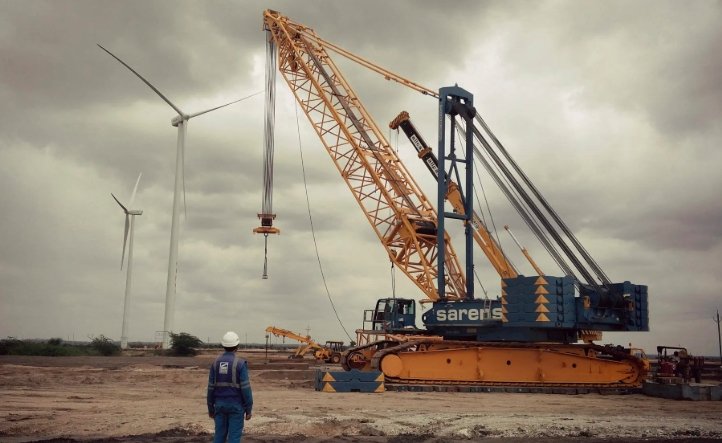
To manage the operation, Sarens deployed its LTM 1450 all-terrain crane, rigged with a powerful main boom and an imposing 134-tonne counterweight. The configuration allowed for a safe, stable lift across the complex dockside environment.
What would typically take multiple days of setup and calibration was completed by Sarens’ team in a single shift, testament to their extensive experience with oversized industrial components and constrained maritime locations.
“From planning to execution, everything ran with clockwork precision,” said a Sarens spokesperson. “This is what we do best — delivering solutions where technical complexity meets environmental impact.”
Why King George V Dock Matters
Glasgow’s King George V Dock — once a symbol of heavy industry — is now playing a different kind of strategic role in Scotland’s green pivot. Its location, infrastructure, and capability to handle oversized and environmentally significant cargo make it an ideal staging point for projects like this.
• Strategic Location: Proximity to major industrial clusters and road networks
• Specialist Infrastructure: Heavy-duty berths and lifting support for abnormal loads
• Sustainability Nexus: Increasingly a hub for renewable, hydrogen, and emissions-mitigation equipment
This is far from the dock’s first green initiative. In recent years, it has also hosted offshore wind infrastructure components and carbon capture systems — a quiet but vital contributor to Scotland’s clean energy roadmap.
Aligning with Scotland’s Broader Climate Targets
The VRU installation feeds into Scotland’s legally binding climate commitments, which include:
-
75% emissions reduction by 2030
-
Net zero by 2045
-
Enhanced air quality standards under local environmental health laws
With increased scrutiny on the oil and gas sector and pressure mounting to deliver not just promises but measurable progress, this kind of emissions-mitigation infrastructure is becoming indispensable.
Table: How Vapour Recovery Units Support Environmental Goals
| Benefit | Impact on Environment & Industry |
|---|---|
| VOC Capture | Prevents toxic vapours from entering the atmosphere |
| Reuse of Recovered Vapours | Promotes circular economy in petrochemical operations |
| Improved Air Quality | Direct health benefits to nearby communities |
| Compliance with Regulations | Helps companies meet UK/EU emission standards |
| Public Trust & Green Credentials | Improves corporate environmental responsibility profile |
Quietly Powerful Progress
While renewable megaprojects often dominate headlines, it’s initiatives like this — technically complex, operationally efficient, and environmentally direct — that often represent the real work of decarbonisation. They bridge the gap between industrial reality and climate aspiration.
For Sarens, Deugro, and Scotland’s docklands, the successful delivery of this VRU isn’t just about logistics — it’s about legacy. A heavy lift for a lighter footprint.