
 Ishan Crawford
 Scotland approved a 2 gigawatt offshore wind complex this month in the same stretch of sea where its existing turbines already get paid to stand idle. The Scottish Government granted marine licences and consent for Ocean Winds’ Caledonia North and Caledonia South projects, clearing the way for up to 140 turbines across 429 square kilometers of the outer Moray Firth capable of supplying close to two million homes a year.
The approval brings real money and real jobs. It also plants two new gigawatts in the same corner of the grid where Ocean Winds’ current wind farms already rank among the most curtailed in Britain, switched off on windy days because the wires south are full.
140 Turbines, One Contested Firth
Caledonia North and Caledonia South sit side by side off northeast Scotland. Caledonia North, roughly 28 kilometers from Wick and 48 from Banff, will carry up to 77 fixed-foundation turbines and 1 gigawatt of capacity. Caledonia South, about 45 kilometers from Wick and 35 from Banff, adds another 78 turbines and its own gigawatt, with up to 39 of those turbines floating rather than bolted to the seabed.
Some of Caledonia North’s turbines will reach a blade-tip height of 355 meters at the blade tip, according to planning papers reviewed by Highland Council, taller than the Eiffel Tower. The application went through under Section 36 of the Electricity Act and the Marine (Scotland) Act, the same legal route every offshore project in Scottish waters has to clear.
| Attribute | Caledonia North | Caledonia South |
|---|---|---|
| Distance from Wick | 28 km | 45 km |
| Distance from Banff | 48 km | 35 km |
| Turbines (up to) | 77 | 78 (up to 39 floating) |
| Foundation type | Fixed only | Fixed and floating |
| Planned capacity | 1 GW | 1 GW |
Together the two sites cap out at 140 turbines and 2 gigawatts, one of only two ScotWind project clusters to reach full marine consent since the leasing round launched.
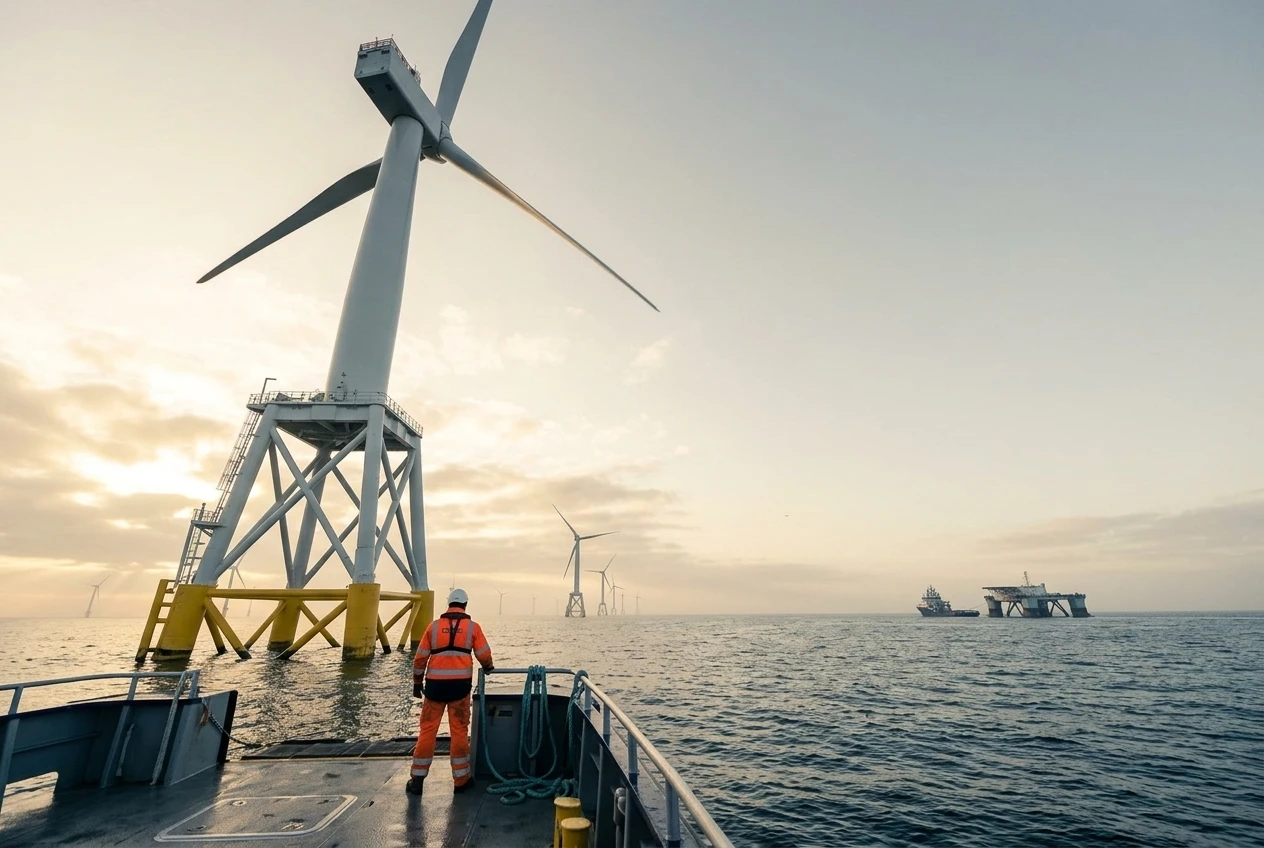
The Same Water Where Ocean Winds Already Stands Turbines Down
Ocean Winds is not new to the Moray Firth. The joint venture, owned equally by Portugal’s EDP Renewables and France’s Engie, already runs Moray East, generating power since April 2022, and Moray West, which reached full output in April 2025. Caledonia will complete a cluster of three Ocean Winds wind farms crowded into the same firth.
Both existing projects are already among the most curtailed offshore assets in the country. Moray East lost 1.7 terawatt hours to curtailment in 2025, and Moray West lost another 1.4 terawatt hours, according to research firm Modo Energy. Only Seagreen, further south on the North Sea coast, was switched off more.
Caledonia will add up to 2 more gigawatts into that same corner of the grid, years before the transmission lines carrying power south are due to grow any bigger.
Scotland’s Wind Boom Is Outpacing Its Own Wires
The problem runs well beyond one firth. Scottish wind farms were paid close to £350 million in 2025 to reduce output, and grid operators spent more than £1 billion firing up gas plants to replace that lost power. Transmission constraint costs across Great Britain hit £1.9 billion in the 2024 to 2025 financial year, 71% of the country’s total balancing bill, up from 44% just two years before.
Fintan Devenney, senior energy market analyst at Montel EnAppSys, said the pace of Scottish wind development is not expected to slow. Twenty projects secured seabed rights through the 2022 ScotWind round, Devenney noted, and building all of them would add close to 30 gigawatts of new capacity.
Should all these projects be completed, almost 30 GW of additional wind generation capacity would be added to the Scottish grid, increasing total Scottish wind generation capacity more than threefold.
Devenney told Energy Voice that figure would nearly triple what Scotland already has connected. The fix is not close. Grid planners expect one key transmission boundary out of northern Scotland to nearly double in capacity by 2030 and another further south to almost triple, according to Modo Energy’s analysis of network build-out data. Even those upgrades only just catch up to the roughly 20 gigawatts of Scottish wind that the UK’s Clean Power 2030 target assumes will already be running, with little room left for whatever comes after Caledonia.
Ocean Winds Backs Caledonia With a £1.7 Billion Bet
Money is moving alongside the megawatts. Ocean Winds’ latest Supply Chain Development Statement commits £1.7 billion to Scottish engineering, manufacturing, ports and maritime operations across both Caledonia sites, plus long-term operations and maintenance jobs once turbines start turning.
Caledonia project director Mark Baxter said the developer is drawing on lessons from its two neighboring projects to de-risk the build. Some of the seabed conditions at the new site resemble Moray East, where Ocean Winds used a jacket foundation design, while Moray West was built with some of the largest monopiles in the industry.
The economics of the corridor have moved fast. Moray East secured a contract for difference at £57.50 per megawatt hour back in 2018, a record low at the time. Moray West’s contract came in at £37.35 per megawatt hour in 2012 prices, and the project also signed corporate power deals with Google and Amazon. Caledonia South’s floating turbines push that cost curve into deeper, less proven water, a segment Scotland is trying to lead globally even as the price of getting it wrong is higher than fixed foundations in shallower ground.
Seabirds and Fishing Grounds Get a Say Before Construction Starts
Consent is not a green light to start building. Ocean Winds still has to satisfy a set of environmental conditions before either site can move forward.
- Seabird compensation plan – a detailed plan offsetting impacts on seabird colonies must be prepared and approved by Scottish ministers.
- Ecosystem safeguards – measures to minimize wider effects on the marine environment before any construction vessel arrives.
- Other sea users – protections for fishing grounds and shipping routes that share the same 429 square kilometers of water.
- Ministerial sign-off – none of the above is optional; construction cannot begin until ministers approve the mitigation plans.
First Minister John Swinney framed the decision as part of a broader balancing act between climate targets and the communities that use the same water.
We have given the Caledonia North and South offshore wind farm applications very careful consideration. This consent decision is a significant step in Scotland’s progress towards tackling climate change and reaching net zero, which is a key priority for the Scottish Government.
Swinney also granted consents and marine licences to Ocean Winds while pledging continued talks with fishing crews and conservation groups, the same stakeholders whose objections can still slow the seabird plan even after consent is granted.
When Will Caledonia Actually Reach a Plug?
Not soon. History in this exact firth suggests years still separate today’s paperwork from a live turbine. Moray East took eight years to go from consent to first power. Caledonia is only now clearing the consent stage, four and a half years after Ocean Winds first secured the site through ScotWind.
- 2014: Moray East wins Scottish Government consent, the first of Ocean Winds’ three Moray Firth projects.
- January 2022: The ScotWind leasing round hands Ocean Winds an option on the Caledonia seabed, one of 20 sites awarded nationwide.
- April 2022: Moray East starts generating power, eight years after its original consent.
- April 2025: Moray West reaches full power output.
- July 2026: Caledonia North and South receive marine licences and consent, the second ScotWind cluster to reach this stage.
One box is already ticked. Ofgem, Great Britain’s energy regulator, has granted Caledonia’s electricity generation licence, a procedural step that sits alongside, not instead of, the environmental approvals still pending. A contract for difference auction, financing close and years of offshore construction still stand between this month’s headlines and a lit lightbulb.
Frequently Asked Questions
Why Does Scotland Pay Wind Farms to Switch Off?
The transmission network linking northern Scotland to England cannot carry all the power generated on windy days, so grid operators pay wind farms to cut output and pay gas plants elsewhere to fill the gap instead. Ofgem, the energy regulator, has approved plans for the country’s transmission operators to spend tens of billions of pounds upgrading lines and substations, though that work will take years to finish.
What Makes Caledonia South’s Floating Turbines Different?
Instead of a foundation driven into the seabed, up to 39 of Caledonia South’s turbines will sit on floating platforms held in place by mooring lines and anchors, a design suited to deeper water than fixed foundations can reach. Scotland already hosts Hywind Scotland, the world’s first commercial-scale floating wind farm from 2017, and Kincardine, currently the largest grid-connected floating project anywhere.
How Much Has the ScotWind Program Raised for Scotland So Far?
The original 2022 leasing round generated £755 million in seabed option fees for the Scottish Government, according to a 2026 Audit Scotland review of the program, with £80 million of offshore wind revenue earmarked for public spending in the 2026/27 budget alone.
 ONGC licence frees Venezuela cash and operatorship talks
  Anthropic Hits $65 Billion Run Rate and Flips the AI Cash Test
  Supreme Court grounds the fare free-for-all with three-week clock
  Gold Nears $4400 as Soft Data Meets Oil Inflation Risk
  Nifty Slips as Zaggle Circuits and Dhoot Debuts Big
  Diesel Crack Tops $100 as Iran Rhetoric Lifts Crude