
 Ishan Crawford
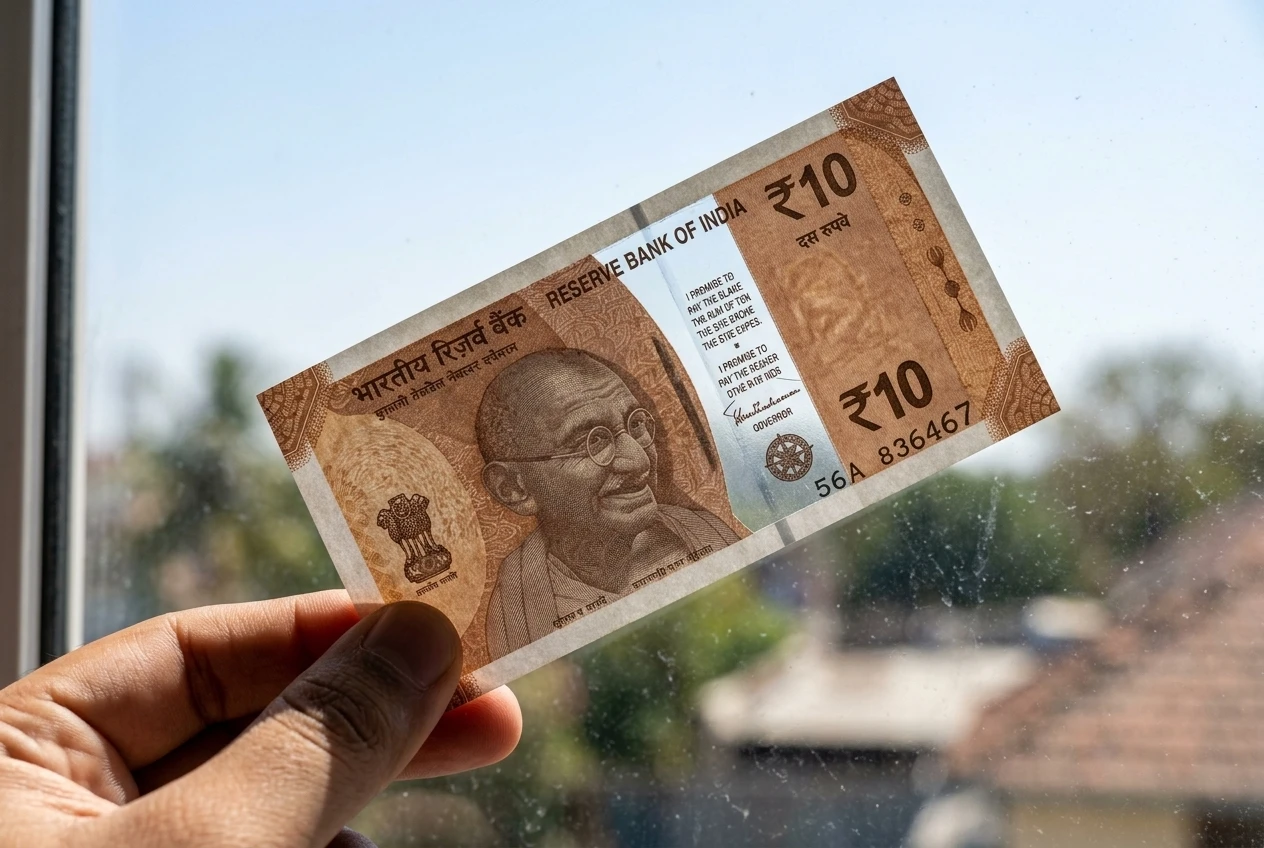
 The Reserve Bank of India has opened global bidding for plastic banknote material, the first concrete step toward printing Rs 10 and Rs 20 notes on polymer instead of paper. Bharatiya Reserve Bank Note Mudran Private Limited (BRBNMPL), the RBI’s currency-printing arm, wants 68,000 reams of polymer substrate before bids close on August 18. A successful trial could lead to a full rollout in 2027.
India has been here before. A near-identical plan reached field trials in five cities roughly a decade ago, then disappeared from the RBI’s own annual reports without much public explanation. This time the tender comes with hardened security clauses, a sharper cost argument, and two denominations instead of one.
BRBNMPL’s Wish List Runs to 68,000 Reams
The Global Expression of Interest asks manufacturers worldwide to supply opacified polymer substrate sheets, built from Biaxially Oriented Polypropylene (BOPP), a thin plastic film rather than the cotton and linen fiber used in paper currency. The indicative order is 68,000 reams, split evenly at 34,000 reams each for two denominations, with 500 sheets per ream, according to details reported by ANI and the Indian Express.
Every sheet has to carry a specific set of security features, suitable for printing at both BRBNMPL’s presses and those of Security Printing and Minting Corporation of India (SPMCIL), the government’s own currency and mint company. The list, as reported by ANI, includes:
- A clear window with a portrait
- A metallic numeral
- A magnetic pseudo thread
- A shadow image
- An iridescent pattern
Eligibility is narrow by design. Bidders need at least three years supplying polymer substrate with security features to a central bank or banknote printing organisation, and must be able to deliver a minimum of 20,400 reams, 30 percent of the total ask, on their own. They also have to hand over sample sheets for lab testing, certified free of animal tallow and DNA content. BRBNMPL has been explicit that this order is only the opening move: larger contracts across more denominations follow only if the field trial actually works.
Plastic Money Already Failed Here Once
The RBI is not trying polymer notes for the first time. It is trying them again, after a long and largely forgotten first attempt.
- 2002: The RBI issued a press release stating it had no plan to introduce polymer notes, seemingly to quiet market rumors.
- 2009: The central bank reversed course and called for expressions of interest from global manufacturers to supply one billion pieces of Rs 10 polymer notes.
- 2012: A field trial launched in five cities, chosen for their climatic range: Kochi, Mysuru, Jaipur, Bhubaneswar and Shimla.
- 2015: The RBI’s own annual report said a request for proposal had been issued and technically evaluated, but the process to acquire the billion notes could not move forward because of what it called technical infirmities.
- 2016: Demonetisation swallowed the entire conversation. Rs 2,000 notes were rushed into circulation instead, printed on paper from the RBI and government’s own mill in Mysuru.
- 2026: A fresh EOI reopens the question, this time covering Rs 10 and Rs 20 together rather than Rs 10 alone.
Part of the earlier failure came down to hardware. Reporting on the episode has noted that the acquisition of a billion pieces could not be taken further once technical evaluation ran into trouble, and separate accounts of the trial describe ATMs struggling to process the thicker plastic notes, a mechanical problem as much as a monetary one. The original plan, laid out in a 2012 government release, framed the goal plainly: a field trial basis in five cities meant to test durability, not to fight counterfeiting.
By 2022, the idea had drifted again. One account of the period reported that policymakers had considered coinising the Rs 10 note entirely and moving only the Rs 20 denomination onto polymer. The current tender abandons that split and goes back to printing both.
RBI’s Printing Bill Climbs Toward Rs 6,373 Crore
Cash in India keeps growing even as digital payments do too. Currency in circulation reached Rs 41.23 trillion by the end of March 2026, up 11.8 percent from Rs 36.86 trillion a year earlier. Feeding that much paper into the economy costs real money: the RBI spent Rs 6,372.8 crore printing currency in FY25, up from Rs 5,101.4 crore in FY24, a jump of nearly a quarter in a single year.
Notes wear out fast at the bottom of the ladder. Roughly 23.8 billion notes were withdrawn and destroyed in FY25 alone, up 12.3 percent from the year before, with Rs 500 and Rs 100 notes making up the largest share. Lower-denomination paper notes in India typically do not survive beyond a year of handling, a durability gap that is central to the entire pitch for switching material in the first place.
The trade-off is not free, and the people who make the material say so themselves. CCL Secure, the industry’s largest substrate supplier, describes its own product on its polymer banknote technology built over three decades as durable enough to lower total costs for central banks despite a higher sticker price per note.
Where the Industry and the Paper Lobby Disagree
- Polymer advocates argue production costs more upfront, but a lifespan stretching toward five years, versus about a year for low-denomination paper, makes it cheaper over time.
- India’s domestic paper industry counters that polymer ink can dissolve faster in circulation and that fire destroys plastic notes more easily than paper ones.
Both claims come from the same broad debate that has followed India’s currency planners since the first polymer push began, and neither side has fully settled it in this country’s own conditions.
China and Pakistan Are Locked Out of the Bid
The tender’s eligibility rules go well beyond reams and lab certificates. Bidders must keep any operations in China or Pakistan completely separated from India-related work, cannot source raw materials from either country, and cannot deploy personnel who have previously worked in China or Pakistan on this project, according to ANI and the Indian Express. Companies from any country sharing a land border with India must also register with the Department for Promotion of Industry and Internal Trade’s (DPIIT) Registration Committee before they can even qualify.
That is an unusually specific set of conditions for a procurement exercise built around plastic film and ink. It reads less like a response to a known competitor and more like a template being applied to currency the way it already applies to telecom equipment and other sensitive infrastructure.
Five Firms Control Nearly the Whole Global Market
Whoever wins this tender will be joining a small club. The global polymer banknote substrate market was highly concentrated in 2023, with the top five companies accounting for more than 90 percent of total revenue, and CCL Secure sitting at the top of that list. None of the five come from China or Pakistan; the industry is Australian, British, Swiss, German and, increasingly, Vietnamese.
| Supplier | Home Base | Where It Shows Up |
|---|---|---|
| CCL Secure | Australia and the United Kingdom | Guardian substrate used across more than 40 central banks and 80 billion banknotes worldwide |
| De La Rue | United Kingdom | Co-supplier on the Bank of England’s polymer fifty-pound note contract |
| Q&T Hi-Tech Polymer | Vietnam | Domestic substrate now printing Vietnam’s 10,000 and 20,000 dong notes |
| Landqart / Giesecke+Devrient | Switzerland and Germany | European substrate makers among the market’s top revenue holders |
The Bank of England’s own procurement shows how this plays out in practice. In 2019 it signed eight-year contracts splitting supply of its next fifty-pound note 55 percent to CCL Secure and 45 percent to De La Rue.
Guardian polymer banknotes have a 30-year track record for reducing counterfeiting rates and a banknote’s carbon footprint over its lifespan, producing a greener, cleaner, more secure and longer-lasting banknote.
Neil Sanders, CCL Secure’s vice president and managing director, said that after the Bank of England deal was announced. It is the kind of pitch every central bank weighing polymer eventually hears from the same short list of suppliers.
Vietnam offers a preview of what independence from that list can look like. Its central bank printer initially ran on CCL Secure’s Guardian substrate before shifting recent note runs to Q&T Hi-Tech Polymer, a domestic manufacturer that industry researchers say is now enhancing the country’s financial autonomy. India’s own competitive landscape analysis of the substrate market makes clear how rare that kind of domestic capability still is globally.
Small Notes Rarely Come Out of a Machine Anyway
The mechanical failure that helped sink the first attempt may matter less this time, for a simple reason: Rs 10 and Rs 20 notes are not really ATM currency to begin with.
The RBI’s own 2025 directive on cash machines was aimed at Rs 100 and Rs 200 notes, ordering banks to have at least 75 percent of ATMs dispensing one of those two denominations from a cassette by September 30, 2025, rising to 90 percent by March 31, 2026. As of March 2025, India had about 2.20 lakh ATMs plus roughly 35,000 white label machines, all built around cassettes sized for mid and high-value notes, not the ones now headed for the polymer pilot.
That leaves the new Rs 10 and Rs 20 polymer notes largely outside the network whose jammed cassettes reportedly helped kill the last attempt. Whether they cause new problems at bank counters, cash registers and vending machines is exactly what the coming field trial is meant to find out.
Malhotra’s Caution Turns Into a Live Tender
RBI Governor Sanjay Malhotra had signaled this was coming. After the central bank’s June monetary policy meeting, he said a proposal on polymer banknotes was under consideration and that the RBI was still weighing the advantages and feasibility before making a final call, according to the Indian Express.
That caution has now become a live procurement with a hard date attached. Bidding closes August 18, after which BRBNMPL evaluates whether any supplier can deliver 68,000 reams of security-hardened plastic sheet without the raw-material and personnel ties the tender explicitly rules out. If the substrate passes and the field trial holds up better than the one a decade ago, full-scale introduction could begin in 2027.
Frequently Asked Questions
What Makes a Polymer Note Different From a Paper One?
A polymer note is made from a thin, non-fibrous, non-porous plastic film called BOPP rather than the cotton and linen blend used in Indian paper currency. That plastic base is naturally more water resistant and harder to tear, and it allows a genuinely transparent window to be built into the note itself, something paper cannot replicate.
Which Countries Already Use Polymer Currency?
Australia issued the world’s first polymer note in 1988 and the format is now used in more than 50 countries. The United Kingdom has issued polymer five, ten and twenty-pound notes since 2016, Vietnam has printed several dong denominations on polymer for years, and the Philippines began a phased rollout of its 1,000-peso polymer note in April 2022.
Will Old Paper Rs 10 and Rs 20 Notes Stop Working?
Not immediately. The current tender covers only an immediate, limited procurement tied to a field trial. BRBNMPL has said larger orders across more denominations depend entirely on that trial succeeding, so paper and polymer notes would circulate side by side for some time even if the pilot goes ahead.
How Much Longer Do Polymer Notes Last Than Paper Ones?
Industry estimates cited in reporting on India’s earlier trial put polymer note life at up to five years, compared with well under a year for India’s lower-denomination paper notes in heavy circulation. That gap is the main financial argument for absorbing a higher printing cost per note.
Could a Rs 10 Coin Replace the Note Instead of Going Polymer?
It has been floated before. A 2022 account of the RBI’s earlier plans reported that officials had at one point considered coinising the Rs 10 note entirely and issuing only the Rs 20 denomination on polymer. The current EOI reverses that thinking, ordering equal volumes of substrate for both Rs 10 and Rs 20 notes.
 ONGC licence frees Venezuela cash and operatorship talks
  Anthropic Hits $65 Billion Run Rate and Flips the AI Cash Test
  Supreme Court grounds the fare free-for-all with three-week clock
  Gold Nears $4400 as Soft Data Meets Oil Inflation Risk
  Nifty Slips as Zaggle Circuits and Dhoot Debuts Big
  Diesel Crack Tops $100 as Iran Rhetoric Lifts Crude