
 Ishan Crawford
 Scotland’s North Coast 500 runs roughly 516 miles (830 km) of single-track passes, sea lochs and bare mountain, and an all-electric Porsche Macan Turbo can loop the whole thing on ocean-charged power and a handful of fast-charge stops. The route launched in 2015 with no new tarmac, no filled potholes and not a penny of public infrastructure money. A decade on, it pumps tens of millions of pounds a year into one of Britain’s most thinly populated rural economies.
That economic jolt is the part the glossy drive features tend to skip. The same surge of visitors that handed crofters’ children year-round wages has clogged passing places, fouled verges and earned the road a place on a global “do not visit” list, and an independent impact review is due to report in 2026.
The Route Nobody Laid a Brick For
The North Coast 500 is barely older than a primary-school leaver. It was launched in March 2015 by the Tourism Project Board of the North Highland Initiative (NHI, a non-profit set up in 2007 by the then-Prince Charles, now King Charles III, to revive the far north). When the marketeers measured the loop of existing coastal roads and it came to about 500 miles, the name wrote itself.
What followed is a small marketing legend. A Facebook page went live. Pamphlets went out at the Inverness Classic Car Show. Then the numbers climbed, helped along when Jeremy Clarkson drove it for Amazon Prime’s The Grand Tour and called it “the best drive in the world.” The route starts and finishes at Inverness, a 12-hour drive or an overnight sleeper train from London, and most drivers run it counterclockwise to save the wildest western roads for last.
Stacked against the other contenders in the endless argument over the world’s best driving road, it is the youngster with the broadest range.
| Route | Country | Approx. length | Known for |
|---|---|---|---|
| Route 66 | United States | 2,448 miles | Cross-country Americana |
| Großglockner High Alpine Road | Austria | 30 miles | Alpine hairpins |
| Transfăgărășan | Romania | 56 miles | High mountain pass |
| North Coast 500 | Scotland | 516 miles | Coastal Highland loop |
What £22.8 Million Did to a Fragile Economy
The clever bit was the second-order effect. No road was widened, yet money started moving. In its first year the route drew an estimated 29,000 extra visitors and about £9 million in additional spend, according to an early study for the region’s development agency.
By 2018 the scale was clear. Researchers at the Moffat Centre for Tourism at Glasgow Caledonian University found the route generated £22.8 million in Gross Value Added (GVA, the standard measure of economic output) for the north Highlands that year and supported 180 full-time-equivalent jobs. Hotel rooms that sat half empty before the launch were suddenly close to full through the season.
- £22.8 million in GVA across the north Highlands in 2018
- 180 full-time-equivalent jobs supported that year
- Hotel room occupancy climbing from 52% in 2014 to 78% in 2018
- An estimated 29,000 extra visitors and £9 million spend in year one
You can read the detail in the Glasgow Caledonian tourism study of the route and the earlier economic baseline assessment for Highlands and Islands Enterprise. For a corner of the country where the population is ageing and shrinking, that kind of cash is not a rounding error. It is the difference between a village shop staying open and shutting for good.
Driving the NC500 in the Electric Macan Turbo
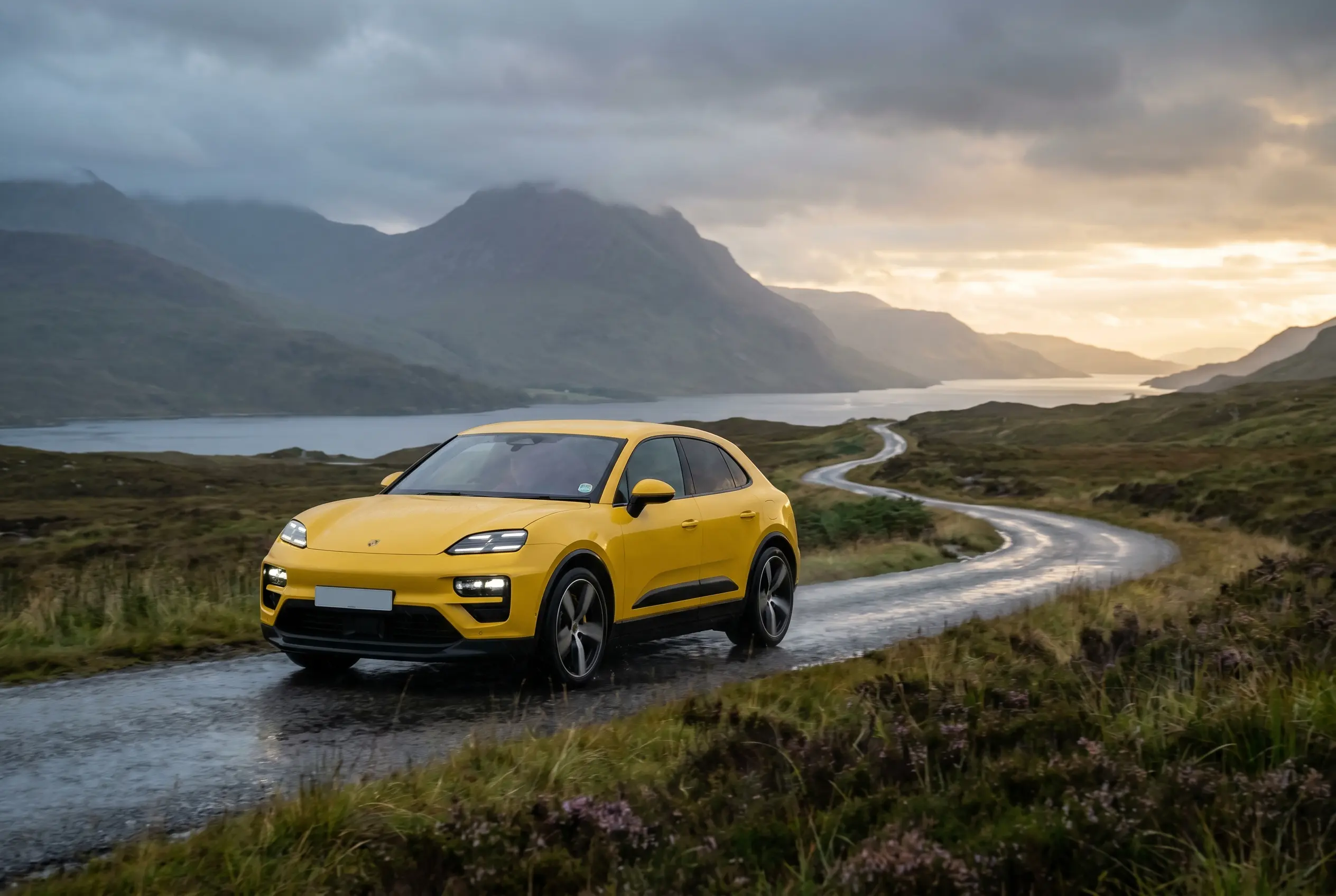
Doing the loop in a Speed Yellow Macan Turbo turns the route into a test of the car as much as the scenery. It is a useful test, too, because the far north is exactly the kind of charging desert where electric road trips are supposed to fall apart.
Range and Charging on a Remote Loop
The numbers help. The specification of the electric Macan Turbo lists up to 630 hp on overboost, a 100 kWh battery and a WLTP (Worldwide Harmonised Light Vehicle Test Procedure, the official lab range standard) figure of up to 590 km. Its 800-volt system takes DC (direct current) fast charging at up to 270 kW, which means a 10% to 80% top-up in around 21 minutes when you can find the hardware.
- 0 to 100 km/h in 3.3 seconds
- WLTP range up to 590 km on a full battery
- 270 kW peak DC charging, roughly 21 minutes from 10% to 80%
- Dual-motor all-wheel drive with rear-biased torque
On this trip the battery even drank local power. At the MeyGen tidal site, the crew topped the Macan up directly from the substation, which makes ocean-current motoring a literal description rather than a slogan. The debate over combustion’s future plays out elsewhere, from Germany’s pushback on the EU combustion-engine ban to the luxury world’s own awkward shift, seen in the backlash over Ferrari’s first electric car. Up here it is settled by a cable and a tide.
Where the Single-Track Roads Bite
The hard yards come on the west coast and the Bealach na Bà, the Pass of the Cattle onto the Applecross Peninsula. It is narrow, steep and stacked with tight hairpins, rocks on one side and a long drop on the other. The car’s compact footprint and grip earn their keep there in a way no spec sheet captures.
The People Building New Lives Along the Route
Behind the postcard views are people who reorganised their lives around the road. In Castletown, Claire and Martin Murray are converting a derelict mill into the new Stannergill whisky distillery, raising three children in the place they grew up in.
We started the business before the NC500 was a thing, and our shop was a bookshelf in our office. A few months later, folk were queuing up across the car park. So we opened a proper shop and we’ve never looked back.
That was Martin Murray, co-founder of the Stannergill distillery, describing how the route turned a side project into a year-round employer rather than a seasonal one. The same pattern repeats along the coast. Hana Sutherland, a 21-year-old University of the Highlands and Islands student who works at the 16th-century Castle of Mey, says the road has brought “businesses and jobs to community projects” to a place that used to export its young people.
At MeyGen, Fraser Johnson, the site’s Director of Operations and Assets, runs what is billed as the world’s largest tidal energy plant, converting the fast currents of the Pentland Firth into electricity since 2016. He grew up nearby and now works on cutting-edge kit rooted in his own backyard, which is its own quiet argument for what the route makes possible.
The Bill Arriving: Waste, Gridlock and a No List
None of this comes free. The road that revived these livelihoods is now straining under its own popularity, and the costs land hardest on the people who live there.
What the Numbers Show
The pressure is measurable and ugly. A 2023 report logged 8,657 outdoor toileting incidents across the Highlands in a single year, including 126 occasions where “black water” waste from campervan toilets was dumped. Single-track roads built for crofters and tractors now carry convoys of motorhomes, raising accident rates and stretching short journeys into long ones. Late last year, Fodor’s Travel added the route to its annual “No List,” the magazine’s roll-call of places it suggests skipping, citing strain on the environment and on roadside communities.
The Review Due in 2026
The promoter has stopped looking away. NC500 Ltd has commissioned an independent economic and environmental review from consultants BiGGAR Economics, with a steering group that includes Highland Council and Highlands and Islands Enterprise, and findings are expected in spring 2026. “If you’re a local and jobs for your kids are important, you have one view of the NC500,” David Richardson, Development and Engagement Manager at NC500 Ltd, told the visiting Porsche crew. “But if you moved up here for the perfect peace and quiet, and that is being disturbed by vehicles not being driven terribly considerately, then you’ll have a very different view of it.”
How to Drive the North Coast 500 Responsibly
The fix is not complicated, and most of it sits with the visitor. The route’s own website now carries a pledge asking drivers to leave no trace, respect the environment and back local businesses. Dan Rose-Bristow, owner of The Torridon hotel, puts it plainly: you do not have to drive antisocially fast to enjoy these roads.
- Travel in the shoulder seasons, when there are fewer midges, fewer motorhomes and quieter passing places
- Use passing places to let locals overtake rather than holding up working traffic
- Carry out all waste and use proper facilities, never the verge
- Book accommodation and eat along the route so the money stays local
- Sign and follow the official North Coast 500 visitor pledge
If the 2026 review pushes hard rules and visitors keep treating the place as a racetrack, the Highlands could end up rationing the very road that saved its shops. If the pledge sticks and the traffic spreads across the calendar, the route becomes the rare success story that pays its own way without breaking the ground beneath it.
Frequently Asked Questions
How long is the North Coast 500?
The route is about 516 miles (830 km), looping the far north coast of Scotland from Inverness and back. Most drivers spend five to seven days on it to take in the single-track sections, castles and coastal villages without rushing.
Can you drive the NC500 in an electric car?
Yes. An electric SUV such as the Porsche Macan Turbo, with a WLTP range of up to 590 km and 270 kW fast charging, can complete the loop comfortably with planned stops. Charging infrastructure is thinner than in cities, so map your stops in advance and charge when you can rather than when you must.
When is the best time to drive the North Coast 500?
The shoulder seasons of spring and autumn are widely recommended. There are fewer biting midges, fewer motorhomes on the single-track roads and more availability at hotels, which also eases the strain on local communities compared with peak summer.
How much money does the NC500 bring to the Highlands?
A Glasgow Caledonian University study found the route generated £22.8 million in Gross Value Added for the north Highlands in 2018 and supported 180 full-time-equivalent jobs. A fresh economic and environmental review is due to report in 2026.
Why is the North Coast 500 controversial?
Rapid growth in visitors has brought congestion on narrow roads, littering, improper disposal of toilet waste and rising local living costs. In 2023, 8,657 outdoor toileting incidents were recorded across the Highlands, and the route was added to Fodor’s Travel “No List” of places to reconsider.
Do you need to book accommodation in advance?
It is strongly advised, especially in summer. Hotel occupancy along the route reached 78% by 2018, and demand has grown since, so popular stops fill quickly. Booking ahead also helps you space your charging and driving days sensibly.
 Scotland’s Tay Country Cashes In as Tourists Flee Crowded Hotspots
  Maruti Brezza Facelift Prices Fall Thanks to a Tax Rule
  Mother Sees How Grown-Up Her Teen Is on Scotland Tour
  Edinburgh’s Tourist Tax Arrives Days Before Its Priciest Month
  Tesla’s Summer Update Hands Grok the Keys, and Musk’s Empire More Reach
  Loganair’s Electric Aircraft Deal Arrives as Scottish Routes Face Cuts