
 Ishan Crawford
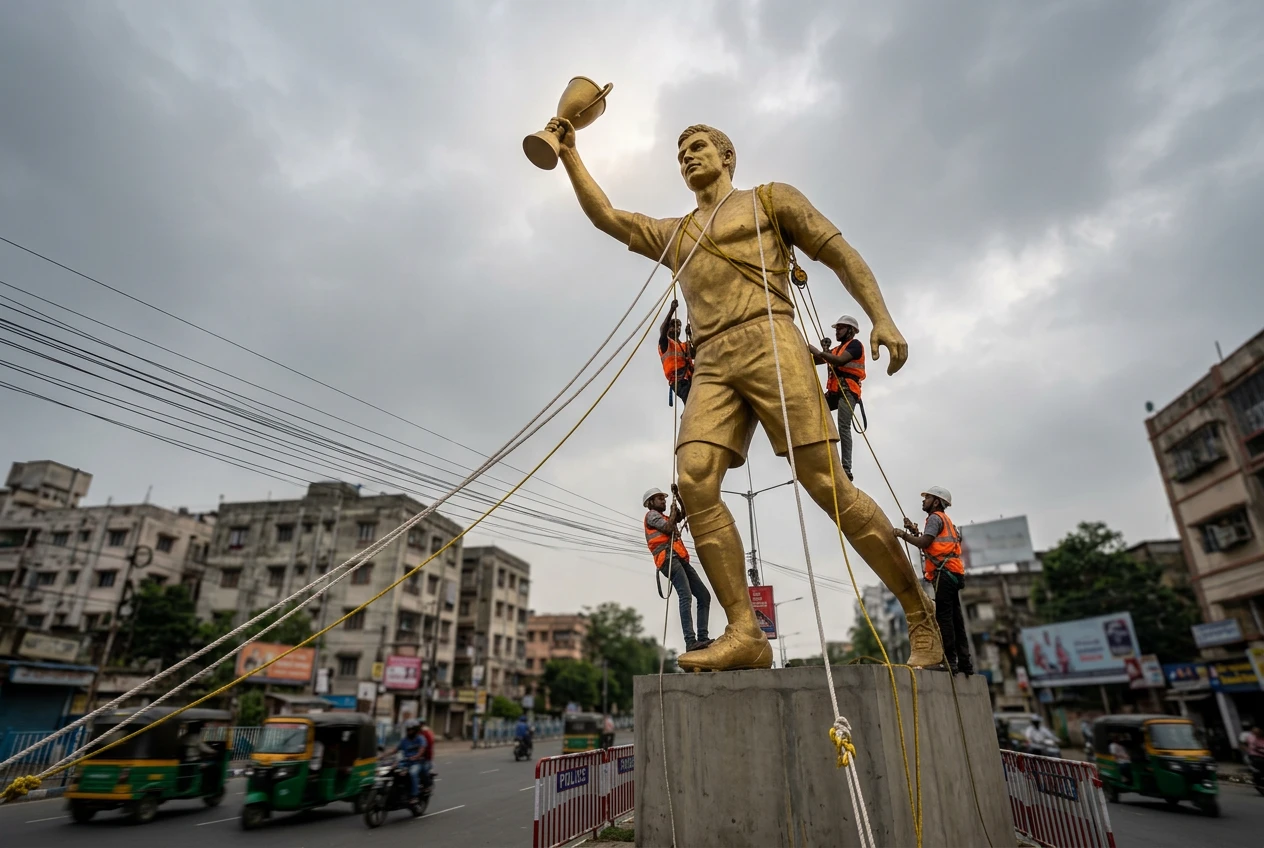
 Workers in harnesses scrambled up a 70-foot golden Lionel Messi on Wednesday in Lake Town, Kolkata, throwing nylon ropes around its shoulders to stop the figure swaying over a busy road. Five months earlier the same statue had been remotely unveiled by Messi himself, lit up as the centrepiece of his 2026 World Cup buildup across India. By the time the pre-monsoon gusts arrived, engineers had a different word for it: unsafe.
West Bengal state legislator Sharadwat Mukherjee told the AFP news agency the figure had been judged structurally unsound and would come down at the earliest opportunity, though he conceded a date had not been set. Removal, he said, has proved easier said than done.
Ropes Around a Seventy-Foot Idol
The statue stands at the Sree Bhumi Sporting Club in Lake Town, a residential pocket of north-east Kolkata where football fandom runs deeper than in most of cricket-saturated India. The figure shows Messi raising the FIFA World Cup trophy he won in Qatar four years ago, sheathed in a metallic gold finish that catches every passing headlight on the arterial road below.
Locals first noticed the figure rocking in moderate wind earlier this month. By 27 May, the West Bengal Public Works Department had completed a formal inspection and found the centre of gravity to be off the mark, with structural deficiencies in the supporting frame. Workers responded with the only tool that could buy time before the monsoon: rope.
The statue of the Argentine football legend in the city of Kolkata was found unsafe by engineers of the West Bengal government. We have noticed that the statue is swaying in the wind.
That was Mukherjee, speaking to AFP from Kolkata as crews tightened the rigging. Police barricades have since closed the immediate footpath to pedestrians and slowed two-wheeler traffic past the site, an inconvenience locals say they will tolerate only until the rains land in early June.
How a Forty-Day Build Failed Its First Monsoon
The figure was sculpted by Monti Paul, a Kolkata-based artist whose previous commissions for Sree Bhumi included festive Durga Puja installations. Paul told reporters at the unveiling that the work had been completed in fewer than 40 days, a turnaround that puja artisans treat as routine for seasonal pandals but that civil engineers regard as aggressive for a permanent steel-frame structure of this height.
The PWD inspection, according to Mukherjee and corroborated by local reporting, surfaced a stack of problems that point in one direction: the figure was designed for an evening of cameras, not for a decade of weather.
- Off-axis mass. The trophy-raising pose puts a disproportionate share of the weight high on one side, and the base anchoring did not compensate.
- Wind loading. A 21-metre form with a broad torso behaves like a sail in gusts above 40 km/h, common in Bengal’s pre-monsoon Kalbaishakhi squalls.
- No-objection certificate. The PWD has stated publicly that no NOC (No-Objection Certificate, the clearance a department issues before a structure can be installed on land it controls) was sought from the department for installation on what it says is PWD-owned roadside land.
- Forty-day timeline. Curing, weld inspection and load testing all compress under that schedule, with the visible result now wrapped in temporary rigging.
None of these findings allege fraud or shortcut at the sculptor’s bench. They describe a permitting and engineering gap between a club that wanted a moment and a state apparatus that processed the moment after the fact.
The GOAT Tour That Skipped the Paperwork
The Kolkata unveiling on 13 December 2025 opened Messi’s GOAT (Greatest Of All Time) Tour of India, a three-day commercial swing covering four cities and including a brokered meeting with Bollywood superstar Shah Rukh Khan and former India cricket captain Sourav Ganguly. The 38-year-old Argentina and Inter Miami forward did not stand beside his own likeness at the launch. Citing security advice, he triggered the unveiling remotely from a separate venue and watched the reveal on a feed.
The wider tour did not run cleanly. At Salt Lake Stadium the same week, a crowd-control failure cut Messi’s on-pitch appearance short, drew complaints of property damage inside the venue and prompted a public apology from Chief Minister Mamata Banerjee. State police opened an inquiry into the organisers. The fiasco produced the only on-record political consequence of the tour to date, and it framed the statue as the surviving physical artefact of an event that had otherwise been written down as a logistical mess.
The promoter behind the tour, Satadru Dutta, marketed the figure as the world’s tallest statue of a footballer. That superlative has been challenged by sculptors elsewhere, but it was the line that did the work: it sold the unveiling, it justified the 40-day build, and it set the height at a number the wind in Lake Town will not accept.
Why Sree Bhumi Wanted It in the First Place
Sree Bhumi Sporting Club is not, by Indian football’s modest standards, an obscure outfit. It plays in the Calcutta Football League, a competition older than most national leagues in Asia, and its puja-season pandals draw crowds in the hundreds of thousands. The Messi commission was meant to extend that pull beyond October’s festival weeks into a year-round attraction, with hawkers selling Argentina jerseys and selfie tickets at the base.
Football in Bengal sits on a contradiction the rest of India does not share. The state hosts the country’s oldest derbies and its most football-literate fan base, yet the national side is ranked 142nd by FIFA, below Curacao and Tajikistan. A Nielsen Sports survey released this week reported that football has overtaken kabaddi to become India’s second most-followed sport behind cricket, with Bengal, Kerala and the north-east driving most of that interest.
The statue is, in other words, more a fan-economy bet than a vanity object. Sree Bhumi was monetising the gap between a 1.4 billion-strong viewership for Messi’s club career and an Indian league that still cannot fill its own stadiums. The bet was sound. The construction sequence that delivered it was not.
Messi at Thirty-Eight, Argentina at Kansas City
The statue’s troubles land at the exact moment Messi’s public stock should be peaking. Argentina, defending the title won in Qatar, begins its World Cup campaign on 16 June against Algeria at Arrowhead Stadium in Kansas City. Messi has not formally confirmed his squad selection but is widely expected to feature, which would tie the record of six World Cup appearances held jointly by four players.
The economics of the GOAT Tour assumed exactly that arc. A Messi who arrives at a sixth World Cup as a reigning champion is a Messi whose image rights sustain merchandise sales, ticketed exhibits and brand activations across Asia through the end of the decade. The Kolkata installation was sized for a multi-year window, not a single tour stop.
| Messi Touchpoint | Date | Status |
|---|---|---|
| GOAT Tour unveiling, Kolkata | 13 Dec 2025 | Held; Messi attended remotely |
| Salt Lake Stadium appearance, Kolkata | 14 Dec 2025 | Cut short; state inquiry opened |
| PWD safety finding on statue | May 2026 | Structure declared unsafe |
| Argentina v Algeria, World Cup opener | 16 Jun 2026 | Scheduled, Kansas City |
| Statue removal window | Pre-monsoon | Date not announced |
The calendar squeezes the West Bengal government. Take the figure down before 16 June and the optics read as a defeat on the eve of Argentina’s opener, with Bengali Messi fans denied a backdrop for matchday photographs. Leave it up through the monsoon under nothing but rope, and a stronger gust does the demolition the state has not.
The Removal That Proved Easier Said Than Done
Mukherjee’s choice of phrase carried more weight than the formal language of the inspection report. A 70-foot steel-framed figure cannot be tipped onto a flatbed; it has to be cut down in sections with cranes the Lake Town road network was not designed to host. Closing the road for the operation would knot traffic across two municipal wards. Doing it at night without closing the road raises a worker-safety question the PWD has been clear it will not sign off on.
There is also the matter of where the figure goes next. Sree Bhumi has not said publicly whether it will commission a stronger frame and re-erect the statue on club-owned land, melt it down, or hand it to a private buyer. The promoter has not offered to fund a rebuild. Monti Paul has not been asked to retain the moulds.
If the rains arrive on schedule in the first week of June and the rigging holds, the West Bengal authorities buy themselves the summer to plan a controlled disassembly and a relocation announcement that does not read as a retreat. If the rigging fails, the GOAT Tour’s most photographed object becomes the only sports-related building-collapse story of the World Cup window, on a road the state government is responsible for.
The trophy in Messi’s raised right hand was supposed to outlast his playing career. The ropes around his shoulders suggest a shorter horizon.
 ONGC licence frees Venezuela cash and operatorship talks
  Anthropic Hits $65 Billion Run Rate and Flips the AI Cash Test
  Supreme Court grounds the fare free-for-all with three-week clock
  Gold Nears $4400 as Soft Data Meets Oil Inflation Risk
  Nifty Slips as Zaggle Circuits and Dhoot Debuts Big
  Diesel Crack Tops $100 as Iran Rhetoric Lifts Crude