
 Ishan Crawford
 India’s IT stocks staged their loudest rally in months on Tuesday, June 2, with the Nifty IT index climbing as much as 4.82% intraday to 31,290.95 and stretching its three-session gain to roughly 8%. Infosys, Tata Consultancy Services and HCL Technologies all jumped between 4% and 6% as buyers piled back into a sector that had spent most of the year as the market’s least-wanted trade.
Even after three green sessions, though, the index remains down roughly 22% in 2026, and the force doing the most to lift it is a currency sliding toward record lows for reasons that have little to do with software demand. That gap between a cheering tape and a still-fragile business is the whole story.
A Three-Session Pop That Still Sits Below Water
The numbers on Tuesday were striking in isolation. All ten constituents of the Nifty IT index traded higher, with TCS, the country’s largest software exporter, up more than 6% and Coforge, a mid-cap digital engineering firm, rising about 5.7% to around 1,544 rupees. Over the Friday, Monday and Tuesday sessions, the index added more than 1,400 points off its prior close.
Step back, and the rally is a recovery from a deep hole rather than a breakout. From its May lows the index has clawed back close to 15%, yet it still trails the broader market by a wide margin over the past year. The Nifty 50 actually fell during the same three days the IT pack ran, a divergence that tells you this was a sector rotation into the most beaten-down names, not a broad risk-on wave.
Here is how the heavyweights moved on Tuesday’s intraday surge.
| Stock | Intraday gain (Jun 2) | Price (₹) |
|---|---|---|
| TCS | ~6.0% | n/a |
| Infosys | ~5.6% | n/a |
| Coforge | ~5.7% | 1,544.00 |
| HCL Technologies | ~4.7% | 1,251.30 |
| Tech Mahindra | ~2.5% | 1,581.90 |
Snowflake’s Blowout Lit the Fuse
The spark came from across the Pacific. On May 27, US cloud-data company Snowflake reported $1.39 billion in revenue for its fiscal first quarter, up 33% from a year earlier, and committed to spending $6 billion on Amazon Web Services (AWS, Amazon’s cloud computing arm) over five years. The stock responded with a 36% surge, its best single day on record, and dragged the broader software complex to fresh highs.
That print mattered to Mumbai because it punctured a fear that had hung over Indian IT all year: that generative artificial intelligence would gut demand for traditional software and services rather than expand it. Snowflake chief executive Sridhar Ramaswamy called AI a powerful tailwind, and better-than-expected results from cloud vendors gave Indian investors cover to argue the same logic applies to the firms that integrate those tools for banks and insurers. You can read the full numbers on the Snowflake fiscal first-quarter results page.
The Rupee Tailwind Is a Macro Warning in Disguise
The least-discussed driver of the rally is also the most double-edged. A large slice of Indian IT revenue is billed in dollars while costs sit in rupees, so a weaker home currency mechanically pads margins and earnings. The problem is why the rupee is so weak.
How Far the Currency Has Fallen
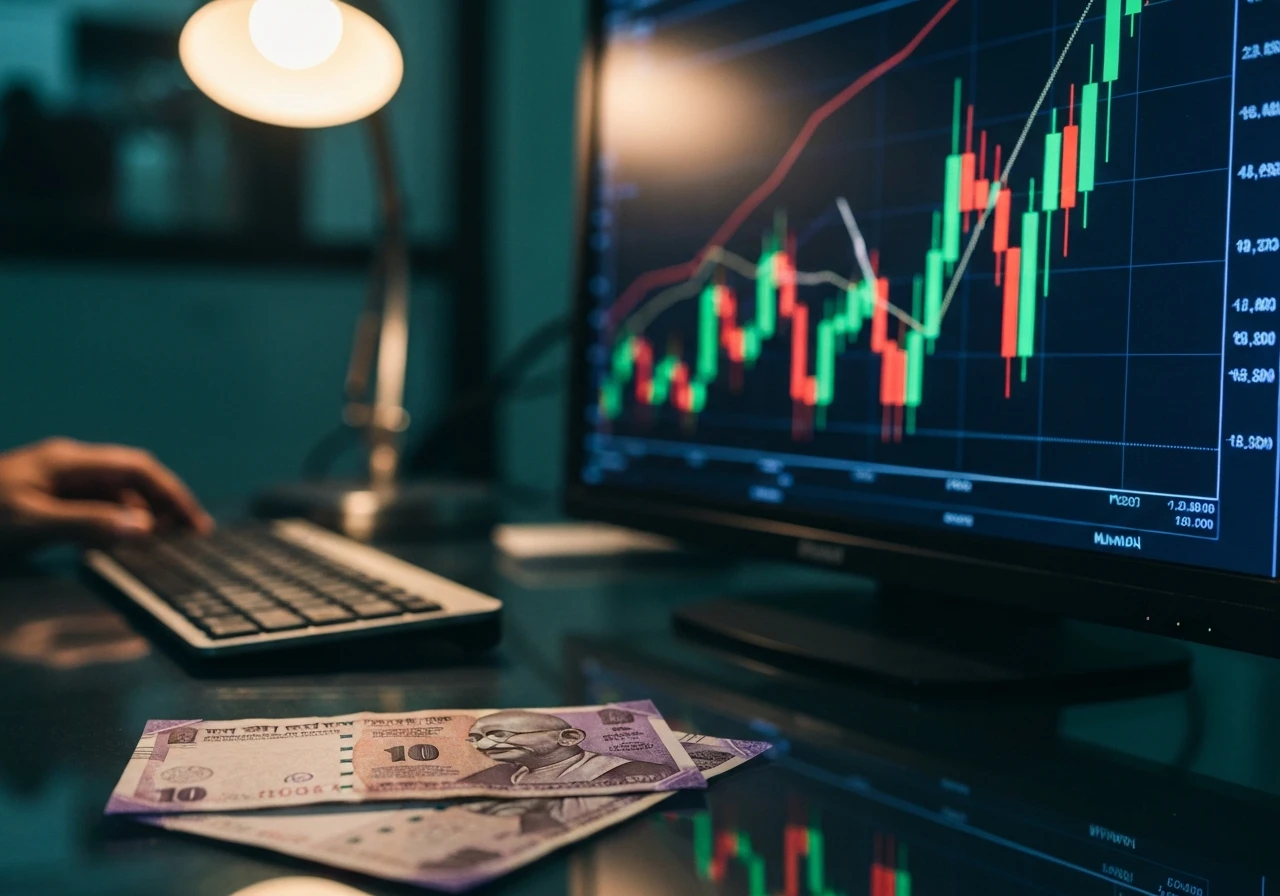
The rupee hit an all-time record low of 96.82 to the dollar on May 20 before the Reserve Bank of India (RBI, the country’s central bank) stepped in with heavy dollar sales through state-run banks, pulling it back to 96.20 the next day. It has depreciated about 7% in 2026 alone and roughly 10% over the past twelve months, the worst showing of any Asian currency.
- 96.82 rupees per dollar: the record intraday low set on May 20.
- ~7%: depreciation in the first five months of 2026.
- 100: the psychological level traders increasingly fear if oil stays elevated.
Why a Weak Rupee Cuts Both Ways
The slide accelerated after conflict in West Asia pushed crude oil prices sharply higher, raising India’s import bill and prompting foreign portfolio investors (FPIs, overseas funds that buy Indian equities and bonds) to pull money out. A weaker rupee that flatters IT income statements is, in other words, a readout on oil shocks, capital flight and a nervous central bank, not on whether enterprises are signing bigger contracts. Lean on it too hard and the bull case starts resting on a crisis.
AI Deals Are Landing, Revenue Hasn’t Followed
The more durable part of the story is the deal pipeline, and here the news flow has genuinely turned. On May 28, TCS said it had become the first global systems integrator (GSI, a firm that builds and deploys technology for large clients) to bring Mistral Forge to enterprises worldwide, working with the French AI developer to build custom models grounded in clients’ own data. The tie-up targets banking, manufacturing, healthcare and the public sector, and the details sit on the TCS and Mistral partnership announcement.
The same day, Wipro deepened its alliance with ServiceNow to embed agentic AI workflows across functions such as IT, human resources, procurement and cybersecurity, folding its Wipro Intelligence suite into the ServiceNow platform. The terms appear on Wipro’s expanded ServiceNow partnership release.
Announcements are not bookings, and bookings are not yet revenue. Even as the headlines pile up, Infosys and HCLTech are expected to guide for only 3% to 5% revenue growth in fiscal 2027, the kind of low-single-digit number that fits an industry still feeling its way out of a multi-year slowdown. The market is paying today for a recovery that the companies themselves are only cautiously underwriting.
Why Value Buyers Are Circling
Valuation is the glue holding the rest together. After a punishing year, the Nifty IT index trades at about 21.7 times forward earnings, roughly 14% below its own five-year average, putting marquee names near multiples not seen in a long time. That discount is why some brokerages have started upgrading: HDFC Securities moved Infosys and HCL Technologies to a buy rating, with target prices of 1,800 and 1,740 rupees respectively, a framework laid out in its 2026 Indian IT sector valuation analysis and similar broker notes.
Put the pieces together and you can see why the buyers showed up at once. The rebound rests on a stack of reinforcing factors:
- Easing AI fears after strong cloud-software earnings abroad.
- Forward multiples well below five-year averages.
- A steady drumbeat of AI and cloud deal wins.
- Currency tailwinds from the weak rupee.
- Tentative signs that client budgets are stabilising.
What Separates a Bottom From a Bounce
The honest answer is that nobody knows yet, and the next two prints will decide it. Management teams have spent recent quarters describing a floor forming under spending, especially in banking and financial services, where furloughs are fading and budgets are reopening after a long freeze. Recovery in manufacturing, retail and healthcare remains patchier.
That makes fiscal 2027 guidance the real referee. A weak rupee can carry reported earnings for a quarter or two, but constant-currency growth, the number stripped of exchange-rate help, is what tells you whether demand has actually turned. Investors who chased Tuesday’s move are betting that the deal pipeline converts before the currency tailwind fades.
If the June quarter delivers the BFSI budget release that managements have promised and FY27 guidance lands at the top of the 5% band, the case for a genuine bottom gets a lot stronger. If the rupee keeps flattering headline numbers while underlying growth stays stuck in the low single digits, this rally will end up filed as another oversold bounce that ran into the same wall.
Frequently Asked Questions
Why are Indian IT stocks rising in June 2026?
They are riding three forces at once: a global software rally after Snowflake’s 36% post-earnings surge eased fears about AI disrupting IT services, attractive valuations after a year of underperformance, and a weak rupee that lifts dollar-billed earnings. The Nifty IT index added roughly 8% over three sessions through June 2.
Is the Indian IT sector’s downturn over?
Not confirmed. Despite the bounce, the Nifty IT index is still down about 22% in 2026 and has only recovered close to 15% from its May lows. Analysts say fiscal 2027 guidance and constant-currency growth, not the recent price pop, will show whether demand has genuinely turned.
How does a weak rupee help Indian IT companies?
Most large Indian IT firms bill clients in dollars while paying costs in rupees, so each fall in the rupee mechanically widens margins. The catch is that the 2026 slide, which hit a record 96.82 per dollar on May 20, is driven by an oil shock and foreign outflows, making it a sign of macro stress rather than business strength.
What FY27 revenue growth are Infosys and HCLTech expected to guide?
Analysts expect both to guide for conservative growth of about 3% to 5% in fiscal 2027. That range reflects a sector still emerging from a prolonged slowdown, even as AI-led deal announcements accelerate.
Disclaimer: This article is for informational purposes only and is not investment advice. Equities, including IT-sector stocks, carry market risk, and prices, index levels and currency figures are accurate as of publication on June 2, 2026. Please consult a qualified financial adviser before making any investment decision.
 ONGC licence frees Venezuela cash and operatorship talks
  Anthropic Hits $65 Billion Run Rate and Flips the AI Cash Test
  Supreme Court grounds the fare free-for-all with three-week clock
  Gold Nears $4400 as Soft Data Meets Oil Inflation Risk
  Nifty Slips as Zaggle Circuits and Dhoot Debuts Big
  Diesel Crack Tops $100 as Iran Rhetoric Lifts Crude