
 Ishan Crawford
 The Galaxy Watch 9 will arrive this summer with a squircle case nearly identical to last year’s Watch 8, a 435mAh battery on the 44mm model, and a chipset question that no one has yet settled. The substantive changes sit inside Samsung Health, where Vitals, Heart Health Score, Daily Cardio Load and Fitness Index turn the next watch into a software story in a familiar shell.
The Design That Stays Familiar
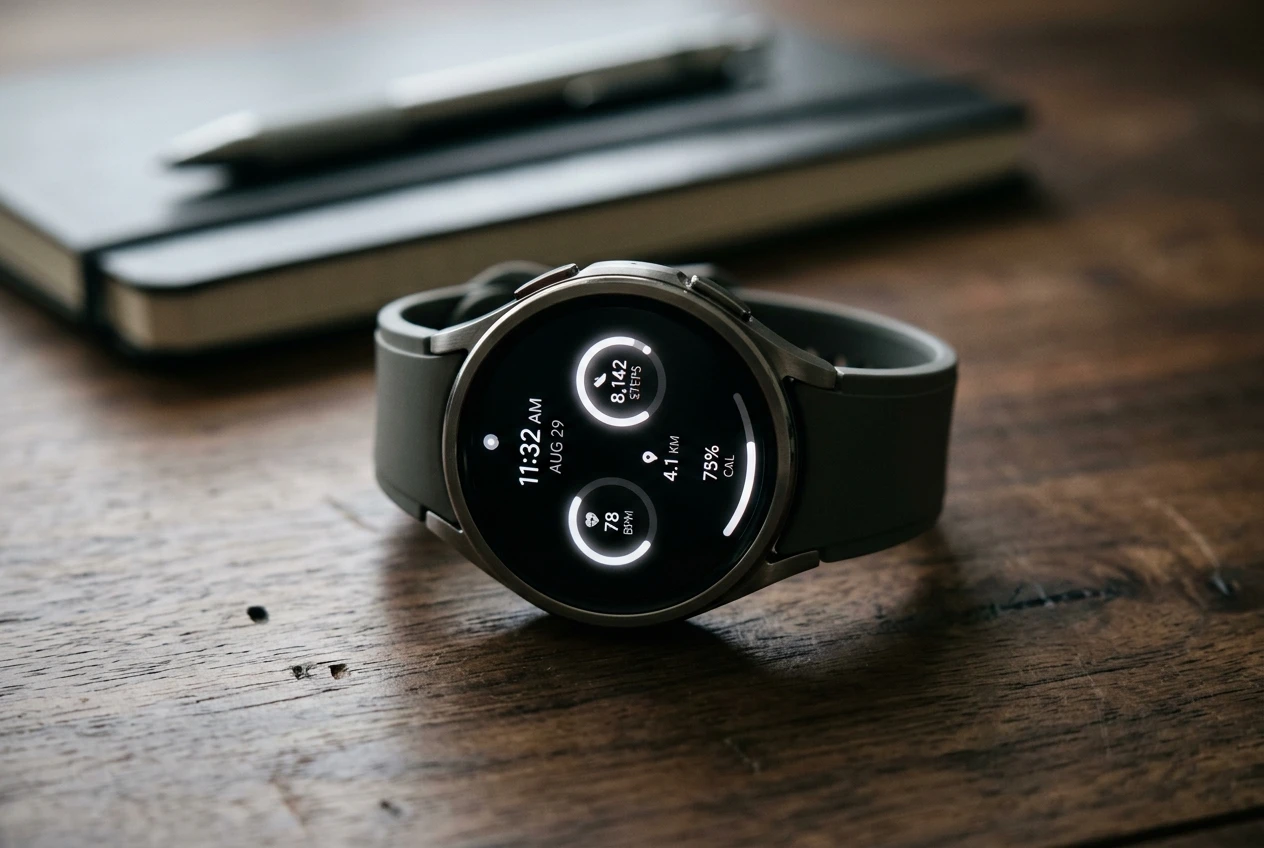
Watch 8 owners will not see a new silhouette on the wrist this year. Leaked renders published by Android Authority on July 1, sourced from Android Headlines and tipster OnLeaks, show a watch that looks, in the publication’s words, “pretty much identical to its predecessor, all the way down to its sensors.” The 40mm model will come in Cream or Graphite. The 44mm will come in Silver or Graphite.
Samsung will sell Bluetooth and LTE versions, and there is no 5G variant planned. Samsung has not officially confirmed the final hardware, and the design details remain unofficial until launch.
The case carries a more subtle brushed-metal finish, fresh color options and a redesigned default band, but those are the only external changes from the Watch 8. The squircle design and circular display that landed in 2025 are back. Samsung pushed a thinner aluminum frame and a 3,000-nit peak display brightness on the Watch 8, and there is no indication it will revisit either figure on the Watch 9.
Leaked spec snapshot
- Sizes: 40mm and 44mm
- Colors: Cream and Graphite (40mm); Silver and Graphite (44mm)
- Connectivity: Bluetooth and LTE; no 5G
- Display: 1.34-inch (40mm) and 1.47-inch (44mm), same as Watch 8
- Resolution: 438×438 (40mm), 480×480 (44mm)
The Chipset Question Nobody Can Settle
The chipset is the leak everyone is fighting over. Android Authority reports that Samsung confirmed earlier this year that its next-generation smartwatch will run on Qualcomm’s new Snapdragon Wear Elite rather than an Exynos chip. Android Central, writing about the firmware sighting, agrees. The Watch 9 could see “better processing performance and efficiency, and better support for AI-driven features” if so.
A separate leak from Jason C, picked up by Notebookcheck, pushes the other way. That account has Samsung splitting the line: the Galaxy Watch Ultra 2 will get the Snapdragon Wear Elite, and the Watch 9 will keep the Exynos W1000 chip that powered the Watch 7 and Watch 8. PhoneArena agrees with Jason C.
Two camps, two chipsets, one watch. Samsung has not confirmed which processor ships in the standard Watch 9. Whoever turns out to be right, the 3nm node on the Snapdragon Wear Elite, announced at MWC 2026, is the first wearable SoC Qualcomm has marketed as AI-native, with a Hexagon NPU on board. If the Watch 9 inherits that silicon, the gains will land first in battery life and on-device health coaching, not in benchmark scores. The split-strategy reading fits Samsung’s recent pattern: the original Galaxy Watch Ultra shipped with Exynos W1000, and Samsung is now pitching a clearer premium-versus-standard divide.
The Battery Math Samsung Is Selling
The 44mm Watch 9 will ship with a battery nearly identical to the Watch 8’s 44mm, according to a leaked Samsung part number (EB-BL355BAY) reported by PhoneArena. The leaked spec sheet gives the rated, or minimum guaranteed, capacity of the new cell, and PhoneArena reads the small bump in that rated figure against last year’s spec as a real, if modest, gain.
| 44mm Watch 9 | Battery spec |
|---|---|
| Rated capacity | 435mAh |
| Typical capacity (estimated) | 445mAh to 450mAh |
| Watch 8 44mm for comparison | 435mAh typical, 425mAh rated |
PhoneArena’s review of the Watch 8 found the watch needed daily charging, an awkward limit for a device that wants to track sleep. The Watch 9’s small bump, paired with whatever efficiency gains the new chipset brings, is unlikely to close the gap to the OnePlus Watch 3’s five-day runtime. Samsung is not closing the multi-day gap this generation.
Where Samsung Health Steps In
If the hardware barely moves, the software is doing the lifting. Samsung previewed a major Samsung Health update on June 4, rolling out to existing Galaxy Watches starting June 8, with features designed for the next generation of devices. The four new metrics are Vitals, Heart Health Score, Daily Cardio Load and Fitness Index.
Vitals analyzes five health metrics during sleep, heart rate, heart rate variability, respiratory rate, skin temperature and blood oxygen, against each user’s resting baseline. Heart Health Score folds sleep, stress and activity data together with body composition into a single daily score. Daily Cardio Load tracks accumulated cardiovascular strain and recommends training targets and rest windows. Fitness Index ranks the user’s aerobic capacity and daily steps against peers and points out specific strengths and weaknesses.
Samsung Health is evolving to connect health data measured by the Galaxy Watch with AI-based insights, enabling users to understand their physical condition more easily and intuitively.
Hon Pak, Senior Vice President and Head of the Digital Health Team for the Mobile eXperience (MX) Business at Samsung Electronics, made the comment in Samsung’s June 4 announcement. The new Samsung Health interface organizes the home screen around five pillars: Sleep, Activity, Nutrition, Mindfulness and Vitals.
The Antioxidant Index introduced on the Watch 8 stays, with new trend charts and a background AGEs index that captures overnight measurements to track how dietary choices accumulate over time. A new hearing health feature uses the Galaxy Watch to monitor ambient noise and integrates with Galaxy Buds to flag exposure. None of these require new sensors. They run on top of the existing BioActive sensor stack that has tracked heart rhythm, heart rate and body composition on Samsung watches for several generations. The implied pitch is that the Watch 9’s value comes from its software layer.
Firmware Test Server Confirms Timing
A firmware build tied to model number SM-L345U appeared on a Samsung-hosted US test server, spotted by leaker Mohammed Khatri and reported by Android Central. When a Samsung firmware lands on a public test server, it usually means core development is done and engineers are tuning for launch.
Samsung launched the Watch 8 alongside its 2025 foldables in July. PhoneArena expects the same pattern this summer, with a Galaxy Unpacked on July 22, 2026 in London alongside the Galaxy Z Fold 8 and Z Flip 8. A separate report from Android Headlines points to a July 25 date. Samsung has not confirmed either.
The firmware sighting, plus the absence of any render correction in the week since, lines up with a summer reveal. If Samsung follows last year’s pattern, retail availability will follow roughly two weeks after the announcement.
Pricing Pressure and the Watch It Replaces
Watch 8 pricing sets the floor. The 40mm Bluetooth started at $349, the 44mm Bluetooth at $379, the LTE models at $399 and $429 respectively. PhoneArena expects Watch 9 pricing to land in the same bands or higher, citing Samsung’s recent price increases on the Galaxy S26 lineup and some Galaxy A models. No Watch 9 pricing has surfaced yet.
For anyone on a Galaxy Watch 6 or earlier, the upgrade pitch is clear: One UI Watch 9, the new Samsung Health features, a small battery bump, and a chipset question that does not yet have a clean answer. For Watch 8 owners, the math is harder. The hardware barely changes. The chipset is either the same Exynos W1000 or a brand-new Snapdragon Wear Elite, depending on whose leak you trust, and Samsung Health’s best new features ship to existing watches via the June 8 update. Samsung is asking buyers to read the Watch 9 as a software story in a familiar case.
Frequently Asked Questions
When is the Galaxy Watch 9 launching?
Samsung has not officially announced a date. PhoneArena points to a Galaxy Unpacked on July 22, 2026 in London, with retail availability roughly two weeks later; Android Headlines has cited July 25. The firmware sighting on a US test server, first reported by Android Central, lines up with a summer reveal.
Will the Galaxy Watch 9 use the Snapdragon Wear Elite chipset?
Reports conflict. Android Authority and Android Central say yes. Leaker Jason C, via Notebookcheck, says no, with Samsung reserving the Snapdragon Wear Elite for the Galaxy Watch Ultra 2 and keeping the Watch 9 on the Exynos W1000. PhoneArena agrees with Jason C. Samsung has not officially confirmed which chip ships in the standard Watch 9.
How big is the battery in the Galaxy Watch 9?
A leaked Samsung part number (EB-BL355BAY) reported by PhoneArena shows the 44mm Watch 9 has a rated capacity of 435mAh, with a typical capacity between 445mAh and 450mAh. The 40mm figure has not yet leaked publicly.
What is new in Samsung Health?
Four new metrics are landing: Vitals (sleep-time analysis of five biometrics), Heart Health Score (a daily composite of sleep, stress, activity and body composition), Daily Cardio Load (cardiovascular strain tracking with training recommendations) and Fitness Index (a peer-ranked aerobic capacity score). Existing Galaxy Watches get the same update through the June 8 app rollout, so the new metrics are not exclusive to the Watch 9.
Is the Galaxy Watch 9 worth buying over the Galaxy Watch 8?
If you own a Watch 8, the case, screen sizes and battery capacity are nearly identical. Watch 8 owners will receive the new Samsung Health features through the June 8 software update, leaving the chipset question as the only meaningful hardware differentiator, and that one is still unresolved. Owners of a Watch 6 or earlier will see a real upgrade across hardware and software.
 ONGC licence frees Venezuela cash and operatorship talks
  Anthropic Hits $65 Billion Run Rate and Flips the AI Cash Test
  Supreme Court grounds the fare free-for-all with three-week clock
  Gold Nears $4400 as Soft Data Meets Oil Inflation Risk
  Nifty Slips as Zaggle Circuits and Dhoot Debuts Big
  Diesel Crack Tops $100 as Iran Rhetoric Lifts Crude